Castle of Riomaggiore: A Historic Coastal Fortification in Italy


Site at a Glance
- Rating
- 4.5
- Popularity
- Medium
- Country
- Italy
- Primary era
- Medieval
- External website
- Open
- Eras represented
- Medieval, Early Modern
- Civilizations
- Genoese
- Site type
- Military
- Remains
- Castle
On this page6 sections
History
The Castle of Riomaggiore is a historic fortification in Italy, first established in 1260 to defend the village and the coastal area. Its military role continued until the nineteenth century, and the complex was later restored and adapted for cultural use.
Thirteenth-Century Foundation
The first defensive structure was built in 1260 by the Turcotti marquises, members of a high-ranking noble family who ruled Ripalta near Borghetto di Vara. It stood on the remains of an earlier site known as the “castellazzo,” near Cerricò Hill.
Genoese Reconstruction
After a period when Count Nicolò Fieschi controlled the area, a new castle was built on the hill dividing the Rio Maggiore and Rio Finale valleys. The Republic of Genoa, a maritime state that fortified settlements and coastal routes along the Ligurian coast, definitively completed the castle between the fifteenth and sixteenth centuries.
Conversion and Later Use
During the rule of Napoleon Bonaparte and the subsequent Ligurian Republic, a French-backed government established in 1797 during Napoleon’s expansion in Italy, earth was placed inside the fortification and the complex was converted into a cemetery. General restoration took place late in the twentieth century, after which the castle became a cultural center. The local municipal administration now uses it as a conference hall and cultural center. The castle is identified as Italian national heritage.
Remains
Fortification Layout
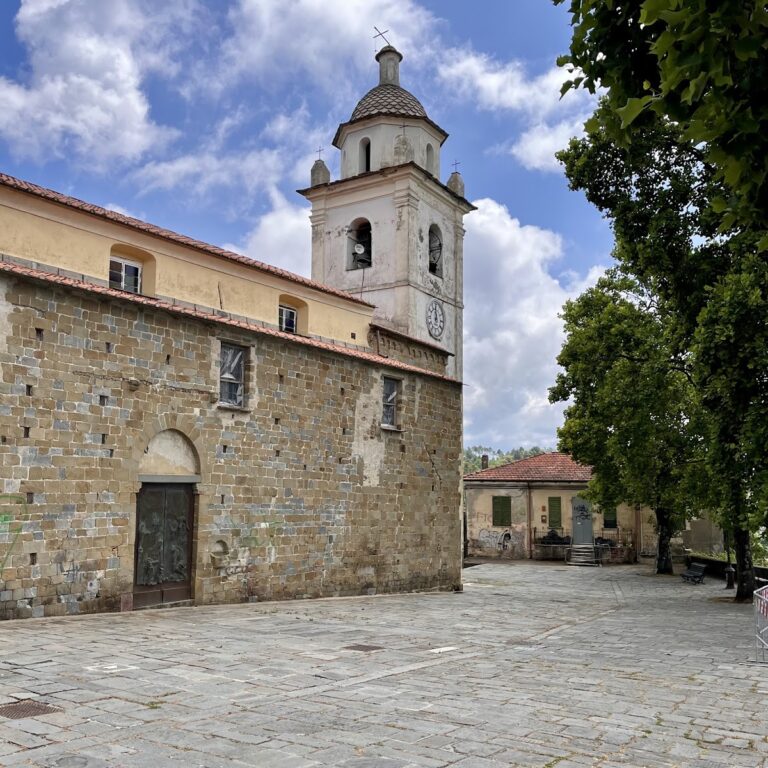
The castle occupies the upper historic center of Riomaggiore, on the hill between the Rio Maggiore and Rio Finale valleys. Its surviving structure has a quadrangular plan with two large, squat circular towers. A clock tower also forms part of the complex. The castle is in good condition, and its present cultural use follows the restoration carried out in the late twentieth century.