Grobnik Castle: A Medieval Fortress and Cultural Center in Croatia

Site at a Glance
- Rating
- 4.7
- Popularity
- Low
- Country
- Croatia
- Primary era
- Medieval
- External website
- Open
- Eras represented
- Medieval, Early Modern
- Civilizations
- Habsburg, Hungarian
- Site type
- Military
- Remains
- Castle
On this page12 sections
History
Grobnik Castle is a medieval fortress in Croatia, standing above Grobnik village and Grobnik Field. The Counts of Krk established the castle by the thirteenth century, and its position in the strategic Vinodol region placed it near the long-standing frontier between the Holy Roman Empire and the Croatian-Hungarian Kingdom.
Medieval origins and the Counts of Krk
The earliest fortification on the hill is uncertain. An older fortified site may have preceded the medieval castle, while Grobnik and the neighboring lordship of Trsat had entered the possession of the Counts of Krk by the mid-thirteenth century. From the fourteenth century, this powerful Croatian noble family was known as the Frankopans.
Grobnik Castle and its lordship first appear in written history in 1288, when representatives of Grobnik attended the assembly associated with the Vinodol Code before Count Leonard of Krk. The code brought together fortified settlements, so the participation of Grobnik provides indirect evidence that the castle already existed. The Counts of Krk retained Grobnik for about 130 years.
Frankopan inheritance and frontier defense
In 1416, Nikola IV of Krk, one of the most powerful Croatian feudal lords, pledged Grobnik Castle for 2,500 ducats while acquiring Okić Castle. The pledge was redeemed in 1419. After Nikola died in 1432, his nine surviving sons disputed the inheritance. Their properties were divided in 1449, when Grobnik passed to Count Stephen II. Boundaries with the neighboring lordships of Trsat and Bakar were fixed at Bakar in 1455.
Stephen III of Modruš supported Matthias Corvinus during the struggle for the Croatian-Hungarian throne. Matthias confirmed Stephen’s possessions in 1460, appointed him ban, a senior governor and military-political official, in 1463, and confirmed Grobnik and the other relevant estates to Stephen and his son Bernardin Frankopan of Ozalj in 1481.
Ottoman incursions began affecting the lordship from 1470, although Grobnik was not attacked at that time. Following the Croatian defeat at the Battle of Krbava Field in 1493, the canons of Modruš took refuge at the castle. They established the Grobnik Chapter, an ecclesiastical institution, which remained there until the end of the eighteenth century and gave Grobnik an important religious role alongside its military function.
On 12 April 1522, Ottoman forces camped below the castle. Ivan Apfaltrer, captain of Rijeka, and Jakob de Dur, captain of Pazin, drove them toward Brinje. Bernardin Frankopan of Ozalj, a prominent opponent of the Ottoman advance, also found refuge at Grobnik and died there in 1530.
The Zrinski succession
After Bernardin’s death, his minor grandson Stephen III of Ozalj inherited the estate under the guardianship of King Ferdinand I. The king appointed Gaspar Walderstein and later Ivan Kacijanar as administrators, while Stephen assumed control in 1536. Since Stephen and his wife, Katarina Eck, had no children, he arranged an inheritance settlement involving his sister Katarina and her husband, Nikola IV Zrinski of Sziget. The king later annulled the arrangement after other Frankopan branches demanded succession through the male line.
Stephen transferred Grobnik, Bakar, and Hreljin to Katarina in 1550. After her death in 1562, he renounced his rights to the estates in favor of her sons through an agreement with Palatine Thomas Nádasdy, a senior official of the Hungarian Crown. Nikola IV Zrinski thereby became the effective lord of Grobnik, a position also supported by General Ivan Lenković in 1563.
A lordship captaincy, a military office responsible for commanding the estate’s armed forces, was established at Grobnik around 1560 to organize Ottoman defense. Mihalj Kobasić was its first captain. Petar Brajković followed in 1565, and local noblemen Mihalj and Fran Dešić later held the office.
Nikola IV Zrinski’s testament requested that Stephen III leave Grobnik to Nikola’s sons. Stephen honored the arrangement and administered the estate with his nephews until his death in 1577. A dispute between the Frankopans and Zrinskis, combined with Emperor Rudolf II’s demand that the estate return to the Crown, was settled in 1580. The Zrinskis surrendered several other estates to Gaspar I Frankopan of Tržac, while the Frankopans recognized Zrinski ownership of Grobnik.
Administration, confiscation, and imperial ownership
The Zrinskis generally governed Grobnik through officials and captains. Julij Čikulin, a prominent administrator, compiled the first known land register of the lordship. A land register, or urbar, recorded the holdings, obligations, rights, and revenues of a feudal estate. The Zrinskis leased Grobnik to Čikulin in 1612, but Count Nikola VI Zrinski later accused him of abuses and dismissed him. Čikulin subsequently won a legal action against Zrinski.
After Nikola VI Zrinski died, his brother, Croatian Ban Juraj V Zrinski, administered the family possessions. Juraj’s minor sons, Nikola VII and Peter IV, jointly inherited them in 1638. Their 1641 division assigned Grobnik, Bakar, and Gerovo to Peter IV. Peter commissioned a new land register but left much of the daily administration to his wife, Ana Katarina Zrinski, who was born a Frankopan. From 1643, Franjo Frankulin served as administrator and later became captain of Grobnik and of the Zrinski estates on the coast.
The discovery of the Zrinski-Frankopan conspiracy in 1670 brought the family’s political opposition to the Habsburg monarchy to an end. Peter IV Zrinski was imprisoned and his estates were confiscated. Franjo Frankulin considered resisting the imperial army led by General Count J. J. Herberstein, but surrendered without fighting. Herberstein’s deputies, Counts Ernest Paradeiser and Heiperger, occupied Grobnik and extensively looted it.
After the confiscation, half of the Grobnik lordship went to Adam Zrinski, the son of Peter’s brother, while the Hungarian Royal Chamber received the other half. Adam, the last Zrinski count, died in suspicious circumstances at the Battle of Slankamen on 19 October 1691. His widow, Maria Katharina Lamberger, renounced the inheritance in favor of the Austrian Chamber.
In 1692, the Austrian Chamber bought the Hungarian Chamber’s share of the Zrinski coastal estates, including Grobnik, for 500,000 florins. Imperial captains and officials administered the estate until it was exchanged for possessions belonging to the Spanish Count Raimondo de Villana Perlas in southern Italy. Perlas became owner in 1725, while his relative Giovanni Stefano de Benzoni of Cremona managed Grobnik because Perlas lived mainly in Vienna.
Private ownership and restoration
Raimondo Perlas’s son Franjo inherited Grobnik and sold the castle and lordship, together with Brod and Ozalj, to Count Theodor Bathyany for 188,000 florins in 1766. The Bathyany family retained Grobnik until 1872, when Count Gustav Bathyany sold it to Princess Victoria von Thurn und Taxis. After her death, her son Albert inherited the estate. Ownership passed to the municipality of Grobnik after the First World War.
From the second half of the eighteenth century, the castle was allowed to decay. Local residents began restoring the ruins in the 1970s after recognizing their cultural and historical importance. The work was completed in 1992. A section of the restored complex received the Grobinština ethnological collection, and the castle now functions chiefly as a cultural center. Grobnik is protected as a monument.
Remains
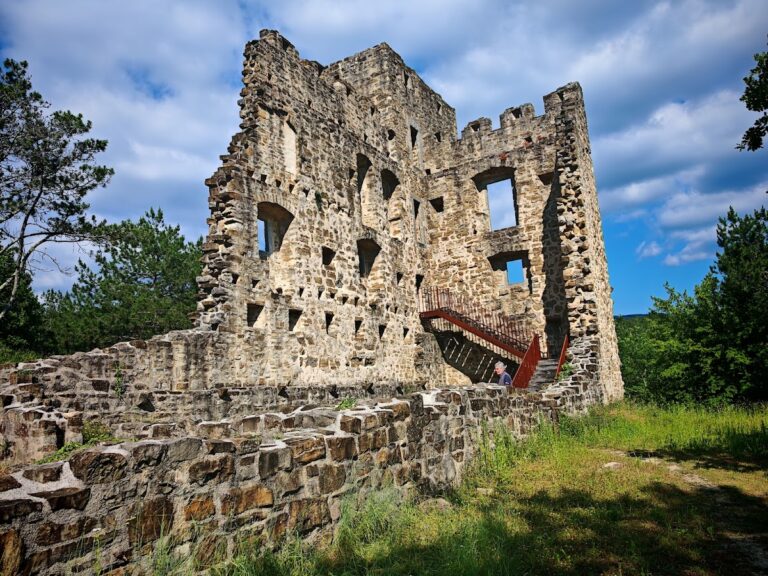
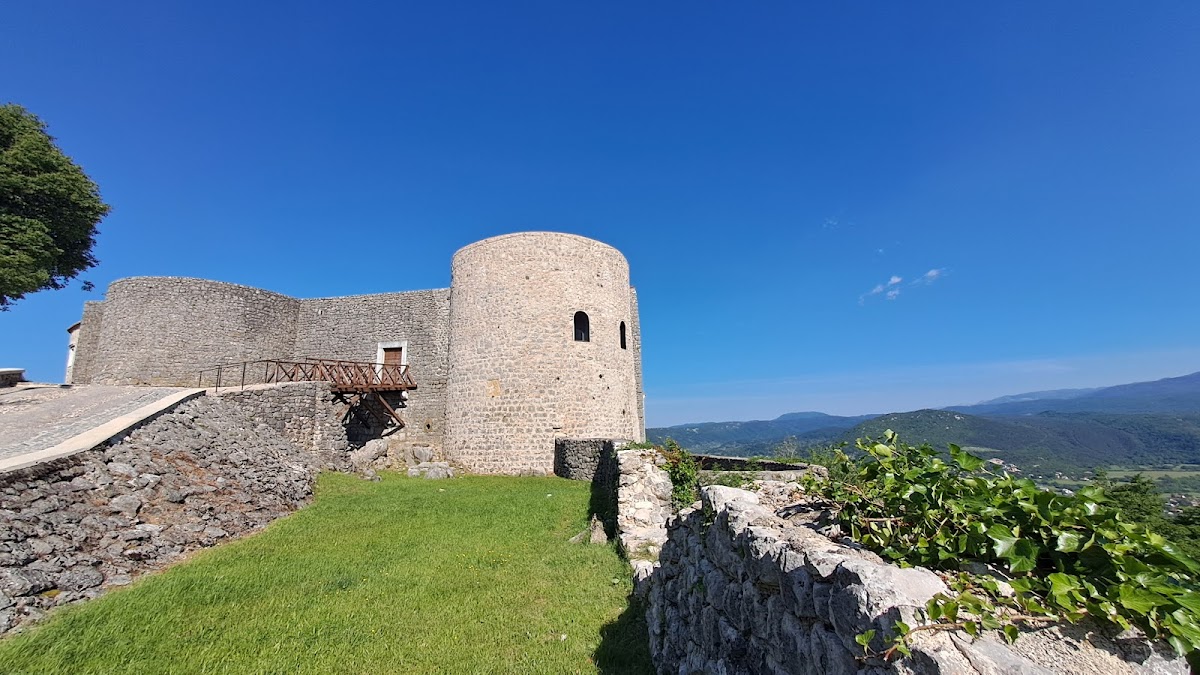
Grobnik Castle occupies a hill about 463 meters above sea level, approximately 10 kilometers northwest of Rijeka. It stands above Grobnik Field and the settlement, in a position that controlled routes leading toward Vinodol and the surrounding borderland. The castle has a triangular ground plan with towers and half-towers at its corners. A surrounding curtain wall, a continuous defensive wall enclosing the site, strengthens the fortification. Most of the surviving walls date from the fifteenth to the seventeenth centuries and are built primarily of limestone.
Fortifications
The triangular enclosure organizes the castle around its defensive perimeter, with towers and half-towers reinforcing the corners and a curtain wall joining them. These structures belong mainly to the period between the fifteenth and seventeenth centuries, when the castle’s existing defenses took their surviving form. The complex is described as imposing ruins as well as a well-preserved, restored, and conserved fortification.
Interior features
Chapel of St. Helena
The Chapel of St. Helena occupies the ground floor of the southwestern tower. Its Renaissance portal survives as part of the castle’s restored interior fabric, linking a religious space with one of the principal defensive structures.
Gothic well
A Gothic well stands in the inner courtyard. It is decorated with fifteenth-century coats of arms belonging to the Frankopans and the Counts of Krbava, preserving a direct connection between the courtyard and the noble families associated with the castle.
Restored complex
The conserved castle contains the Grobinština ethnological collection and a gallery. These uses occupy the restored complex, whose present role is chiefly that of a cultural center while its limestone fortifications and surviving interior features retain the structure of the historic stronghold.
Nearby sites