Sauvo Church: A Medieval Parish Church in Finland
Site at a Glance
- Popularity
- Medium
- Country
- Finland
- Primary era
- Medieval
- Eras represented
- Medieval, Early Modern, Modern
- Civilizations
- Grand Duchy of Finland, Russian, Swedish
- Site type
- Religious
- Remains
- Church
On this page13 sections
History
Earlier churches and the stone building
Sauvo Church is a medieval stone church in Sauvo, Finland, built for a Catholic parish and dedicated to Saint Clement, an early Christian saint traditionally regarded as an early bishop of Rome. Plans and fundraising began in the 1460s, and construction proceeded chiefly between 1460 and 1472. Its star vaults are considered a high point of medieval Finnish church architecture.
Wooden churches had stood on the site before the stone building, and the earliest may date to the early 13th century. The church is first mentioned in writing in a 1346 register of Turku Cathedral. Lars Skalm, a nobleman who served as mayor of Turku in the early 16th century, contributed funds toward construction and was portrayed in a mural.
Parish life and seventeenth-century repairs
More detailed information about worship survives from the 17th century. Services began at 8 a.m. in summer and 9 a.m. at other times, continuing until noon. On church festivals, services were held in both Finnish and Swedish. From the early 17th century, worship also took place in both a wooden church and the stone church, with one service in Finnish and the other in Swedish.
Pews paid for by individuals had been installed in the 16th century, prompting disputes over seating. An arrangement made in 1642 reserved the first five rows for nobles and divided the rows behind them among local households. Arguments over the allocation sometimes escalated into fights on the church hill.
Repairs began by the late 15th century, and further work was carried out from 1630 onward. The chancel was renewed in the 1640s. In the 1690s, extensive repairs and painting included work to support the foundations at the eastern end. Around 1650, the church’s murals were whitewashed because they were thought to evoke the papal cult of saints, a concern shaped by the stricter, ascetic religious outlook of the period.
Eighteenth-century work and modern conservation
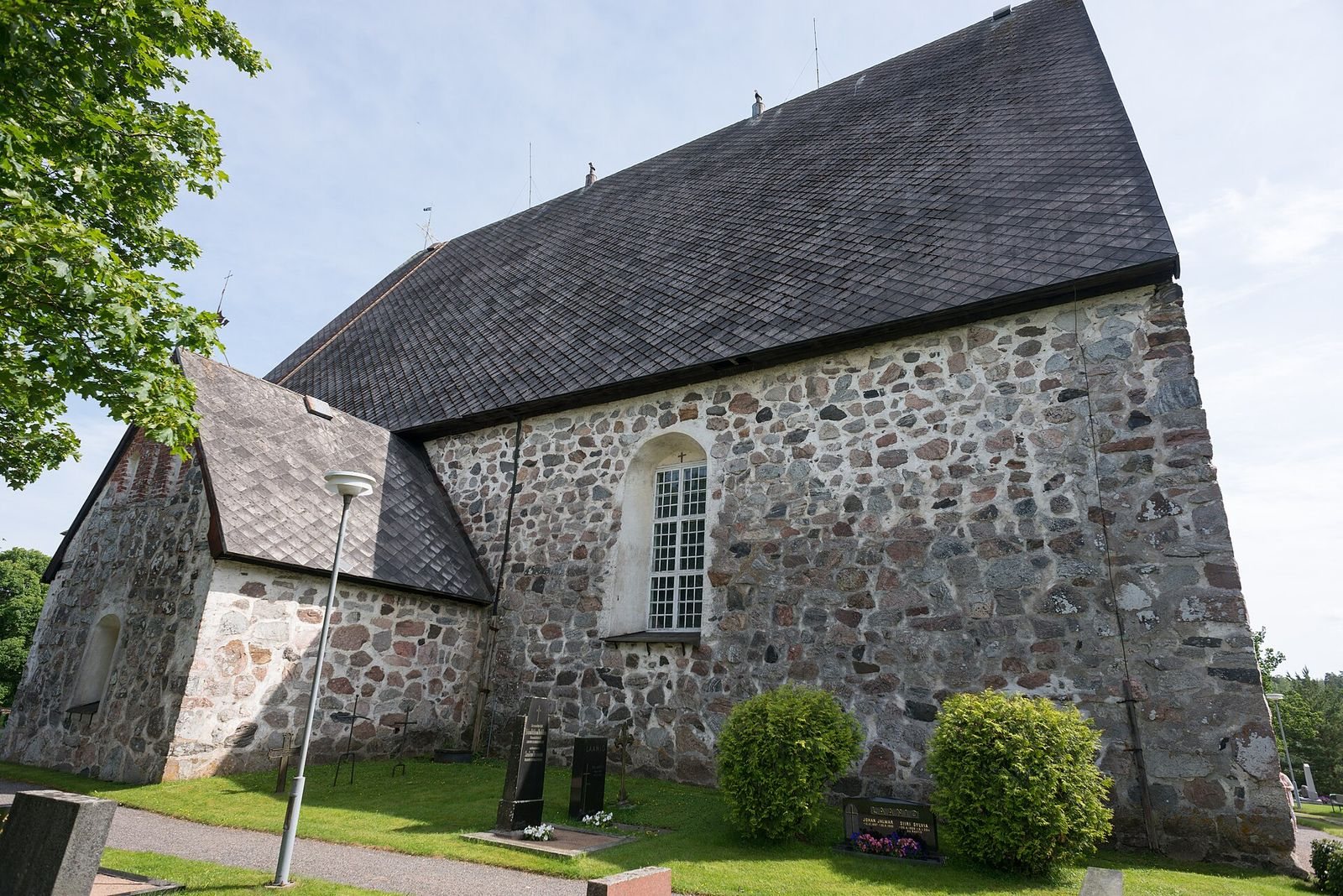
The roof structure was replaced during the 1720s and 1730s. Eaves were added, substantially changing the church’s exterior, and the amount of repair work led the parish to employ a full-time church carpenter in the 1730s.
The original organ was acquired in 1671 with money donated by nobles. It was moved to the Turku Castle Museum in the 1890s and destroyed in the bombing and ensuing fire at the castle in 1941. The church’s present organ dates to 1896.
The murals were uncovered again in the early 20th century and restored in a major conservation campaign completed in the early 1970s under conservator Veikko Kiljunen. On 1 January 2019, Sauvo-Karuna Parish was incorporated into Paimio Parish, bringing the churches of Sauvo and Karuna into that parish. Sauvo Church is associated with the Archdiocese of Turku, the senior diocese of Finland’s Evangelical Lutheran Church. It is recognized as a nationally important built cultural environment and protected under the building-heritage register and the Church Act.
Remains
Plan, construction, and vaults
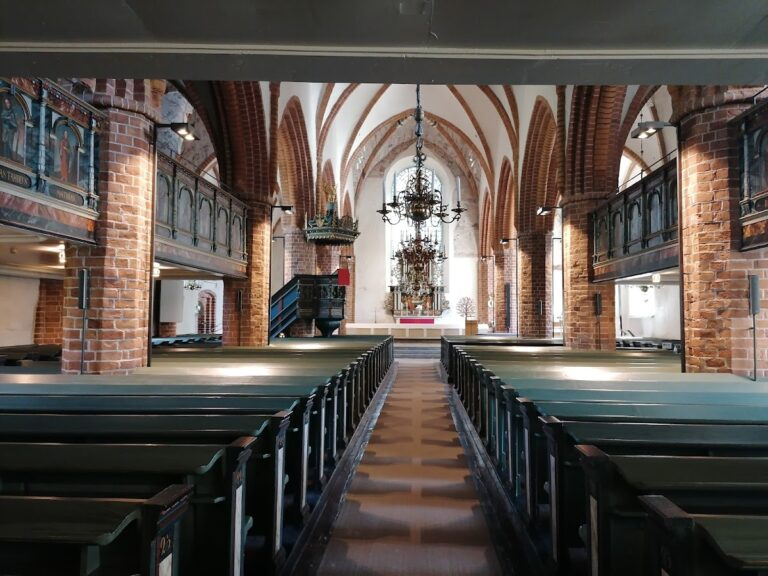
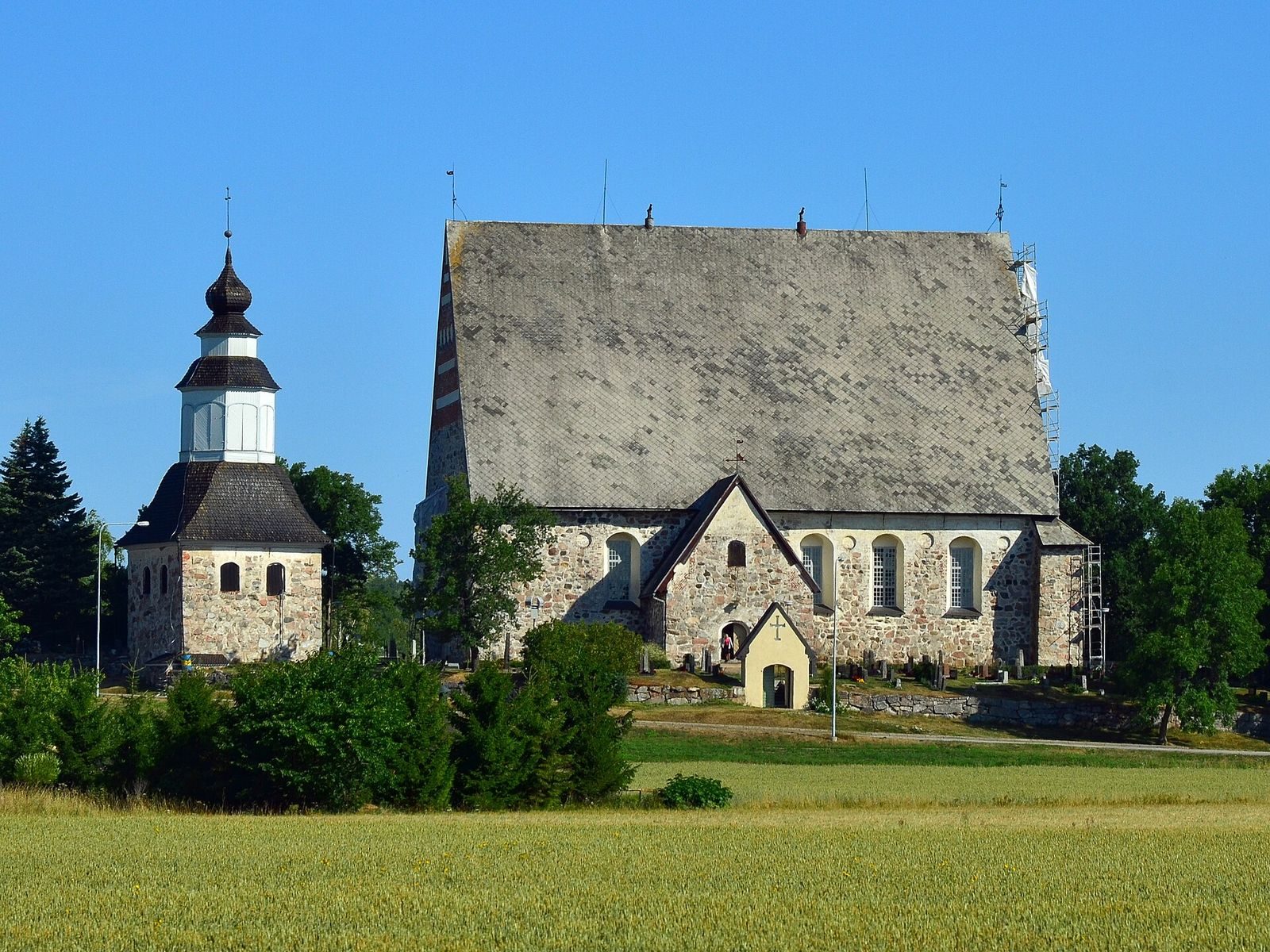
The church is a grey-stone, three-aisled hall church, a building whose nave and side aisles are of similar height. Brick pillars divide its length into six structural bays, or sections between supports. The sacristy, a room for worship-related objects and preparations, is the oldest part of the present church. Much of the medieval appearance survives, with later buttresses, projecting wall supports, added at the southeast and northeast corners in the 1690s.
Ribs in the stone church’s star vaults form star-like patterns. Their design has been compared with vaults at the churches of Kemiö and Tenhola, while their attribution to Petrus of Kimito remains uncertain. A painted inscription dated 1472 runs around the chancel window and may indicate that construction was then nearing completion.
Painted decoration
Paintings from the 1470s cover the brick vaults and are attributed to the circle of medieval painter Peter Henrikinpoja. Plant ornament accompanies figures of apostles and prophets, shown presenting the creed. In the chancel, the vault paintings depict the Church Fathers, influential early Christian theologians, and parables associated with the Evangelists, the writers or proclaimers of the Gospels.
Interior furnishings and memorials
Baptismal font and altar slab
A baptismal font made in the 13th century from Gotland limestone came to Sauvo from elsewhere and originated in an earlier wooden church. A gravestone dated 1391 serves as the altar slab, the stone surface of the altar.
Altarpiece and pulpit
The altarpiece dates to the middle of the 17th century. Its artist is unknown, and it was donated by Gertrud Wessel, a landowner’s widow. The pulpit, with its canopy, was made in 1651 in the Baroque style, a European style associated with elaborate ornament.
Crucifix and sculptures
A large crucifix dating to the second half of the 15th century is a prominent medieval furnishing. Donated sculptures from the first half of the 16th century include a figure of Christ, Saint Lawrence, an early Christian deacon and martyr, and Saint George, a Christian martyr.
Funeral shields
The church retains an unusually large group of 17th-century funeral shields, heraldic panels used to commemorate the dead. They were carried in funeral processions and then displayed in the church. The collection includes the complete set of family arms of Lieutenant General Johan Galle, along with 19 other arms.
Bell tower and cemetery
The bell tower stands on a medieval stone base and has a wooden upper part. Its wooden elements were made in the late 1760s, and the tower was rebuilt in the 1770s under master builder Anders Wahlberg. A bell dated 1791 bears a Finnish inscription urging listeners to heed the call of the Highest, repent, and seek a crown of glory at death.
The cemetery’s west portal dates to 1795, while its south portal was built in the middle of the 19th century. A memorial at the war graves, made in 1946, is the work of sculptor Aarre Aaltonen.