Son Corró Sanctuary: A Post-Talaiotic Place of Worship in Mallorca
Site at a Glance
- Popularity
- Low
- Country
- Spain
- Primary era
- Classical
- Eras represented
- Classical, Modern
- Civilizations
- Spanish
- Site type
- Religious
- Remains
- Sanctuary
On this page8 sections
History
Post-Talaiotic sanctuary
The Son Corró Sanctuary is a place of worship near Costitx on Mallorca, Spain, associated with the Balearic Islands’ Post-Talaiotic culture and dated to the fourth–second centuries BCE. This later phase, sometimes called Talaiotic III, followed the islands’ Talaiotic culture and lasted from the fifth century BCE until the Roman conquest in 123 BCE.
Son Corró may first have served communal and political-social purposes before becoming a center of bull worship. Worship of bulls was important in this period, while pigeons and eagles were also venerated. Loose horns have been found at Son Corró and at Cova Monja. The sanctuary may have belonged to the nearby settlement of Pujol.
During the Post-Talaiotic period, growing contact with other Mediterranean peoples drew the islands into conflicts between Rome and Carthage. Roman rule did not immediately displace local culture, particularly in rural and mountainous areas. The later Roman-period Epitalaiotic culture gradually took the place of Post-Talaiotic culture.
Discovery and the bull heads
Workers uncovered the sanctuary in 1895 while altering a terrace wall to create more cultivated land. Mallorcan archaeologist Bartomeu Ferrà i Perelló recorded the remains and recovered archaeological material. He made plans and elevations, mapped the walls, and noted the positions of 13 cylindrical column sections. Gabriel Llabrés i Quintana also investigated the site.
Three bronze bull heads were found with other archaeological material. The landowner, Joan Vallespir i Serra, placed a value of 3,500 pesetas on them. Ferrà and Llabrés first sought to acquire the heads for the provincial government, then helped arrange their purchase by the Spanish government to prevent a sale abroad. They entered the National Archaeological Museum in Madrid on 30 November 1895.
Excavation, conservation, and heritage
Son Corró received Spain’s Asset of Cultural Interest designation in 1966. In 1995, Costitx’s municipal government acquired land at the sanctuary and began renewed excavation and restoration led by archaeologist Guillem Rosselló i Bordoy. The restoration was controversial. Archaeologists Magdalena Serra and David Javaloyas led cleaning and conservation work in 2010.
From the late twentieth century, Costitx’s municipal government sought the return of the bull heads to Mallorca for deposit in the Museu de Mallorca. It renewed its request in 1979 and 1985; in 1980, the mayor met in Madrid with the National Archaeological Museum director and the culture minister. In 2005, a proposal for the Balearic Government to negotiate a deposit failed at the Mallorca Council because it lacked an absolute majority, while a second motion passed unanimously. A separate proposal in the Balearic Parliament passed by assent. In 2006, Spain’s Congress of Deputies rejected a proposal to return the heads and other Balearic heritage objects, with three votes in favour and 33 against.
Remains
Layout and setting
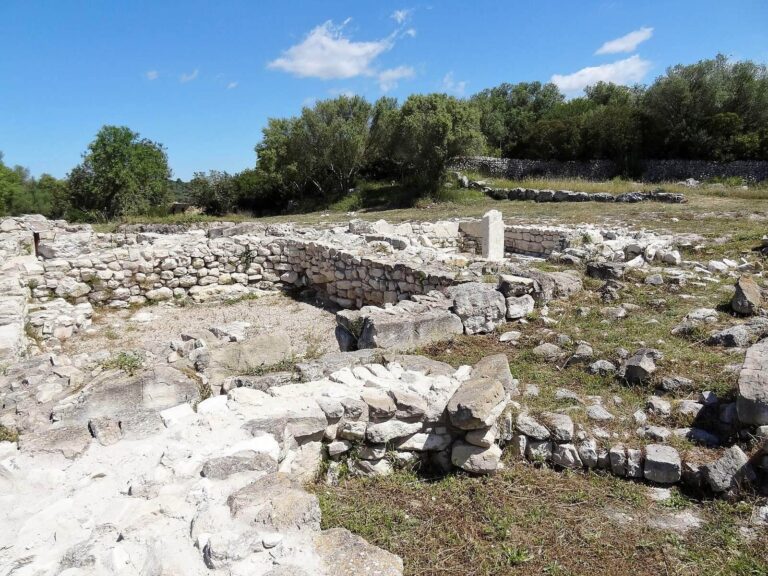
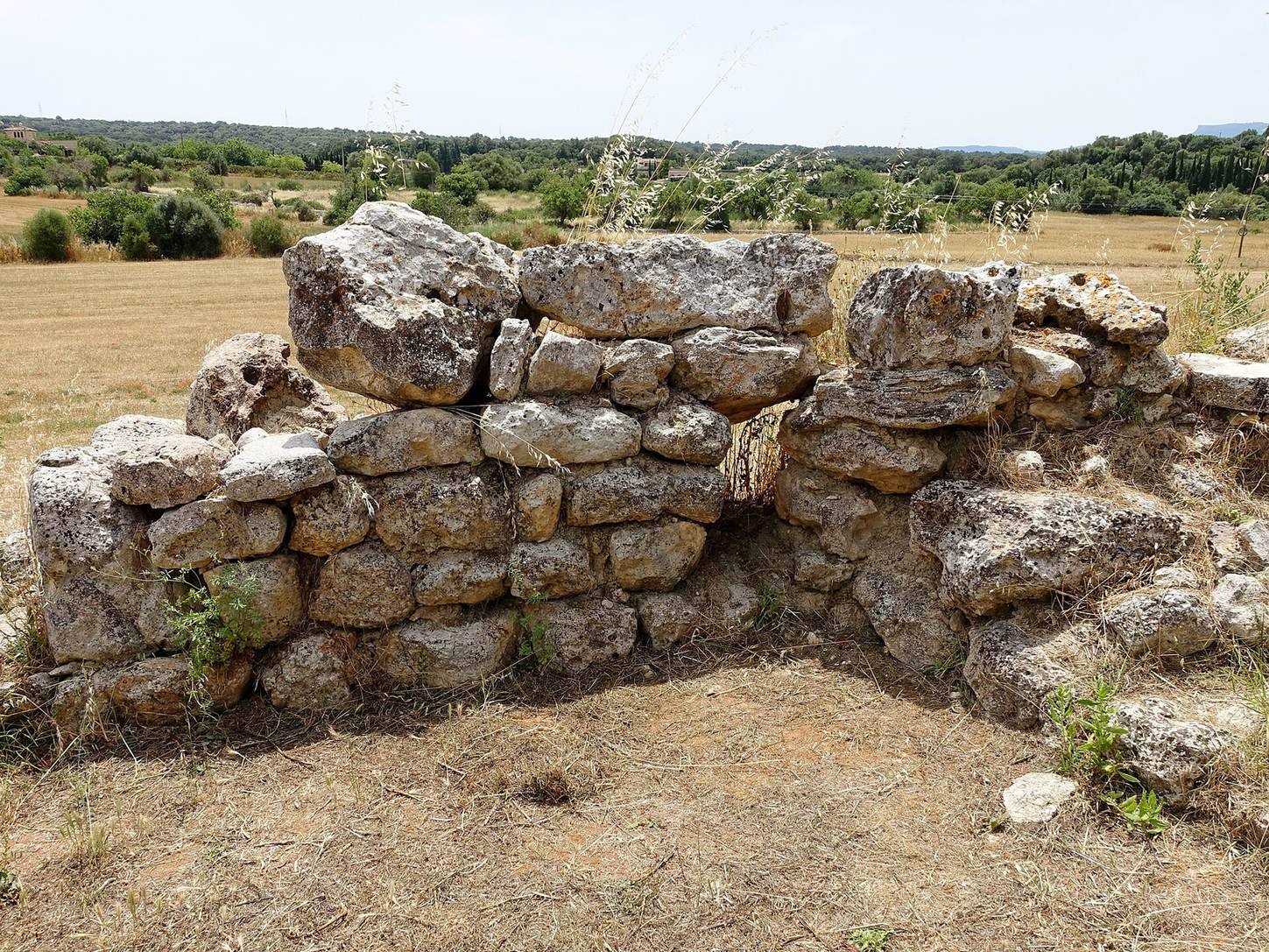
The sanctuary has an apse-ended plan and a hall whose roof was supported by columns. Its remains include a dry-stone outer wall, built without mortar, and ground traces that follow the side walls. The interior measures 10.30 m by 8.20 m, covering 84.5 m²; the whole archaeological site is about 12 m by 11 m, or roughly 120 m². It lies more than 20 km from the sea, on the southeast slope of a 107 m hill at about 95 m above sea level, beside a field around 5 m lower. A stream bends around the area, about 400 m to the west and 500 m to the north. Holm oaks, kermes oaks, wild olive, dwarf palms, and Mediterranean scrub grow nearby.
Columns and altar
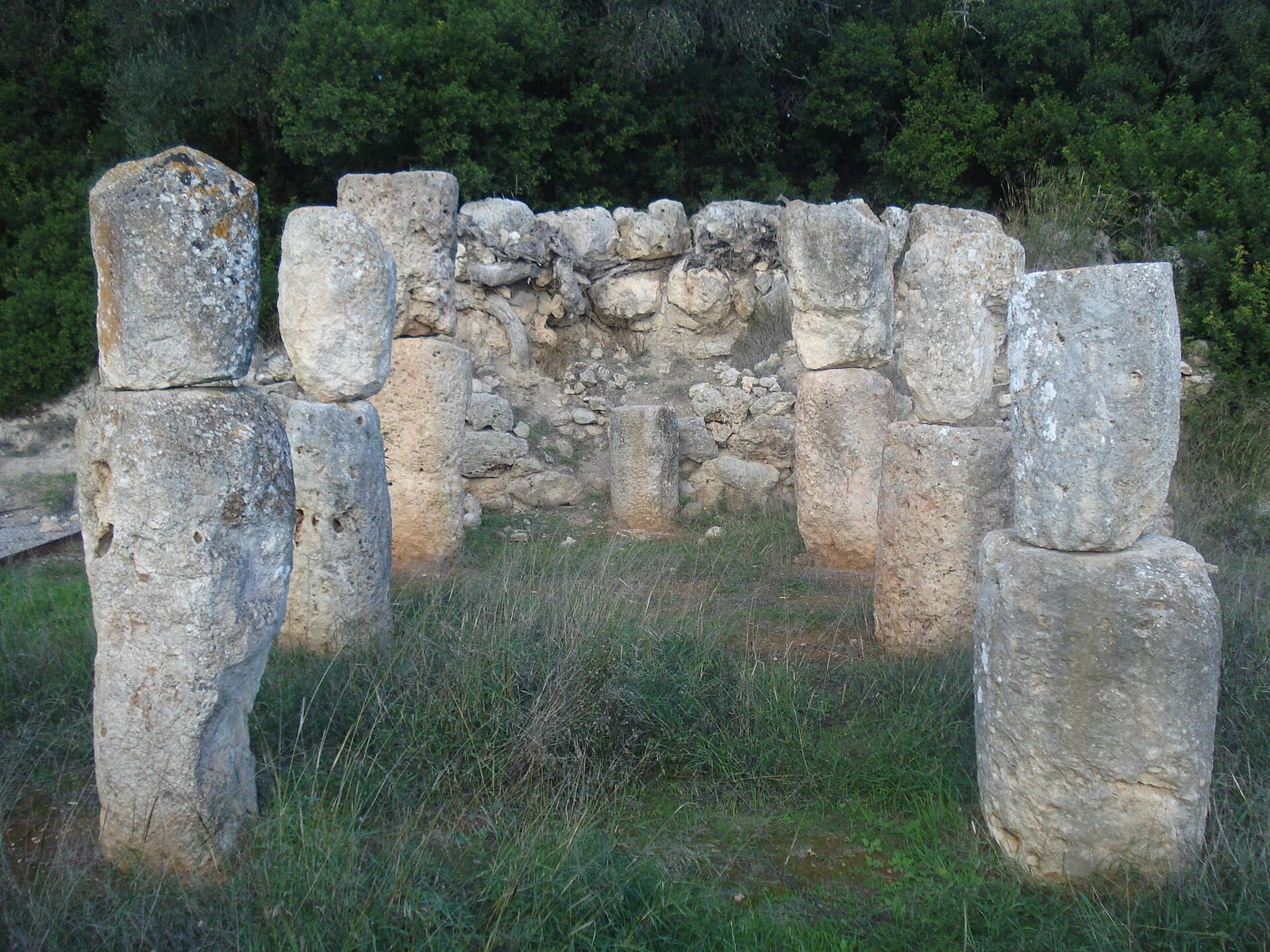
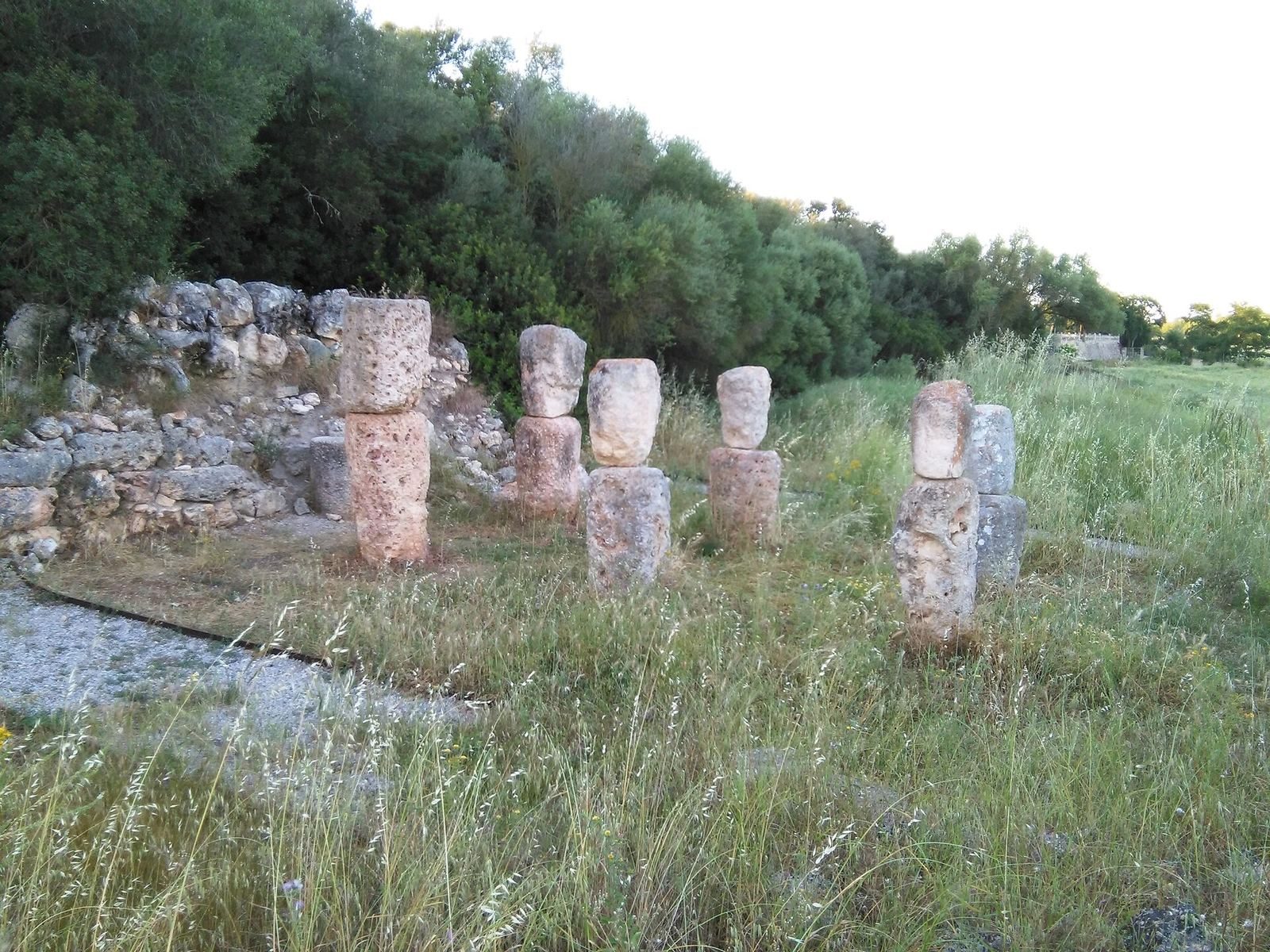
Six columns stand in front of an altar area. Each is made from two joined sections, and the columns form pairs that increase in height. The altar is a seventh, half-column structure. The 13 original cylindrical column sections, each about 55–75 cm in diameter, lay unevenly across the site before restoration, mostly in its eastern part. The restoration stacked two sections for each of the six columns, joining them with a central metal pin, and placed the thirteenth in the altar area. Rosselló interpreted the sections as parts of a former roof rather than as a liturgical arrangement. The columns are described as ranging from about 0.5 m to 2.10 m high; another set of measurements gives surviving structures a range of 83 cm to 2.42 m, with an average of 1.64 m.
Bronze bull heads
The sanctuary’s bronze bull heads may have represented deities connected with livestock, fertility, or war, but their meaning and origin remain uncertain. They may have been made on Mallorca or brought from more developed centers. Other archaeological material was recovered with them.