Santuari de Lluc: Majorca’s Catholic Sanctuary and Pilgrimage Center


Site at a Glance
- Rating
- 4.7
- Popularity
- Very Low
- Country
- Spain
- Primary era
- Early Modern
- Eras represented
- Medieval, Early Modern, Modern
- Civilizations
- Crown of Aragon, Knights Templar, Spanish
- Site type
- Religious
- Remains
- Sanctuary
On this page16 sections
History
Santuari de Lluc is a Catholic sanctuary and pilgrimage center in Spain, in the municipality of Escorca in the Serra de Tramuntana of north-west Majorca. Developed around a medieval chapel and a local devotion to the Virgin Mary, it became the island’s principal spiritual and religious center. The sanctuary is administered by priests rather than occupied by a monastic community.
Before and after the Christian conquest
The area around Lluc was occupied in prehistory. Nearby burial caves, including Cometa dels Morts, contain evidence associated with the Talaiotic period and date to the fourth century BC. Water, woodland, and game may have supported a farm at Lluc during the Roman and early Christian periods. The name Lluc is sometimes connected with the Latin lucus, meaning “sacred grove,” although this proposed origin does not establish that a pre-Christian sanctuary stood here.
During Muslim rule, conventionally dated in this context from 902 to 1229, the place was reportedly known as Al-Luc. After Jaume I, James I of Aragon, conquered Majorca in 1229 and incorporated it into the Crown of Aragon, Lluc entered a Christian religious setting. A first chapel or church was established in 1230. A later royal building initiative, traditionally associated with Jaume I and dated to about 1250, was entrusted to the Knights Templar, a medieval military-religious order that received lands in territories conquered by Christian rulers. The site’s earlier agricultural role continued for some time.
In 1260 the chapel was enlarged into an Augustinian religious establishment. The chapel and sanctuary appear in the testament of Valentí de Ses Torres, dated 31 October 1268. A document from 1273 records that substantial numbers of pilgrims were already reaching Lluc despite the dangerous route. In 1314, the Templar possessions passed to the Hospitallers, or Order of Saint John of Jerusalem, which inherited many former Templar properties after the order’s dissolution. Lluc subsequently developed into an important center of devotion to the Virgin Mary.
The foundation tradition and medieval pilgrimage
A medieval tradition tells how a young Moorish shepherd discovered a dark statue of the Virgin beside the stream at Lluc soon after the Christian conquest. The image was repeatedly taken to the chapel of Sant Pere d’Escorca, yet it was found again at the place where it had first appeared. A chapel was therefore established at that location. The tradition calls the shepherd Lluc or Lucas and describes the discovery as guided by light and music.
During the fourteenth century, pilgrimage routes were organized from Inca through Caimari, from Pollença, and from Sóller. The Virgin of Lluc came to be regarded as the patron saint of Majorca, and the bubonic plague of 1348 brought a marked increase in the number of pilgrims visiting the sanctuary.
Collegiate administration and the Black Madonna
In 1456 the church became a collegiate church with a permanent priestly community. During the same period, Tomàs de Tomàs promoted the creation of a priestly seminary at Lluc. Statutes adopted in 1526 under the prior Gabriel Vaquer and confirmed by Pope Clement VII in 1531 regulated the sanctuary’s administration. They also required morning masses sung by six boys.
The medieval statue linked to the foundation tradition was later lost. The image venerated today is a late Gothic Black Madonna acquired in Belgium by the Mallorcan merchant Joan Amer in 1520 and donated to Lluc. Known locally as Sa Morenita, meaning “the dark-skinned one,” the image became the focus of the sanctuary’s continuing Marian devotion.
The buildings called Els Porxets were constructed in 1586 to house pilgrims and their animals. In 1589, a star-shaped Renaissance fountain was installed in the Pilgrims’ Square as a watering place for horses, mules, and donkeys. These additions reflect the growing scale and practical demands of pilgrimage at Lluc.
The present church and royal status
The present church was begun in 1622 and received its façade in 1691. Its high altar was dedicated in 1684. In the same year, Rafel Busquets published an account of the discovery and miracles associated with Our Lady of Lluc and conducted an apostolic investigation into the reported miracles and the sanctuary’s reputation.
In 1707 the church received the title of Royal Chapel from Charles III, the Habsburg claimant to the Spanish throne during the War of the Spanish Succession, the conflict over the succession to the Spanish monarchy. During the eighteenth century, devotional songs known as the Goigs, or “Joyful Songs,” of the Virgin of Lluc were composed and circulated widely across Majorca.
Administration and transformation in the modern period
Administration of the sanctuary was entrusted to the Missionaries of the Sacred Heart of Jesus and Franciscan sisters in 1881. Since 1891 it has been administered by the Missionaries of the Sacred Hearts. The transfer of the priory to Joaquim Rosselló i Ferrà, founder of the Mallorcan branch of that congregation, was definitively confirmed in 1910 with the approval of the Holy See.
On 10 August 1884, the Virgin’s statue received a papal coronation performed by the Bishop of Majorca, Jaume Mateu, on behalf of Pope Leo XIII. It was among the earliest Spanish Marian images to receive this honor. The basilica was consecrated on 30 September 1884 and reconsecrated on 17 July 1914 after early twentieth-century works.
Antoni Gaudí visited Lluc in 1908 and contributed ideas associated with later works. The Camí dels Misteris was developed between 1909 and 1913, while the church interior was remodelled in a Neobaroque manner, using later forms inspired by Baroque architecture and decoration. The façade was renewed in 1925, apart from its seventeenth-century portal. A new hostel was completed in 1914, and a paved road from Inca to Lluc was built during the 1930s, reducing the sanctuary’s isolation.
During the Marian Year of 1948, the statue was carried through the villages of Majorca. The sanctuary museum opened in 1954 and the botanical garden in 1956. In 1962 Pope John XXIII granted the church the honorary title of minor basilica through the bull Gloria et praesidium. A minor basilica is a papal title for a church of particular religious or historical importance.
Lluc remains a major pilgrimage center. The annual Marxa des Güell a Lluc a peu, a night walk from Palma to Lluc, has been held since the 1970s and attracts thousands of participants. The sanctuary is also associated with the continuing Christmas Eve performance of the Song of the Sibyl, recognized as UNESCO Intangible Cultural Heritage since 2010. Since 2006, the Els Blauets choir and boarding school have admitted girls as well as boys. The traditional first Mass and first Eucharist of the year are celebrated at Lluc by the Bishop of Majorca. The sanctuary forms part of the cultural and pilgrimage landscape of the Serra de Tramuntana, a UNESCO World Heritage cultural landscape.
Remains
Mountain setting and sanctuary complex
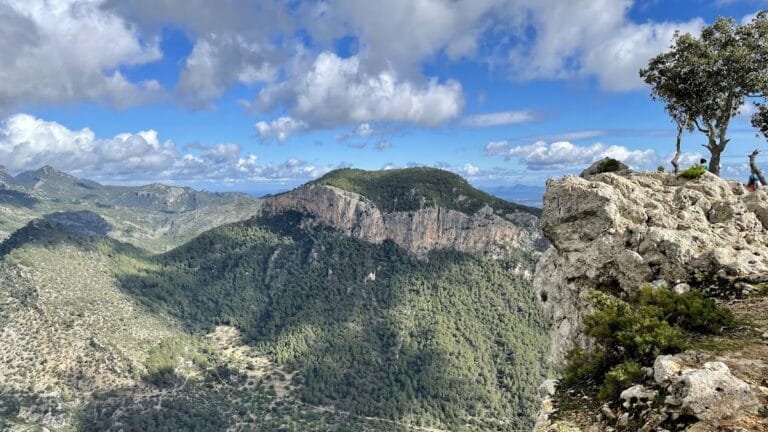
The sanctuary stands at approximately 500 metres above sea level in a mountain basin of the Serra de Tramuntana, within the extensive territory of Escorca and among mountains exceeding 1,000 metres. It lies beside the Torrent de Lluc, also called the Torrent d’Albarca. Farther west, this stream joins the Torrent des Gorg Blau to form the Torrent de Pareis.
The complex brings together the basilica, the main sanctuary buildings, pilgrim accommodation, restaurants, the Col·legi de Lluc boarding school, the museum, Escorca municipal offices, the botanical garden, and associated public and private buildings. Its overall arrangement has been compared with that of the Sanctuary of Montserrat.
The basilica
The basilica is a Renaissance church with a Latin-cross plan, meaning that a long central axis is crossed by a shorter transept. It has a central nave, a transept, a barrel vault, three side chapels on each side, and a dome topped by a lantern. The nave measures 28.28 metres in length and 6.70 metres in width, while the transept measures 13.45 metres across.
Locally quarried stone forms the church’s arches and cornices. Baroque gilded ornament enriches the interior, and paintings of the Twelve Apostles occupy the dome. A rose window stands above the main portal, with organ pipes framing it on the inside.
High altar and Virgin’s chapel
The high altar contains a richly gilded altarpiece and a painting of the Virgin of Lluc by Jaume Blanquer, a Majorcan Baroque painter and sculptor. Above it, an arch carries the Psalm inscription “Fundamenta eius in montibus sanctis,” translated as “Her foundations are in the holy hills.” Behind the apse, the rounded or polygonal end of the church, a chapel provides a place for contemplating the Virgin’s statue and probably occupies the site of the primitive chapel.
Renovated in 1963, the chapel has the coats of arms of 53 Mallorcan municipalities arranged across seven walls. The municipalities donated their arms between 1983 and 1988 for the centenary of the statue’s coronation.
The Black Madonna
The Black Madonna stands behind the high altar in an ornamented, glass-protected niche. A pivoting platform allows the image to face the choir during religious ceremonies, while it normally remains visible from the chapel behind the altar. The dark-stone Gothic statue is 61 centimetres high. The Virgin holds the infant Jesus on her left arm and points toward him with her right hand.
A crown and twelve surrounding angels form part of the image’s presentation. The child holds an open book marked with the letters Alpha and Omega. The statue was partially restored in 1884, and the book and the child’s right arm pointing toward it derive from that restoration, which also made other substantial alterations.
Devotional route and traditional apparition site
A paved route leads from the basilica to the rock above the stream traditionally identified as the place where the statue appeared. Called the Camí dels Misteris, or Pujol de la Trobada, it carries five sculptural groups representing the fifteen mysteries of the Rosary. Joan Rubió i Bellver and Guillem Reinés designed the groups after suggestions associated with Gaudí. The work was completed by 1913 and includes bronze reliefs by the sculptor Josep Llimona i Bruguera.
A large metal cross stands on the rock above the basilica and symbolically marks the traditional apparition site. The rock lies near the source of the Torrent de Lluc, whose winter waters can flow toward the Torrent de Pareis and ultimately reach the sea at Sa Calobra.
Pilgrim buildings and water supply
The pilgrim accommodation on the Plaça dels Pelegrins includes four three-storey buildings and the separate Els Blauets residence. Els Porxets, the rural-style arcades, contain apartments for pilgrims. Former pilgrim cells, or cel·les, have been converted into 129 guest rooms and apartments. A separate hangar-like building was erected behind Els Porxets in 1984 for large celebrations.
The Font Cuberta supplies the sanctuary with water reputed for its quality. The complex also includes a pool, a football field, and a small botanical garden. Plants in the garden include butcher’s broom, Mediterranean fan palm, laurustinus, and American pokeweed.
Museum and historical collections
The museum occupies two floors of the main building and contains eight rooms. It began in 1952 as a repository for archaeological material found near the sanctuary, especially objects from the Cometa dels Morts caves. Its collections later expanded to include Majorcan folk art, furniture, ceramics, jewellery, religious objects, clothing, paintings, sculpture, and contemporary art.
The archaeological material includes finds from the Talaiotic period. Other collections contain liturgical objects, Majorcan religious and secular clothing, ceramics, medieval and modern religious images, and paintings from the eighteenth and nineteenth centuries. The museum also holds a substantial group of works by Josep Coll i Bardolet, including pieces donated from his personal collection.
An archive attached to the Col·legi de Lluc preserves more than 500 scrolls and approximately 5,000 historical works. Its oldest document dates to 1244, extending the written history of the sanctuary into the decades after its medieval foundation.
Crosses, roads, and the surrounding landscape
Two medieval roadside crosses stand at the sanctuary entrance at the end of the route from Caimari. They belong to different periods. The former pilgrimage route from Lluc to Caimari, known as the Camí Vell de Lluc, is largely paved and has been restored. The route is marked by seven crosses representing the Joys of the Virgin and includes the place called the Salt de la Bella Dona, which is associated with a local legend.
The sanctuary is also connected with the GR 221 long-distance route through the Serra de Tramuntana and the developing GR 222 route toward Artà. These paths preserve the physical connection between Lluc, Caimari, and the Mallorcan plain. A multiple sundial fixed to a rock slab above the western exterior wall of the main building adds a later scientific and devotional feature to the complex.
The multiple sundial
The sundial’s three-part vertical panel measures 3.20 by 1.80 metres and contains five dials. They indicate true local solar time, Central European standard time, Central European summer time, Babylonian hours, and canonical prayer hours. A canonical sundial indicates traditional divisions of the day used for religious prayer. Constructed in 1991, the instrument was designed by Rafael Soler Gayà and engraved on artificial sandstone panels in a workshop at Santanyí.
Nearby sites