Church of Saint Philip Neri: A Baroque Oratorian Church in Palma, Spain
Site at a Glance
- Rating
- 4.6
- Popularity
- Low
- Country
- Spain
- Primary era
- Early Modern
- External website
- Open
- Eras represented
- Early Modern, Modern
- Civilizations
- Crown of Aragon, Spanish
- Site type
- Religious
- Remains
- Church
On this page22 sections
History
The Church of Saint Philip Neri in Palma, Spain, is a Baroque Catholic church occupying the former convent and church of the Holy Spirit of the Trinitarian Order. The church’s foundations were laid in 1612 and it was blessed on 8 October 1628. Its history reflects the succession of two religious communities, first the Trinitarians, whose work included the redemption of captives and the care of the sick, and later the Congregation of the Oratory, founded by Saint Philip Neri.
The Trinitarian foundation
The Trinitarians, approved by Pope Innocent II in 1198, established themselves in Mallorca in 1232 through the intercession of Constance of Aragon, a member of the Aragonese royal family and half-sister of James I the Conqueror, the medieval king who ruled the Crown of Aragon during the Christian conquest of Mallorca. The first Mallorcan community was formed by Sebastian Robes, five priests from Marseille, and three lay brothers from Lleida.
The community initially received property at the Sitjar Gate, where it founded a hospital known as the Hospital of the Rossos. In 1299, the Trinitarians moved to a new convent beside the parish of Saint Michael on Vilanova Street. Their hospital continued operating until 1458, when the hospitals of Palma were consolidated into the General Hospital of Mallorca. The later church of the Holy Spirit was built within the same complex, with work beginning in 1612 and the completed church blessed in 1628.
The nineteenth-century transition
The Trinitarian convent was expropriated and auctioned by the state in 1836 during the Mendizábal confiscations, nineteenth-century measures that dissolved religious communities and transferred their property to the state for sale or other uses. The community of 35 Trinitarians was dissolved, and the Order did not return to Mallorca. The church was subsequently used as a straw warehouse, while the convent buildings fell into severe neglect.
The Oratory of Saint Philip Neri had reached Mallorca in 1712 and established a convent opposite the Inquisition’s Black House in what is now the Main Square. That house was dissolved after the 1836 exclaustration, meaning the departure or removal of members from a religious community, and its demolition was approved in 1854 to create the Main Square. In 1858, the Oratory was authorized to return to Mallorca and was offered the former Trinitarian complex.
The Oratorians settled there in January 1859. The first community consisted of Father Frau and Brother Pere Antoni Canyelles, although Father Frau died seven days after their arrival. The former church of the Holy Spirit was renamed Saint Philip Neri in May 1859. Restoration of the church and construction of new convent buildings began in 1858 and 1859 and continued until 1875, with interruptions from 1869 to 1873. The church restoration followed a project by Pere d’Alcàntara Penya, with craftsmen including Joan Bauçà, Francesc Rosselló, Josep Muntaner, Miquel Mates, Jordi Palmer, Mariano Enric, and Vicenç Mates.
The former Trinitarian cloister was partly demolished in 1863 when Saint Philip Neri Street was opened. The Oratorians substantially altered the remaining complex, although the church itself principally preserves the earlier Trinitarian establishment. The Oratory continues to maintain its community and school there. The church remains a place of Catholic worship in the Diocese of Mallorca and also functions as a museum and cultural site. Its Baroque architecture is included in Palma’s protected heritage catalogue.
Chapels and later religious use
The chapel of the Divine Love began as a sixteenth-century chapel dedicated to Our Lady of Remedies. In 1574, Viceroy Miquel de Moncada founded a confraternity there. After the Trinitarians were expelled, the chapel was used as a theatre, but it reopened for public worship in 1867 and was blessed again after restoration in 1954. The chapel of Our Lady of Sorrows was commissioned during the priorate of Pere Pont, a Trinitarian and Bishop of Cluny, and is dated to 1544 by the historian Santiago Sebastián López. It reopened for worship on 30 August 1864 after having been used as a firewood store.
The Oratorian restoration was associated particularly with Francesc Molina i Guardiola, whose remains were brought to the church in 1959. The complex contains an archive concerning the convent and church, original documents associated with Miquel Costa i Llobera and Maria Antònia Salvà, a major European archive of the oratorio, a large musical composition for voices and instruments usually based on a religious text, and an old religious library. Some of the Costa i Llobera documents are displayed in the church museum.
Remains
Exterior and convent complex
Church portals
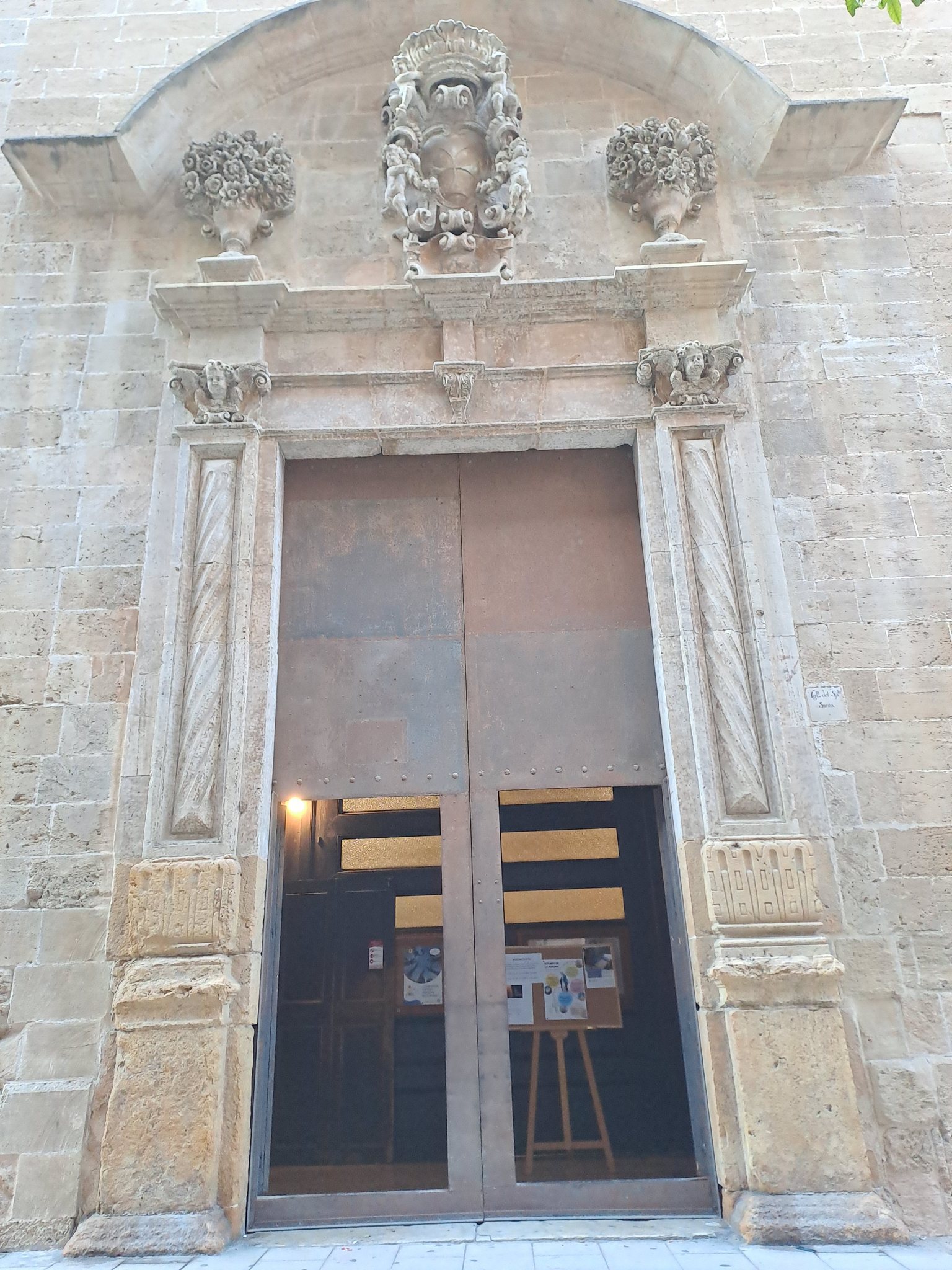
The church stands between Vilanova Street and Saint Philip Neri Street and has two portals. The Main Portal opens onto Vilanova Street. Between large flower vases and pairs of angels, it carries a carved Trinitarian shield, preserving a visible connection with the building’s earlier religious community. The smaller portal opens onto a small square between the two streets and bears a painted image that appears to represent the Trinity.
Cloister and convent rooms
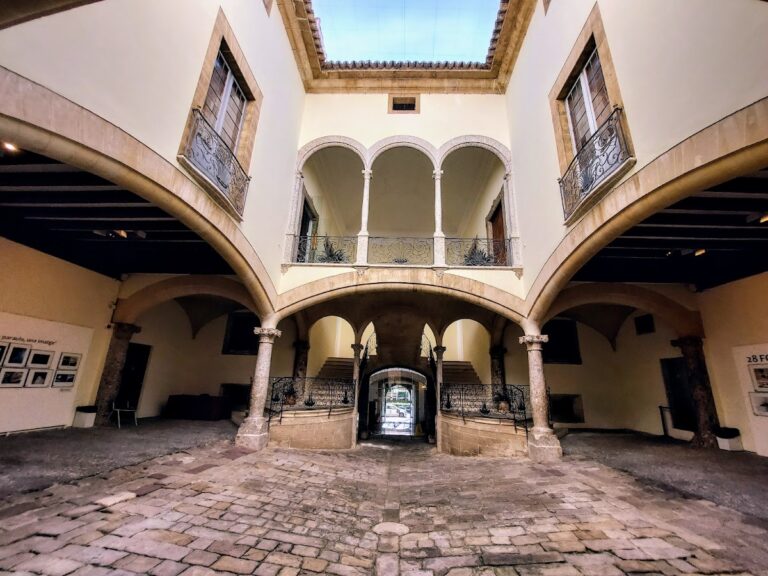
The former cloister was considerably larger than the surviving convent area. The opening of Saint Philip Neri Street cut through the convent buildings and made the two cloister wells accessible from the public street. Three nineteenth-century convent rooms remain practically intact. They belonged to Joaquim Rosselló, founder of the Missionaries of the Sacred Heart; Salvi Huix i Miralpeix, a Catalan bishop executed in Lleida during the Spanish Civil War; and Francesc Molina i Guardiola.
Main interior and choir
Main altarpiece
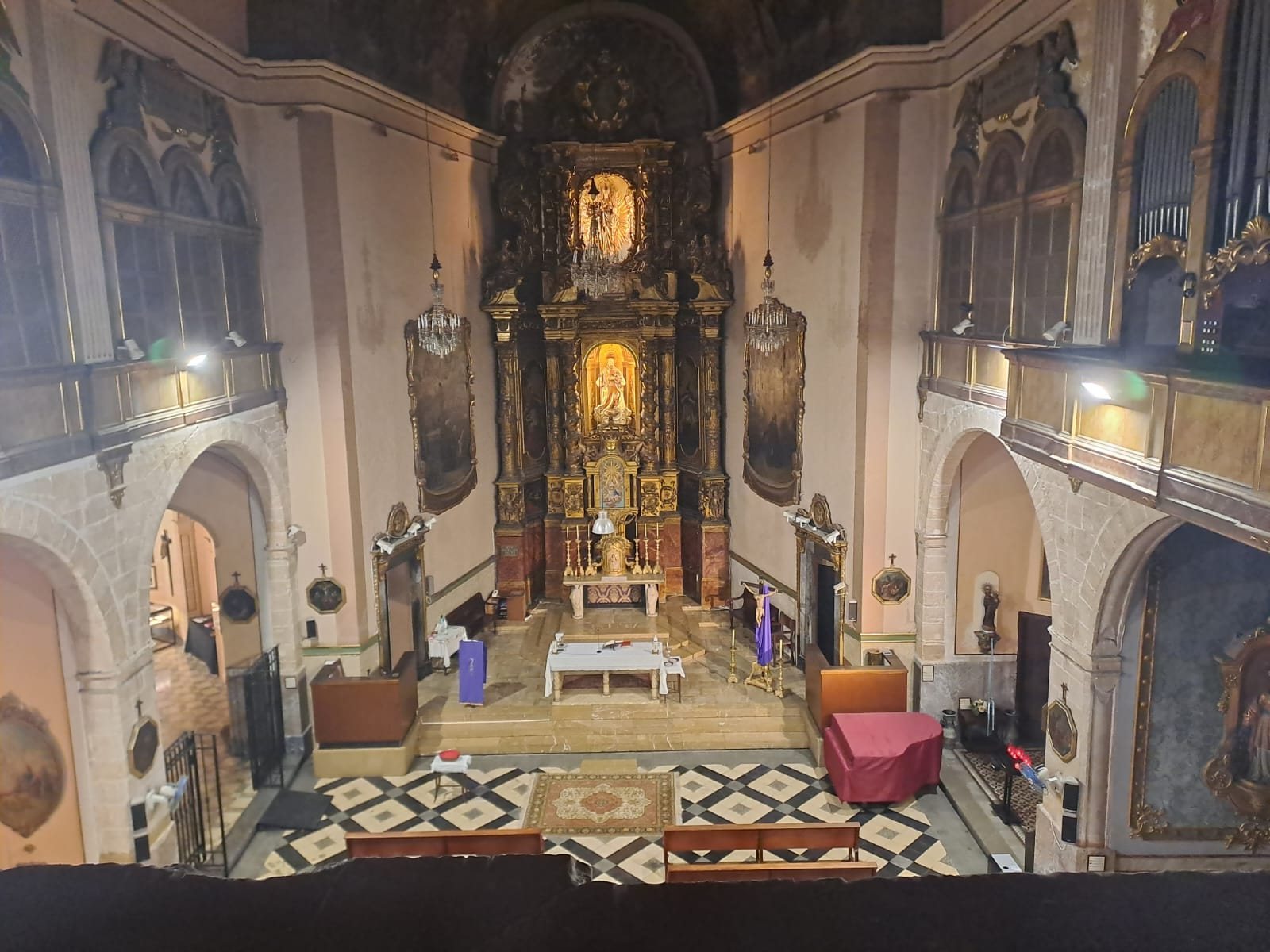
The principal altarpiece is a Baroque work made in 1713 by the Catalan sculptor Andreu Carbonell. It originally stood in the first Oratorian church in the Main Square before being transferred to Saint Philip Neri. The structure is approximately 13 metres high, 6 metres wide, and 1.35 metres deep. Its upper part contains a medallion of Saint Peter with his keys and a statue of the Immaculate Conception by Llorenç Ferrer i Martí. The theological virtues of Faith, Hope, Charity, and Truth appear before the Virgin.
The central niche holds Saint Philip Neri, flanked by paintings of Saint Charles Borromeo and Saint Francis de Sales by Miquel Pont. The lower section contains paintings of Saint Matthew and the Stigmata of Saint Francis by Bartomeu Morey. Their inclusion commemorates the name saints of the Canons Mir, who paid for the altarpiece. A modern display case dates from 1926.
Altar and presbytery
The main altar is made from a single block of stone and rests on two sculpted angels by Pere Martínez Pavia. Vicar General Francesc Planas consecrated it on 25 May 1959 during the centenary commemorations of the Oratorians’ arrival at the convent. Vicenç Mates decorated the apse vault with the glorification of Saint Philip Neri. Large paintings on the sides of the presbytery, the area around the main altar reserved for the clergy, show Saint Philip receiving the Holy Spirit as a globe of fire while praying in the catacombs of Saint Sebastian and founding the Confraternity of the Most Holy Trinity to assist pilgrims and convalescents.
Choir and organ
The choir retains thirty-five choir stalls, among the few surviving elements from the Trinitarian period. Their number is probably incomplete, and the choir may not be their original location. The rear wall carries a painting of Our Lady of Vallicella, patron of the Oratory in Rome, with Saint Philip Neri, Blessed John Juvenal Ancina, and Blessed Sebastian Valfré below. Above the prior’s stall is an oil painting of Saint Philip Neri by Vicenç Mates, installed in 1859. Two paintings above the portals depict the appearance of Saint Peter and the beheading of Saint Paul.
The organ is positioned above the second chapel on the right and dates from approximately 1876 to 1880. It is in good condition.
Chapels on the right side
Chapel of the Holy Christ Rescued
The chapel of the Holy Christ Rescued contains the venerated image of the Holy Christ Rescued, which has been honored in the church since 1697. Its traditional history says that Father Joan Antoni Bello of the Trinitarian Order recovered the image from Algerians. Two medallions in the chapel depict the rescue. Other features include a medallion of Saint Vincent Ferrer, an unidentified painting of the Nativity, and small sculptures of Saint Nicholas of Bari and Saint John the Baptist.
Chapel of Our Lady of Lourdes
The chapel of Our Lady of Lourdes has been presided over by its image since 1908. Guillem Galmés made the image of the Virgin, the kneeling Saint Bernadette Soubirous, and sculptures of Blessed Antoni Grassi and Saint Aloysius Gonzaga. The side walls carry images of Saint Catherine with her wheel and Saint Cecilia with an organ, installed and blessed on 21 November 1909. Marble was added in 1927 and 1928. The altar was consecrated on 22 May 1959, when a Lourdes painting at the smaller portal was also blessed.
Chapel of Saint Joseph
The chapel of Saint Joseph contains a medallion of the Annunciation and a central sculpture of Saint Joseph with the Christ Child on a cloud-shaped pedestal. Paintings of Saint Anne and Saint Joachim accompany smaller paintings of Saint Joseph Calasanz and Saint Joseph of Cupertino. Two side paintings show unidentified martyr saints who are thought to be Saints Matthew and Mark.
Chapel of Our Lady of Mount Carmel
The chapel of Our Lady of Mount Carmel contains a medallion of Saint Alphonsus Maria de Liguori, representations of Saint Leonard of Porto Maurizio, Saint Camillus de Lellis, Saint Catherine of Genoa, and Saint Gertrude, and oval paintings of Our Lady of Guadalupe and Our Lady of Fatima. Beneath the altar is a silver urn containing the remains of Saint Peregrine Martyr. The urn was exposed for public veneration in 1950. Father Bru Cortès had bequeathed it in 1880 to his nephew Francesc Forteza Cortès, and it passed to the church after the heirs renounced their legal claims in favor of the Congregation.
Chapel of the Sacred Heart of Jesus
An iron grille encloses the chapel of the Sacred Heart of Jesus, as well as the chapel of Our Lady of Sorrows. The Sacred Heart chapel contains a sculpture of Christ, figures of Blessed John Juvenal Ancina and Blessed Sebastian Valfré, and paintings of the appearances of the Sacred Heart to Saint Margaret Mary Alacoque and of Saint Michael to the same saint.
Beneath the altar are the remains of Saint Victoria Martyr, placed inside a wax mask, together with a bottle said to contain her blood. The relics were installed in 1892 after Father Josep d’Olesa gave them to the Oratorians. His father had received them from Pope Gregory XVI.
Chapels on the left side
Chapel of the Divine Love
The chapel of the Divine Love is a small chapel beside the Main Portal, dedicated to Our Lady of Divine Love. Its paintings show the Virgin protecting Saint Rose and Saint Teresa, while a large Gospel scene and a painting of Saint Philip Neri copied from Guido Reni complete the decoration. Canon Mir brought the Saint Philip painting from Rome.
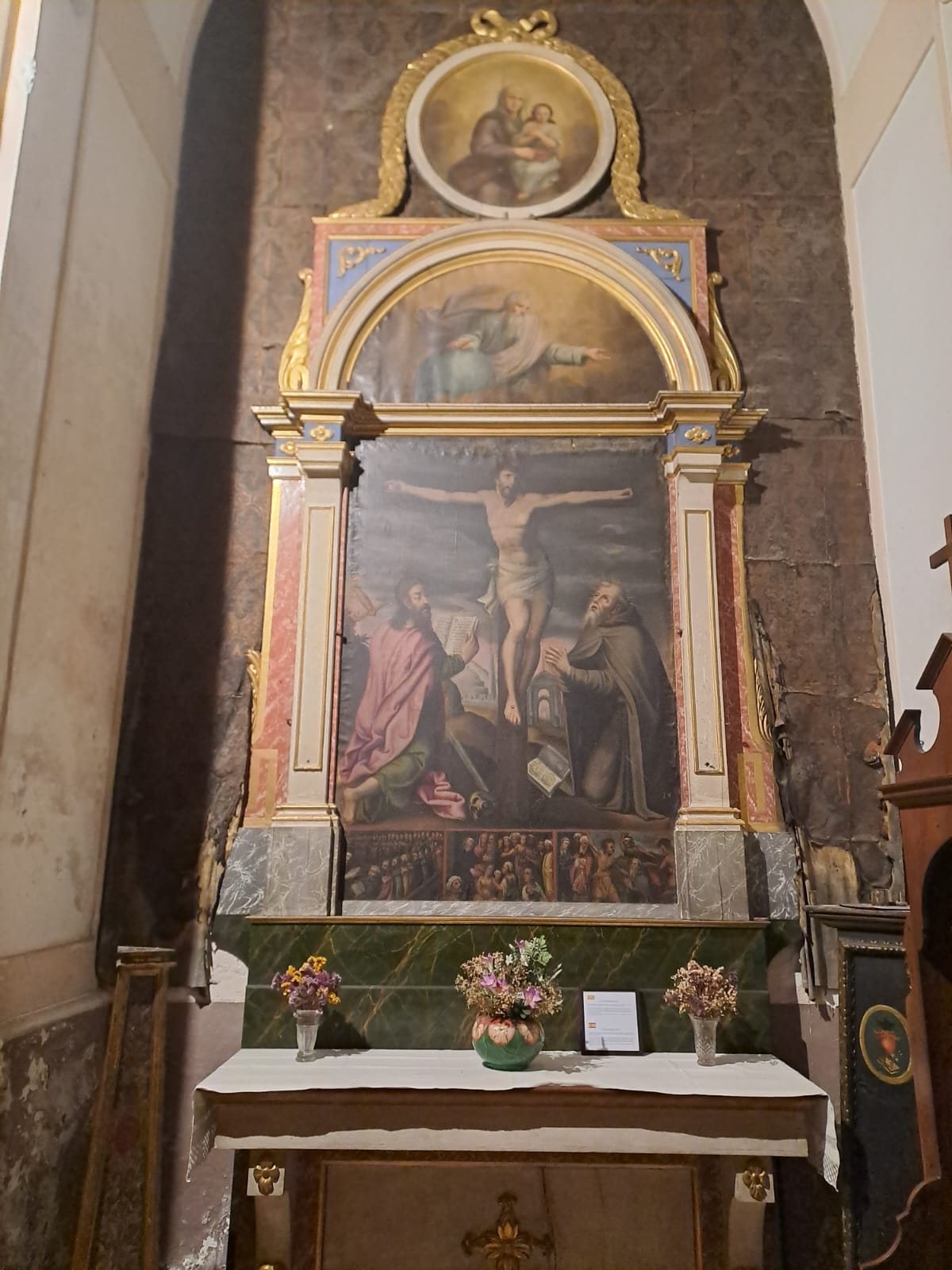
Four lateral altars are dedicated to Saint Catherine Thomas; the Coronation of the Virgin dressed in a Trinitarian habit; Saint Philip Neri and the four saints canonized with him, Ignatius of Loyola, Francis Xavier, Isidore the Farmer, and Teresa of Jesus; and the Crucified Christ flanked by Saint Paul and Blessed Ramon Llull. The Crucified Christ altar came from Can Cererols in the Main Square, traditionally identified as the house of Blessed Ramon Llull, and was transferred to Saint Philip Neri at the direction of Bishop Miquel Salvà.
Vicenç Mates decorated the chapel’s dome and vault. Restoration work revealed fifteen burials, some dating from the eighteenth century, including one from 1717. An altar containing the remains of Saint Albert Martyr has stood in the church since 1950. It was moved from the chapel of the Holy Christ Rescued to the Divine Love chapel in 2019.
Chapel of Our Lady of Sorrows
The chapel of Our Lady of Sorrows stands to the left of the main altar and now contains the church museum. It has a relatively large octagonal plan with an ambulatory, a passage running behind the central altar area, and seven entrances. Its Baroque altarpiece contains the Virgin of Sorrows, the four Evangelists, and a medallion of God the Father.
Above the seven entrances are biblical quotations referring to the Passion of Christ, medallions of prophets, and paintings of the Seven Sorrows of the Virgin. The central entrance instead has the facade of an organ, whose exterior bears a noble coat of arms and an image of the Ecce Homo. During the Trinitarian period, the chapel contained seven altarpieces dedicated to the Seven Sorrows of Mary. They were transferred to the chapel of the House of Mercy in 1840 and are now lost.
Bell tower and bells
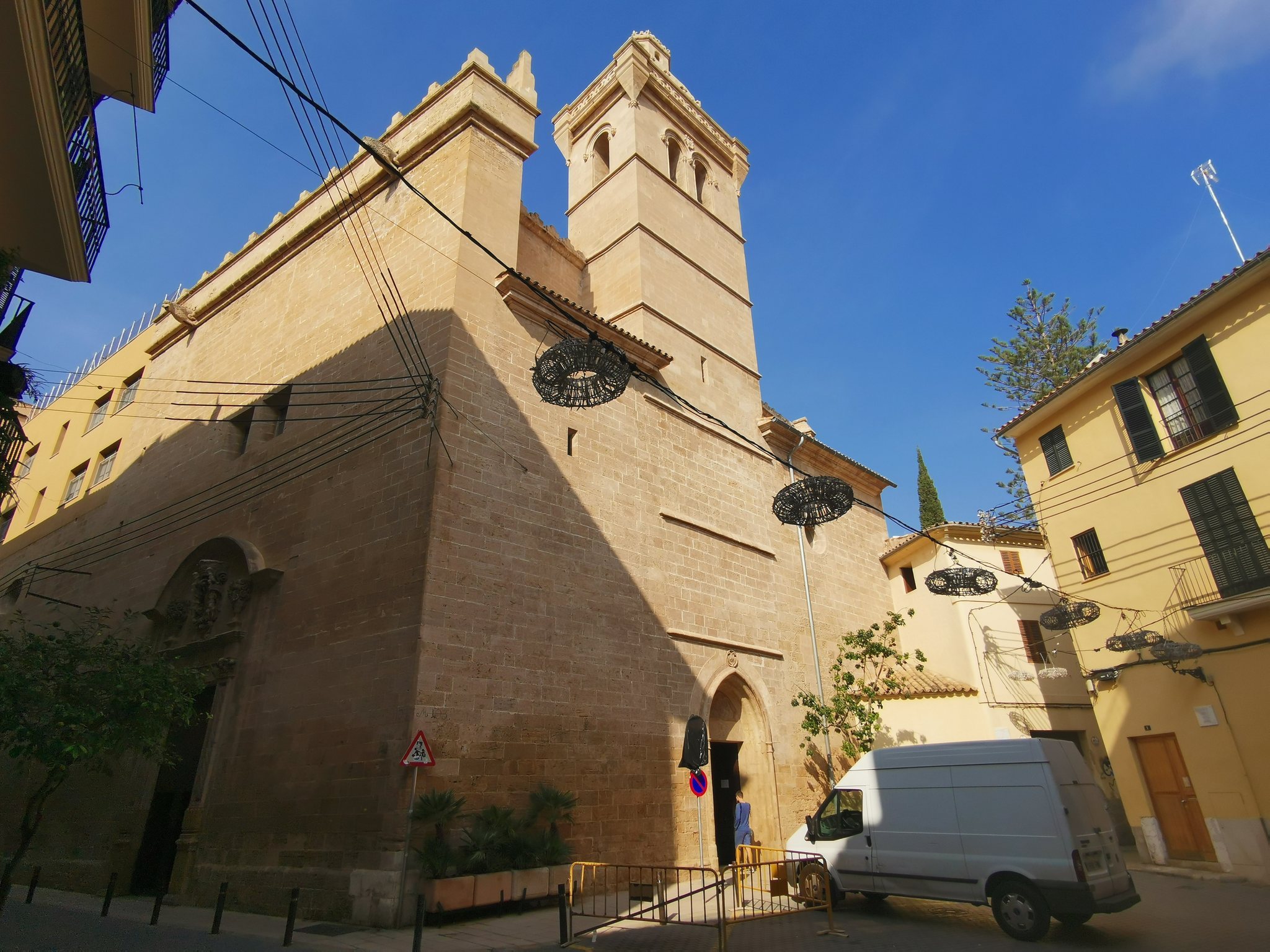
The square bell tower has six stages and paired windows in its upper stage. A dome with a lantern rises above an octagonal drum. The tower contains two bells. The larger bell, whose name has worn away, was cast in Barcelona in 1889 by the Pallés Foundry.
The smaller bell cracked on Pentecost, 19 May 1907. A replacement named Maria Assumption was cast at Palencia by Moisés Diez and blessed in 1908. It was recast in 1952, passed through several locations including Las Palmas de Gran Canaria, and returned to Saint Philip Neri for blessing under the same name in 1954. A bell formerly used by the Trinitarians is now in the bell tower of the Parish of Our Lady of Sorrows in Manacor, where it is known as Holy Spirit.