Convent de les Caputxines: A Capuchin Convent in Palma, Spain
Site at a Glance
- Rating
- 4.6
- Popularity
- Very Low
- Country
- Spain
- Primary era
- Early Modern
- External website
- Open
- Eras represented
- Early Modern
- Civilizations
- Spanish
- Site type
- Religious
- Remains
- Monastery
On this page10 sections
History
The Convent de les Caputxines, formally the Convent of the Immaculate Conception, is a historic Capuchin convent in Palma, Spain, founded in 1662. It was established for Capuchin Poor Clares, a contemplative branch of the women’s Franciscan order associated with Saint Clare of Assisi, and developed into a religious complex whose church was built in the Baroque period between 1682 and 1695.
Foundation in Palma
The foundation was led by Teresa Ponce de León, who entered the Capuchin convent in Zaragoza in 1647 and took the religious name Clara. Her husband, Josep de Torres, viceroy of Mallorca, had died on 29 May 1645 after falling into the city-wall moat at the place later associated with the Viceroy’s Cross. Sor Clara was subsequently commissioned to establish a Capuchin community in Mallorca.
At the request of Palma’s jurats, the city’s municipal magistrates, King Philip IV approved the foundation by royal charter, a formal legal authorization issued by a monarch, on 6 June 1662. On 22 October that year, Sor Clara Ponce, Sor Teresa Gurrea, and Sor Dionísia Gómez arrived from Zaragoza, accompanied by Sor Clemència Camporells and two other nuns from the Barcelona community.
The women first lived in houses belonging to the Dameto family on Carrer de Sant Feliu and later moved to houses near Monti-sion. Sor Clemència was initially selected as abbess, but the community’s decision to follow the constitutions of the Zaragoza house led her to return to Barcelona. Sor Clara became abbess in 1664.
Development of the convent
The community moved to its present site on 29 July 1668. An inheritance from Antoni Núñez de Santjoan allowed the nuns to purchase houses in the parish of Sant Jaume. The church was begun in 1682, its first stone was laid in 1687, and it was blessed in 1695. Further purchases of land continued until the community occupied the entire block in 1734.
Sor Dionísia Gómez Gómez, who served as the second abbess from 1692 to 1719, was associated with an intensely mystical religious life that included ecstasies and visions. She was also credited with a prophetic spirit, forming part of the convent’s religious memory.
Survival and changing communities
The convent survived the disentailment of 1836, a nineteenth-century process in which ecclesiastical and other corporate properties were confiscated and sold or transferred. Its relatively secluded position in central Palma limited the effects of the mass tourism that developed during the 1960s. The community nevertheless declined as religious practice weakened, falling from about thirty nuns to a substantially smaller number by the end of the twentieth century.
During the 1990s, art historians Aina Pascual i Bennàsar and Jaume Llabrés i Mulet helped preserve and promote the convent’s historical and religious heritage. From 1996 they organized guided visits and exhibitions, supported its classification as an Asset of Cultural Interest, and obtained subsidies for the study and preservation of its movable heritage.
The Capuchin community ended in 2006. A community of Franciscan women of the Third Order from Calvià then took over the convent. The Franciscan Third Order is a branch of the wider Franciscan movement whose members follow Franciscan principles without belonging to the friars or the Poor Clare nuns. These women continue to live in the convent and care for it. In 2010, the complex and all its movable property were declared an Asset of Cultural Interest, a Spanish heritage designation for places and objects of historical, architectural, archaeological, or cultural importance.
Remains
Site layout and cloister
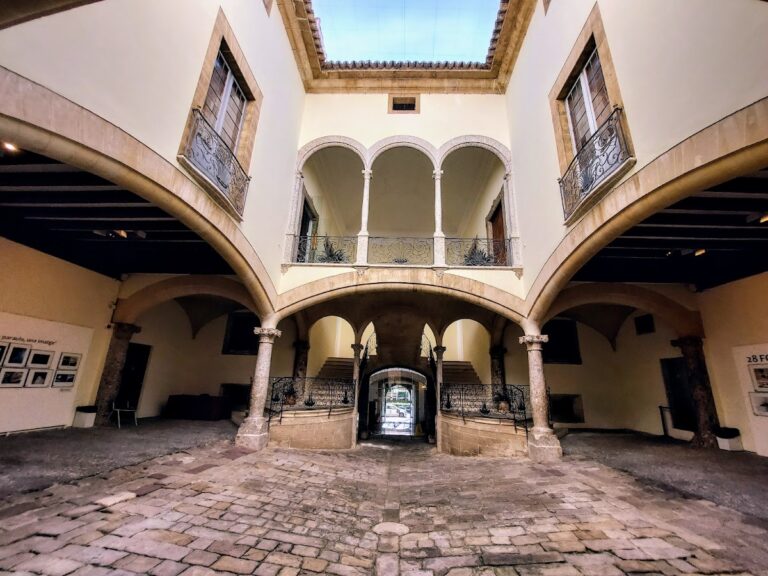
The convent occupies a block in the parish of Sant Jaume, between Carrer de Can Pinós, Carrer de Can Oliva, Carrer de les Caputxines, and Carrer de Can Jaquotot, where the church stands. Its principal organization is a rectangular cloister, meaning a covered passage surrounding an open court, with arcades and two storeys. The oldest surviving elements include the staircase on the north side of the cloister and the roof structures over the dormitories and kitchen.
Baroque church
Facade and bell tower
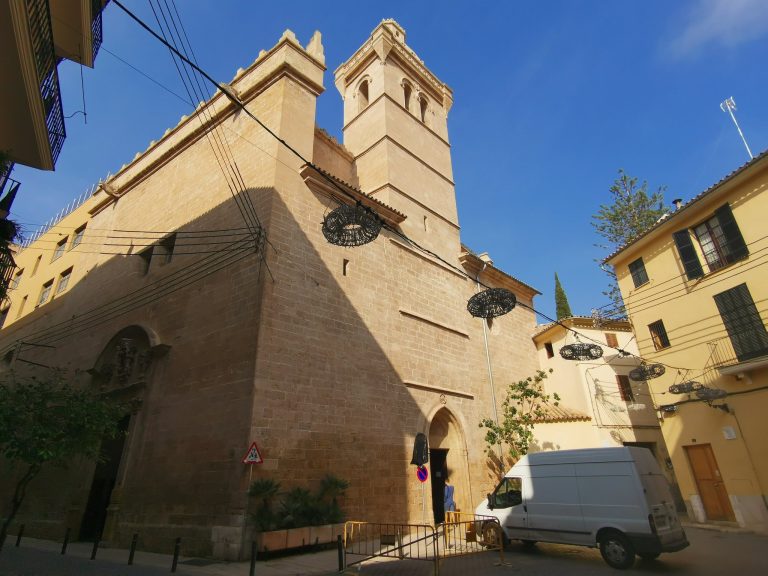
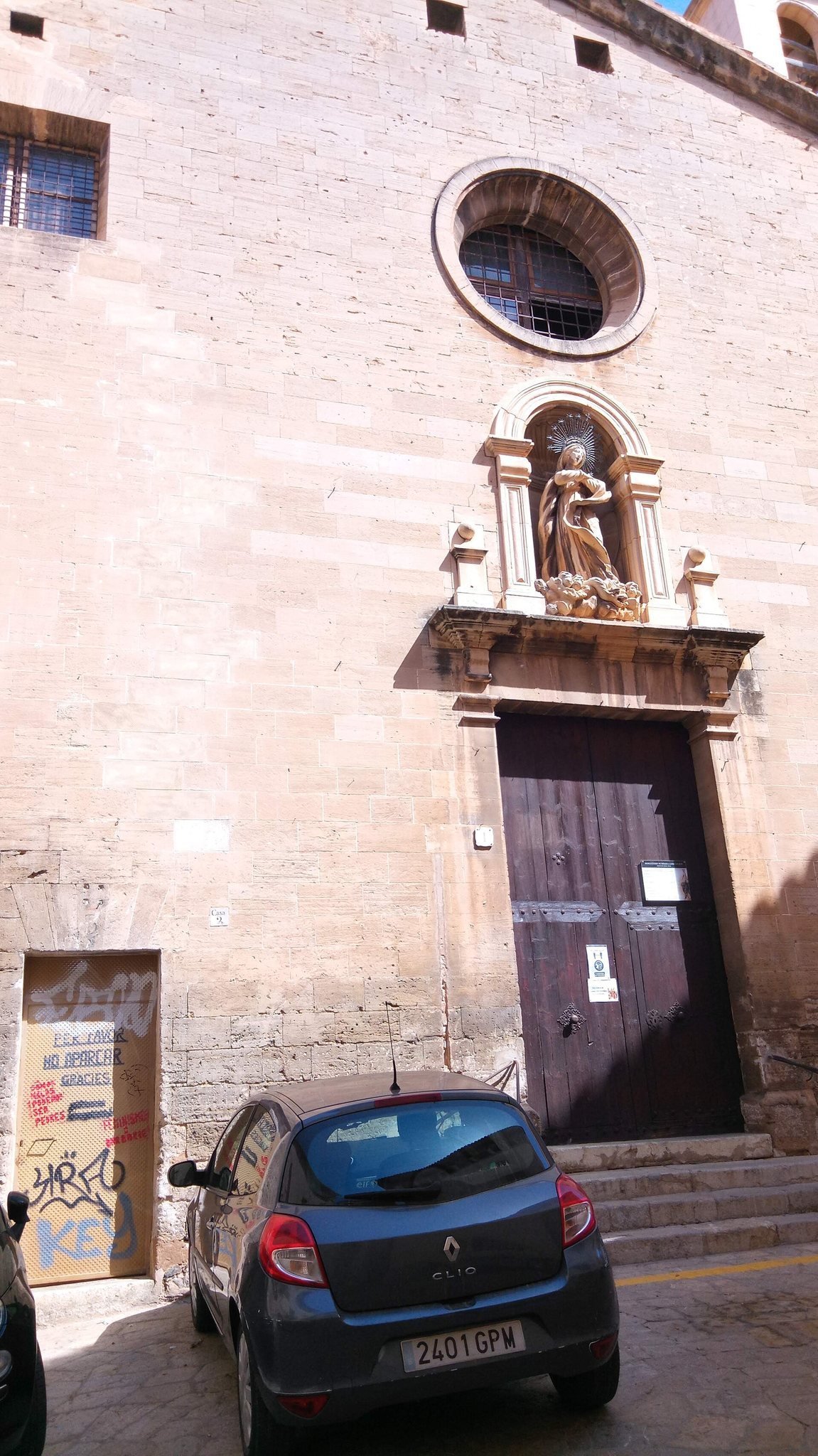
Built between 1682 and 1695, the church has a plain facade with a portal, a simple rose window, and square windows. A triangular gable crowns the wall, with a cross at its upper point. The portal has pilasters supporting an architrave and a niche containing an image of the Immaculate Conception. A separate square-plan bell tower stands to the right and is covered by a four-sided roof.
Archduke Ludwig Salvator described the facade as Renaissance in character. That description refers to the structure of the facade rather than its date, while the image of the Immaculate Conception is fully Baroque.
Interior arrangement
The church combines a traditional single-nave plan with a centralized arrangement characteristic of much seventeenth-century architecture. The first two bays have no side chapels. The third bay, immediately before the crossing, has side chapels, while the apse ends in a quadrangular plan.
The interior is coated and painted white, with yellow lines marking the structural elements. This treatment probably dates from the eighteenth century. The first two bays are covered by barrel vaults with lunettes, the semicircular areas formed beneath a vault. Above them is a screened gallery with latticework, a customary feature in enclosed convents, and the choir is positioned above the entrance.
The side chapels have ribbed vaults. Barrel vaults without lunettes cover the transept and apse, while the crossing is capped by a hemispherical dome without a lantern, the roof structure that normally provides light or ventilation above a dome.
Nativity collection
The convent preserves a collection of display-case nativity scenes, most of them dating from the eighteenth century. Its most notable work is the Foundresses’ Nativity, brought to the convent in the seventeenth century by Sor Clara Ponce de León and Sor Dionísia Gómez.
The figures representing the Nativity Mystery have carefully worked clothing. Other figures were added during the seventeenth, eighteenth, and nineteenth centuries. Most are made of polychrome fired clay, while further figures use wood, papier-mâché, cardboard, and glued fabric.