Pair-non-Pair: A Decorated Paleolithic Cave in France
Site at a Glance
- Popularity
- Medium
- Country
- France
- Primary era
- Stone Age
- Eras represented
- Stone Age, Modern
- Civilizations
- Unclassified
- Site type
- Civic
- Remains
- Rock Art
On this page12 sections
History
Pair-non-Pair is a decorated prehistoric cave in Prignac-et-Marcamps, France, occupied by Neanderthals and later modern humans from more than 80,000 years ago. It is the only known decorated cave in Gironde. Its engravings, buried beneath prehistoric deposits, provided important evidence for the great antiquity of human art.
Prehistoric occupation
Human occupation began during the Mousterian, a Middle Paleolithic tradition strongly associated with Neanderthals, and continued through the Châtelperronian, a culture linked to the transition between the Middle and Upper Paleolithic. Neanderthals occupied the cave during these first two phases. Modern humans used it in the Aurignacian, and occupation continued into the Gravettian; both were Upper Paleolithic cultures.
During the Châtelperronian, about 40,000 years ago, the roof of the cave’s outer corridor collapsed and blocked its original entrance. People later entered through side passages, while sediment progressively accumulated inside. The cave was abandoned around 22,000 to 20,000 years ago, when deposits had made it impractical to enter and occupy.
The name and Daleau’s excavations
The cave’s name developed from a 1667 land-sale record that called the property Penot père. Late-eighteenth-century maps used the form Penotpair, which later evolved into Pair-non-Pair.
François Daleau discovered the cave on March 6, 1881, and began excavating two days later. He started a further phase of work in June 1883, concentrating on sediment in the Engravings Chamber, and reached the back of the cave in August 1887. Excavations continued until 1913. In 1892, landowner Baptiste Milpied demanded payment for permission to dig. Daleau stopped work for three years, then agreed in May 1896 to pay an annual rent of 80 francs, allowing excavation to resume.
Engravings and archaeological interpretation
Daleau noted intersecting lines on the cave walls in 1883 and recognized an animal outline on August 31, 1896. The animal engravings were identified that year, and a further passage bearing wall images was uncovered later. Their age remains debated. Daleau assigned them to the Aurignacian, and dates of about 37,000 to 32,000 years ago have also been proposed. Their position beneath Gravettian deposits shows that they predate those deposits, while stylistic comparisons have suggested a date as late as the Solutrean. Overlapping images may belong to different phases, with some attributed to the Aurignacian and better-preserved examples to the Gravettian.
Pair-non-Pair was the third decorated cave to be discovered, after Altamira in Spain and the Chabot cave in France. The engravings’ burial beneath prehistoric deposits helped demonstrate the antiquity of prehistoric art at a time when its early origins were not yet generally accepted in scientific circles. Daleau initially assigned some archaeological layers to the Solutrean and Magdalenian. Henri Breuil’s later examination, followed by André Cheynier’s review of the finds in 1963, identified four occupation horizons: Mousterian, Châtelperronian, Aurignacian, and Gravettian. Édouard Harlé, François Prat, and E. T. Newton studied animal remains from the excavations, and Louis Moisan later published a study of a mammoth specimen in Daleau’s collection. Breuil also returned to the cave in 1919 and between 1934 and 1937 to interpret and date the engravings.
On December 20, 1900, Pair-non-Pair became the first cave in France acquired by the state and the first classified as a historic monument. It remains state-owned. Annual sampling of the cave walls helps monitor the effects of visitation as a conservation measure.
Remains
Cave layout and limestone
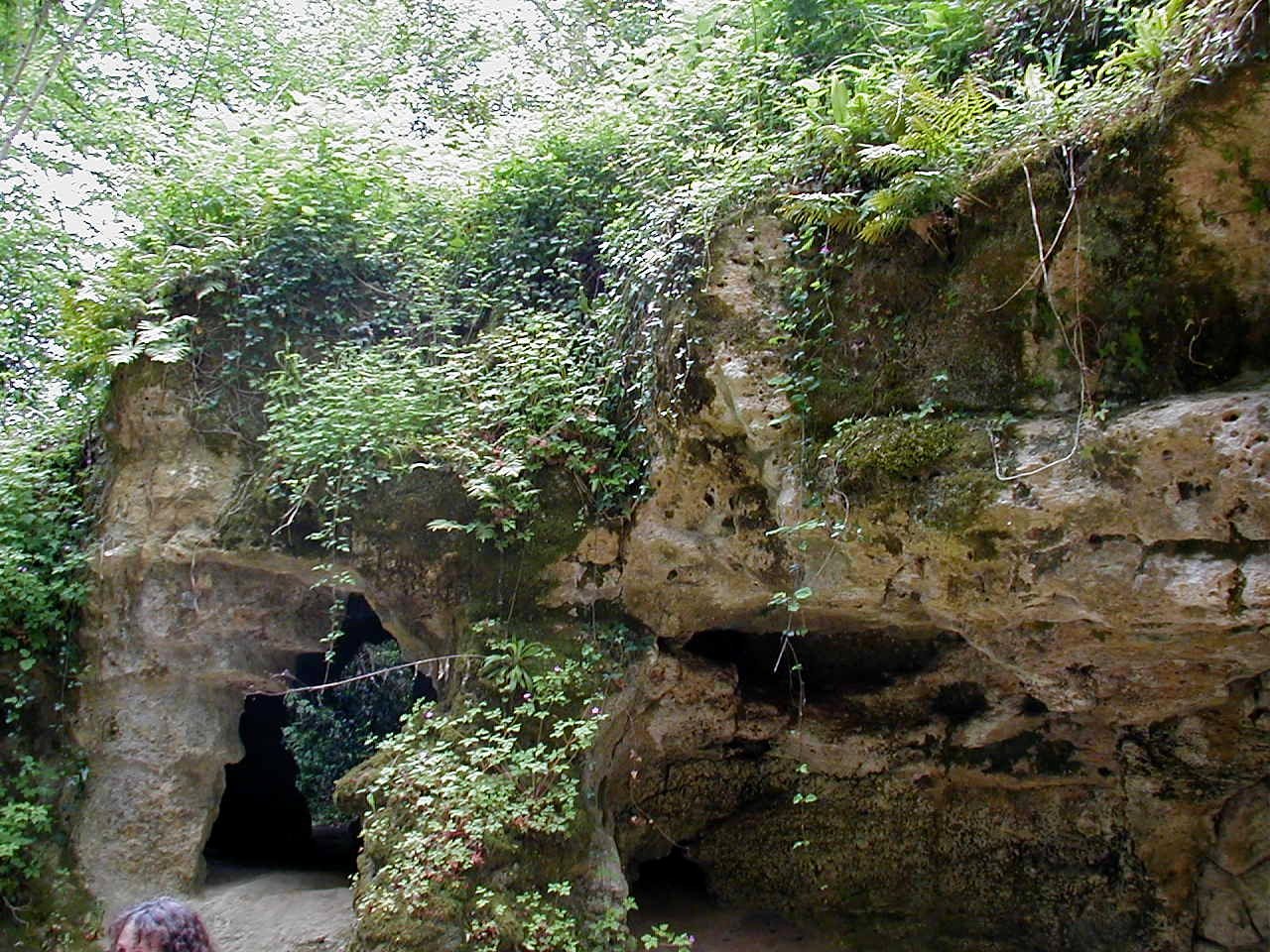
The cave lies in a small wooded limestone outcrop on the right bank of the Moron, about 2.75 kilometres upstream from its confluence with the Dordogne. Cut into Astéries limestone, a fossil-bearing rock from the early Oligocene, it extends about 20 metres. Its present main passage is nearly straight, about 15 metres long, and runs southeast to northwest along a joint in the rock. Cross-joints form lateral spaces: a side gallery opens on the left, while a rounded recess on the right creates a junction beneath a chimney. A second chimney connects the side gallery with the outdoors, and most engravings lie in the area of the recess. Daleau’s plan also records an earlier arrangement of passages and chambers, including a South Room, a North Room also called the Great Room, and a corridor leading to the room later identified as the Engravings Chamber. The walls are rough and marked by fossils and hollows.
Engraved and painted panels
Engravings and paintings of ibex, mammoths, bison, horses, and deer occupy the front part of the cave around the entrance area. Daleau’s notes record six panels, and pigment remains on some engraved figures. The images include a giant deer, or Megaloceros, a rare subject in European Paleolithic art, and a horse engraving about 2.5 metres long. Other compositions show pairs of animals, including two mammoths, two aurochs facing one another, and two horses side by side. Breuil nicknamed one horse the Lamb of God; it turns its head toward its rump, giving the figure a sense of movement. Circles and ovals have been interpreted as female sexual symbols. Rows of marks read as male symbols appear on all six panels, including a double row of dots above cattle and horses on panel five. In 1971, André Leroi-Gourhan classified the engravings as Style II, a category in his system for Paleolithic art. Here, it is characterized by emphatic back lines and often raised necks, with details such as horns, legs, and tails omitted.
Excavated remains
Animal bones
Daleau recovered about 6,000 animal bones representing roughly 60 identified species. They include equids, giant deer, mammoth, cave bear, wolf or cave lion, wild boar, reindeer, deer, rhinoceros, and bison. These remains have also been used to infer changes in hunting: reindeer, mammoth, or bison were hunted in colder periods, while aurochs, wild boar, and deer were more common targets in warmer ones.
Tools and implements
The excavated material includes about 15,000 tools and fragments made from stone, bone, and ivory. Finds from the Mousterian include Quina-style tools, a Mousterian stone-tool tradition, and tools of Acheulean tradition. Châtelperronian layers yielded stone points. Aurignacian finds include blades, awls, perforated rods, and bone points split at the base. The Gravettian assemblage includes Gravette and Font-Robert stone points, decorated bone rods, and double projectile points.
Ornaments and other objects
Other finds include an ivory pendant shaped like a cowrie shell, fragments of a flute made from bearded-vulture bone, ochre balls, and cattle shoulder blades used as surfaces for preparing or mixing pigments. Carved and cut bones, along with stone and bone beads, were also recovered. The use of bearded-vulture bone for the flute has been interpreted as evidence of the inhabitants’ nomadic way of life. Retained excavation material is held at the Musée d’Aquitaine and the Bordeaux Museum of Natural History.
Reception and interpretation building
A reception and interpretation building constructed in 2008 uses unfinished oak, concrete, glass, metal, and a copper roof. Its display partitions present archaeological and animal remains from Pair-non-Pair and the surrounding area.