Gesù e Maria: A Baroque Church and Augustinian Foundation in Rome
Site at a Glance
- Popularity
- Medium
- Country
- Italy
- Primary era
- Early Modern
- Eras represented
- Early Modern
- Civilizations
- Papal States
- Site type
- Religious
- Remains
- Church
On this page14 sections
History
Gesù e Maria is a Baroque church on Via del Corso in Rome, Italy, built by the Discalced Augustinians as their Roman headquarters and a house for training seminarians. Construction began in 1633, and the church was completed in the 1670s. The Discalced Augustinians were a branch of the Augustinian order that followed a stricter form of religious observance.
Foundation and dedication
A villa and garden belonging to Antonio Orsini, a nephew of Cardinal Flavio Orsini, occupied part of the site in the early seventeenth century. The Discalced Augustinians bought the property in 1615. While their church was being planned and built, they worshipped in a small chapel dedicated to St Anthony Abbot, facing Via del Babuino. That chapel was later demolished, and construction also displaced an earlier church dedicated to the same saint. One side chapel in the new church retained the dedication to St Anthony.
The first stone of Gesù e Maria was laid on 3 April 1633. Carlo Buzio designed the initial phase, which was finished in late 1635. On 17 January 1636, worship moved from the chapel of St Anthony Abbot to the new church. Its dedication arose from a meeting of the Augustinians on 6 January. When the chapter could not settle on a name, its chair, Father Ambrogio di Sant’Andrea, exclaimed “Jesus and Mary!” The convent prior accepted the words as the answer, and the church received that dedication.
Completion and patronage
The church remained unfinished, without its final section and façade, until Carlo Rainaldi directed further work between 1671 and 1674. It was solemnly consecrated on 28 January 1675, although its altar had already been consecrated in 1636. From 1678 to 1690, the interior was decorated and faced with marble under the patronage of Giorgio Bolognetti, Bishop of Rieti.
The Bolognetti family’s patronage rights passed to the Cenci Bolognetti family after Marianna Bolognetti, the last of her family, married Virginio Cenci in 1723. Members of both families were buried beneath the presbytery floor until 1805, when the Edict of Saint-Cloud, a Napoleonic law requiring burials outside populated areas, brought those burials to an end.
Later history and ecclesiastical role
From the eighteenth through the nineteenth century, the church belonged to the Jesuits, members of the Society of Jesus. During the Napoleonic suppression of 1810–1815, two paintings by Giacinto Brandi that had hung in the chapel of St Joseph disappeared. In 1849, anti-clerical unrest during the short-lived Roman Republic led to the church being looted. Confessionals taken from the building were burned in Piazza del Popolo.
Pope Paul VI established Gesù e Maria as a cardinal deaconry on 7 June 1967, under the title of the Most Holy Names of Jesus and Mary on Via Lata. A cardinal deaconry is a church assigned as a symbolic ecclesiastical title to a cardinal of the diaconal order. Gesù e Maria is also a titular church, an ecclesiastical title assigned to a cardinal, and a rectoral church of the parish of San Giacomo in Augusta. The Tridentine Mass, the traditional Latin form of the Roman Rite based on the missal promulgated after the Council of Trent, has been celebrated there since the late 1980s. The Institute of Christ the King Sovereign Priest, a Catholic clerical society associated with the traditional Roman liturgy, has managed the church since 1992.
Remains
The church has a rectangular plan, measuring 27 metres by about 15 metres, with a presbytery of roughly 7 by 7 metres incorporated into the monastery building. Brick forms the main construction, while travertine is used on the façade. Inside, a single nave is covered by a barrel vault, with three side chapels on each side and the presbytery at the altar end.
Exterior and plan
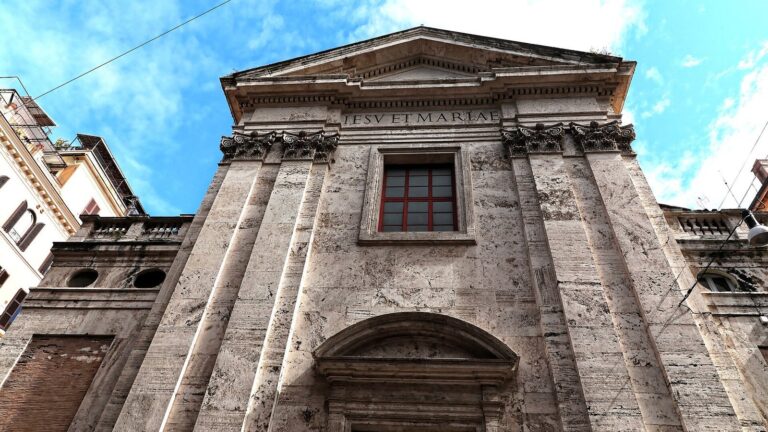
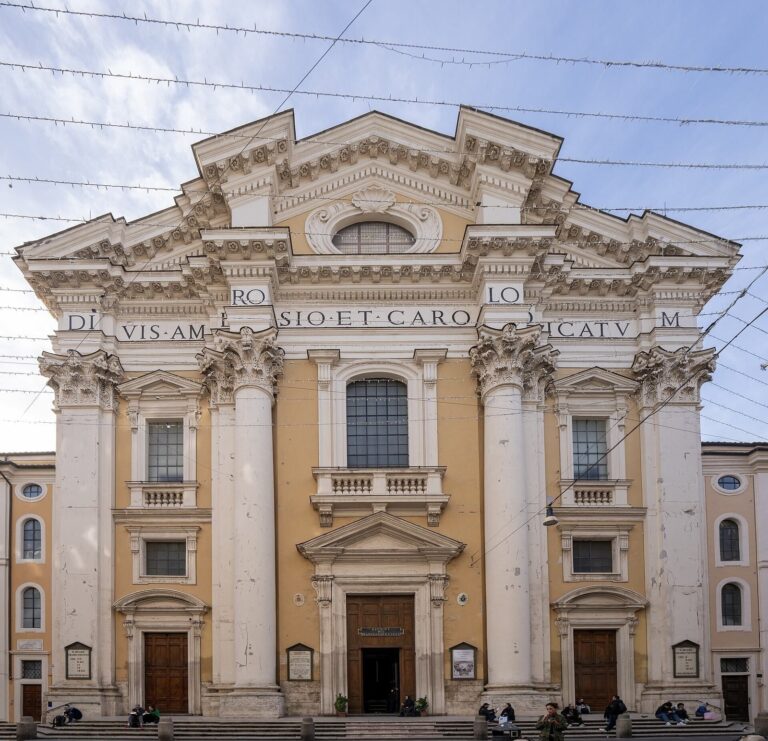
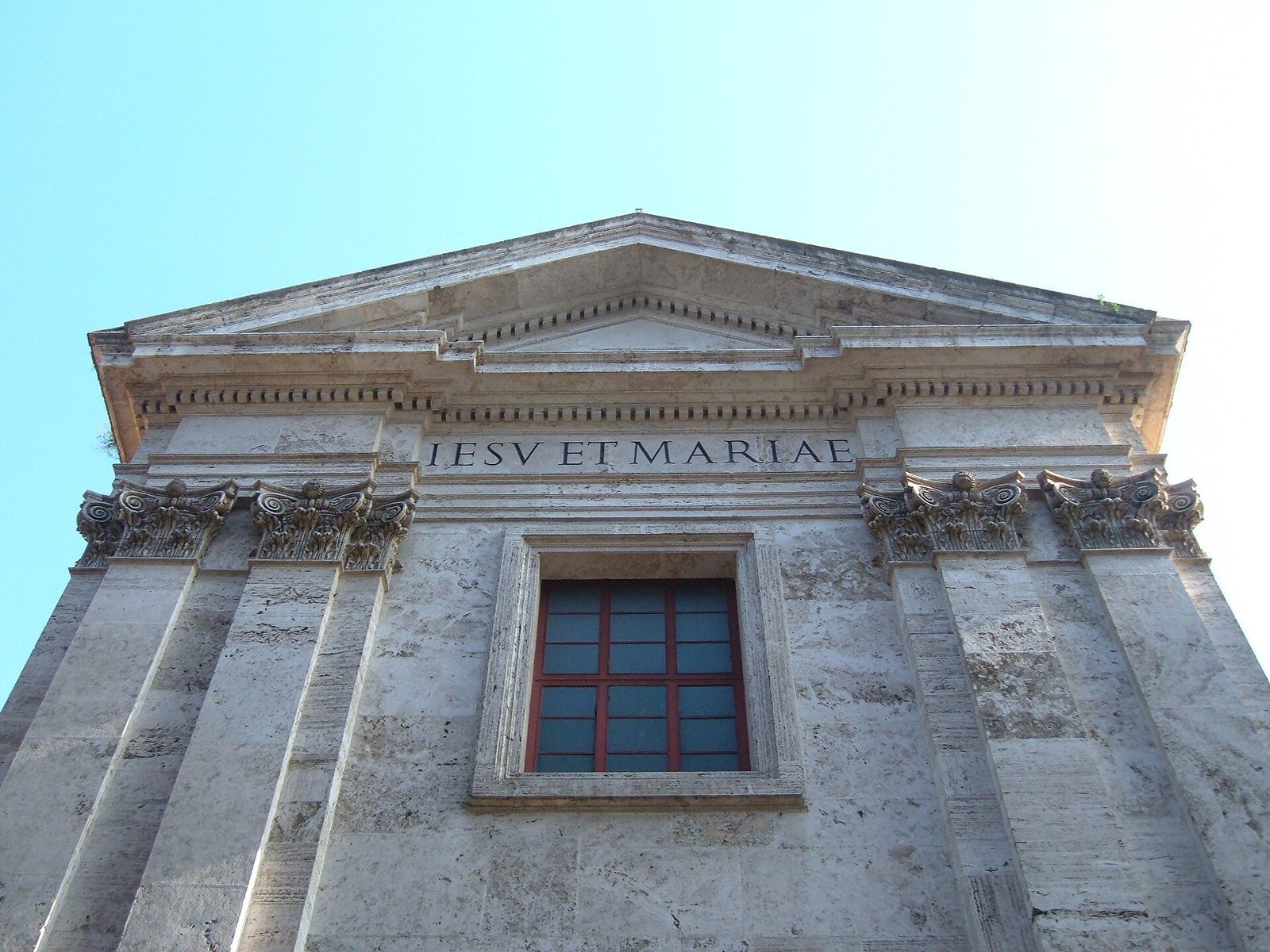
The single-storey travertine façade is organized around one entrance and four large Corinthian pilasters standing on a high base. The pilasters support a horizontal entablature whose frieze carries the church’s dedication to Jesus and Mary, and a triangular pediment with an empty central field. The inner pilasters are doubled at the corners; the outer pair turns around the façade’s outside corners. A semicircular pediment crowns the entrance, with a large rectangular window in a plain, slightly projecting frame above it. Each side of the façade has a tall framed panel, an entablature containing two horizontal oval windows, and a balustrade above.
Nave and altar
Nave and chancel arch
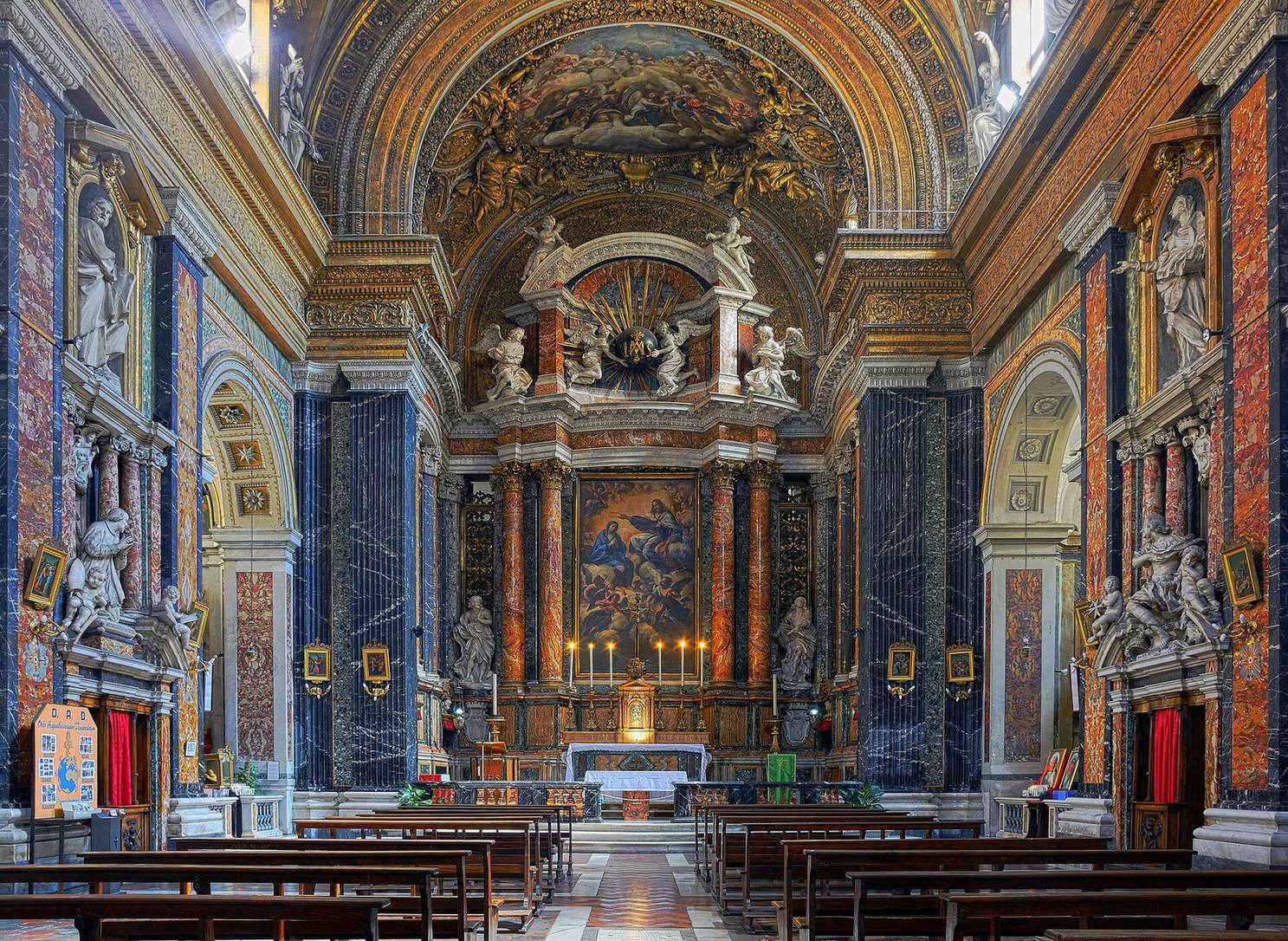
High arches open from the nave into the six side chapels. Between them, pairs of Doric pilasters support an entablature with a decorated frieze. Funerary monuments occupy spaces between some pilasters, with statues of saints above. Three rectangular windows on each side sit over the chapels and are ornamented with stucco figures of Old Testament characters. Giacinto Brandi painted the vault with the Glorification of the Virgin and the four Evangelists.
At the chancel arch, pairs of fluted black-marble Doric pilasters support an arch framed by several bands of gilded moulding. The outer pilasters are narrower than the inner pair. Angels support a coat of arms at the crown of the arch, and a further painting by Brandi occupies the vault beyond it.
High altar
The convex high altar is framed by four red-marble Corinthian columns carrying a white-marble entablature with a red-marble frieze. Above, two smaller red-marble Doric supports hold a semicircular pediment. Between them, two angels by Pietro Paolo Naldini raise a black sphere with golden rays and the initials IMAS, representing the names of Jesus and Mary. Francesco Cavallini made other angels and the putti, or decorative child figures, on the pediment. Brandi’s 1680 altarpiece shows Jesus crowning Mary. Statues of St John the Baptist and St John the Evangelist, on the left and right respectively, are by Giuseppe Mazzuoli.
Side chapels and funerary monuments
Chapels on the left
The first chapel on the left is dedicated to St Thomas of Villanova. Felice Ottini painted its walls and vault, including scenes of St Mary Magdalene in the wilderness and the Ecstasy of St Francis. Reliefs in the lunettes depict episodes from saints’ lives, and an image of the Charity of St Thomas of Villanova is also attributed to Ottini. The next chapel, dedicated to St Joseph, contains Brandi’s altarpiece of the Nativity. In the third chapel, dedicated to the Madonna of Divine Help, the venerated image appears within an oil painting showing St Thomas of Villanova and St Clare of Montefalco venerating it. Its side lunettes contain Pietro Labruzzi’s 1793 Adoration of the Shepherds and an anonymous Flight into Egypt.
Chapels on the right
The first chapel on the right is dedicated to the Crucifix. It contains statues by Francesco Aprile and an anonymous seventeenth-century painting of Noli me tangere, meaning “Do not touch me.” Aprile also made a bust of a member of the Bolognetti family for the chapel. The chapel of St Nicholas of Tolentino has an altarpiece depicting the saint during a vision of the Virgin, attributed either to Basilio Francese or Giovanni Carbone. Two scenes from the saint’s life appear on the side walls, and the chapel contains sculptures by Cavallini.
The third chapel on the right is dedicated to St Anne. Girolamo Pesci painted its altarpiece, while two anonymous nineteenth-century works on the side walls depict the Presentation of Mary and the Birth of Mary.
Family monuments
On the left side of the nave are monuments to Ercole and Luigi Bolognetti, brothers of the church’s benefactor, and to Giorgio Bolognetti, positioned between the chapels of St Joseph and the Madonna of Divine Help. On the right are monuments to Pietro and Francesco Bolognetti, attributed to Cavallini and dated 1681, and to Fra Mario Bolognetti, made by Aprile. Near the entrance, monuments commemorate members of the Corno family, including Giulio del Corno’s monument by Ercole Ferrata and Domenico Guidi.
Sacristy and stucco work
The sacristy has a plaque commemorating the church’s consecration in 1675. Giovanni Lanfranco painted the frescoes at its entrance, and other paintings there are by Padre Matteo di San Alessio of Palermo. Stucco work and statues in the church were made by Girolamo Gramignoli and Monsù Michele, with further stucco sculpture by Cavallini and Lorenzo Ottoni.