Château d’Agassac: A Historic Wine Estate in Ludon-Médoc


Site at a Glance
- Rating
- 4.3
- Popularity
- Low
- Country
- France
- Primary era
- Medieval
- External website
- Open
- Eras represented
- Medieval
- Civilizations
- English
- Site type
- Military
- Remains
- Castle
On this page12 sections
History
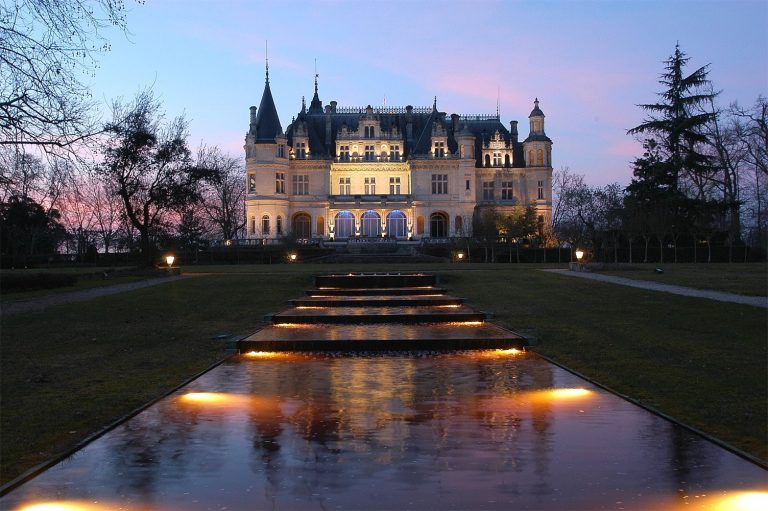
Château d’Agassac is a historic wine estate in Ludon-Médoc, France, within the Haut-Médoc appellation of Gironde. With a fortified medieval character, it is associated with one of the earliest vineyards in the Médoc. The estate’s recorded history reaches back to 1172, when Guillaume-Raymond d’Agassac was identified as its first known lord.
Medieval lordship
Guillaume-Raymond d’Agassac was described as a descendant of Arnaud de Blanquefort, Lord of Blanquefort. From 1238, the Gaillard de Gassac family held the seigniory of Agassac, a lord’s territorial jurisdiction that then extended over approximately 800 hectares. Its lord stood as a vassal of the English crown, holding land or authority in a formally subordinate relationship to a superior lord.
The lord of Agassac was summoned to London by Edward I in 1299. Edward I was the English king who ruled from 1272 to 1307. The lord also took part in the defence of Bourg in 1296, placing Agassac within the military and political affairs of medieval southwestern France.
Albret and Pommiers ownership
In 1357, a descendant of the Gaillard de Gassac family sold the seigniory to Arnaud d’Albret. The House of Albret, a prominent noble dynasty in southwestern France, then held Agassac through several generations. Among its holders was Rose d’Albret, Lady of Montferrand. The property passed to the Pommiers family in 1580.
A member of the Pommiers family first served as councillor and later became president of the Parliament of Guyenne in Bordeaux. This institution was the region’s high judicial and administrative court under the French monarchy. He adopted the title Baron of Agassac, and the property became a barony, a higher-ranking feudal lordship.
Conflict and reconstruction
The drainage of the Médoc marshes during the seventeenth century helped open the region’s major viticultural soils to development. Agassac was also affected by the political and military conflicts of the period. In June 1650, troops commanded by Bernard de Nogaret de La Valette d’Épernon devastated the Haut-Médoc. Because Agassac belonged to one of the duke’s opponents, the château was probably damaged and later needed repairs.
In June 1652, many proscribed members of the Parliament of Guyenne took refuge at Agassac with President Pommiers, their dean. They remained at the estate until the troubles ended. Pommiers repaired the château, and the great enclosure was probably destroyed during this work. Traces of that enclosure survive within the property.
Revolutionary and modern transformations
In 1766, Sauvat de Pommiers, Baron of Agassac, married Marie-Anne Leblanc Nogues, a cousin of Joséphine de Beauharnais. During the French Revolution, the baron was compromised, and one quarter of the estate was confiscated by the state and sold as national property.
Marcel Richier purchased the property in 1841. A nineteenth-century French agronomist associated with agricultural innovation, Richier is credited with inventing vine training on wire trellises. Agassac became an early estate to use this technique. During the nineteenth century, its wines were exported under the names Château Ludon and Château Pomiès. The neighbouring D’Agassac and Pomiès Agassac estates were reunited late in that century.
Philippe Capbern-Gasqueton and Henry Capbern-Gasqueton bought the property on 5 July 1961. Groupama acquired the winery from the Gasqueton family in 1996 and began renovation work. Gérard Jicquel, a Breton industrialist who also owns Château Fourcas Dupré at Listrac, purchased the property in 2021.
A local tradition connects the building’s construction with a Latin inscription found in underground galleries beneath the château and places it in an uncertain period. The château and its former wine cellars entered the register of French historic monuments in 2013. The estate was classified as a Cru bourgeois supérieur in the 1932 Bordeaux wine classification and as a Cru Bourgeois Exceptionnel in 2020. Cru Bourgeois is a classification for quality estates outside the five-tier 1855 classification, while Cru Bourgeois Exceptionnel is its highest modern category.
Remains
Fortified buildings
Château and underground galleries
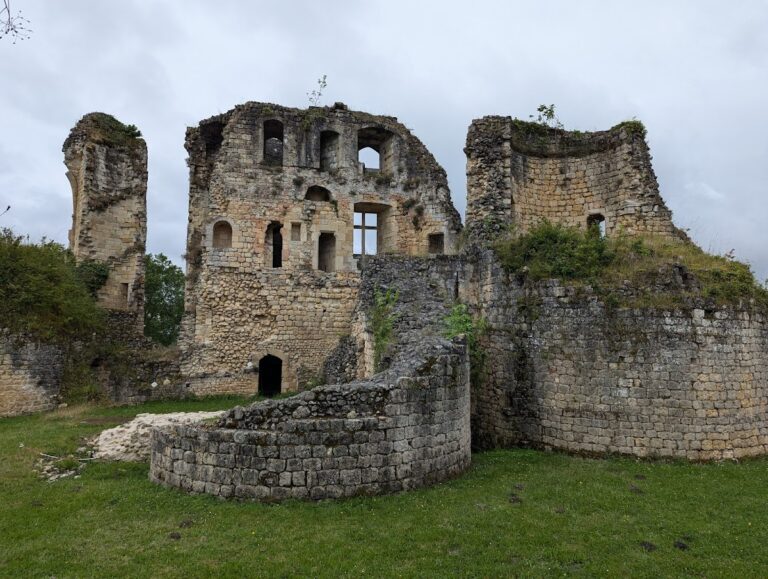
The château presents a fortified medieval character, while large and elegant wine cellars adjoin the fortress. Underground galleries beneath the building contain the Latin inscription associated with the local tradition concerning its date of construction. Together, the château, cellars, and galleries preserve the physical setting in which the estate’s medieval identity and later wine production developed.
Former great enclosure
The great enclosure belonged to the earlier defensive and territorial arrangement of Agassac. It was probably destroyed during the repairs undertaken after the disturbances of 1650 to 1652, when President Pommiers restored the château following the refuge of members of the Parliament of Guyenne. Traces of the enclosure remain.
Vineyard landscape and production
Gravel terraces
The 43-hectare vineyard lies between two gravelly rises and an area of sandy gravel or sandy colluvium. One rise consists of fine Garonne gravels characteristic of Ludon-Médoc. The layer reaches depths of up to 3 metres, drains water effectively, and encourages earlier ripening. It corresponds to the fifth Médoc gravel terrace. The second rise contains large Gunz gravels in a layer more than 6 metres deep. These ancient river gravels are associated with the Gunz glacial stage, while their higher clay content contributes to fuller-bodied and more strongly structured wines. This rise corresponds to the fourth Médoc gravel terrace.
Vines and cellar work
The vineyard contains approximately 6,700 vines per hectare, with an average vine age of 25 years. Bud pruning and the thinning of leaves and bunches shape the crop. The plantings comprise 50 percent Merlot, 47 percent Cabernet Sauvignon, and 3 percent Cabernet Franc. Grapes are sorted in the vineyard and again in the cellar before vinification in 23 temperature-controlled stainless-steel vats. Maceration lasts three to four weeks.
The wine matures for 12 to 15 months, with 60 percent placed in new barrels and 40 percent kept in vats to preserve fruit character. The associated cooperages include Taransaud, Mercurey, Saury, Miquel, Doreau, Berger, Allary, Berthomieu, Cadus, and Baron. Bottling takes place at the estate, with egg-white fining and light filtration. The vineyard holds Terra Vitis and HVE 3 certifications, French environmental certifications concerning agricultural and vineyard management.
The estate produces Château d’Agassac as its grand vin, Château Pomiès-Agassac as a second wine, L’Agassant d’Agassac as a second label introduced in 2006 and made with 90 percent Merlot, and Précision d’Agassac, a vintage cuvée produced since 2009. The vineyard produces approximately 250,000 bottles annually. In April 2003, the estate’s wine was selected by Wine Spectator for its list of the “100 best wines of the World.”