Château Cantemerle: A Classified Fifth Growth Winery in France
Site at a Glance
- Rating
- 4.7
- Popularity
- Very Low
- Country
- France
- Primary era
- Modern
- External website
- Open
- Eras represented
- Modern
- Civilizations
- French
- Site type
- Economic
- Remains
- Production Complex
On this page16 sections
History
Château Cantemerle is a historic winery in Macau, France, within the Haut-Médoc appellation of the Bordeaux wine region. The estate is recorded from at least 1147, and its medieval origins are linked to the fortified defenses of the Médoc. Wine production is documented at Cantemerle from 1354, while the present château belongs to the nineteenth century.
Medieval Lords and Viticulture
The name Cantemerle appears in a record of 1147, when Arnaud de Blanquefort donated land to the Abbey of La Sauve-Majeure and Pons de Cantemerle witnessed the transaction. The original château formed part of a defensive line along the Médoc bank of the Gironde during the Middle Ages.
During the period when substantial parts of Aquitaine were under English rule, the Lord of Cantemerle fought for Henry III of England, who reigned from 1216 to 1272. He was defeated at the Battle of Taillebourg in 1241, but the domain remained under his control. Ponset de Cantemerle was still identified as its lord in 1340.
Viticulture at the estate is first recorded in 1354, when Ponset de Cantemerle paid a tithe with a tonneau of clairet. A tonneau was a traditional Bordeaux wine cask and a historical measure of production. This payment provides the earliest known evidence of wine production at Cantemerle.
The Caupène, La Roque, and Villeneuve-Durfort Families
The Caupène family held the seigneury from the fifteenth century. Jean de Caupène was recognized as Lord of Cantemerle in 1422, and his son Médard retained the title until the end of the century. Through Jeanne de Caupène’s marriage to Henry de la Roque, the property passed to the La Roque family. Their son Charles de la Roque became lord in 1510.
On 20 August 1579, Jean de Villeneuve, the second president of the Parliament of Bordeaux, acquired Cantemerle and married Antoinette de Durfort. The Villeneuve-Durfort family retained the estate until 1892. Over time, its activities became increasingly focused on wine rather than mixed agriculture. From 1643, the family operated from a building on the site of the present estate.
Nineteenth-Century Expansion and Classification
Jean Baptiste Fleuret carried out experiments at Cantemerle in 1852 to combat powdery mildew, a disease affecting grapevines. The estate sold much of its wine directly to Dutch merchants instead of relying on Bordeaux négociants, which left fewer sales records for the first version of the 1855 Bordeaux classification.
On 19 September 1855, Cantemerle was added to the classification as a Cinquième Grand Cru Classé, or Fifth Growth. The Bordeaux classification ranked leading estates according to historical wine prices in five categories, from First Growth to Fifth Growth. Caroline de Villeneuve-Durfort secured Cantemerle’s inclusion by presenting sales invoices showing that the estate met the relevant price criteria.
The omission from the initial documents and from the map displayed at the 1855 Paris Exposition created a continuing controversy. Later lists often marked Cantemerle with an asterisk. The estate also received a silver medal at the 1867 Paris World’s Fair.
In 1858, Cantemerle had about 91 hectares of vines and produced approximately 160 tonneaux of principal wine and 30 tonneaux of second wine. By 1866, the vineyard covered about 110 hectares within an estate of nearly 400 hectares. Production then stood at roughly 150 to 160 tonneaux of principal wine and 50 to 60 tonneaux of second wine.
Disease, Sale, and Decline
Between 1879 and 1887, phylloxera and downy mildew severely damaged the vineyards. Phylloxera, an introduced pest that attacks vine roots, and downy mildew both caused major nineteenth-century losses. Cantemerle’s potential average annual production fell to less than half its earlier level.
The Macau, Margaux, and Cantenac areas were less affected by mildew than other parts of the Médoc. In 1884, Cantemerle and Château Dauzac could therefore command higher prices than Château Lafite-Rothschild.
In 1892, the Villeneuve-Durfort family sold the estate to Théophile-Jean Dubos. After his death in 1905, his sons Pierre and Bernard managed it. Economic difficulties during the First World War and the 1930s led to the sale of parcels. Pierre Dubos became sole owner in 1923, and after the Second World War he cultivated only about 25 hectares of vines.
Twentieth-Century Restoration
After Pierre Dubos died in 1962, his nephew Bertrand Clauzel managed Cantemerle until its sale in 1981. The estate was then acquired by SMABTP, a French mutual insurance group, for 25 million francs while it was close to ruin.
During the 1980s, the new owners rebuilt or extensively renovated the winemaking facilities, replanted the vineyards, and invested nearly 60 million francs in the estate. The productive vineyard grew from 20 hectares at the time of purchase by approximately 70 hectares. Mexican vineyard workers with experience in California helped graft and replant the vines. Weaker Cabernet Franc plantings were largely converted to Cabernet Sauvignon and Petit Verdot.
Since 2004, the estate and its director, Philippe Dambrine, have opposed the proposed Grand Contournement road around Bordeaux. In some versions, the planned route would have divided Cantemerle’s vineyards and required the demolition of the estate. By March 2007, no further development of the plan had occurred. Château Cantemerle remains a Fifth Growth in the 1855 classification and is owned by the SMA insurance group.
Remains
Fortified Origins and Present Château
Medieval Defensive Site
The medieval château stood about one kilometre from the present building and formed part of the defensive line along the Médoc bank of the Gironde. Its position belonged to the fortified landscape that protected the region during the Middle Ages.
Nineteenth-Century Château
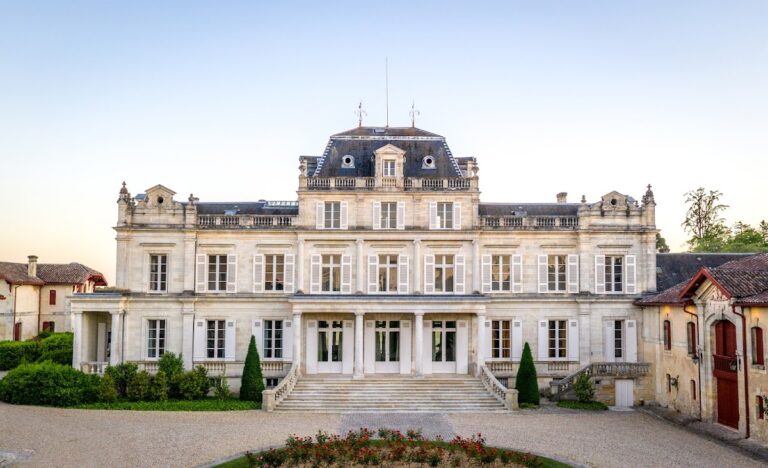
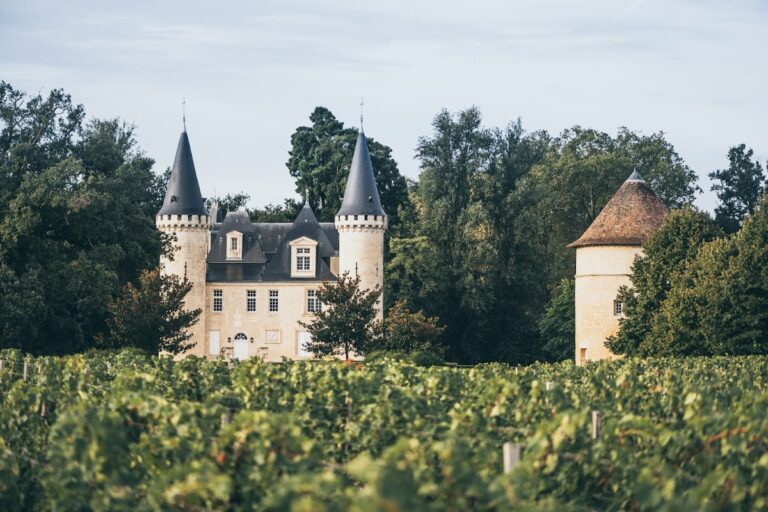
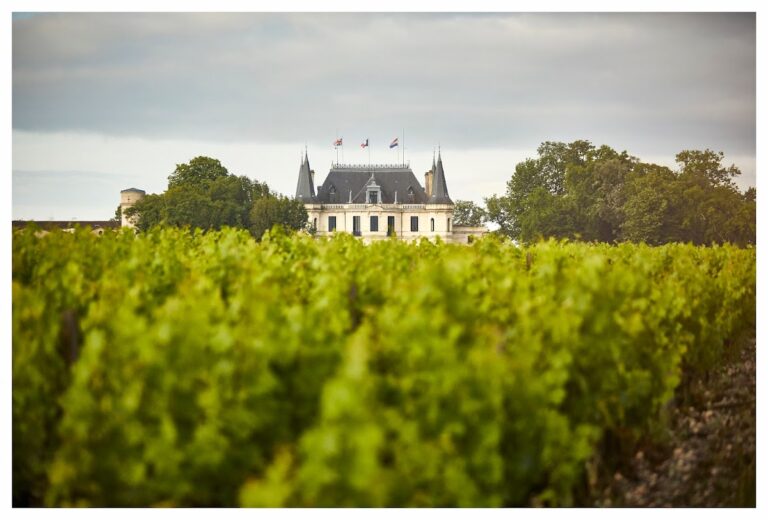
The surviving château dates from the nineteenth century. Two turrets were added around 1851, probably under the direction of Henri Duphot, an architect from Bordeaux. The building forms part of an estate that now covers nearly 190 hectares, including the château grounds and vineyard land.
Park and Vineyard Landscape
Park
The estate includes a 28-hectare park designed by Louis Fischer. It forms a distinct landscaped part of the property alongside the château and the productive agricultural grounds.
Vineyard Soils and Planting
The vineyards lie in Macau and Ludon, with some vines on the best slopes of Macau. They grow on fine, deep gravel soils made up of sand and rounded stones derived from the ancient erosion of the Pyrenees by the Garonne. This siliceous ground is highly permeable, reflects sunlight, and retains daytime heat overnight.
About 90 hectares of the estate are planted with vines, of which approximately 87 hectares are in production. The vineyard is planted mainly with Cabernet Sauvignon and Merlot, with smaller areas of Cabernet Franc and Petit Verdot. The proportions are approximately 60 percent, 30 percent, 6 percent, and 4 percent respectively. The vines average about 30 years of age and are planted at around 9,600 vines per hectare.
Winemaking Buildings and Production
Vats and Cellars
Harvesting is carried out by hand, followed by selective sorting. Grapes from each parcel are vinified separately in large oak vats, allowing a slow extraction of tannins. The wines mature in barrels for approximately twelve months before bottling at the château.
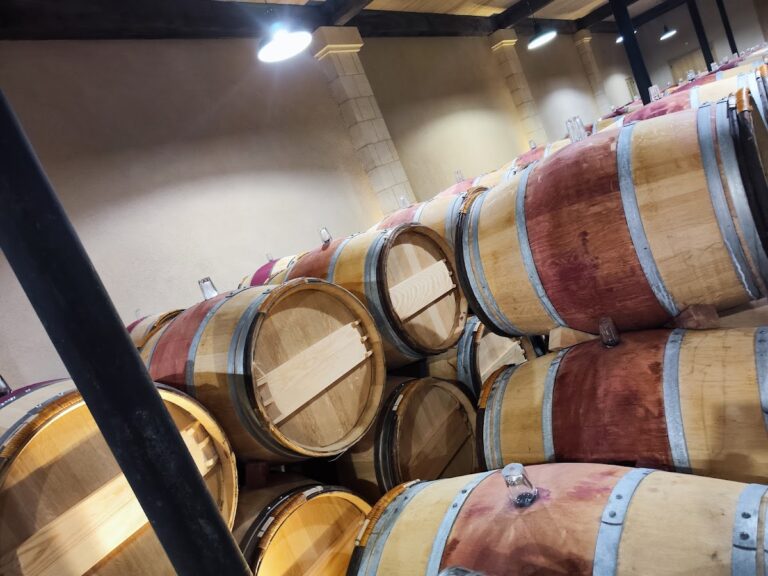
The cellars hold nearly 2,000 barriques, Bordeaux-style oak barrels commonly holding about 225 litres. About half of these barrels are replaced each year. After barrel aging, the wines spend a further four months in large containers.
Estate Wines
The estate produces Château Cantemerle as its grand vin and Les Allées de Cantemerle as its second wine. Les Allées was formerly called Villeneuve de Cantemerle and is made mainly from younger vines. A third wine, Baronne Caroline, is also produced in some vintages.
Average annual production is approximately 25,000 cases of the grand vin and 12,500 cases of Les Allées de Cantemerle. Baronne Caroline has been produced at approximately 5,000 to 10,000 cases in vintages when it is made.
Nearby sites