Schanze Wagesenberg: A Prehistoric Settlement Site and Early Medieval Fortification
Site at a Glance
- Popularity
- Low
- Country
- Germany
- Primary era
- Medieval
- Eras represented
- Medieval
- Civilizations
- Unclassified
- Site type
- Military
- Remains
- Fort
On this page9 sections
History
Schanze Wagesenberg is a fortified enclosure on a ridge spur above the hamlet of Wagesenberg in Germany. Its final construction phase probably dates to the first half of the 10th century, during incursions by the Magyars, a mounted people whose attacks threatened Central Europe. The defenses were intended to keep mounted warriors at a distance and force them to dismount.
Prehistoric settlement
Finds indicate that people settled within the enclosure during the Bronze Age and the later Urnfield and Hallstatt periods, successive archaeological periods in Central Europe. The site therefore had a history of occupation long before its early medieval fortification.
Early medieval defenses
Large territorial fortresses of the period may have been built under the castle-building ordinance of Henry I, an East Frankish king in the early 10th century. Smaller defenses were also constructed, or older fortifications strengthened. Schanze Wagesenberg’s final building phase belongs to this broader era of defensive works.
Comparable refuge fortresses and troop-assembly sites existed near Augsburg, including Haldenburg near Schwabegg and Buschelberg near Fischach. The Augsburg bishopric, an ecclesiastical territory administered by a bishop, probably employed a master fortification builder to coordinate work across this defensive system.
Count Berthold’s castle
In 1977, researcher Rudolf Wagner associated the enclosure with the long-sought castle of Count Berthold of Burgeck, who lived in the early 12th century. Wagner proposed that the enclosure had served as the castle’s service yard. That interpretation appears unlikely in view of the size and period-appropriate form of the separate motte castle remains nearby. A motte castle is a fortified residence centered on a raised mound.
Remains
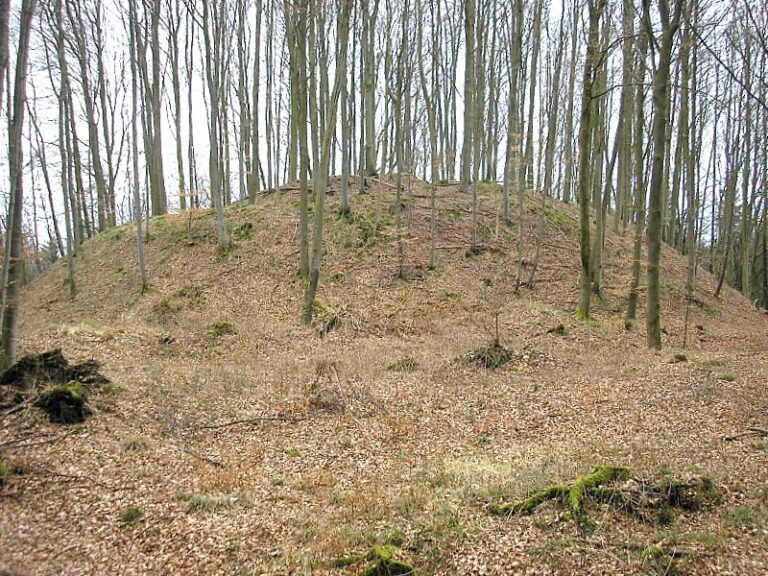
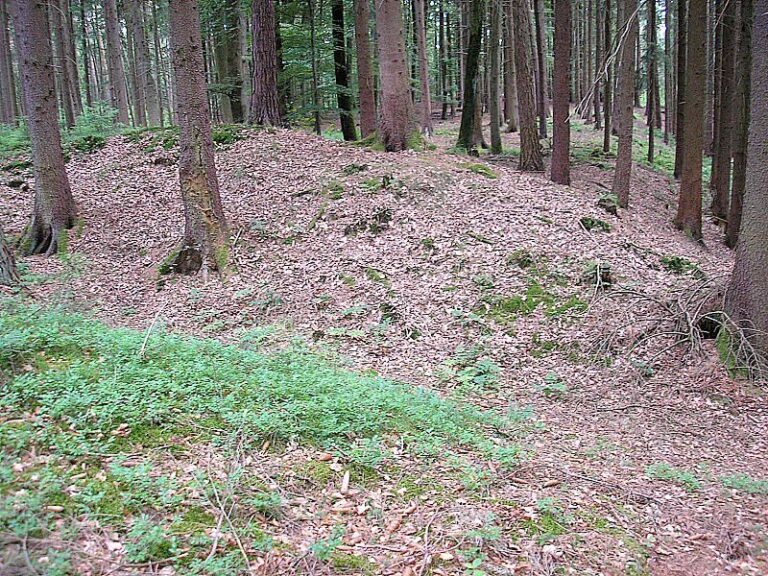
The fortification occupies a nearly level, kidney-shaped plateau about 300 by 190 metres, at roughly 515 metres above sea level and about 100 metres above Wagesenberg. Its northeast-facing spur joins the ridge at the southwest, while moderately to steeply sloping sides protect the other approaches. Earth banks and ditches shape the defenses, with several staggered barriers on the main attack side.
Earthwork defenses
Main banks and ditches
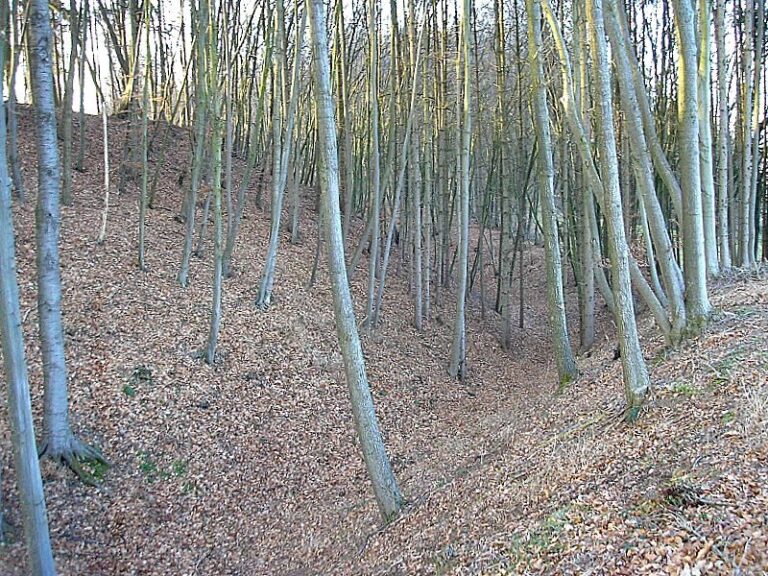
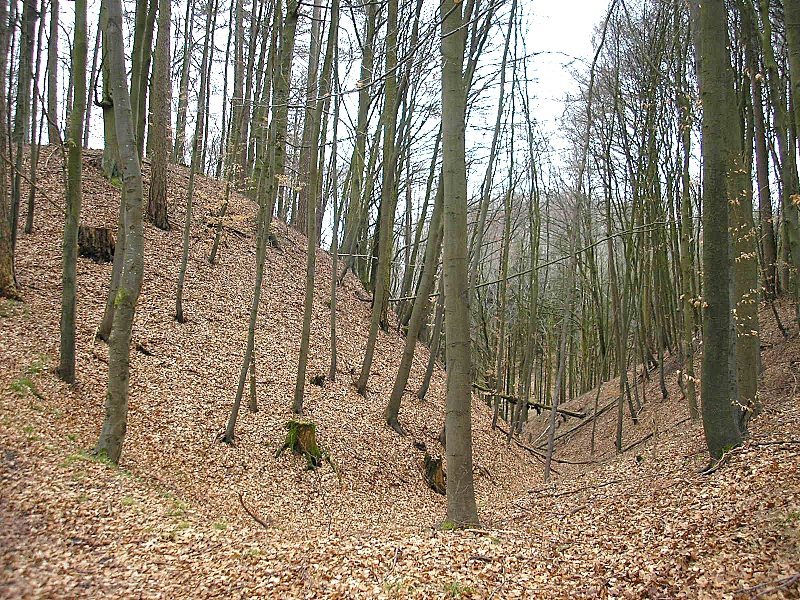
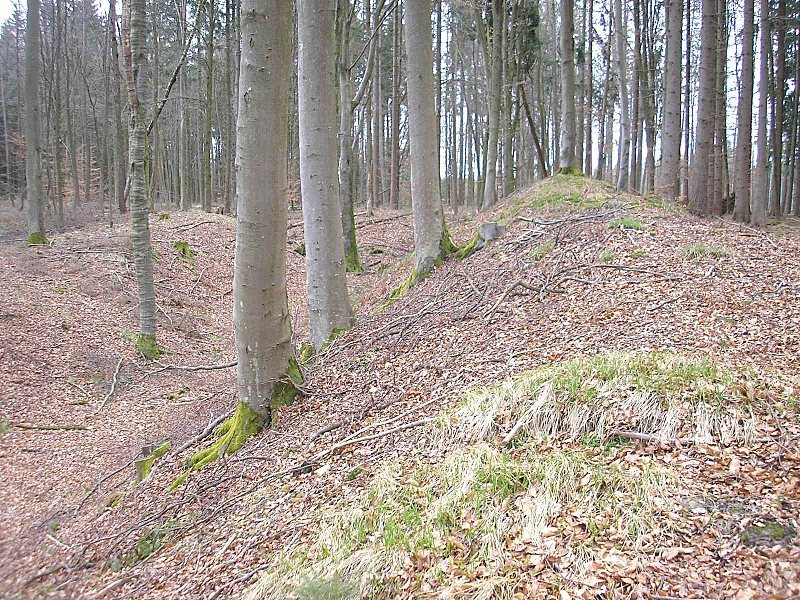
A deep ditch crosses the ridge, beginning on the south side and continuing northeast across the plateau. On the southeast, a broad outer bank, up to 4 metres high, partly fronts the ditch. Behind it, a V-shaped ditch reaches about 8 metres deep, and the main rampart, a raised defensive bank, rises to 15 metres. It then descends by about 3 metres and, beyond a broad hollow, rises again by as much as 4 metres. The enclosure interior lies about 2 metres below the rampart crest.
The fortified section is about 70 metres wide and uses a natural erosion channel. The main attack side has four staggered tiers of ramparts. Elsewhere, the slopes were artificially steepened and were probably defended with wooden stakes or fences woven from branches.
Western barriers
About 100 metres west of the main rampart, a bank about 4 metres high and 50 metres long runs south, with a ditch in front. Farther west, an angular bank survives to a height of 2 metres. It is interpreted as a remnant of the outer enclosure belonging to the neighboring high-medieval motte castle. The approach barrier also continues west in a flattened or unfinished line.
Settlement and nearby archaeological remains
Remains of medieval settlement lie within the large enclosure. Near the site, at Ackerschlag, is a small group of Hallstatt-period burial mounds. West of the enclosure, earthworks of a square enclosure from the La Tène period, a later archaeological period in Central Europe, remain visible. The separate high-medieval motte castle lies immediately south of the fortification, and the Wagesenberg motte-castle site extends for about 350 metres.