Burgstall Wagesenberg: A High-Medieval Castle Site in Germany
Site at a Glance
- Popularity
- Very Low
- Country
- Germany
- Primary era
- Medieval
- Eras represented
- Medieval
- Civilizations
- Duchy of Bavaria, Holy Roman Empire
- Site type
- Military
- Remains
- Castle
On this page8 sections
History
Burgstall Wagesenberg is a high-medieval castle site in Pöttmes, Germany. Its earthwork design follows the motte form, a castle centered on a raised mound. In Central Europe, such castles were built chiefly between the 11th and 13th centuries, and Wagesenberg’s form fits that broad period.
A castle of unusual scale
Motte castles in the region are generally understood as residences of lower-ranking nobles, including ministerials, a class of German nobles who served more powerful lords. Wagesenberg’s unusual overall scale has instead prompted the suggestion that it was the seat of a more powerful lord.
Historian Rudolf Wagner proposed that the neighboring early-medieval Schanze to the north held a count’s castle. A count was a high-ranking territorial noble. In this interpretation, Wagesenberg was an associated farmstead. Its scale and design, however, make the idea that it served only as an economic dependency unlikely.
Reconsidering the Berthold connection
An earlier interpretation identified Wagesenberg with Civitas Purgeka, a Latinized place-name for a settlement, and thus with the residence of Count Berthold von Burgeck. Historian Elli Wolf challenged that identification using a charter from Scheyern Abbey, a charter issued in 1107 by King Henry V, and writings by the monk Conrad of Scheyern from around 1220. Henry V was a German king and Holy Roman Emperor.
Wolf placed Berthold’s residence near Berg, now Ilmberg, by Lampertshausen, rather than near Berg im Gau at Lampertshofen. Lampertshausen, Berg, and Eck lie about 3 km from one another. Scheyern, where Berthold and Countess Haziga made a joint donation, is about 5.5 km from Ilmberg. A noble residence stood at Eck by 1220. Wolf’s reassessment therefore rejected Wagesenberg as the location of Civitas Purgeka.
The revised identification also affected interpretations of the origins of the Wittelsbachs, the ruling dynasty of Bavaria. Haziga, regarded as the family’s ancestress, was linked to Berthold through their joint donation, and Berthold was identified as her only known relative. Placing his residence near Ilmberg rather than Wagesenberg brought the connections among Scheyern, Ilmberg, and Lampertshausen into clearer view.
Remains
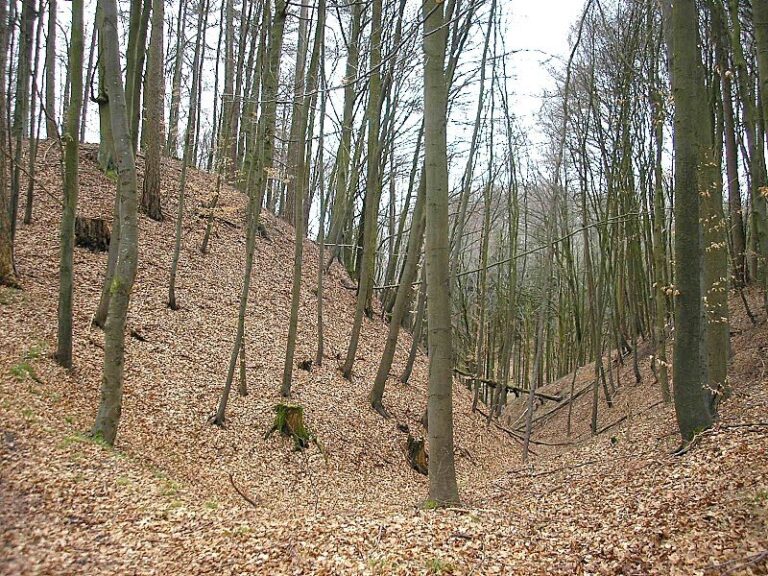
The earthwork complex extends about 350 m and includes a central mound and a separate enclosure. It occupies the forest compartment called Schanze near Wagesenberg, at about 510 m above sea level, immediately south of a large early-medieval rampart fortification.
Castle earthworks
Central motte
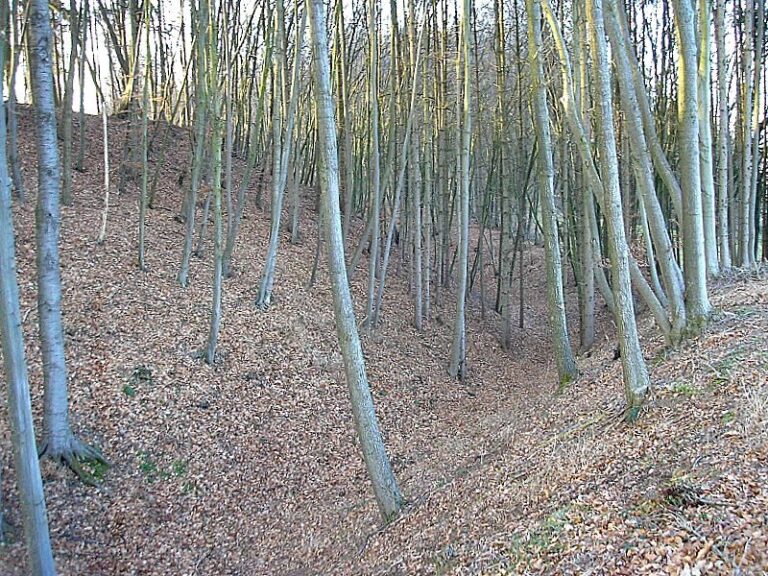
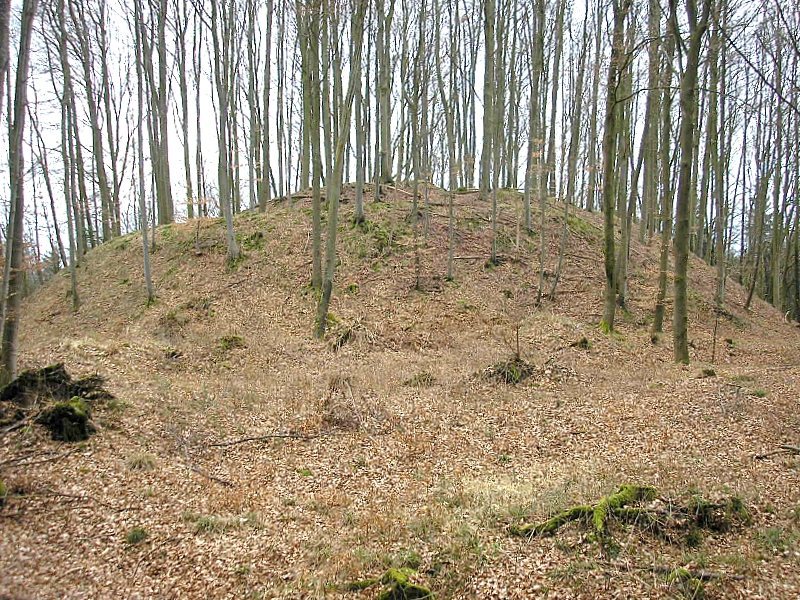
The oval central mound has a base about 40 m long and rises directly above the local road to Stuben. A shallow ditch follows its southwestern side. A deep hollow on the summit, left by the removal of earth, marks the position of the former buildings.
Outer-bailey enclosure
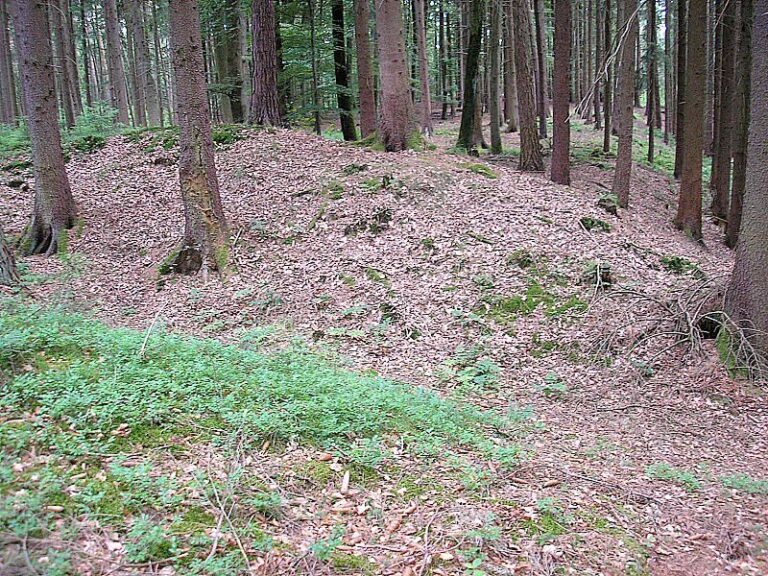
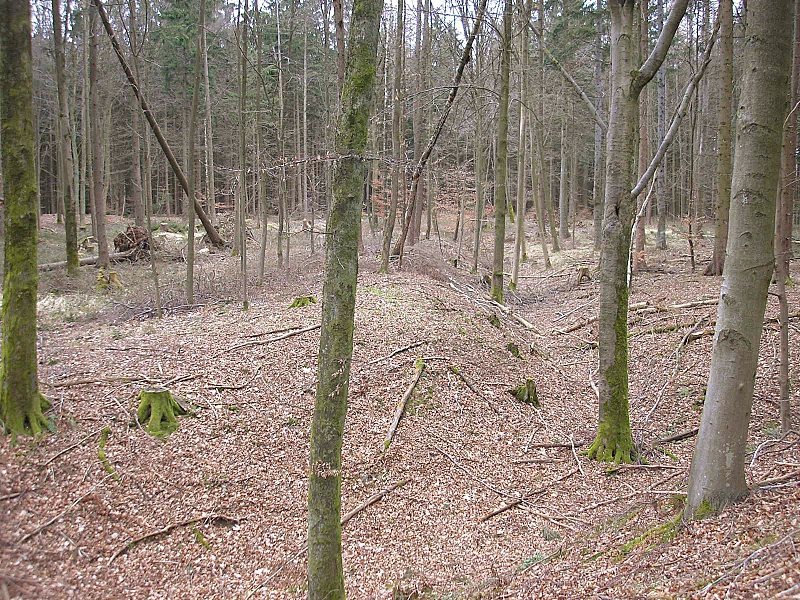
An outer bailey is an enclosed area outside a castle’s central stronghold. About 300 m northwest of the mound, a low, angular bank-and-ditch feature extends for roughly 250 m and is interpreted as the remains of this enclosure. On its eastern side, the enclosure adjoins an outer wall of the neighboring Schanze that is about 4 m high. Material removal during the 19th and 20th centuries substantially altered the outer-bailey area.
Neighboring Schanze rampart
The early-medieval Schanze is a large rampart fortification beside the castle site. Its unusually massive front rampart has been interpreted as a likely 10th-century Hungarian wall, a defensive bank associated with the period of Hungarian incursions into Central Europe.