Nizhny Novgorod Kremlin: A Fortified Civic and Religious Precinct
Site at a Glance
- Country
- Russia
- Primary era
- Early Modern
- Eras represented
- Early Modern, Modern
- Civilizations
- Russian
- Site type
- Military
- Remains
- Citadel
On this page20 sections
History
The Nizhny Novgorod Kremlin is a fortified central precinct in Nizhny Novgorod, Russia. Founded in 1221 by Grand Prince Yuri Vsevolodovich of Vladimir, the city first relied on wooden-and-earth defences. Its later stone fortress served as a frontier stronghold, then became a centre of provincial government and civic life.
Foundation and stone fortification
In 1374, Prince Dmitry Konstantinovich laid the foundations of a white-stone Kremlin. Financial and political difficulties prevented the project from progressing beyond one tower, which did not survive. A new building campaign began in 1500, when Nizhny Novgorod was an important frontier position under Ivan III, Grand Prince of Moscow.
Khan Muhammad-Amin’s siege in 1505 interrupted the work, which resumed in 1508. The old oak defences burned in 1513, and the stone fortress was probably completed in the middle of the 1510s under the Italian architect Pietro Francesco, also known as Peter Fryazin. Nizhny Novgorod also served as a base where Moscow’s forces assembled for campaigns against the Khanate of Kazan, a Tatar state centred on Kazan.
Frontier fortress and garrison
The Kremlin resisted Tatar attacks in 1521, 1536, and 1574. Its military importance diminished after Russia conquered Kazan in 1552, and by 1697 it no longer had a military role of consequence. A permanent garrison nevertheless remained for much of this period. Inventories list 19 artillery pieces in 1619, 22 in 1621, and 20 in 1663. Most were small fortress guns, alongside fewer medium- and large-calibre weapons and a small number that fired shot. The guns were chiefly bronze, with some iron pieces; some rested on supports and others on wheeled carriages. The garrison also held firearms, gunpowder, and other weapons, with supplies kept in tower cellars.
Provincial centre and nineteenth-century change
Peter I established Nizhny Novgorod Province in 1714, making the Kremlin its administrative centre and a base for city government. In the late eighteenth century, government offices and other public buildings reshaped its interior. Repairs ordered by Catherine II between 1785 and 1790, however, weakened the old defences. Workers removed roofs that had protected the wall battlements and projecting works at the main tower, then lowered the battlements by more than half. Weathering damaged the masonry left exposed.
The moat was filled in between 1834 and 1837. This lowered the fortress profile by about four metres and left buried lower parts of the towers vulnerable to groundwater. The Kremlin was also whitewashed, and its roofs painted red. In 1812, during the war against Napoleon’s invasion of Russia, Nizhny Novgorod’s militia set out from the Kremlin walls, although the fortress was no longer a defensive work.
Museum use, Soviet changes, and war
In 1894, architect Nikolai Sultanov began adapting Dmitrievskaya Tower for an art and history museum, which opened in 1896. The work substantially altered the tower’s appearance, and an imperial double-headed eagle was installed on its roof. After the Bolsheviks came to power, the Kremlin was painted red, the tower roofs green, and the eagle replaced with a Soviet flag. Museum objects were removed from the tower and transferred to city museums; some were destroyed.
The Transfiguration Cathedral was demolished in 1929–1930, and the House of Soviets rose on its site in 1931. Other churches inside the fortress were also demolished, with the Archangel Michael Cathedral surviving. Plans made in 1935–1937 to extend Soviet Square through the Kremlin threatened a section of wall, three towers, and buildings within the enclosure. The Second World War prevented the scheme from proceeding.
On 22 June 1941, a meeting of the Gorky regional party committee and a large rally took place in the Kremlin. The Gorky Division later gathered by its walls before departing for the front. During the war, the roofs of Taynitskaya, Severnaya, and Chasovaya Towers were taken down so anti-aircraft machine guns could be installed on their upper platforms. A victory parade was held beside the walls after the war.
Restoration and continuing use
A restoration order followed on 30 January 1949, and work began that autumn under architect Ignaty Trofimov. Svyatoslav Agafonov became chief restoration architect and scientific director in 1951. The project included surveys, trial repairs, drainage, slope grading, and measures against landslides. A restoration plan was completed in 1961; work on the walls and towers was largely finished by 1965, while rebuilding destroyed sections continued until 1981. Borisoglebskaya Tower was reconstructed in 1972–1974.
Restoration halted after the Soviet Union dissolved in 1991. By about 2005, cracks and crumbling brickwork had prompted work to resume. Later interventions also changed parts of the fortress, including the sealing of small gates between Taynitskaya and Severnaya Towers and the installation of glazed retail spaces in wall niches. Archaeological excavations in 2018 preceded the rebuilding of the Church of St Simeon Stylites in 2020–2021. Zachatskaya Tower was reconstructed in 2012, completing the wall circuit. Restoration for the city’s 800th anniversary included slope stabilization and renewal of the wall walk. The Kremlin is a federally significant Russian cultural heritage site and continues to accommodate regional and city government, courts, museums, and Orthodox churches.
Remains
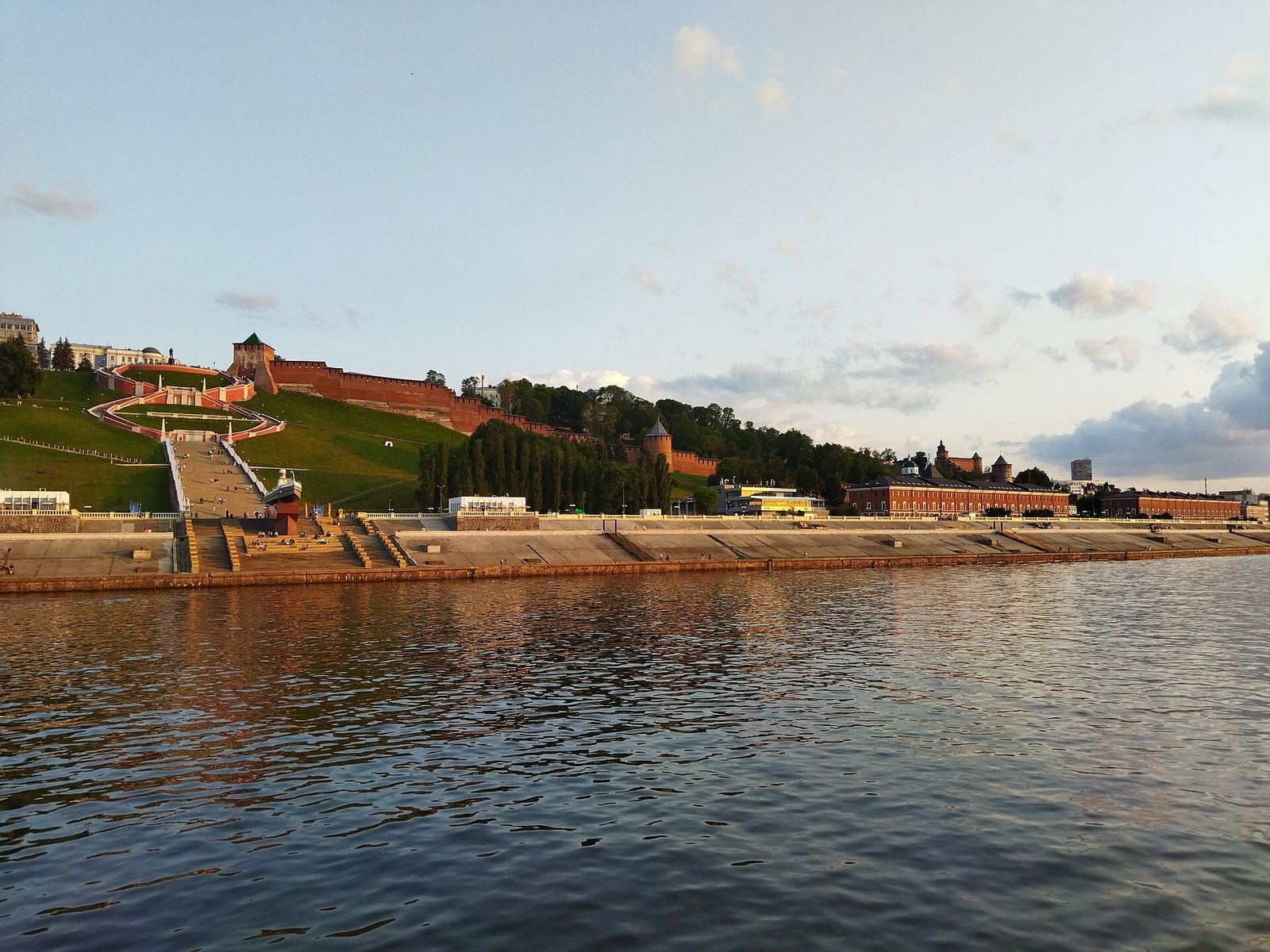
The 22.7-hectare Kremlin occupies the high right bank at the meeting of the Volga and Oka rivers. Its northwestern side descends towards the slopes; the southeastern side faces Minin and Pozharsky Square, while the southwestern edge rises above Pochaina Ravine and Zelensky Descent. The enclosure follows a circuit of about two kilometres. Its walls stand 12–22 metres high and measure 3.5–4.5 metres thick.
Walls and defensive features
Wall circuit and moat
The enclosure has 13 towers and five gates. Five rectangular towers served as passages, while eight round towers had no through-passage. All 13 towers survive or have been reconstructed. The upland side was protected by a dry moat about 2.5–4 metres deep and roughly 25–30 metres wide. A 1622 record describes a narrower trench along the upper wall, possibly a ditch within the larger moat; groundwater may have gathered in it near Dmitrievskaya Tower. A further moat lay in front of Ivanovskaya Tower on the lower part of the site. After the moat was filled, Zelensky Descent followed its line.
Approaches and wall defences
A projecting stone bridge and an outwork tower protected the approach to Dmitrievskaya Tower, an arrangement regarded as a new feature in Russian fortress design. Openings in the lower walls allowed defenders to shoot through the masonry; additional enclosed chambers provided fire along the base of the walls. Some of the openings, called loopholes, were placed low in the wall. Underground passages may have linked certain towers below this level, but that possibility has not been investigated.
Towers and their names
Georgievskaya Tower is square and has four tiers. A drawbridge once stood before it; before the seventeenth century, the bridge was 5.3 metres high and its gate measured 3.52 metres. The tower takes its name from a nearby church of St George. Borisoglebskaya Tower is named for a church dedicated to Saints Boris and Gleb, formerly below the Kremlin near the Volga. After the church remains were excavated in 1966, the tower was rebuilt on its original site between 1972 and 1974. Zachatskaya Tower, also called the Conception Tower, is a two-tiered rectangular gate tower. A landslide destroyed it in the eighteenth century, and its 2012 reconstruction includes exhibition space for archaeological finds from the Kremlin.
Belaya Tower is round and four-tiered; its name refers to the white-stone facing on the lower exterior. It was also called Semyonovskaya, after a monastery inside the Kremlin. The provincial archive occupied the tower from 1889. A fire in 1923 destroyed the documents stored there without seriously damaging the tower’s structure. Ivanovskaya Tower, named for its proximity to a church of St John the Baptist, now houses a museum exhibition. Chasovaya Tower takes its name from a clock installed there in the sixteenth century; a recreated clock was installed in 2024. Severnaya, meaning northern, was also called Ilyinskaya because it stood opposite a town church of Elijah the Prophet.
Taynitskaya Tower is named for a concealed passage in the wall near the tower that led towards the Pochaina River. It was also known as Mironositskaya, after a church across Pochaina Ravine, and was associated with a powder yard and water mill below it. Koromyslova Tower is linked to legends of a young woman carrying a yoke. One version says she killed ten attackers during a 1520 siege before being killed; another says she was buried beneath the tower as a foundation sacrifice. In a variant, builders buried an insect instead. Nikolskaya Tower takes its name from a nearby church of St Nicholas the Wonderworker. A pedestrian bridge over Zelensky Descent, built in the 1980s, leads to the tower, which contains a museum exhibition.
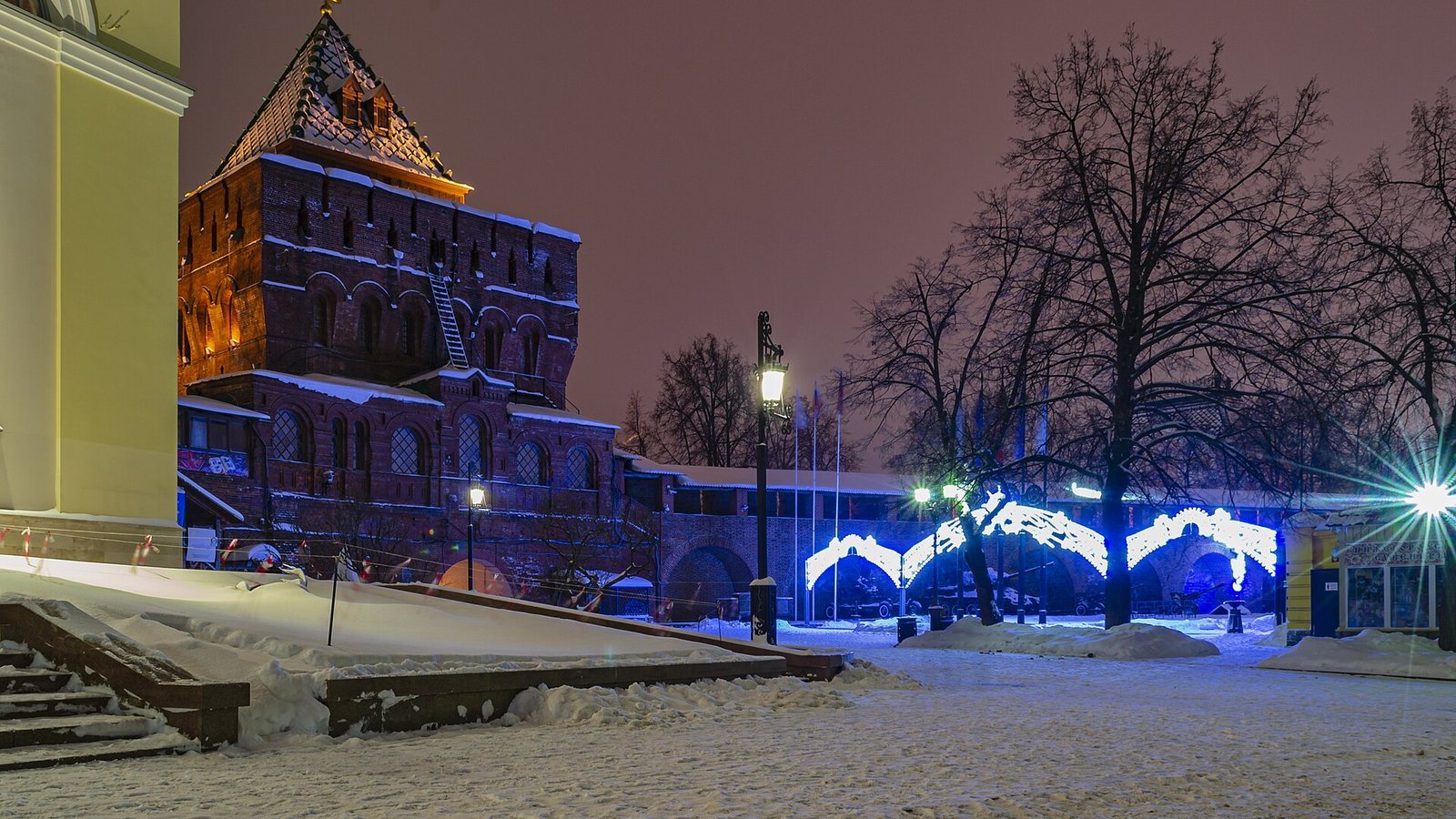
Kladovaya Tower served as a storehouse and was also called Round, Zeughaus, or Alekseyevskaya, the last name referring to a nearby church. Dmitrievskaya Tower, regarded as the oldest, was first recorded in 1372–1374. Its name may refer to Prince Dmitry Konstantinovich or to a church of St Demetrius of Thessaloniki built in front of it in 1378. It now contains an exhibition hall and displays the city arms and an icon above its gate depicting Yuri Vsevolodovich. Porokhovaya Tower is round, with four tiers, and was used to keep gunpowder and ammunition. Its lower levels lack openings facing outward, allowing it to act as a caponier, a protected position for firing along a fortification.
Restored wall walk
The restored wall walk, a passage along the top of a defensive wall, now forms a complete circuit of more than two kilometres. The route follows an elevation change of 82 metres. Slope stabilization for the city’s 800th anniversary used 3,290 piles; the largest reached 25 metres deep and measured 670 millimetres in diameter.
Religious buildings and memorials
Archangel Michael Cathedral
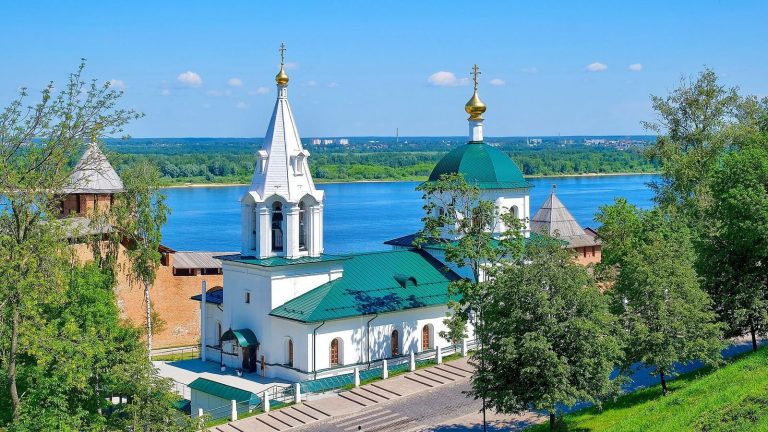
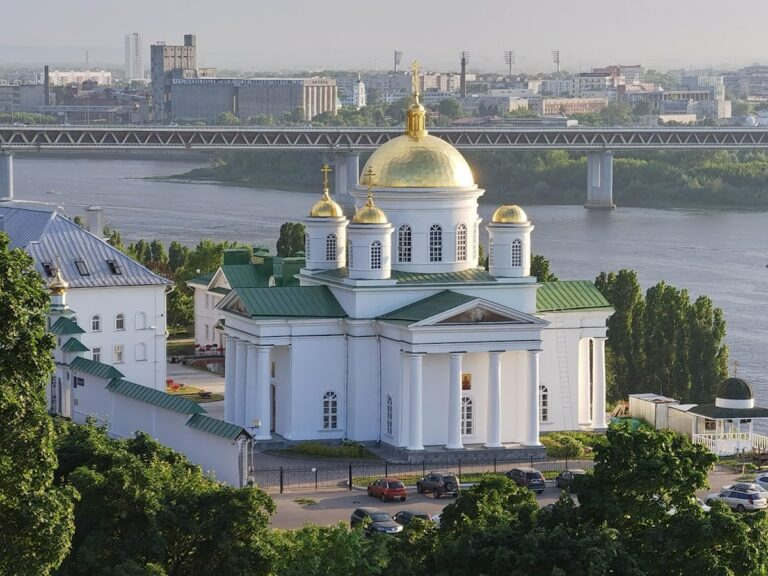
The Archangel Michael Cathedral, dedicated to Michael in Christian tradition, is the oldest surviving building within the Kremlin. It was built no later than the middle of the sixteenth century and rebuilt between 1628 and 1631. The church contains the tomb of Kuzma Minin, a leader of the Russian militia during the early-seventeenth-century struggle against Polish-Lithuanian forces.
Church of St Simeon Stylites
The Church of St Simeon Stylites stands in the northern part of the enclosure. Excavations beneath its site in October 2018 revealed settlement remains and a cemetery containing about 900 burials. The oldest cultural layer dates to 1221. The church was rebuilt in 2020–2021, and the recovered human remains were reburied in a burial chamber in its altar. Recovered objects were placed in a museum context.
Bell tower, chapels, and memorials
The bell tower of the demolished Transfiguration Cathedral was rebuilt in 2021 to an eighteenth-century design. It is 51.5 metres high, and its bell tier also serves as an observation platform. The Spasskaya Chapel, built in 2012 opposite the city administration, commemorates the demolished cathedral. In front of the Archangel Michael Cathedral stands an obelisk commemorating Minin and Dmitry Pozharsky, erected in 1828 to a design by Melnikov and Martos. Other memorial features include monuments to Yuri Vsevolodovich and Bishop Simon of Suzdal, and to Prince Dmitry Donskoy and his wife Euphrosyne of Moscow. The Minin Garden contains the memorial to Gorky residents who died in the Second World War, established in 1965 with an eternal flame. A memorial to Gorky’s contribution to the war effort and a bronze model of pre-revolutionary Nizhny Novgorod are also within the Kremlin; a monument to home-front workers was added in 2020.
Civic buildings and internal spaces
Government and military buildings
Buildings around the late-eighteenth-century parade ground include government offices built between 1782 and 1785, a vice-governor’s house and wing dating to 1786–1788, and a garrison house built between 1791 and 1801. A banking office followed beside the government offices in 1785–1786. Two barracks for officers’ families were added between 1797 and 1806, one on the southern side of the parade ground and another near the vice-governor’s house. The military governor’s house, built between 1837 and 1841, now houses the Art Museum. The Arsenal, constructed between 1840 and 1843 at the direction of Nicholas I, serves as an exhibition venue.
Twentieth-century and later buildings
The House of Soviets, built in 1931 on the site of the Transfiguration Cathedral, is a Soviet-era building whose plan has been likened to an aircraft. It houses the city council and administration. A red wing of the cadet corps was built in 1914–1915, and a regional party committee garage near Georgievskaya Tower followed in 1934–1935. A regional party committee building was erected in 1975 on the site of the demolished military Cathedral of the Dormition. In the southeastern part of the Kremlin, construction of a government complex began in 2008. A treasury building completed in 2014 adjoins the historic banking office; work on the other administrative buildings was suspended in 2015.
Courtyards, gardens, and adjoining spaces
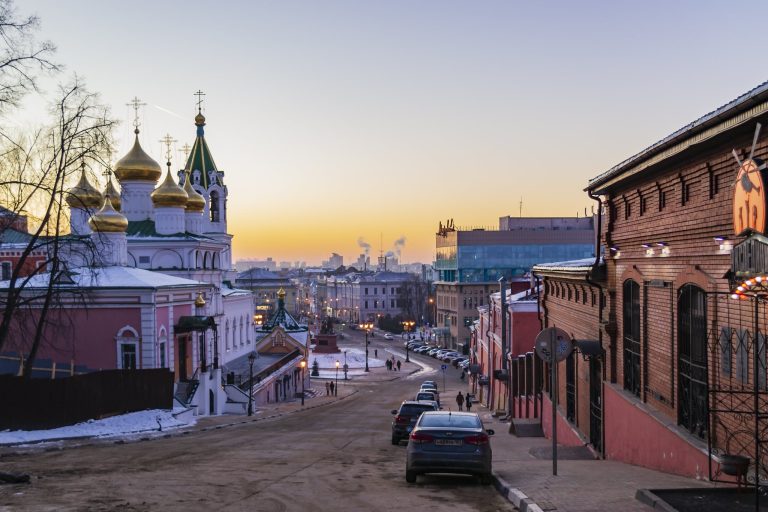
Ivanovsky Descent, once called Big Bridge Street, connects the Kremlin’s internal spaces. These include the parade ground, Governor’s Garden, Minin Garden, Spruce Garden, and Literary Garden. The former Cathedral Square is occupied by the House of Soviets. Beyond the walls, Minin and Pozharsky Square, Zelensky Descent, Kremlin Boulevard, National Unity Square, and the Lower Volga Embankment form part of the wider ensemble, including the area at the foot of the Chkalov Stairs and the square in front of Zachatskaya Tower.