La Mouthe Cave: A Decorated Paleolithic Cave in France
Site at a Glance
- Country
- France
- Primary era
- Stone Age
- Eras represented
- Stone Age
- Civilizations
- Unclassified
- Site type
- Civic
- Remains
- Rock Art
On this page7 sections
History
La Mouthe cave is a decorated Paleolithic cave at Les Eyzies in France. Discovered in 1894, it helped establish recognition of Upper Paleolithic art, the later phase of the Old Stone Age.
Discovery and study
La Mouthe was the fourth decorated Paleolithic cave to be discovered, while its art was the third from such a cave to be published, after Chabot and Altamira. Following his work at Grotte des Combarelles, French prehistorian and archaeologist Émile Rivière visited La Mouthe in September 1894. He began excavations in June 1895, uncovering the cave art that year. His work continued for eight years.
After visiting Pair-non-Pair at the invitation of French prehistorian François Daleau, Rivière remarked on the close resemblance between images in the two caves.
Protection and heritage status
La Mouthe has been protected as a French historical monument since 11 June 1953. In 1979 it became part of the UNESCO World Heritage property “Prehistoric Sites and Decorated Caves of the Vézère Valley,” a group of 15 sites.
Remains
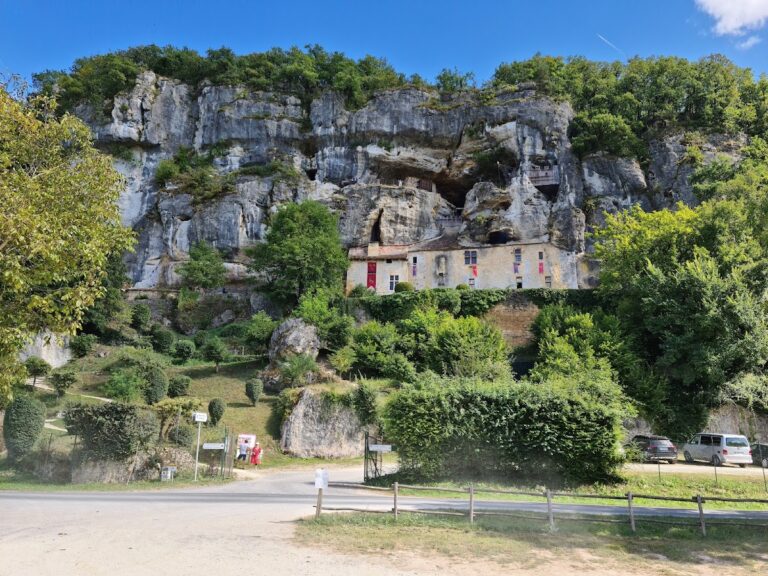
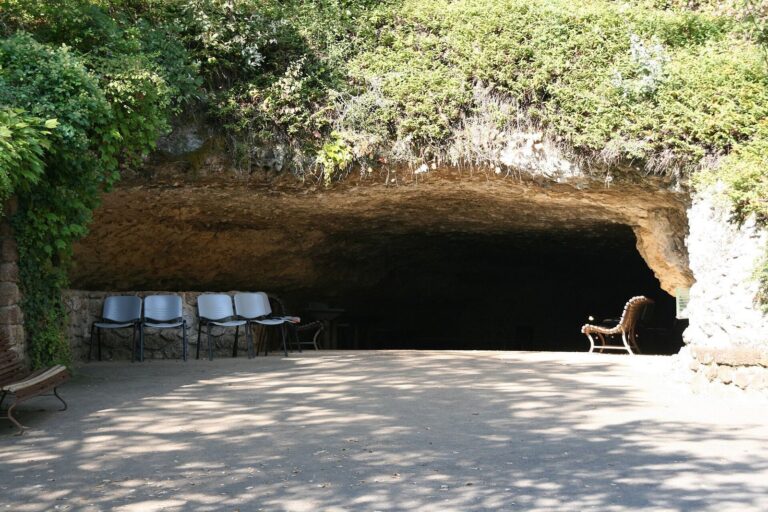
The cave opens at the foot of the Cingle cliff, west of the hamlet of La Mouthe, which lies about 1.1 km south of Les Eyzies village. Its entrance faces north or northwest. A 100-metre tunnel connects the entrance with the decorated part of the cave; Rivière cleared it during his excavations.
Cave art
More than 200 engravings and paintings depict bison, horses, reindeer, mammoths, felines, a wolf, two hands, and signs. Among the signs is a large tectiform, a geometric shape usually resembling a roof or shelter.
Stone lamp
A red sandstone lamp was found on 29 August 1899 in a Magdalenian hearth near the entrance. The Magdalenian was a later Upper Paleolithic period in western Europe. Measuring 17 by 20 cm, the lamp has an ibex head engraved on its underside, with long horns curving backward. Its size places it third among known Paleolithic lamps, after examples from the Coual and Scilles caves. A hollowed area marks its darker upper surface. Examination of dark deposits found animal fat had been used as fuel, and the lamp was probably used for lighting. In lamp classifications, triangular-handled examples are called the La Mouthe type, in contrast to racket-handled lamps of the Lascaux type. By 2010, about 300 Paleolithic lamps were known; around 30 had distinctively shaped handles, about half of them sandstone and ten limestone.
Disputed limestone figure
A limestone figure sometimes attributed to La Mouthe has uncertain provenance. Jean Gaussen told Randall White that Hallam Movius had heard of a figure bought by an Italian from a local resident, who claimed to have found it at a small, previously unknown deposit above and near the cave. The British Museum examined the object around 1968, while it belonged to a London collection. In 1972, New York dealer Alan Brandt Inc. sold it to the Minneapolis Institute of Art, a museum in Minneapolis, Minnesota. The figure has unusually smooth polishing, and its stone inclusions differ from those in limestone at La Mouthe. Tool marks are limited to the head, while the incisions have rounded bottoms rather than V-shaped ones. The block has no sediment, and a patina resembling abrasion in dirty water obscures the apparent freshness of the cuts. White judged it 90 percent likely to be a forgery.