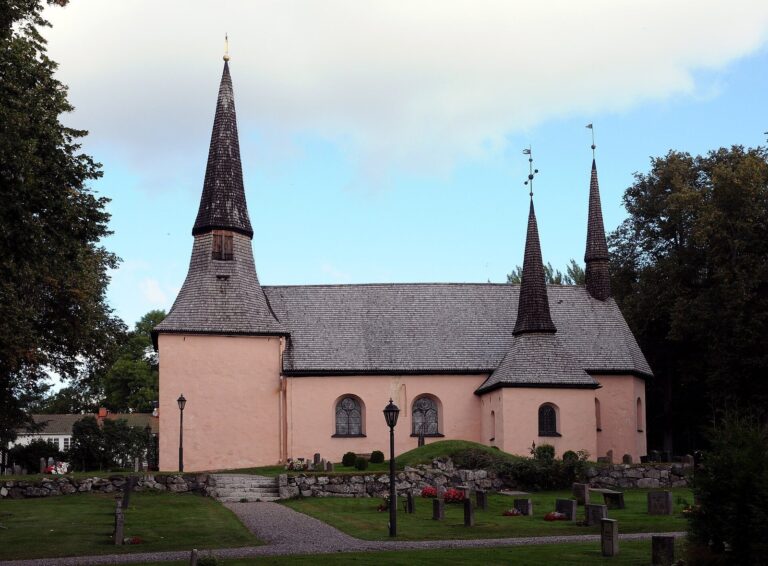
Svärta Church: A Medieval Parish Church in Sweden
Site at a Glance
- Country
- Sweden
- Primary era
- Medieval
- Eras represented
- Medieval, Early Modern, Modern
- Civilizations
- Swedish
- Site type
- Religious
- Remains
- Church
On this page14 sections
History
Medieval origins
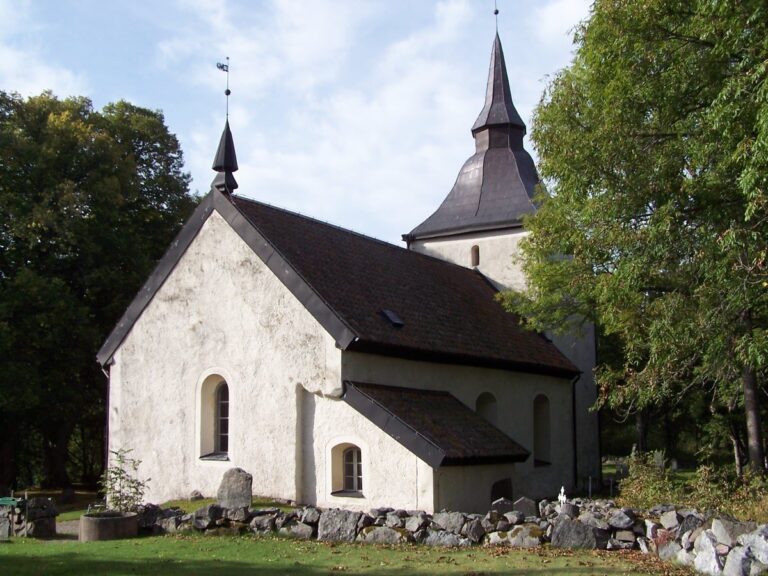
Svärta Church is a medieval church in Nyköping Municipality, Sweden, at the northern edge of Svärta parish. It belongs to Nyköping parish in the Diocese of Strängnäs. The church was built and dedicated in the 13th century, with a cross-shaped plan.
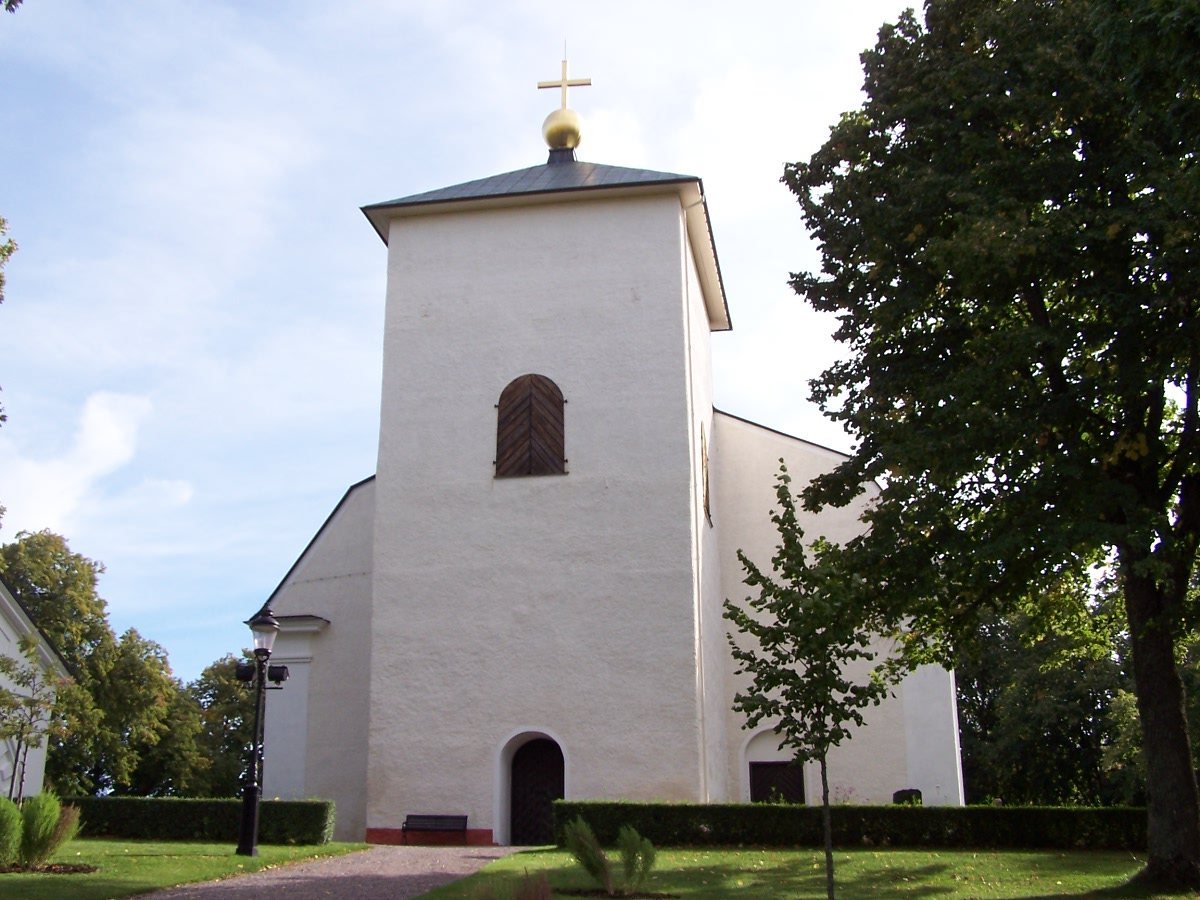
A tower was added in the 15th century, and a porch was built on the south side late in the medieval period. The church’s later alterations changed both its footprint and the position of the porch.
Alterations and rebuilding
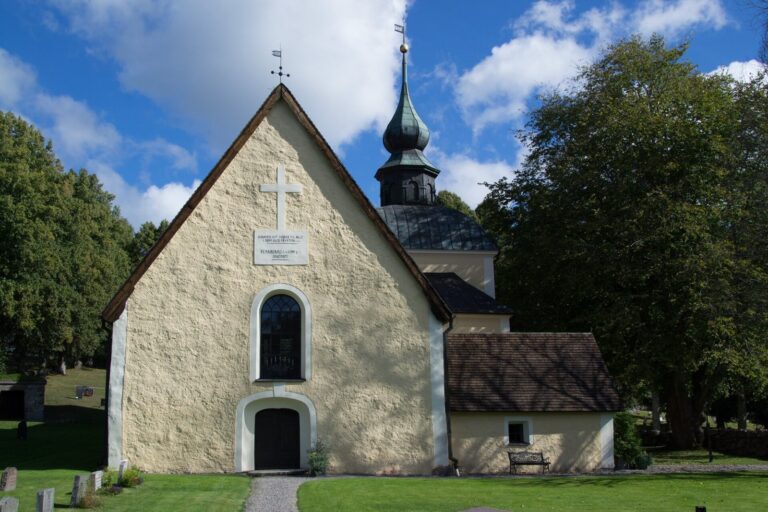
In 1689, the church was widened to the northwest and southwest. The south porch was transferred to the ground floor of the tower, while its former space became part of the church interior. In 1802, most of the building was demolished and rebuilt, with the tower retained.
Plans drawn up in the 1860s proposed a new upper structure for the tower, but the work was not carried out.
Remains
Church and churchyard
Church building
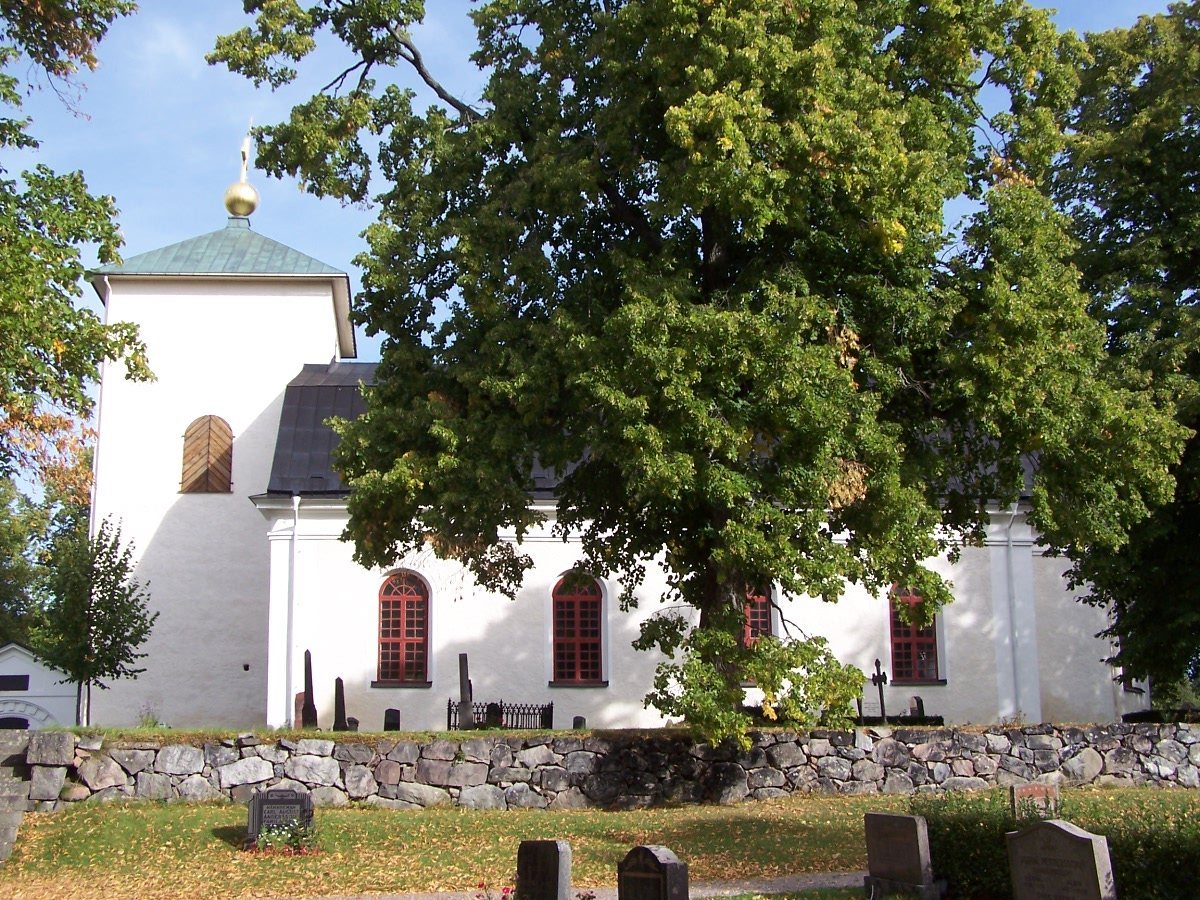
The surviving medieval fabric includes the sacristy’s north wall and the west gable, as well as the tower. The rebuilt church extends eastward and ends in a rounded chancel, the area around the altar. A terrace wall to the north and south marks the extent of the older church.
Cemetery and burial chapels
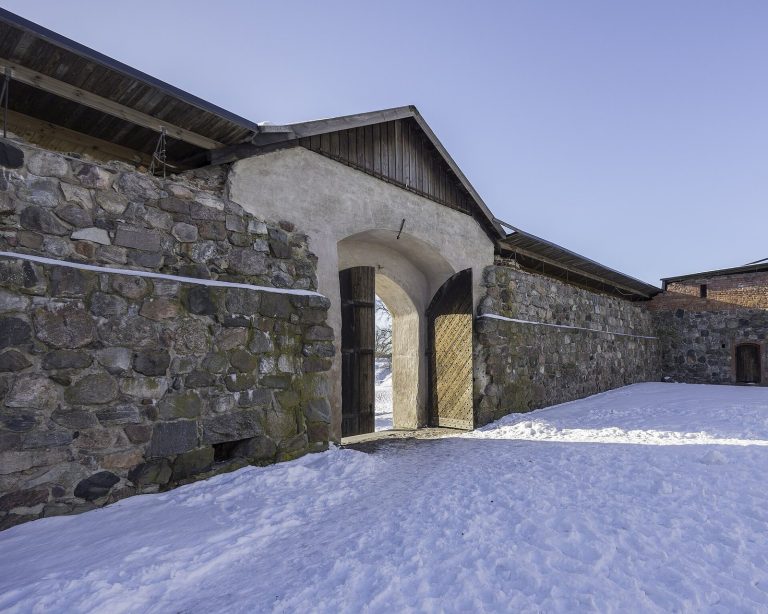
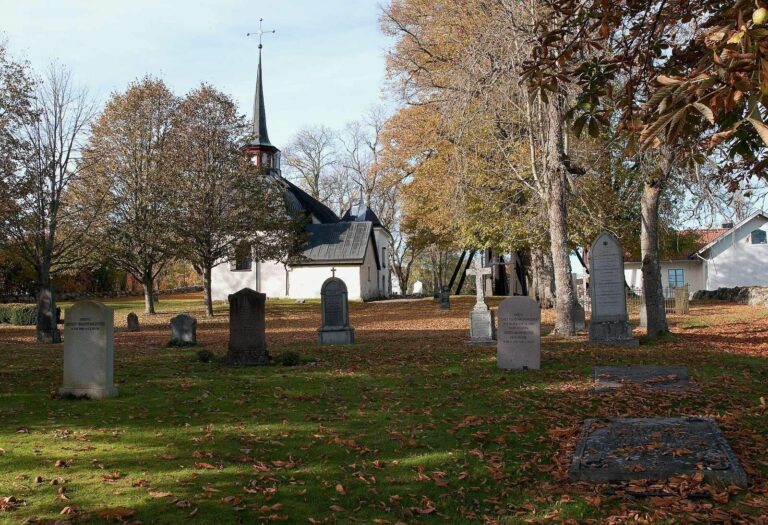
A cemetery map from 1714 shows that the western boundary already followed its present line. The cemetery lay close to the church on its north and south sides. Its wall had a covering of tarred shingles and two entrances with lychgates, or roofed entrances to a churchyard. The large lychgate was demolished in 1794 and replaced with masonry gateposts.
Two small, white-plastered burial chapels stand in the cemetery’s western part, built in a style inspired by classical architecture. One was built for Sjösa in 1827; the Norshammar ironworks chapel dates to about the same time. Members of the Berchner and Örnsköld families are buried in the Norshammar chapel.
Interior and furnishings
Pulpit and baptismal furnishings
The pulpit dates to the 1640s and is attributed to master carpenter Hans Behm. It stood in the northeast corner of the church’s main body until 1823. A restoration in 1873 added a spiral-twisted column beneath its bowl. The column now rests on the foot of an older baptismal font, probably carved in Gotland in the 13th century. That font’s foot remained in use into the 17th century. The present font was carved in 1932, and a pewter baptismal basin made in Nyköping in 1827 is also preserved.
Altar and memorial
The altarpiece, made by Pehr Hörberg in 1807, shows the Churching of the Virgin Mary, a Christian rite of thanksgiving and purification after the birth of Jesus. A gravestone set into the chancel wall portrays a man in armor, with his helmet and gloves laid aside, beside a woman in 16th-century dress. Their coats of arms identify them as Jon Karleson of Mem in Östergötland, who died at the Battle of Norrby in 1568, and his wife Agneta Arentsdotter (Örnflycht) of Sjösa.
Communion vessels and textiles
The church’s gilded-silver chalice and paten, a plate used with a chalice for Communion, are decorated with Christ on the cross. Gerhard von Berchner donated them in 1708, along with a velvet chasuble, a priest’s outer vestment bearing coats of arms and the same date. A silver wine pitcher, made in 1755 by Stockholm goldsmith J. F. Sickman, was financed through the work paid for by Major General Fabian Löwen of Sjösa. It may have been made using silver from an older pitcher and a chasuble. A pewter pitcher made in Nyköping was purchased in 1736.
Other communion objects include a silver wafer box made by Nyköping master Carl Gustaf Björkman between 1735 and 1745, and a set for visits to the sick made in 1777 by Anders Ulfsberg using silver from an older set. The church’s wedding crown was purchased in 1773; ornaments attached to its ring obscure its maker’s marks.
An altar frontal incorporates panels originally made of red silk and velvet. It bears the initials AS and MK and the date 1702, referring to Sjösa’s owners Axel Stålarm and Maria Kyle. A red-silk chalice cloth has an embroidered octagonal field of white silk, worked in gold thread and multicolored silk. Its martial motifs include drums, spears, banners, quivers, and curved sabres. The cloth is thought to be a Polish work from around 1700.
Chandeliers and candlesticks
Four metal chandeliers hang in the church. The easternmost, a small six-arm piece with traces of silvering, appears to have been made for secular use; Commissioner Lorens Gustaf Jerlin donated it in 1758. An eight-arm chandelier bears an image of a woman playing a lute above its globe and an inscription naming Samuel Helstedt, bailiff at Ånga estate around 1720. Countess Stålarm of Sjösa gave the 16-arm chandelier in 1720; it was probably already an old piece, made in the mid-17th century. The remaining eight-arm chandelier, decorated with a cloaked figure, leaves, and ornamental flowers, was probably new when Cavalry Captain Planting donated it in 1686.
Three matching brass candle plates date to around 1700 and are thought to have come from Sjösa; two similar plates are from the early 18th century. Other lighting includes a four-arm altar candlestick from around 1600, silvered-brass candlesticks from the later 17th century, two pairs of pewter candlesticks from around 1670 and the early 18th century, and a pair with urn-shaped holders made in 1787.
Bells and organ
The church has three bells. The largest, cast in Stockholm by master Jurgen Putensen, was donated in 1656 in memory of Sjösa owner Erik Ryning and his wife, Maria Elisabeth Kurtzel. Baron B. A. Löwen of Sjösa donated the middle bell, cast in Stockholm in 1839 by F. Scipel and J. Liljendal. The smallest was given by the baronial family at Sjösa in 1687. After lightning destroyed it, Vendela Stålarm paid for its recasting in 1736.
The first organ was built in 1862 by Per Larsson Åkerman of Stockholm. In 1918, Åkerman & Lund of Sundbyberg added two sound registers. The organ’s keys operate through mechanical linkages, and its range is given as 54/18.
Material from the medieval church
A sacrament house, a wall receptacle for the Eucharist or Communion, originally from Svärta Church dates to around 1450. It is now held in the church museum in Strängnäs.