Bogsta Church: A Medieval Parish Church in Sweden
Site at a Glance
- Country
- Sweden
- Primary era
- Medieval
- Eras represented
- Medieval, Early Modern, Modern
- Civilizations
- Swedish
- Site type
- Religious
- Remains
- Church
On this page15 sections
History
Foundation and medieval development
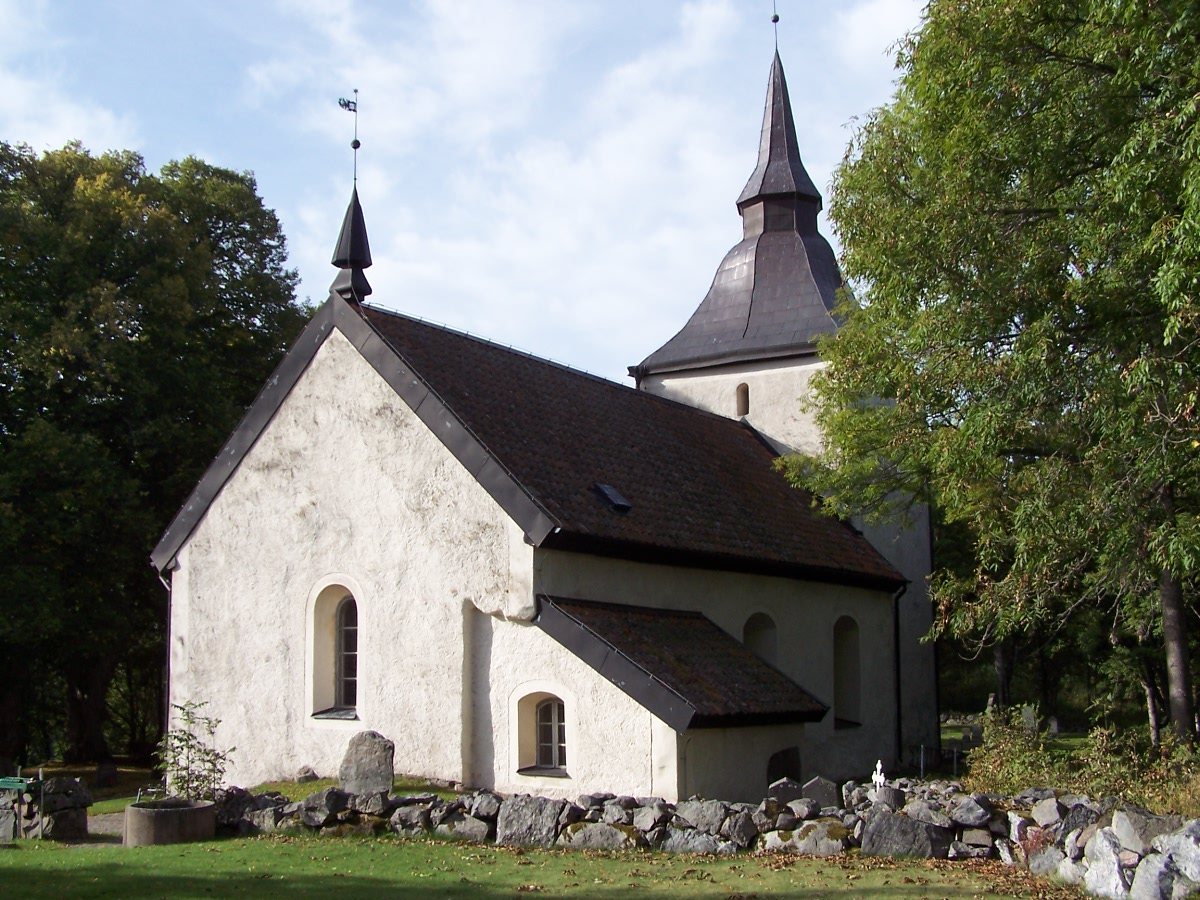
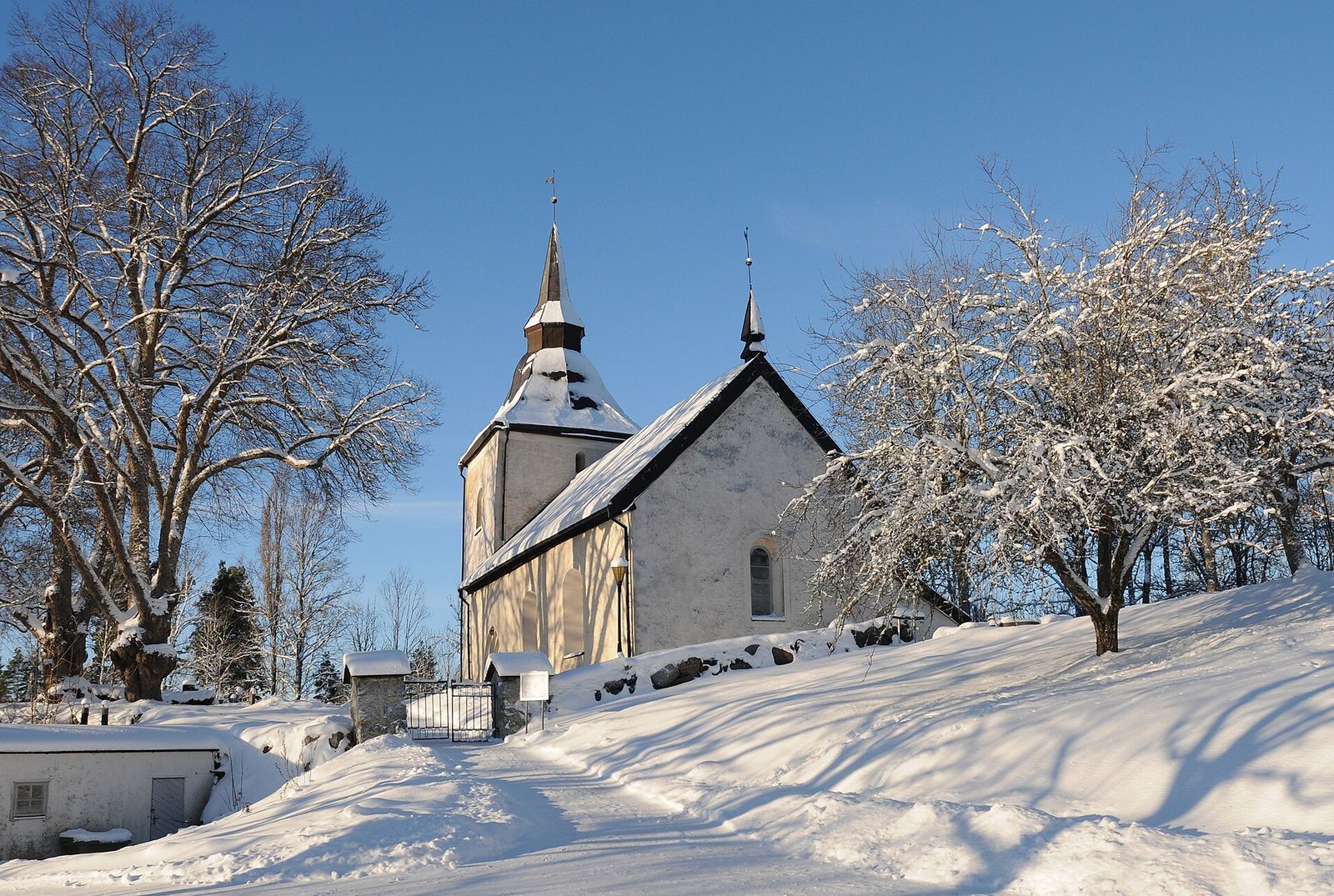
Bogsta Church is a parish church in Tystberga, Sweden, built and consecrated in the 12th century. It belongs to Tystbergabygden parish in the Diocese of Strängnäs.
The church acquired its west tower in the 14th century. A sacristy, a room for preparing for worship and keeping church furnishings, was added on the north side in the late 14th or early 15th century. The choir followed in the 15th century.
Later changes and restoration
A drawing from 1685 shows a wooden porch, which was still present when the church was described in 1830. It was probably removed during a major restoration in the 1840s. The smaller church bell bears an inscription saying that King Charles XI of Sweden gave it to the church in 1691. After it cracked, it was recast in 1758. The old rectory across Lake Runnviken was built in 1697.
A gallery was constructed at the church’s west end in 1813 and taken out during the 1905 renovation. Fixed pews installed in 1849 gave way to Gothic Revival furnishings in 1905; their end panels and screens were replaced in 1936. Major restorations were carried out in both 1905 and 1936.
Remains
Beside Lake Runnviken, the church is organized around a nave, a tower at its west end, a choir, and a north-side sacristy. The churchyard extends mainly to the south and west. The surviving buildings and furnishings include features from several centuries.
Church, churchyard, and rectory
Church fabric
The tower roof was clad in sheet metal in 1889. Before that alteration, tarred shingles covered both the tower and nave roofs; the nave is now roofed with single-channel tiles. Weather vanes on the tower spire and the nave’s eastern gable carry the date 1660, probably indicating when the present tower roof was made. Architect Agi Lindegren designed the church’s distinctive facade for the 1905 restoration. The iron-bound doors, designed by Hakon Ahlberg, date to 1936.
Churchyard and rectory
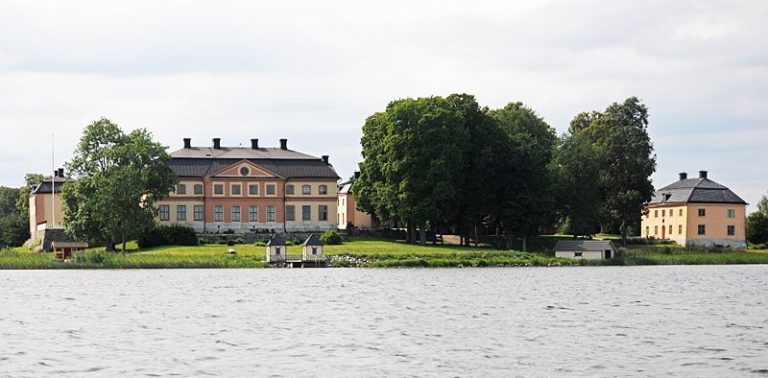
The churchyard’s southern wall acts as a terrace wall because fill was placed against its inner side. The gates and gateposts were made to Ahlberg’s designs in 1929. Across the lake, the old rectory has a six-part plan, a floor-plan arrangement divided into six parts.
Runestones
One runestone stands outside the church; until 1908, it served as the threshold in the church doorway. A second is set into the sacristy’s north wall and is catalogued as Södermanland Runic Inscription 124.
Interior furnishings and objects
Altar, font, and pulpit
The altar furnishings include a crucifix given by Captain Schinkel and his wife of Norrby. An altar adornment made for the 1905 restoration at the expense of Baron C. F. von Rosen of Näsby is kept in the church stable. The sandstone baptismal font dates to the later 12th century. Its foot has a rope-like moulding, and rings decorate its basin, a form common around Lake Mälaren in east-central Sweden. The pulpit, made in 1849 to architect Ludvig Hedin’s designs, is another part of the church’s interior furnishings.
Communion vessels
One communion chalice combines parts of different dates. Nyköping goldsmith Anders Ulfsberg made its foot and bowl in 1764, while its richly decorated shaft is probably continental work from the early 17th century. The shaft may have been made for secular use before a new bowl and foot adapted it for worship. Its paten, a small plate for communion bread, is unmarked gilded silver. A second chalice has a medieval shaft and foot, with a paten made by Ulfsberg in 1793.
An oval wafer box by Nyköping goldsmith Henning Petri bears a baronial crown and the initials GMAPS. Goldsmith Petter Pettersson Lund made a Rococo wine jug in Stockholm in 1753; Rococo is a decorative style associated with the 18th century. Another wine jug, shaped like a tankard, bears the joint arms of county governor Carl Gustaf Silversparre of Ökna and his wife Hedvig Ulrika Lilliecrantz. Made by Anders Falck of Jönköping, it was probably intended for their wedding there in 1721 and later given to the church.
Lighting
A 15th-century iron chandelier, formerly in the church and now in the church museum in Strängnäs, consists of a ring crossed by bands that hold candles. The outer ring is pierced to form letters and small unicorns. Its inscription, ‘korona eclecie saetersta help help help,’ suggests that the chandelier originally came from Sättersta Church. The church also has three brass chandeliers from the middle or later 17th century. The easternmost, partly made from pressed sheet metal and originally silvered, is crowned by Venus, the Roman goddess, rising from a shell; it was probably first made for secular use. Other lighting includes three pairs of later 17th-century pressed-brass sconces decorated mainly with tulips and poppies, an early 17th-century metal candelabrum with three candleholders, late 17th-century brass candlesticks with twisted stems and raised, lobed feet, and a pair of early 19th-century gilded-bronze candlesticks in Empire style, a decorative style associated with the early 19th century.
Textiles
Museum collections hold textiles associated with the church. One altar frontal, a decorated covering for the front of an altar, is red velvet embroidered in white cotton with the initials E.G. and the date 1660. Another is blue-green silk damask patterned with dark blue, red, and gold flowers, dating to the early 18th century. A blue silk chasuble, a vestment worn by a priest during communion, has gold embroidery and sequins and dates to the first half of the 17th century. Pieces of blue-grey Chinese silk were used to repair it in the mid-18th century; the initials MR appear low on its back. A second chasuble made from the same blue-green damask was probably donated at that time.
A third chasuble is black velvet, with a sun embroidered in gold thread on the front and a gold-braid cross on the back. It bears the date 1800 and the initials ECPG, referring to Eva Catharina Planting-Gyllenbåga of Hedvigslund. She died unmarried in the year the chasuble was donated.
Bells and organ
The larger bell, probably cast in the 15th century, bears an axe, a bishop’s crozier, or ceremonial staff, and a thunderbolt. The smaller bell carries the inscription about its gift to the church and subsequent recasting. The organ was built in 1907 by E. A. Setterquist & Son of Örebro. It has mechanical action, a Roosevelt wind chest, a component that supplies air to the pipes, and a stated compass of 54/27. It survives in its original condition.
Stained glass
The east window contains stained glass dating to 1936. Elsbeth Funch funded it, and N. P. Ringström made it to designs by Einar Forseth, drawing partly on Funch’s own sketches. Its motifs include Bogsta Church and Ökna Manor.