Necropolis of Monterozzi: The Etruscan Cemetery of Tarquinia
Site at a Glance
- Country
- Italy
- Primary era
- Classical
- Eras represented
- Iron Age, Classical
- Civilizations
- Etruscan
- Site type
- Burial
- Remains
- Necropolis
On this page15 sections
History
The Necropolis of Monterozzi was the principal cemetery of ancient Etruscan Tarquinia, on a plateau about one kilometre east of modern Tarquinia in Italy. Burials span from the ninth century BC into Roman times, with most tombs dating from the sixth to third centuries BC. The cemetery offers important evidence of Etruscan funerary customs, social distinctions, art, and beliefs.
Early burials and family tombs
The earliest graves belong to the Villanovan period, an early Iron Age culture associated with the formation of Etruscan civilization. They include simple, round tombs cut into the rock for cremation burials. Toward the end of the eighth century BC, family burial chambers began to appear alongside the rise of an aristocracy. The mounds raised over some tombs could display the power and prestige of noble families, as suggested by those known as the King and Queen tombs.
Many older chambers were probably designed for couples, who may have been placed in wooden coffins. Most tombs were intended for two people and contained a single burial chamber. Extensive looting has made the grave goods and their original arrangement difficult to understand.
Discovery and recognition
Modern interest in the cemetery began in the seventeenth and eighteenth centuries, and most tombs had been found by the first half of the nineteenth century. About 600 burial mounds were still visible in the nineteenth century, although many were flattened after excavation. The Tomb of the Baron was discovered in 1827. In 1834, Ludwig I, king of Bavaria, visited Monterozzi and commissioned artists to copy Etruscan frescoes for Munich’s Old Pinakothek. Paintings and wall decorations from the Tomb of the Baron were also reproduced at Racconigi Castle.
Geophysical investigations have taken place at the necropolis since the 1950s. Many objects, along with some frescoes, were transferred to the nearby Tarquinia National Museum for preservation. In 2004, Monterozzi and the Banditaccia Necropolis at Cerveteri became part of the UNESCO World Heritage property Etruscan Necropolises of Cerveteri and Tarquinia. The recognition reflects the frescoes’ artistic quality and their depiction of Etruscan life and beliefs, as well as the cemeteries’ exceptional evidence for Etruscan culture, tomb architecture, and urban planning.
Remains
Layout and construction
The cemetery covers approximately 327 hectares on the Monterozzi plateau, separated by a valley from the plateau where the ancient city stood. Around 6,000 graves and roughly 6,100 burial complexes are recorded. Its arrangement follows an Etruscan urban plan: roads and paths once ran between the burial mounds, though they are now difficult to trace, and the ground appears relatively flat. Many tombs are chambers cut into rock and covered by tumuli, mounds raised over burials. Some larger tombs were reached by sloping corridors or stairways. About 70 decorated blocks from the late seventh or early sixth century BC probably adorned the entrances or façades of mounds.
Burial forms and furnishings
Early cremation burials
Round, rock-cut tombs from the Villanovan period form part of the cemetery’s early burial record. Stone cists, small stone-lined burial containers usually used for cremation, and numerous urns also occur. Most urns are black-figure vessels, decorated with dark figures against lighter clay; some were made locally and others imported from Athens.
Chambers and sarcophagi
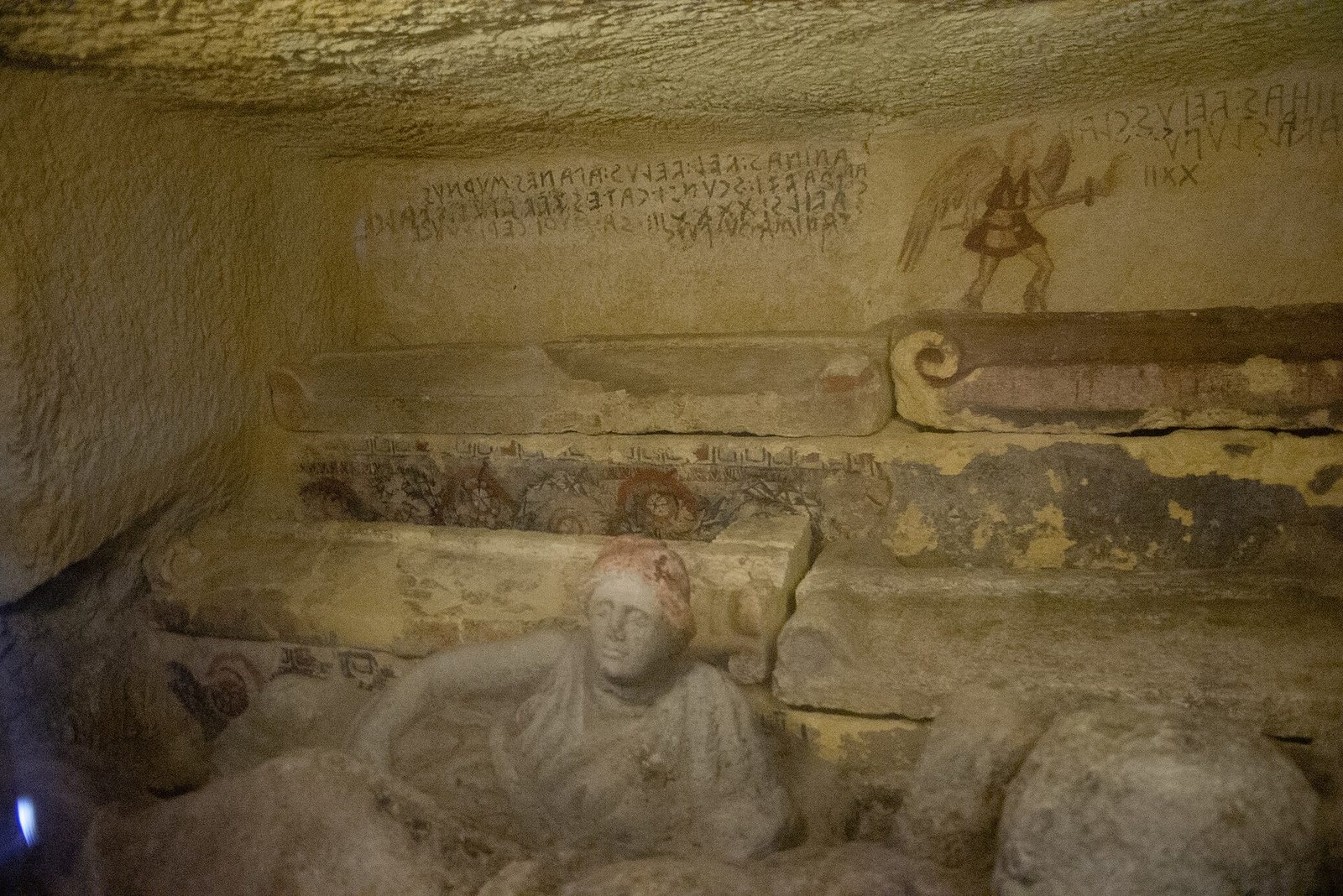
Underground chambers held sarcophagi, or stone coffins, as well as personal belongings. Stone sarcophagi appear from the fourth century BC. On the earliest examples, the deceased lies on their back on the lid. Later figures more often recline on their left side, facing the viewer and frequently holding a libation vessel for pouring liquid offerings. Some male figures hold a scroll bearing their ancestry and public offices.
From the second half of the fourth century BC, increasingly large chambers held sculpted and painted sarcophagi placed on rock-cut benches or against the walls. Made from nenfro, a volcanic stone used in central Italy, as well as marble and alabaster, they carry symbolic or mythological reliefs, often drawing on models from Tarentum, an ancient Greek city in southern Italy. Their abundance at Tarquinia points to local production, and this type continued into the second century BC.
Painted tombs
Decorated chambers
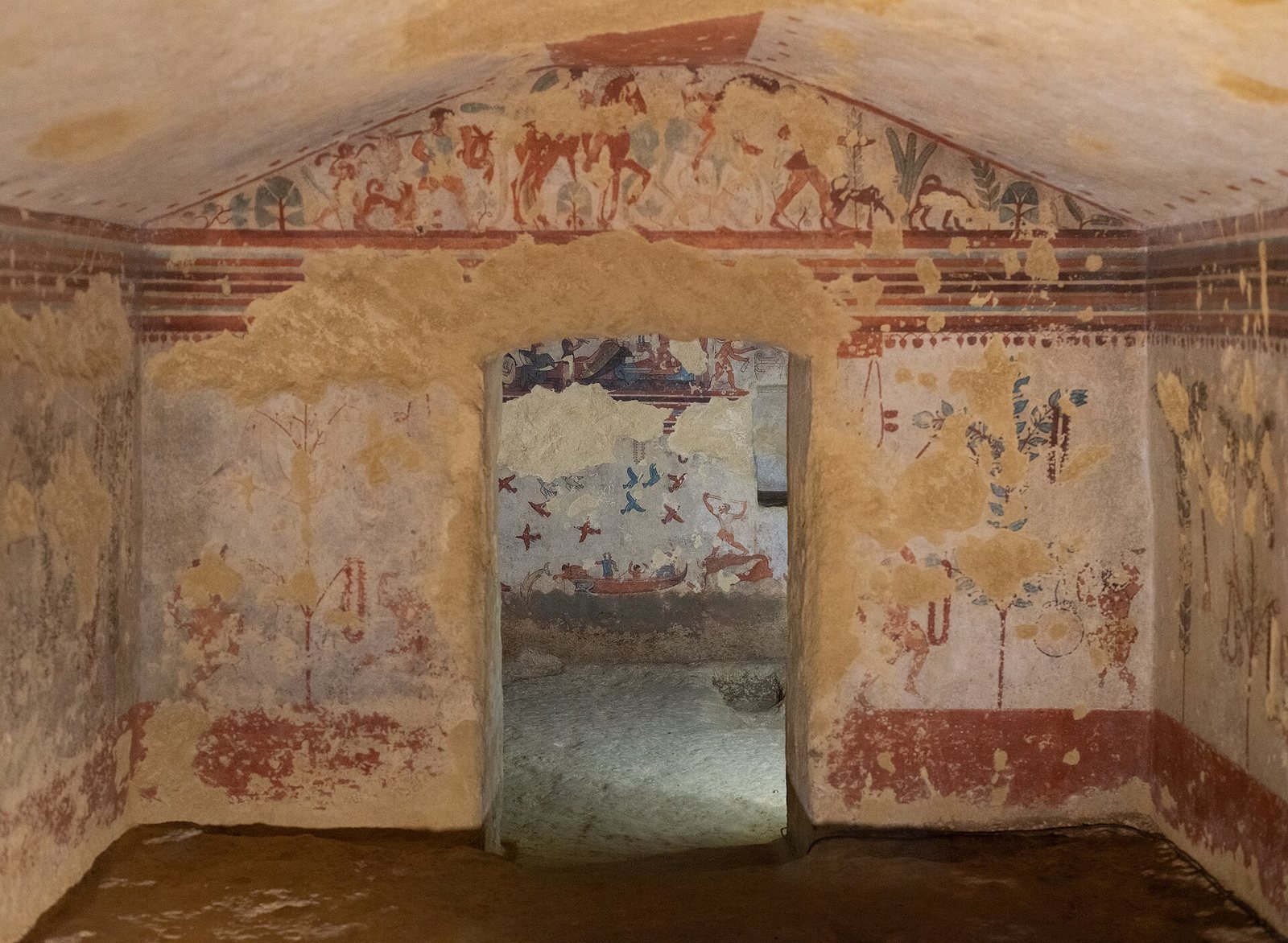
About 200 tomb chambers have wall paintings. Their subjects include ritual, animals, magical themes, dance, music, daily life, and mythology. Paintings in later chambers include underworld demons escorting the dead, scenes of the afterlife, processions of magistrates, and signs of family rank.
Tomb of the Bulls
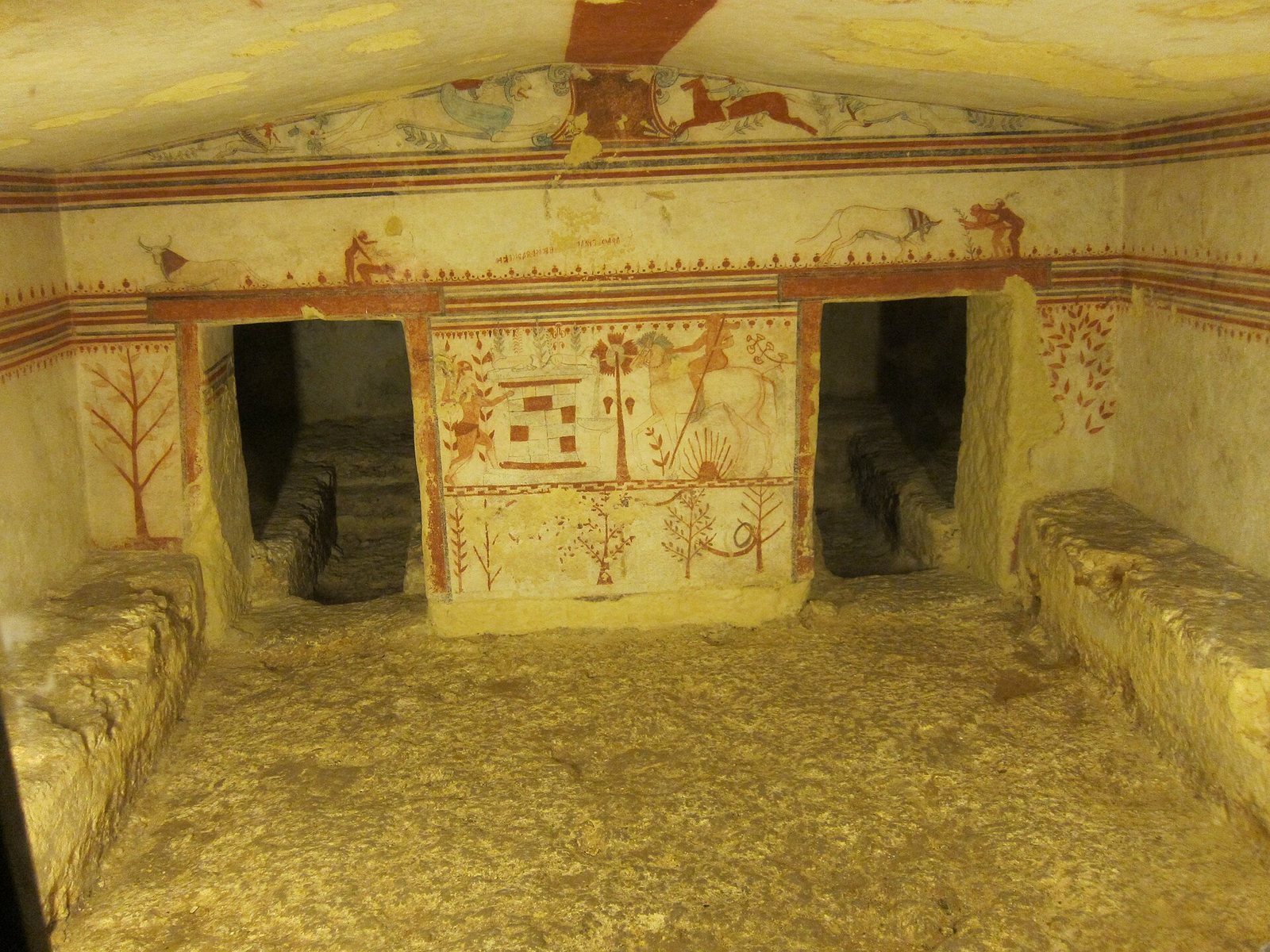
Dating to the sixth century BC, the Tomb of the Bulls has three rooms: a broad central hall and two smaller chambers entered through doorways in its end wall. Its gabled roof recalls the roofs of Etruscan houses, and paintings survive in the central hall. Between the doorways, Achilles hides beside a well as he prepares to attack Troilus. Animal sculptures decorate the top of the well, and plants fill the surrounding space. In a curved painted panel, two sphinxes occupy the left side, while a bull pursues a horseman on the right; plants fill the remaining areas. The paintings use sharply drawn outlines and figures and animals of unequal proportions. The tomb is among the few Etruscan burial chambers with erotic frescoes.
Tomb of the Augurs
This sixth-century BC tomb consists of one chamber beneath a gabled roof. On the wall opposite the entrance, a painted double door appears beside two dark-bearded men wearing long white tunics and short black cloaks. A bearded Etruscan in a short tunic dances beside trees on the left wall, with birds in flight nearby. On the right, a young athlete and an older one wrestle.
Tomb of the Lionesses
The fourth-century BC Tomb of the Lionesses is a small chamber with a pointed roof. A checkerboard design imitates roof tiles, while painted Tuscan columns, a plain classical column type, appear at the corners and midpoints of the walls as if supporting the roof. Dancers and musicians fill the central band of paintings. Below them are green and blue palmettes, followed by a seascape with leaping dolphins and birds in flight.
Other named painted tombs
The Tomb of the Leopards contains some of the best-preserved frescoes. Other notable painted chambers include the Tomb of Hunting and Fishing, the Tomb of the Triclinium, the Tomb of the Blue Demons, the Tomb of the Whipping, and the Tomb of the Bigas.
Tomb of Orcus
The Tomb of Orcus contains the only known pictorial depiction of Tuchulcha, an Etruscan underworld demon.