Bälinge Church: A Medieval Parish Church in Sweden
Site at a Glance
- Country
- Sweden
- Primary era
- Medieval
- Eras represented
- Medieval, Early Modern, Modern
- Civilizations
- Swedish
- Site type
- Religious
- Remains
- Church
On this page13 sections
History
Medieval church and later extensions
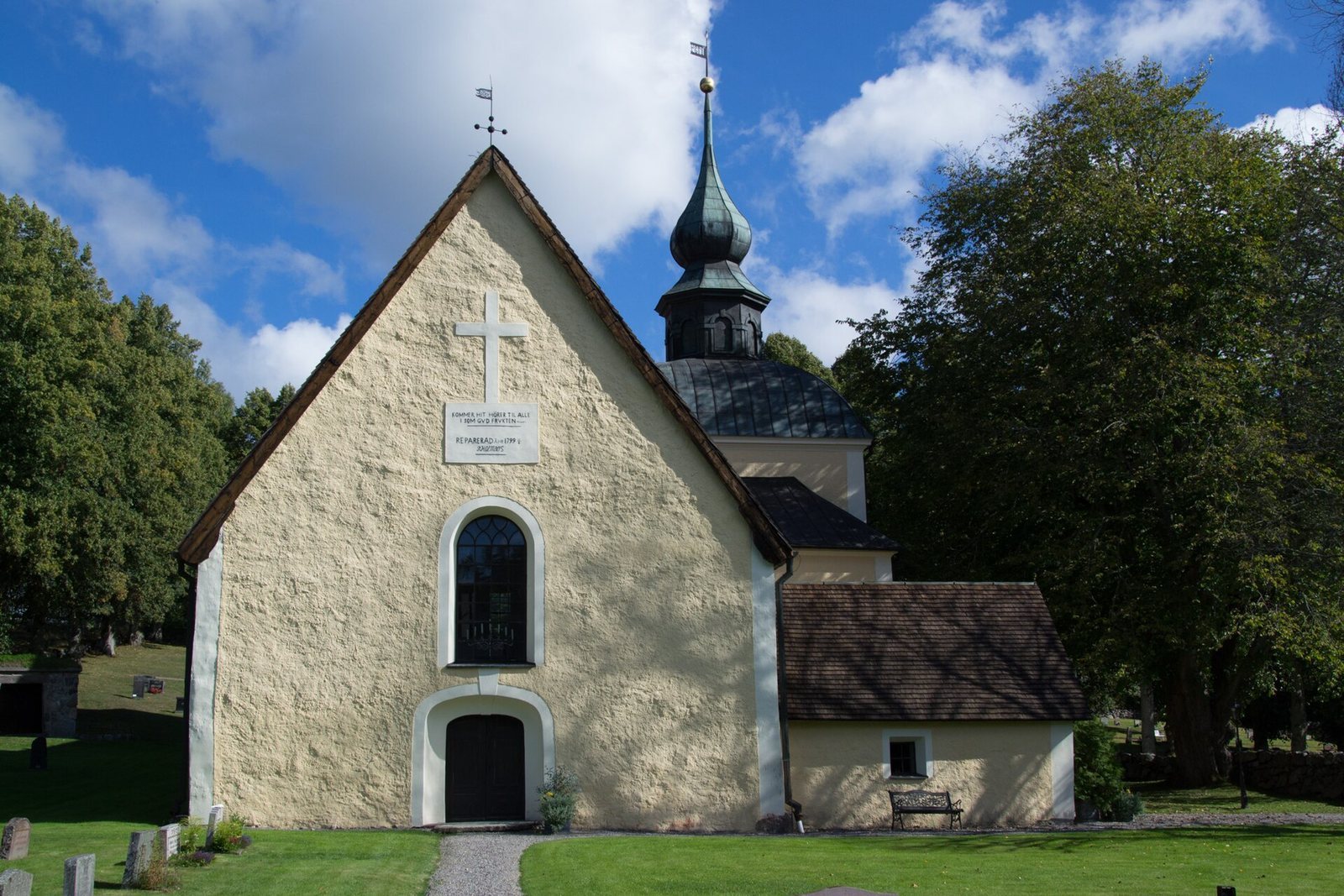
Bälinge Church is a parish church in Tystberga, Sweden, consecrated in the thirteenth century and serving Tystbergabygden parish in the Church of Sweden’s Diocese of Strängnäs. Its oldest parts were built in the late twelfth or early thirteenth century. In the mid-fourteenth century, the Swedish magnate and political figure Bo Jonsson Grip built Sundboholm Castle a few kilometres away. Around the same period, the church’s choir was probably widened and a sacristy added.
Star vaults, vaulted ceilings whose ribs form star-like patterns, were installed in the fifteenth century. In the sixteenth century, the church was extended westward, and a porch and burial chapel were added on its south side.
Seventeenth-century painting and patronage
Peder the Painter decorated the church with murals in 1621 and 1622. Ingeborg Bielkenstierna, a member of the Swedish nobility, helped pay for the work. In 1656, Erik Gyllenstierna, a councillor serving in Sweden’s high political council, and his wife Beata von Yxkull commissioned a burial chapel. A tradition links Beata’s nickname, Pintorpafrun, meaning “Lady of Pintorp,” to her cruelty.
Organs and later changes
Between 1700 and 1706, Countess Eva Lewenhaupt of Nynäs gave the church a six-stop organ. Its stops selected different ranks or sounds of pipes. She also paid to have the organ and its gallery painted, and her coat of arms was added. Olof Lax of Nyköping repaired the mechanism in 1708. Jonas Gren and Petter Stråhle of Stockholm built a seven-stop organ in 1759, which Lorentz Peter Lorin expanded to nine stops in 1805.
During the eighteenth century, the iron grille of the Gyllenstierna chapel was removed and the altar moved eastward. A new bell tower, erected in 1762, replaced an older one; in 1802 it was moved from its original position southwest of the church. Johan August Gripenstedt, a Swedish politician and finance minister, was buried in a newly built masonry chamber in the churchyard on 11 August 1874.
A major repair in 1890 altered the windows, floors, walls, vaults, pews, and gilding. The church was rededicated on 14 December that year. Its present organ, built by E. A. Setterquist & Son of Örebro, was inaugurated on the same date.
Remains
Plan and exterior
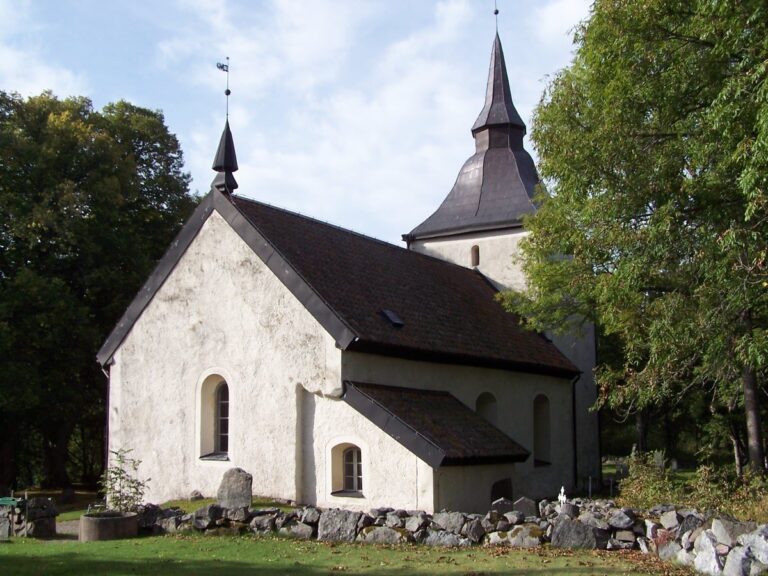
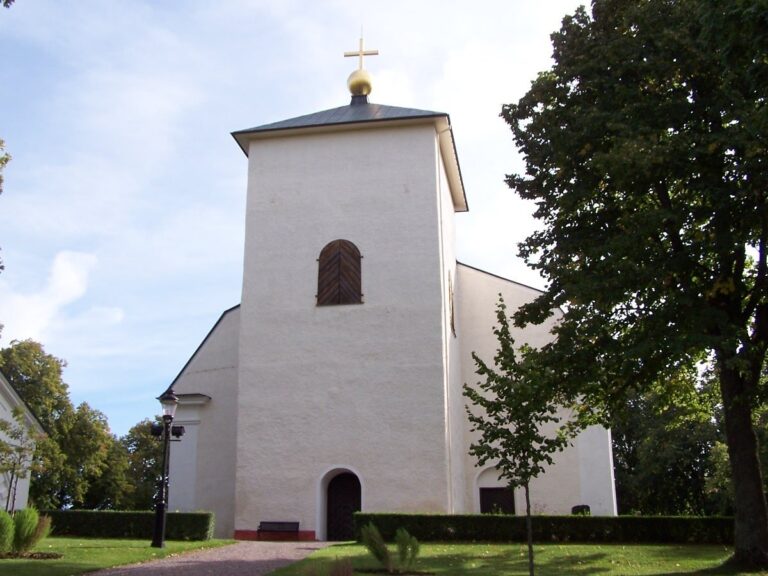
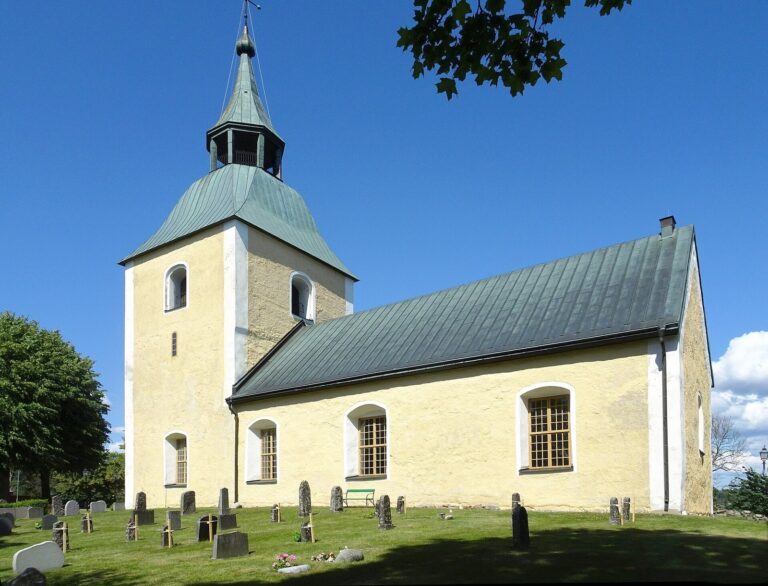
The church is built of brick and natural stone. Its earliest plan had a nave about nine metres long and a longer, narrower choir. The choir was later widened, and a sacristy added. The surviving building also includes the star-vaulted ceilings, the westward extension, a porch, and a burial chapel on the south side. At the east end, the Gyllenstierna burial chapel forms an octagonal, tower-like projection; a weather vane on its roof bears the date 1656. The bell tower now stands away from its original site southwest of the church.
Painted decoration
Choir paintings and consecration crosses
The murals are a dominant feature of the interior. In the choir, a sequence of scenes from the final events in Jesus’s life includes Gethsemane, his arrest, and his appearance before Caiaphas, the high priest. It continues with Pontius Pilate, the Roman governor associated with Jesus’s trial, washing his hands, followed by the Crucifixion, burial, Resurrection, and Ascension. The sequence ends with the Last Judgment. Painted consecration crosses survive on the pilasters between the choir and nave. These marks were associated with the ritual consecration of a church.
Nave vault paintings
The eastern nave vault depicts the Creation, with Adam and Eve at its centre. The next vault to the west shows episodes from the life of Samson, including his struggle. The westernmost vault bay represents the four elements and includes symbols for air, fire, and water. The murals draw on German Bible woodcuts and copper engravings, including prints by Albrecht Dürer.
Furnishings and organ
Altar, pulpit, and gallery
The altar furnishing, pulpit, and barrier across the gallery front are fine examples of early-eighteenth-century woodwork. A painting of Christ on the Cross forms part of the altar furnishing. The pulpit, made by Stockholm sculptor Daniel Kortz, was installed in 1709.
Donated furnishings and sacristy portrait
Gifts made in connection with the 1890 repair included an altarpiece depicting the Transfiguration, two large terracotta figures beside the altar, an altar cloth, and two seven-light wall sconces. The figures, representing Peter and Paul, are copies of works by Danish sculptor Bertel Thorvaldsen and were bought in Berlin. A large painting in the sacristy portrays parish priest Lucas Olai Gadd with his family. It is signed by Johan Raam and dated 1678.
Organ
The present organ is mechanical and retains its original condition. Its facade was designed by architect Folke Zettervall.