Blaca: A Catholic Hermitage and Monastery on Brač
Site at a Glance
- Country
- Croatia
- Primary era
- Early Modern
- Eras represented
- Early Modern, Modern
- Civilizations
- Austria-Hungary, Austrian Empire, Habsburg, Venetian
- Site type
- Religious
- Remains
- Monastery
On this page14 sections
History
Blaca is a Catholic hermitage and monastery in Nerežišća, on the island of Brač in Croatia, founded in the early 1550s by Glagolitic monks, Slavic Catholic clergy associated with the Glagolitic script and Old Slavonic worship. Its church reflects Dalmatian Baroque, a European style that developed from the late sixteenth century and is known for expressive forms and elaborate decoration. The community’s history joined religious life with shared agriculture and, later, astronomy.
Foundation and communal life
The name Blaca is recorded from 1305 and is thought to refer to mud left by an intermittent stream during heavy rain. The monks had fled Poljica as the Ottoman Empire advanced. Brač was then governed by the Venetian Republic, and the island’s local official, the count, allowed them to settle. They began cultivating land that had been donated to the community.
The Catholic community belonged to the Diocese of Hvar-Brač-Vis, a territorial district of the church. Clergy lived alongside lay members who worked the land and raised livestock. In 1570, the bishop gave the hermits permission to build a monastery and church and to live, pray, worship, and perform penance there. Construction of the church began in 1588 under priest Grgur Martinović and was completed in 1614 by priest Juraj Martinović.
A visitation by Bishop Petar Cedulin in 1621 confirmed that the brothers held their property in common. The community included priests and lay members; after a period of service, lay members could become brothers. Servants, agricultural workers, guests, and travelers were also part of life at Blaca. Members elected a superior for three-year terms, with the option of re-election. The superior directed religious and communal work, while a member could leave or be expelled after a proven breach of the rules.
Growth and economic change
In the eighteenth century, regulations associated with the Nemčić family tightened communal discipline. Boys serving the hermitage could receive an education from its clergy until ordination. Those who left after becoming priests had to repay the cost of their education. In 1757, Frane, Marko, Ante, and Ivan Nemčić took charge of the hermitage and put arrangements in place that supported its later prosperity.
A fire destroyed the church in 1724, and it was rebuilt and enlarged in 1757. A fire in 1754 and severe hail in 1784 also harmed the community’s economic fortunes and contributed to a decline in the number of hermits. Despite these setbacks, Blaca reached its greatest prosperity during the eighteenth and nineteenth centuries, although its fortunes had weakened by the nineteenth century.
Ivan Nemčić administered Blaca from 1772 to 1800. In 1785, he obtained a Venetian government decree affirming the integrity of the community’s property. Blaca expanded its holdings, grew grapes and olives, raised sheep, and traded through its cove. It became one of Brač’s strongest economic enterprises. The part of Milna’s harbor where its goods were unloaded is still locally known as Blataška Riva.
The Miličević family and the end of the community
Priests from the Miličević family administered Blaca from 1862. In 1897, administrator Nikola Miličević published the community’s rules using its own printing shop. Nikola Miličević Sr. renewed the hermitage’s prosperity from 1905 by improving agriculture and animal husbandry.
His nephew, Nikola Miličević Jr., established an astronomical observatory at Blaca in 1920, with a library, instruments, and telescopes. He studied binary stars and searched for comets and novae. A telescope he acquired in 1926 was for a long time the largest in Croatia. It was still in use in 1985, when it ranked as the country’s third most powerful.
Nikola Miličević Jr. died in 1963. As the last monk and administrator, his death brought Blaca’s life as a religious community to an end. The complex now functions as a museum. In 2007, Blaca was placed on UNESCO’s World Heritage Tentative List, and Croatia registers it as an individually protected cultural property classified as religious and secular architectural heritage.
Remains
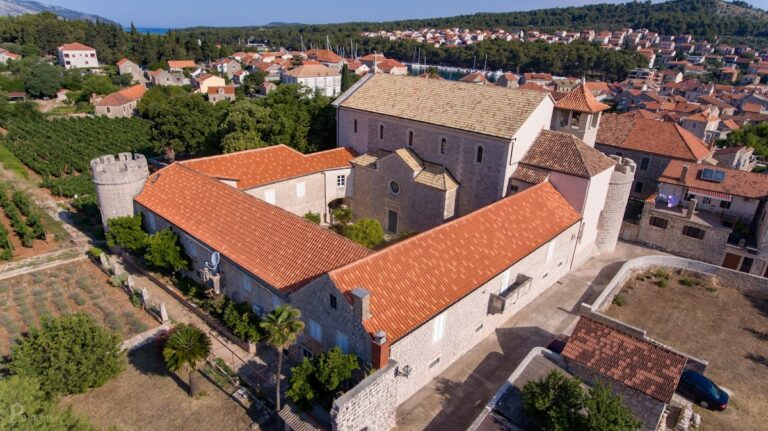
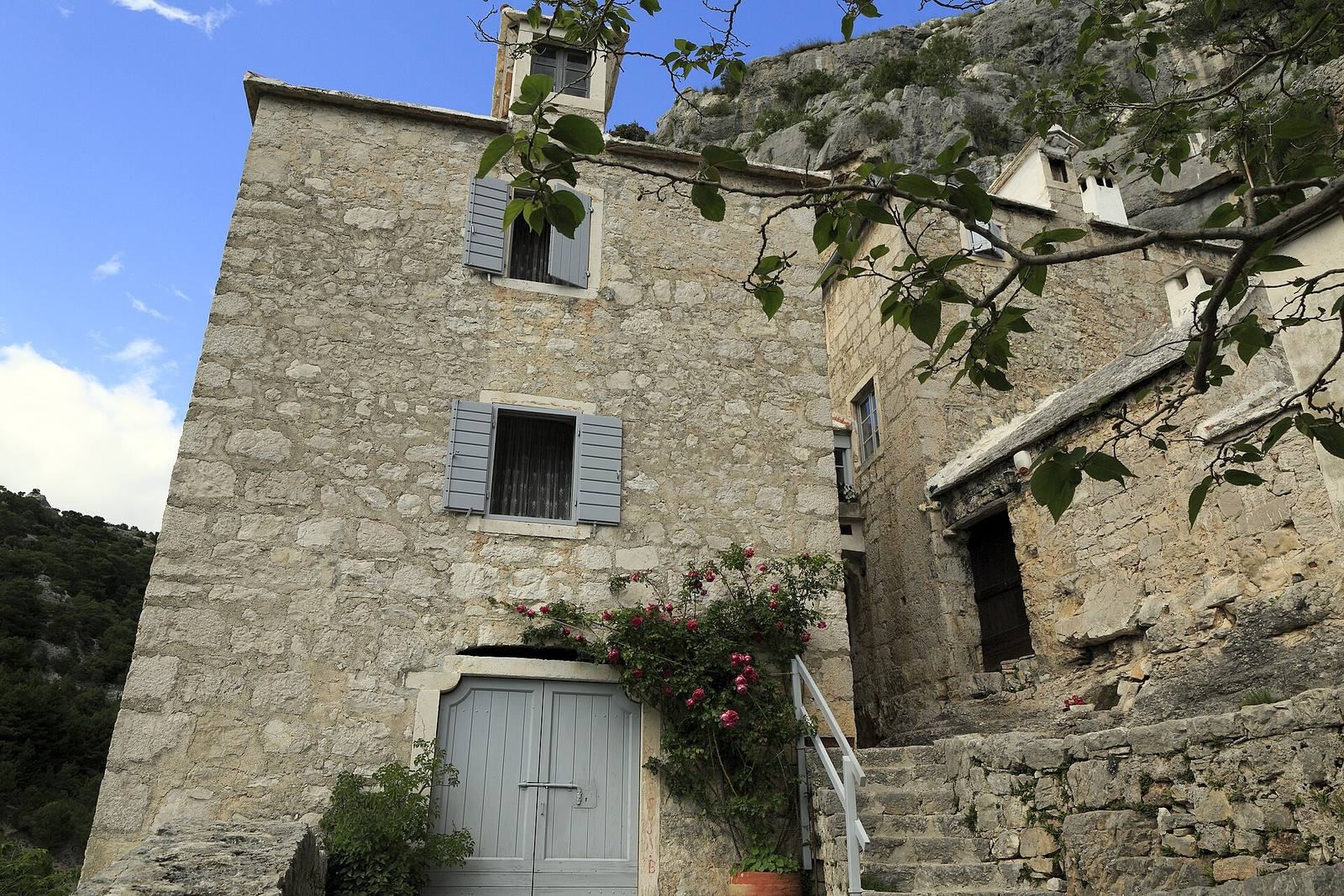
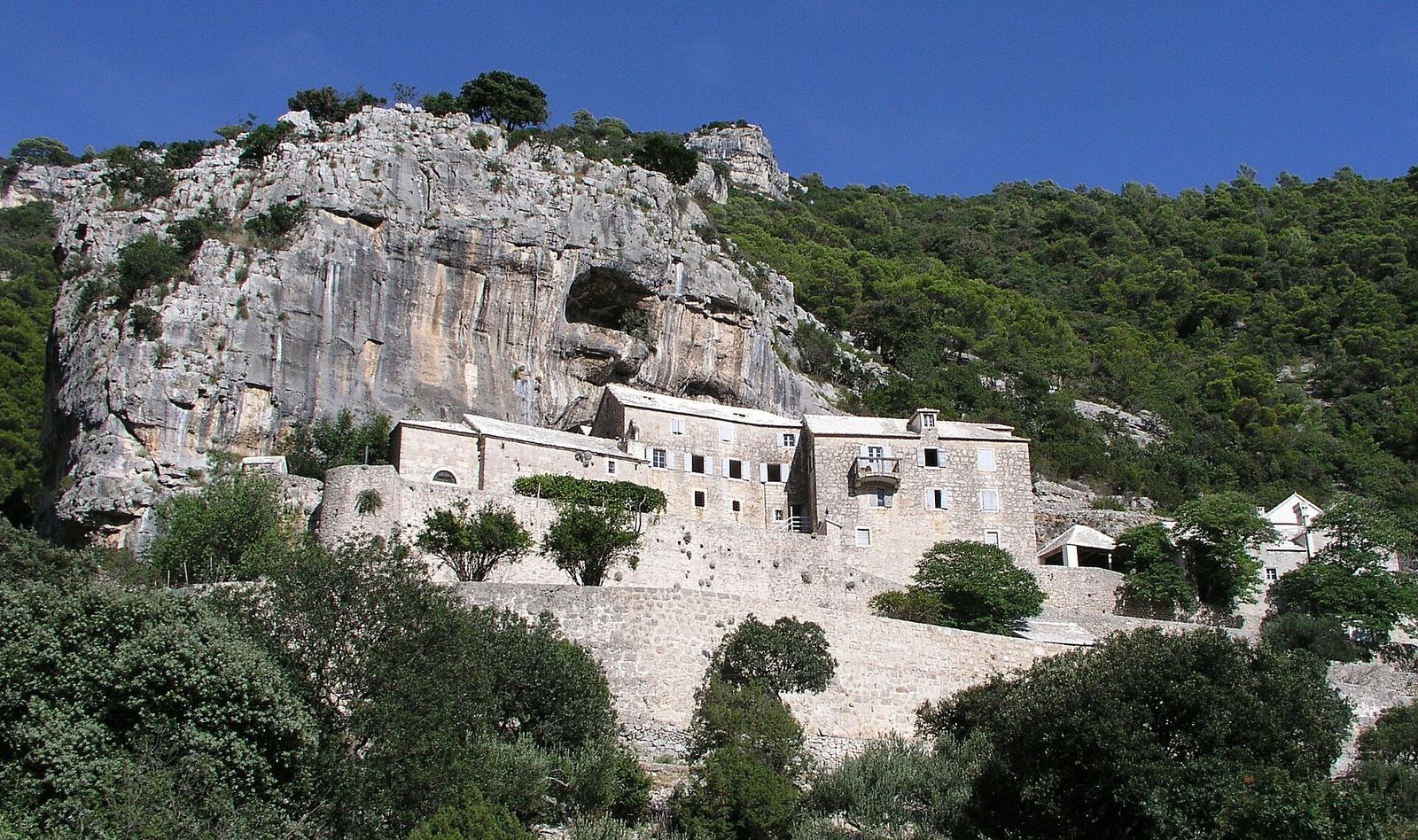
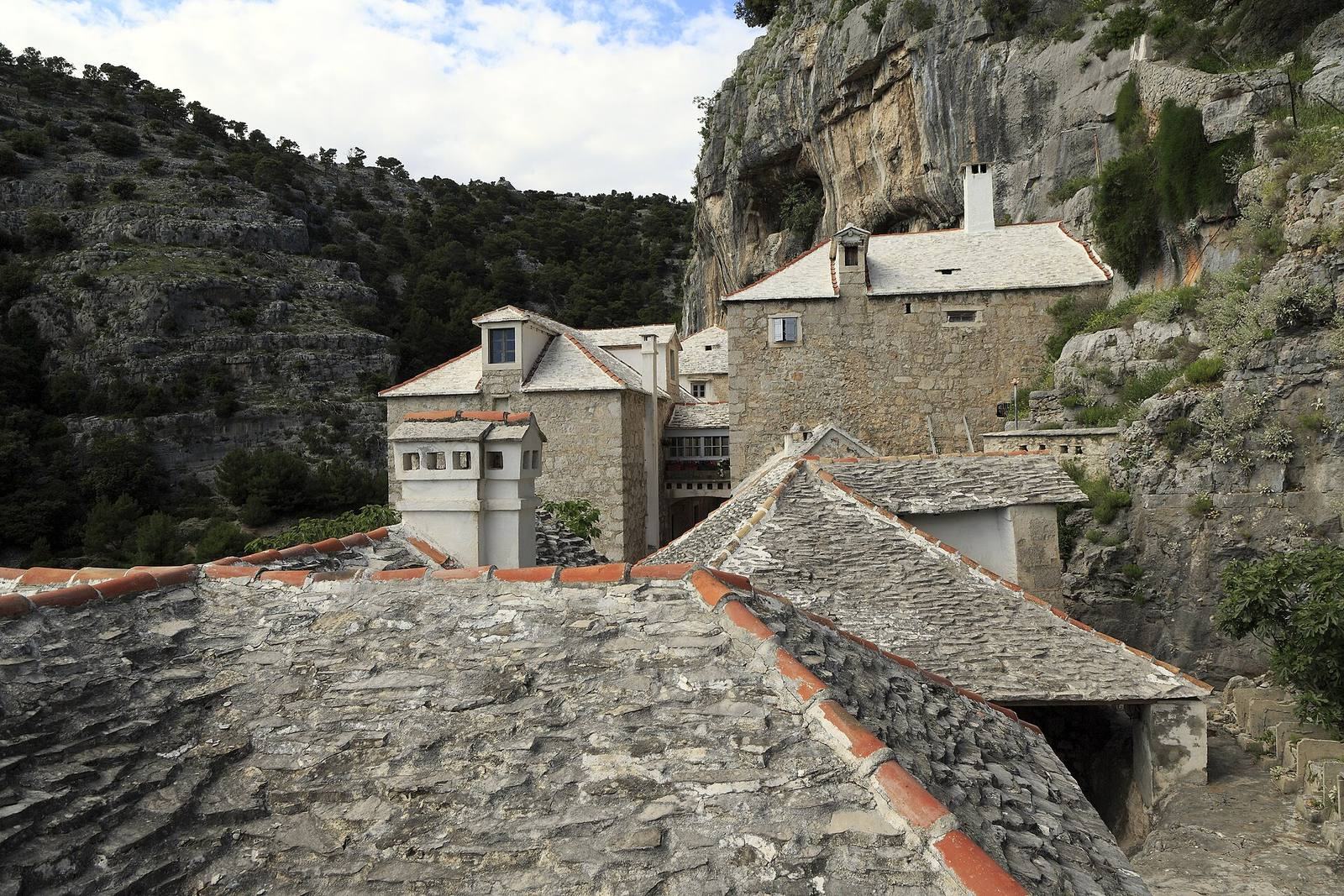
The hermitage occupies the eastern slope of a steep valley on the southern side of Brač, inland from the sea between Bol and Milna. It lies beneath a cave and about two kilometres north of the cove that shares its name. The complex began with a cave enclosed by stonework and grew into a group of stone buildings, from single-storey work spaces to larger multi-storey structures. Stone slabs cover the roofs, which are whitewashed. Restored houses and farm buildings survive with complete domestic interiors and a substantial collection of furnishings and other contents.
Church and working spaces
Church
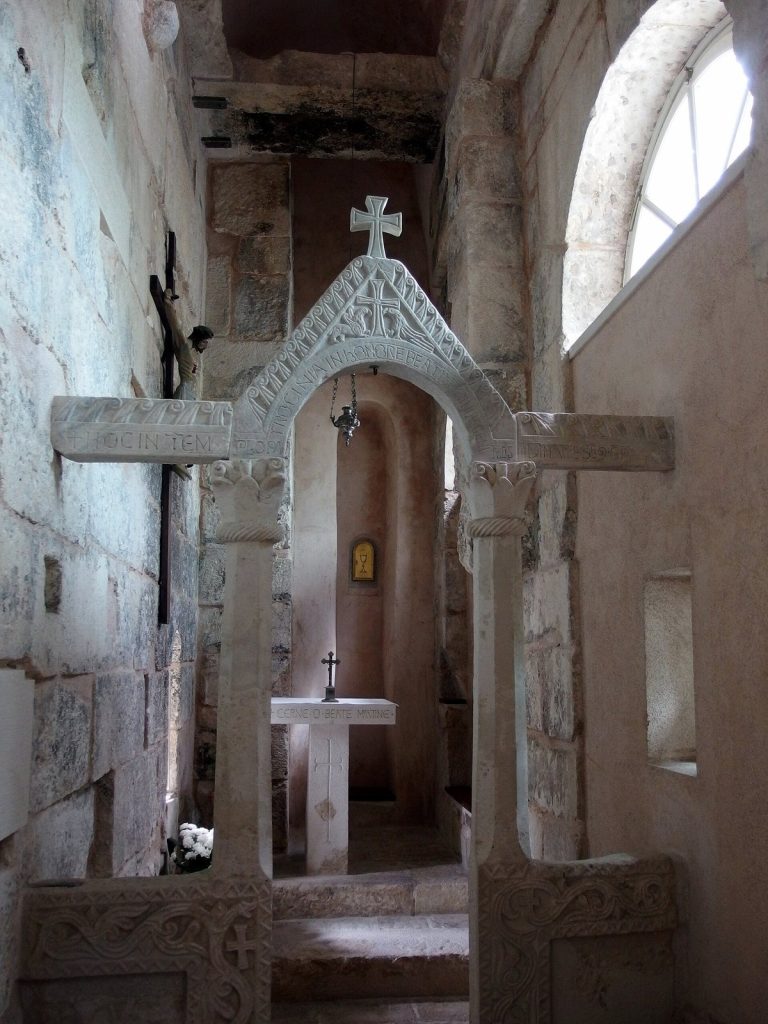
The church’s design was adapted to the nearby cave where the hermitage began. Its main façade faces south and has a raised wall with open arches for the bells. The elongated sanctuary, the area used for worship, extends north. Three Baroque altarpieces stand inside.
Kitchen and storage building
Behind the church, a kitchen is built against the rock. Its unusually large room contains a broad hearth and a chimney with a hood. The fire at the hearth was kept burning throughout the year, then extinguished and relit on Holy Thursday, the day the hearth was blessed. A two-storey building adjoins the church. A separate building southwest of it connects to the kitchen by a bridge built around the middle of the nineteenth century. Large chests for storing grain and stone mills occupied this building’s ground floor.
Farmyard and agricultural buildings
Courtyard and southern buildings
A shed in the widest part of the courtyard housed a grape press beneath a roof supported by four columns. Buildings to the south, constructed toward the end of the nineteenth century, had agricultural work spaces on their ground floors and workers’ quarters above.
Apiary and livestock facilities
The complex also includes an apiary, livestock pens, and agricultural tools. The apiary was distinctive in Dalmatia for its form and method of keeping bees.
Domestic interiors and collections
Furnishings and paintings
The southwest two-storey building contains furnished bedrooms, a reception room, and a study. Its furnishings include leather-decorated chairs, probably made in Venice in the second half of the eighteenth century and unique in Dalmatia. Two portraits by the same Venetian painter show Ivan Nemčić and his representative in Venice, Giuseppe Vavisca, each holding the other’s visiting card. Other paintings at the hermitage belong to the seventeenth-century Venetian school.
Library, printing press, and astronomical instruments
A library and desk occupy the central part of the second floor. The library holds about 11,000 books, including volumes dating from 1800. A hand-operated printing press from the late nineteenth century was used by Nikola Miličević Sr. to print historical notes about Blaca and prayer books. The museum’s collections also include the astronomical instruments and telescopes associated with the observatory.