Skultuna Church: A Medieval Parish Church in Sweden
Site at a Glance
- Country
- Sweden
- Primary era
- Medieval
- Eras represented
- Medieval, Early Modern, Modern
- Civilizations
- Swedish
- Site type
- Religious
- Remains
- Church
On this page18 sections
History
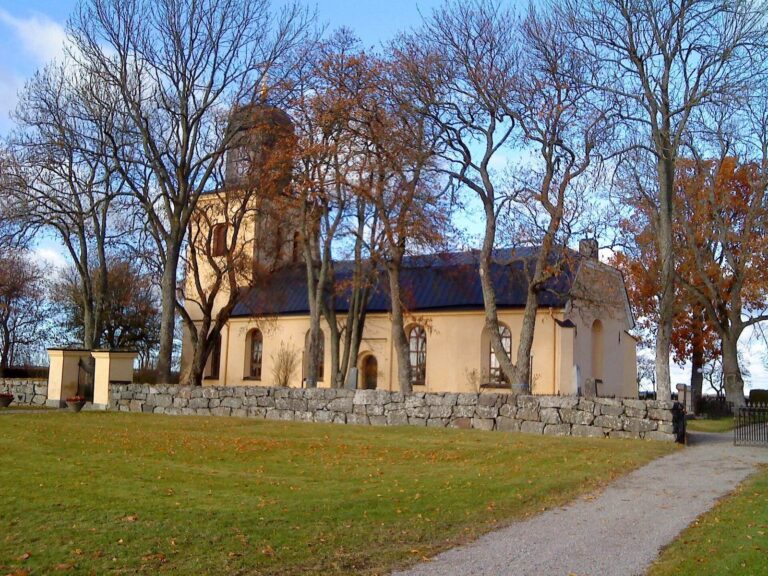
Skultuna Church is a medieval church built around 1300 in Skultuna, Sweden. It belongs to the Church of Sweden, a Lutheran church, and to Norrbo Parish, a local congregation within Västerås Diocese, a regional church administration. Its history includes major rebuilding supported by proprietors of the nearby Skultuna Brassworks.
Medieval church and early changes
A sandstone baptismal font dated to about 1200 suggests that a church probably stood nearby before the present building, perhaps a wooden one. The church erected around 1300 was initially shorter and lower than it is today. A sacristy, a room for clergy to prepare and store religious objects, stood to the north, and a porch was on the south side.
In the fifteenth century, builders added brick vaults over the nave. These were probably decorated with wall paintings. By the seventeenth century, cracks had developed in the vaults, and iron ties were used in an attempt to stabilize them. During the 1670s, the vaults were taken down and replaced by the timber ceiling. Isaac Cronström, owner of Skultuna Brassworks, helped finance this work.
Rebuilding in the seventeenth and eighteenth centuries
A major rebuilding in 1770–1772 extended the nave westward and added a tower at the west end. Carl Jacob Adlerwald, proprietor of the brassworks, contributed to its cost. The design is unsigned and is probably by Swedish architect Carl Fredrik Adelcrantz. The medieval porch and a freestanding bell tower in the churchyard were probably removed; the bells were moved into the new tower in 1771.
About a year later, Adlerwald built an eastern chancel, the area around the altar, as a burial chapel for his family. Its design is also attributed to Adelcrantz, and the altar was placed there from the beginning. The church’s furnishings changed over time, with a pulpit, organ gallery, and new pews added.
Nineteenth-century changes and modern restoration
In 1815, workers replaced the sacristy’s medieval cross-shaped vault with a timber ceiling. Architect Per Ulrik Stenhammar directed a substantial interior reordering in the 1860s. The chancel window was enlarged, the wall between the tower and nave was removed, and the floors and pews were renewed. The interior woodwork was painted grey.
Architect Fritz Eckert led an exterior redesign in 1904, partly in the Neo-Baroque style, which revives Baroque forms. The work gave the church much of its present appearance and extended the sacristy eastward. Artist Edvard August Bergh decorated the interior, while builder Nilsson remodeled the organ gallery.
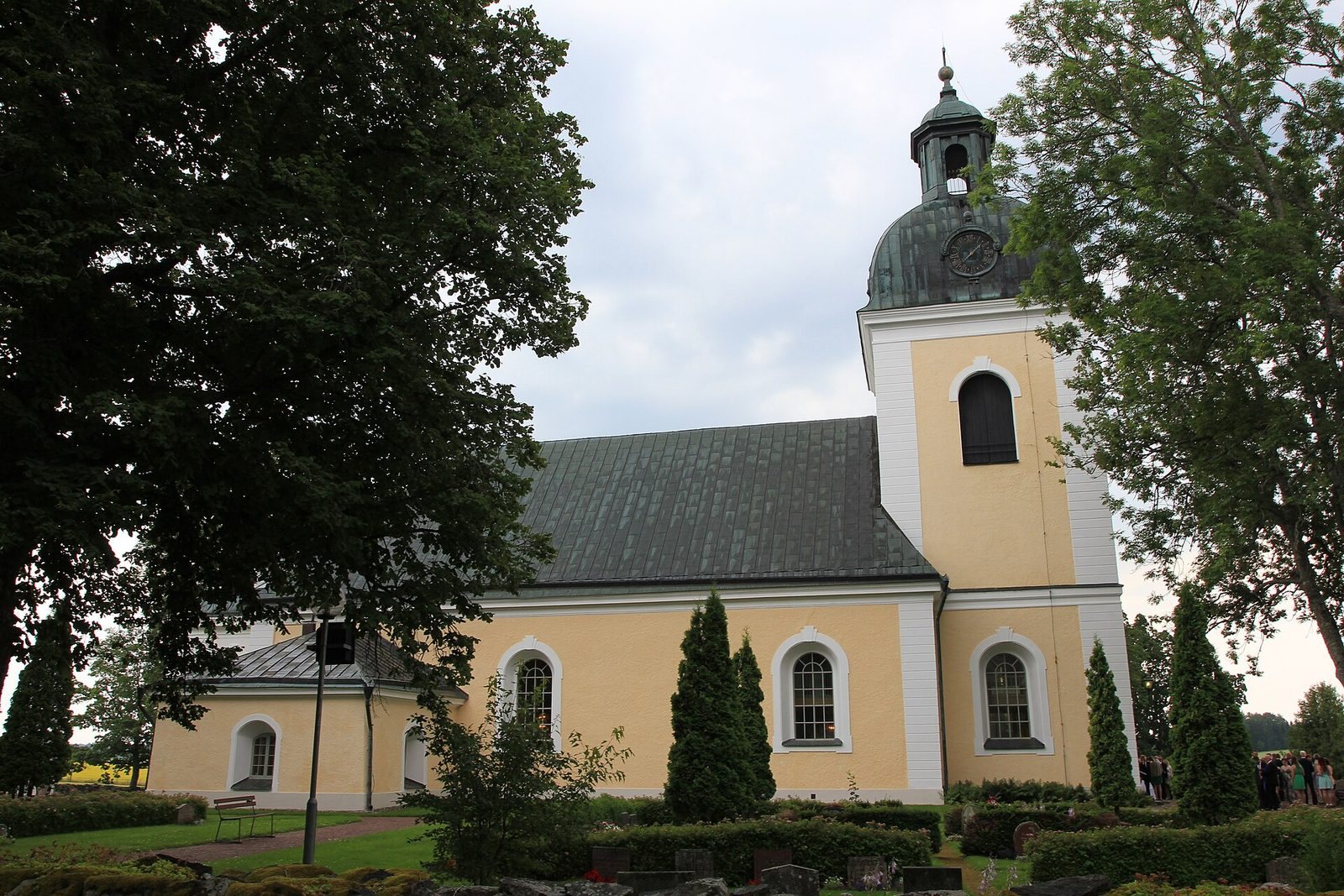
An interior renovation in 1951 sought to restore an eighteenth-century appearance. The chancel window was returned to the size and shape it had in 1773 and fitted with stained glass by Nils-Aron Berge. Workers installed closed pews and a lacquered brick floor, and whitewashed the walls and ceiling, covering Bergh’s decoration. The exterior was painted a light color with ochre accents. A 2011 facade renovation restored the yellow wall color used in 1904.
Skultuna Church lies within the Svartån Valley with Skultuna Brassworks, an area recognized for its importance to Sweden’s cultural environment. The medieval churches at Skultuna and Skerike are among the features that express the area’s heritage value.
Remains
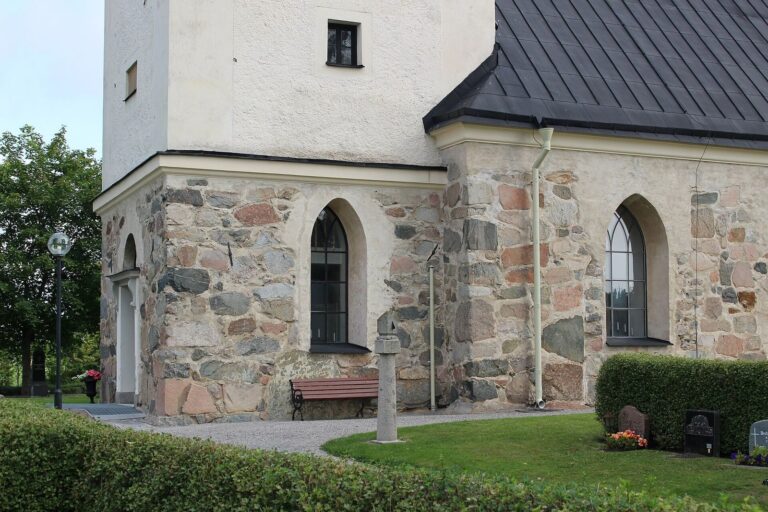
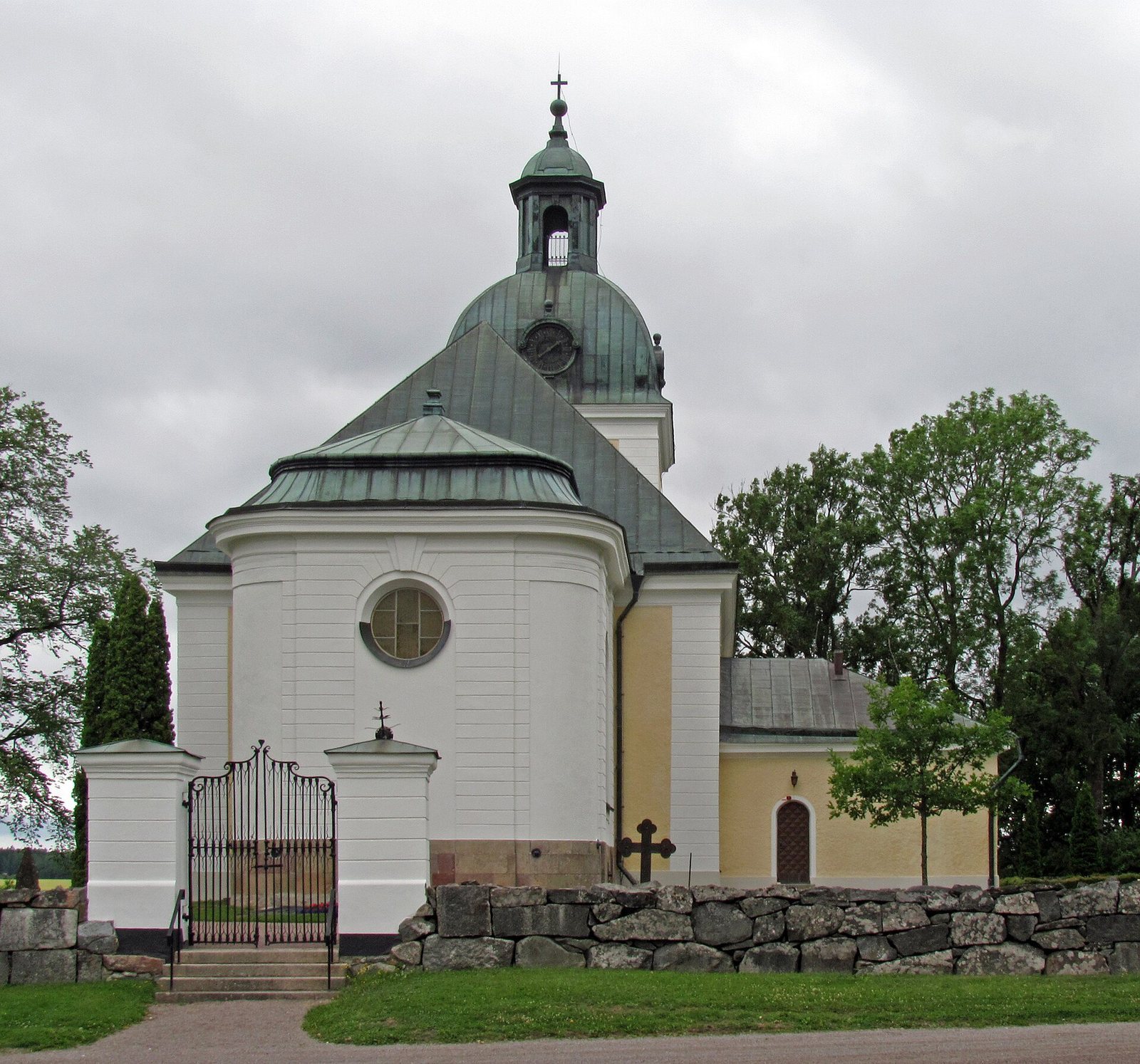
The church’s layout brings together a nave, a tower at the west end, an eastern burial chapel now serving as the chancel, and a sacristy to the north. The nave and sacristy are built mainly of fieldstone, with brick in their upper sections; the tower and chancel are brick. The rendered walls are yellow and white, with shallow vertical strips and corner blocks that give the surface a strongly jointed appearance.
Exterior and plan
Sculpted limestone portals frame the south and west entrances. Smooth plaster surrounds the windows and the vertical strips added or reshaped in the 1904 exterior design. The nave has two large round-arched windows on each long wall, and the tower has two more. A smaller semicircular opening sits above the south entrance, while a circular window is set in the chancel wall.
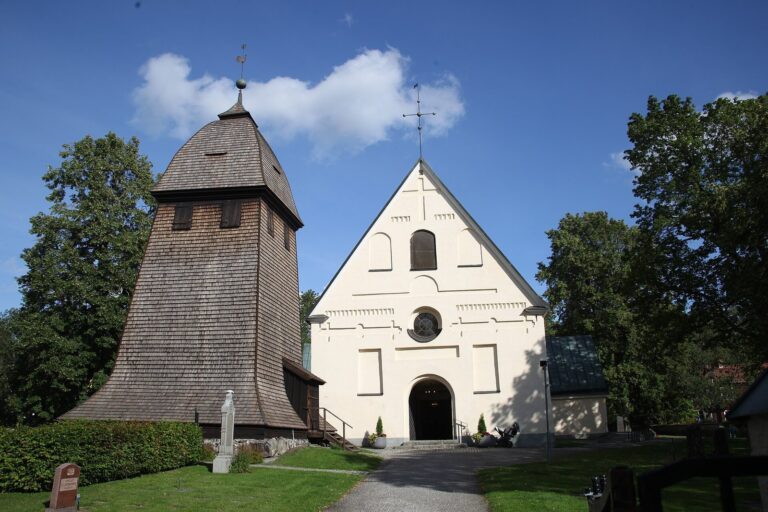
The nave has a partly hipped roof, with some slopes turning down toward the ends; the sacristy has a tent-shaped roof, and the chancel a domed one. Copper sheets cover all three. A copper-clad cap tops the tower, with a four-sided upper structure above it. A mid-eighteenth-century depiction by Olof Grau shows the earlier church with high gables and a three-part window at the chancel end, as well as a shingle-covered freestanding bell tower in the churchyard.
Interior layout
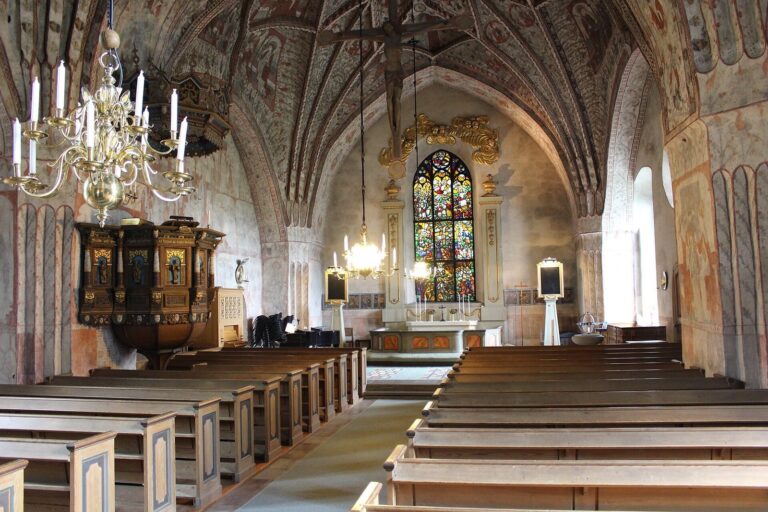
The church room has a single aisle and a high timber barrel vault, a tunnel-shaped ceiling. Its floor is laid in lacquered brick. Closed pews form two blocks divided by a central aisle, and the pulpit stands toward the front of the nave. The altar is in the eastern chancel beneath a circular window with stained glass; the organ gallery is at the west end.
Furnishings and memorials
Altar and related furnishings
The wooden altar dates to 1865 and carries gilded ornaments. Some were donated in 1874 and had previously belonged to a pulpit at Västerås Cathedral. Behind the altar stands a seven-branched brass candlestick, given in 1692 by parish priest Johan Rabenius. Julia Nyberg, an author and songwriter best known for Vårvindar friska, is buried beneath the altar area.
Pulpit and memorials
The pulpit, dated to 1773, was made to designs by master mason Anders Bergström and came from Västerås Cathedral. Its curved Rococo decoration, an eighteenth-century style of ornamental forms, includes green marbling and gilded emblems. The church also holds a carved bishop’s chair from about 1650, funeral panels bearing the arms of Carl Jacob Adlerwald and Captain Marcus Cronström, and an epitaph for parish priest Magnus Swederus and his wife, Anna Maria Christiernin. Adlerwald and Cronström died in 1788 and 1688, respectively.
Crucifix and altar painting
A brass group showing the crucifixion, with a silver-plated cross, is displayed above the pulpit door. Cronström gave it in 1673 as an altar ornament. In 1679, an altar painting of Christ praying took its place. Johan Johansson Aureller the Elder painted it, and Adlerwald donated it. After serving as the altar painting until 1865, it was hung on the south wall.
Baptismal objects and medieval figures
Sandstone font
The relatively well-preserved sandstone baptismal font dates to about 1200. It has a chain-like pattern around its upper ring and four equal-armed crosses on its base.
Brass baptismal bowl
The baptismal bowl still in use was donated by Cronström in 1673. Its decoration was shaped by hammering the brass from the reverse side, and its lid is topped by a figure of John the Baptist. Artist Pierre Forssell made the bowl’s foot in 1967.
Angel figures
Two medieval angel figures once served as tops for candle staffs. One held a bell, and a cord allowed its arm to move and ring it during Mass. The heavily restored figure is attached to the foremost pew, with a modern copy across the central aisle. The second, fragmentary figure is on the north wall beside the sacristy door.
Organ and bells
Organ
An organ from Västerås Monastery, which was being demolished, came to the church during the sixteenth century and was transferred to Västerås Cathedral around 1580. Pehr Zacharias Strand of Stockholm built a 12-stop organ in 1829; stops control groups of organ pipes, and its facade was in the late-eighteenth-century Swedish Gustavian style. E. A. Setterquist & Son built a pneumatic organ, operated through air pressure, in 1905 while retaining the earlier facade. Åkerman & Lund enlarged the instrument and changed its stops in 1951. Its controls included graduated volume settings and a mechanism that progressively added stops.
Bells
Two bells hang in the tower. The great bell weighs 1,820 kilograms and was last recast by Gerhard Horner in 1809. Its inscription calls the living to worship and instruction, and speaks of the dead awaiting judgment. The smaller bell weighs 860 kilograms and was last recast by J. G. Liljendal in 1839. Its inscription calls people to worship and the Sabbath, urging them to repent before death and to look toward rest in Jesus.