Vatopedi Monastery: An Orthodox Monastery on Mount Athos
Site at a Glance
- Popularity
- High
- Country
- Greece
- Primary era
- Medieval
- Eras represented
- Medieval, Early Modern, Modern
- Civilizations
- Byzantine, Ottoman
- Site type
- Religious
- Remains
- Fortified Monastery
On this page18 sections
History
Vatopedi Monastery is an Orthodox monastery at Karyes on Mount Athos in Greece, probably founded around 980 by three monks from Adrianople. The founders, Athanasios, Nicholaos, and Antonios, were Thracian nobles and disciples of Athanasius the Athonite. A document from 985 identifies Nicholaos as abbot and one of the founders. Vatopedi ranks second in the fixed order of Mount Athos’s twenty Orthodox monasteries, a community recognized as the Holy Mountain under regulations approved by Emperor Constantine IX Monomachos in 1046.
Foundation and Athonite status
Later traditions offer different accounts of the monastery’s beginnings. One places an earlier foundation here in the fourth century, attributing its construction to Constantine, its destruction to Julian, and its rebuilding to Theodosius the Great. In this story, Theodosius acted in gratitude after his son Arcadius, lost overboard from a ship, was found ashore beside a bramble through the Virgin Mary’s intervention. Another tradition says Saracen raiders attacked the monastery in 862 and that the three founders later rebuilt it with 3,000 gold coins. These stories are separate from the probable foundation around 980.
The monastery’s name is also explained in two ways. One tradition connects it to the bramble beside which Arcadius was rescued; another derives it from bramble-rich vegetation around the monastery. Vatopedi was first dedicated to the Presentation and later to the Annunciation of Mary, honored in Orthodox Christianity as the Theotokos, or Mother of God. Its feast is observed on March 25, also given as April 7.
Vatopedi is a patriarchal, stavropegial monastery, meaning it answers directly to the Ecumenical Patriarchate of Constantinople rather than to a local diocese. It is also classed as an imperial monastery, a status associated with an imperial foundation or recognition by charter. The Charter of Mount Athos fixes the number of sovereign monasteries at twenty and establishes their hierarchy. Each has a council of elders and an abbot elected for life. The abbots make up the Holy Assembly, which meets twice a year at Karyes, while the Holy Epistasia and Holy Community carry out executive and administrative duties through representatives elected annually.
Byzantine patronage and growing estates
The Byzantine Empire, the medieval continuation of the Roman Empire centered on Constantinople, supported Vatopedi through imperial grants and financial assistance. Constantine IX established a pension for the monastery in a typikon, a document setting out religious or monastic rules. Theodora Kantakouzene and her son, the future Emperor John VI Kantakouzenos, gave it a dependent property at Serres. John VI also helped pay for construction and granted further properties. Emperor Andronikos of the Palaiologan dynasty provided funds after periods of insecurity and attacks on monasteries across Mount Athos.
By the eleventh century, nine smaller monasteries were under Vatopedi’s direction. Its properties grew substantially between 1080 and 1350, extending across Thrace, Macedonia, Chalcidice, and Thessaloniki. Donations came from Byzantine aristocrats, state funds, senior officials, and Serbian patrons. Some aristocratic families established religious foundations that offered a place of retirement, prayers for the founder and family, and protection for family property.
Land, trade, and late Byzantine pressures
Documents from the first half of the fourteenth century describe villagers selling fields to the monastery. One sale followed famine after a Catalan mercenary raid; another document describes a landowner suspending a vineyard tenant’s rent for several years to help establish the vineyard. In 1328, the founder of the family monastery of Prodromos of Petra transferred it to Vatopedi after settling there near the end of his life. The monastery’s records also preserve disputes with other Athonite communities. Much of its surviving archive begins after the thirteenth century, and raids may account for the loss of earlier documents. Catalan mercenaries ravaged some monasteries on Mount Athos in the early fourteenth century.
Vatopedi’s ships first served to supply the monastery and connect its properties, and later took part in commercial trade. A 1356 imperial charter exempted the monastery from taxes on maritime commerce, including trade that could reach cities and islands throughout the Byzantine Empire. By the late fourteenth century, it also served as a place where rural landowners deposited assets they considered secure.
Vatopedi formed a close relationship with the monastery of Chelandari, including shared participation in some celebrations. The relationship’s beginnings are associated with a request by Serbian prince Stefan II that Chelandari be entrusted to two monks from Vatopedi: Stefan Nemanja, who became the monk Simeon, and his son Rastko, who became the monk Sava.
After defeat at the Battle of Maritsa in 1371, Vatopedi and other monasteries surrendered some property to pronoia holders, who had been granted rights to revenue as part of the state’s defenses against the Turks. From the mid-fourteenth to the early fifteenth century, Serbian despots granted Vatopedi villages and annual income, including revenue from a lake.
Ottoman rule and modern changes
Heavy Ottoman taxation placed Vatopedi under severe financial pressure in the seventeenth century. It sold some land to meet its needs, despite help from Russian tsars and princes of the Danubian regions. Donations in the eighteenth century improved its finances and supported construction, restoration, and maintenance beyond the monastery itself. The nearby island of Ammouliani belonged to Vatopedi until 1925. Two or three monks managed its 4.5-square-kilometre estate with about twenty agricultural workers, who raised livestock and cultivated olives. After the island received refugees from Asia Minor in 1925, its inhabitants developed a fishing industry.
Metropolitan Gerasimos of Drama lived at Vatopedi in 1788 and paid for a chapel dedicated to the Apostle Andrew in the reception hall. Daniel of Smyrna, later known as Daniel Katounakiotis, spent about five years at the monastery after returning to Mount Athos from exile. Vatopedi sent him to Smyrna to manage its affairs, and he later returned to Athos. An Armenian Orthodox community known as the dzaith also lived at the monastery before ceasing to exist as a distinct community.
Until 1990, Vatopedi followed an idiorrhythmic rule, which allowed monks greater variation between solitary and shared religious practice and permitted paid work and personal possessions. That year it became cenobitic, organizing prayer, meals, and work communally. In 1822, Turkish soldiers arrived at the monastery and one fired at the icon Pyrovolitheisa.
In 1912, Bulgarian military persecution of Greeks led to the expulsion of Nikodimos, the last Metropolitan of Lititsa, from his see in northern Thrace. He settled at Vatopedi in 1929 and died there in 1930. A major fire in February 1966 destroyed part of the north wing. Restoration continued from 1966 to 1973, and the restored building came to accommodate sculpture displays, a gallery, library facilities, bookbinding and manuscript conservation, storage, offices, a meeting hall, and guest rooms.
In 1988, Mount Athos, including Vatopedi, was inscribed as a UNESCO World Heritage site. A 2008 political controversy concerned alleged exchanges of monastic land assessed as having low value for more valuable state property under Prime Minister Kostas Karamanlis. The exchanges were cancelled, two ministers resigned, and court proceedings ended with the acquittal of all those accused; no financial loss to the public treasury was found.
Remains
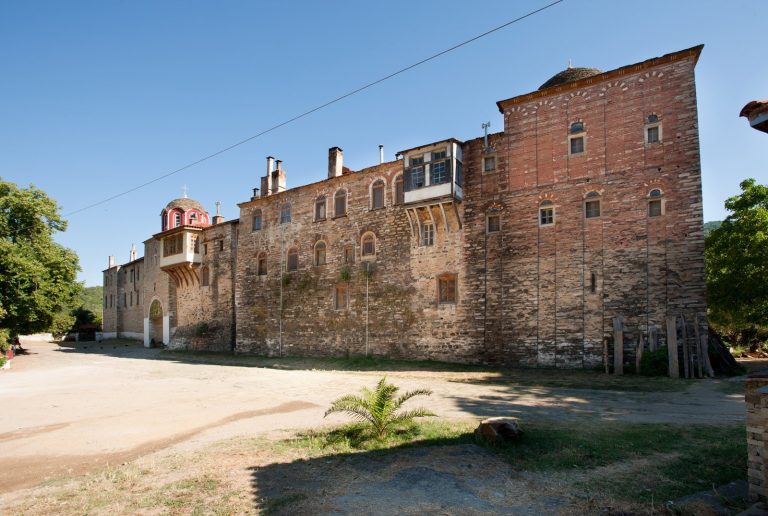
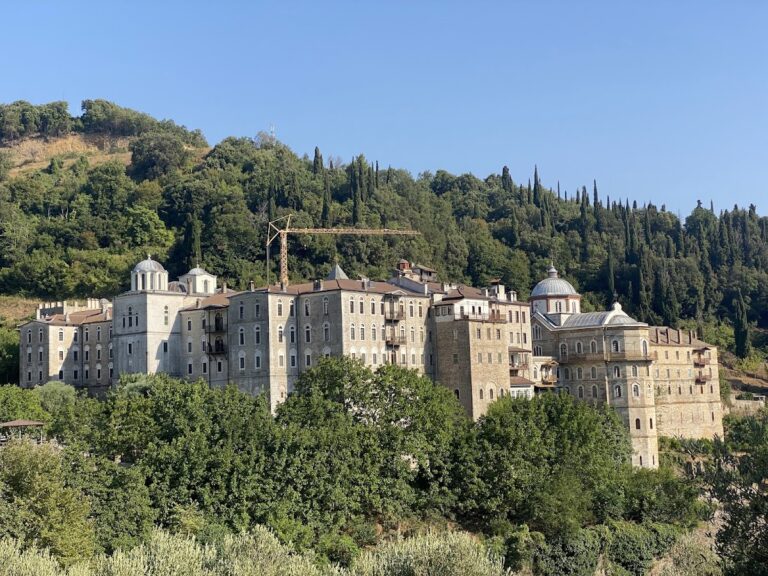
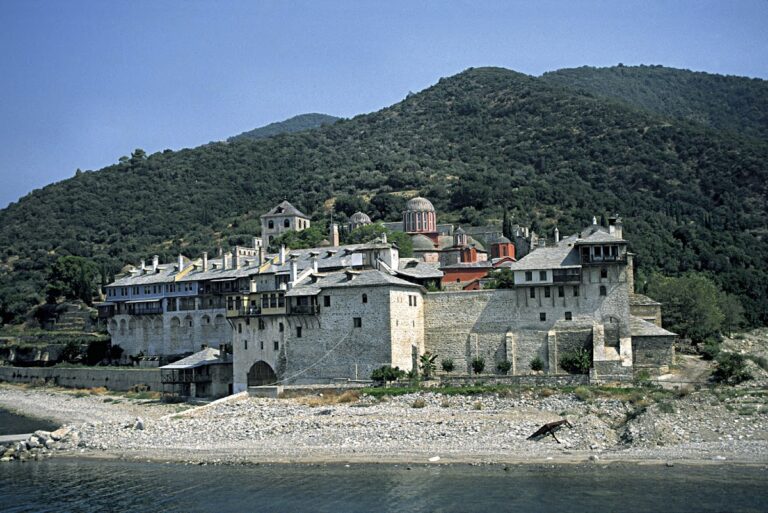
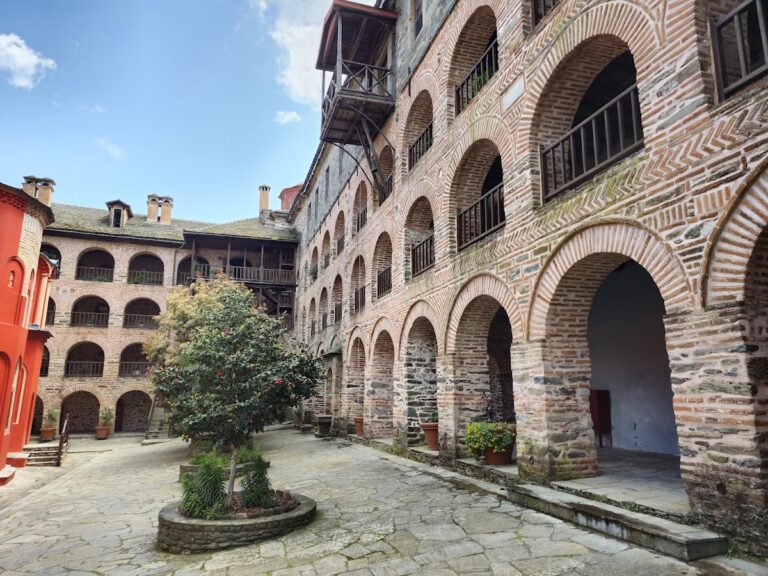
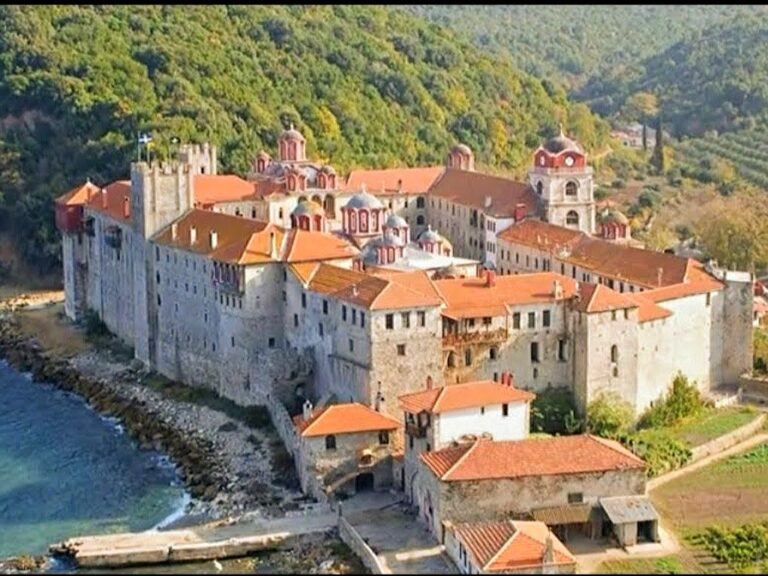
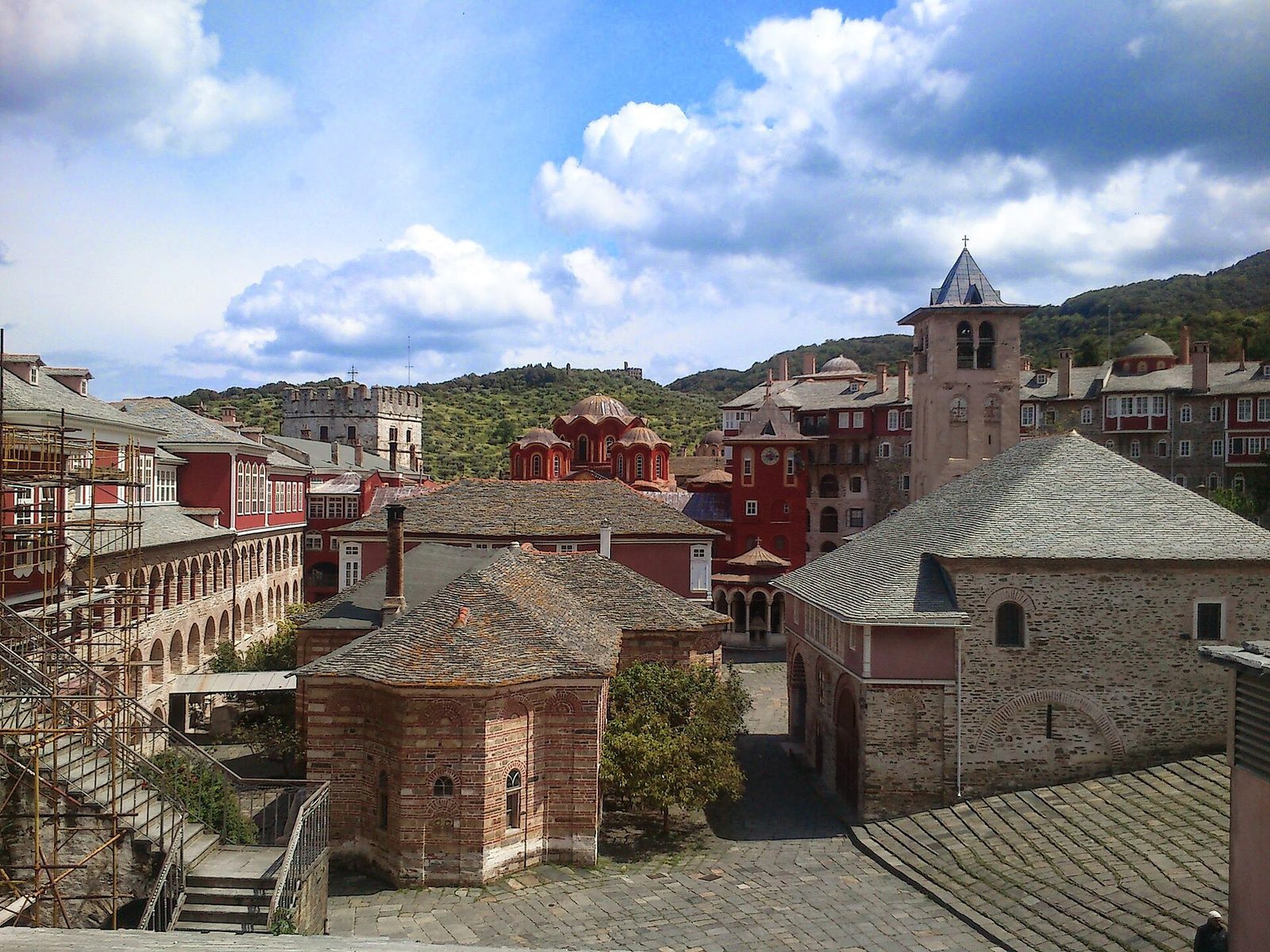
Vatopedi’s built area covers 15,900 square metres on the northeastern side of the Mount Athos peninsula, east of a large bay once called the Harbour of Clement. Its buildings and defensive towers form a polygonal enclosure around a paved courtyard, where the principal church and several chapels stand. The complex combines buildings from different periods, including the tenth-century church and later additions to its entrance areas, towers, and surrounding monastic structures.
Church and central courtyard
Principal church
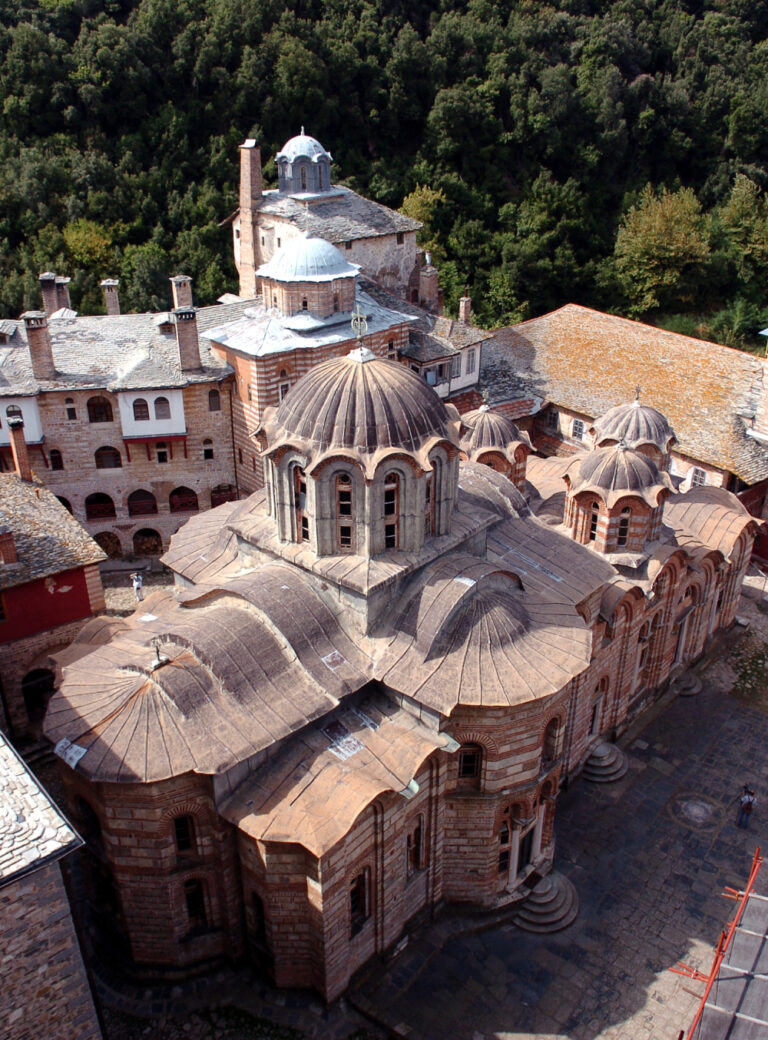
The monastery’s principal church, or katholikon, dates to the tenth century and has undergone later renovations. It stands above the remains of an early Christian basilica. Foundations of an early Christian basilica have also been excavated north of the present church. The church has three apsidal projections, a form known as a triconch, with an apse on each side of the nave beneath the dome; each side apse is covered by a half-dome. This arrangement is thought to have allowed monks singing during services to gather together. The marble-inlaid floor is noted for its workmanship.
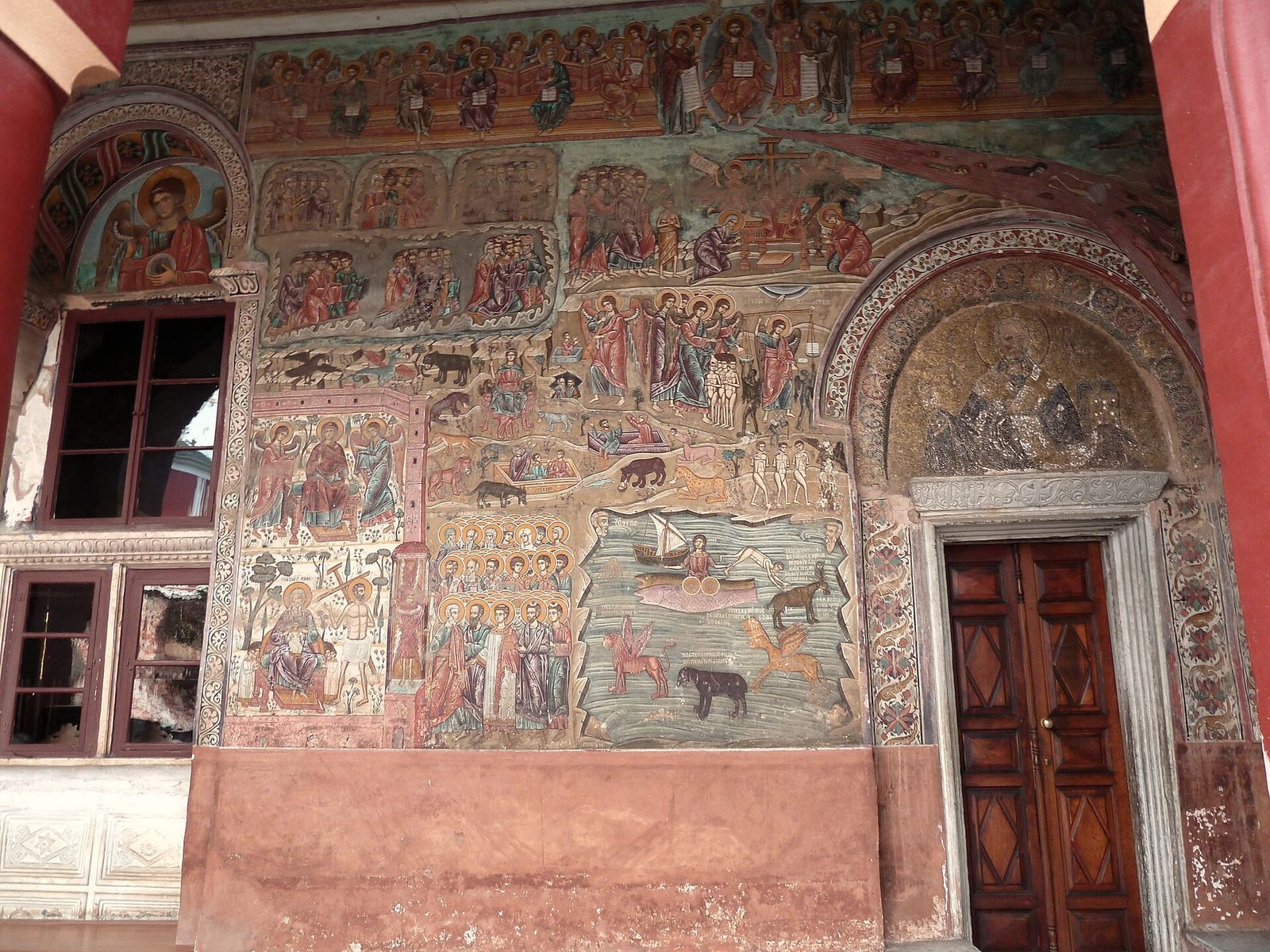
The church’s wall paintings belong to the Macedonian School, a Byzantine painting tradition, and date to 1312. Paintings in the inner narthex, the entrance area at the west end of the church, have not been overpainted; most of the other paintings have been retouched, in some cases more than once. Three Byzantine wall mosaics date from between the tenth and fourteenth centuries and are described as unique on Mount Athos.
Church entrances and bell tower
The church’s outer entrance hall and bell tower date to the fifteenth century. The tower has five storeys and an eighteenth-century roof, and is described as the oldest bell tower on Mount Athos. A church tower also has a clock mechanism that marks the hours with a human-shaped figure holding a hammer. The carved screen separating the sanctuary from the main worship space dates to the eighteenth century.
Refectory and treasury
The refectory was built in the same period as the principal church. A treasury above its eastern section dates to after 1792. A separate treasury occupies the upper floor of the two-storey building south of the refectory, whose ground floor serves as a storehouse for liquids. That storehouse has undergone at least three renovations.
Fountains and service buildings
The courtyard’s central fountain was rebuilt in 1810. South of the liquid storehouse is the small neoclassical Miller Fountain. Another neoclassical fountain is built into the base of the bell tower and bears a plaque dated 1788. An octagonal shelter covers a well east of the tower. A separate two-storey building south of the bell tower has fuel storage on the ground floor and a flour store above.
Other churches and chapels
Churches in the complex
The Church of the Holy Girdle stands on the western side of the courtyard. Built in 1794 over an earlier building, it contains a finely carved, gilded wooden screen dating to 1816. The Church of the Holy Unmercenary Saints is among the monastery’s oldest buildings; an inscription in its entrance hall gives the date 1847. The cemetery church is dedicated to the Holy Apostles.
Chapels
The monastery has thirty-three chapels, twelve outside the main complex and the remainder within it. Five are incorporated into the principal church, dedicated to Saint Demetrius, Saint Nicholas, Paramythia, the Holy Archangels, and the Holy Trinity. Three chapels occupy defensive towers and are dedicated to the Nativity of the Theotokos, the Transfiguration, and Saint John the Forerunner. Eleven are in the monastery wings and two in the courtyard. The chapel of the Apostle Andrew has a carved wooden screen.
Library, archive, and sacred objects
Library and archive
The library and archive are housed in a defensive tower and two other buildings. The library holds about 2,000 manuscripts, roughly a third on parchment, as well as twenty-five parchment scrolls. Its 60,000 printed books include many incunabula, books printed before 1501, and other early works. Manuscripts cover religious and secular subjects, including geographical writings by Strabo and Ptolemy. A royal charter dedicated to the monastery by the thirteenth-century Bulgarian ruler Ivan Asen II was found in the archive in 1929.
Works that originated at Vatopedi include the Vatopedi Psalter, now in the British Library, and the early-fourteenth-century Codex Vatopedinus 655, now divided between the British Library and the National Library of France. The codex contains coastal sailing itineraries, geographical extracts from Strabo and Ptolemy, and early maps.
Icons
Seven icons of Mary are associated with Vatopedi. Vimatarissa, also called Ktetorissa, was found in the founders’ era and serves as the monastery’s protective icon in the church sanctuary. Esphagmeni is a fourteenth-century fresco in the entrance hall of the chapel of Saint Demetrius, which is part of the principal church. Pantanassa, brought from Asia Minor, is also in the principal church and is associated with miraculous healings. Elderly monks from Asia Minor gave it to Elder Joseph Vatopedinos for safekeeping while he lived at the New Skete on Mount Athos.
Antiphonitria recalls a traditional account of the Virgin Mary answering Placidia, daughter of Emperor Theodosius. Paramythia, whose name means consolation, is linked to a tradition that the monastery escaped a pirate attack in 1320. Elaiovrytissa is associated with a story that oil jars overflowed during a shortage. Pyrovolitheisa is a fresco on the monastery’s outer gate.
Relics and religious objects
Vatopedi holds a fragment of the True Cross, the Cincture of the Theotokos, a belt traditionally associated with Mary, and the skull of John Chrysostom in a silver reliquary set with jewels. Orthodox believers attribute miracles to the Cincture and the skull reliquary. The monastery also holds a jasper chalice carved from a single piece of stone and inlaid with precious stones, donated by Emperor Manuel II Palaiologos. Byzantine reliquaries shaped like small churches are displayed during religious celebrations.