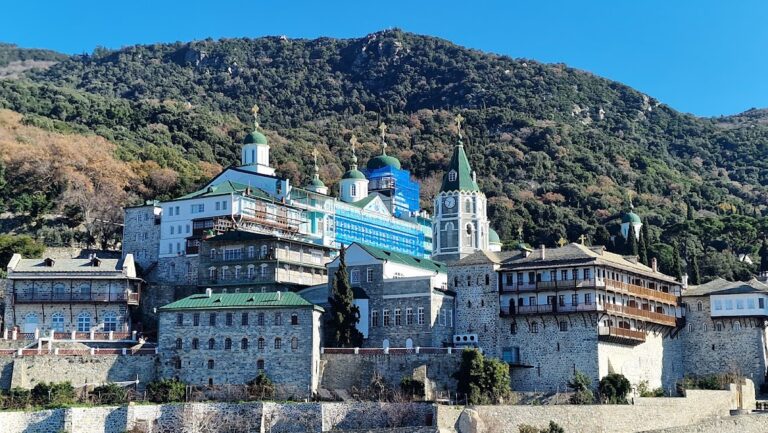
Esphigmenou Monastery: An Eastern Orthodox Monastery on Mount Athos


Site at a Glance
- Rating
- 4.8
- Popularity
- Low
- Country
- Greece
- Primary era
- Modern
- External website
- Open
- Eras represented
- Early Modern, Modern
- Civilizations
- Ottoman
- Site type
- Religious
- Remains
- Monastery
On this page11 sections
History
Esphigmenou Monastery is a Sacred Patriarchal and Stauropegic Eastern Orthodox monastery in Greece, on the northeastern side of Mount Athos. Its present institution is securely attested from the late tenth or early eleventh century, while most of the surviving complex belongs to the first half of the nineteenth century. The monastery is coenobitic, meaning that its monks live under a common rule and share communal property and daily life. It ranks eighteenth among the twenty Athonite monasteries and is dedicated to the Ascension of Christ, celebrated forty days after Easter.
Early traditions and medieval foundations
Athonite tradition attributes an earlier foundation on the site to the Byzantine emperor Theodosius II and his sister Pulcheria in the fifth century. According to the tradition, that monastery was destroyed when a landslide or a great rock fell from the surrounding hills. Ruins about 500 metres from the present monastery have been identified with it, although historical and archaeological evidence does not confirm the story. Documents once used to support the early foundation were later found to be forged.
The present monastery appears in reliable records from the late tenth or early eleventh century. A letter of Paul of Xeropotamou dated 1016 mentions it, as does the will of Demetrius of Chalki from 1030. That will was signed by Theoktistos, then a monk and abbot of Esphigmenou. The monastery also appears in the second Typicon of Mount Athos, a regulatory document governing monastic organization, issued in 1046.
Prosperity, destruction, and restoration
Before the Ottoman conquest, Esphigmenou benefited from donations by Byzantine rulers, including Emperor John V Palaiologos, as well as by Orthodox rulers such as the Serbian Emperor Stefan Dušan and Serbian Despot Đurađ Branković. Its fortunes were damaged by disputes over land with Vatopediou Monastery, repeated pirate raids, and two major fires during the fourteenth century. The monastery eventually became ruined and almost deserted. Hilandar and Zograf later took portions of its land, leading to further legal disputes.
A manuscript dated 1569 records 51 monks engaged in restoring the community. In 1655, Tsar Alexis I of Russia allowed the monks to travel through his territories every five years to collect donations. Rulers of the Danubian principalities also provided support, helping the monastery maintain its religious and material life.
During the eighteenth century, Bishop Gregory of Melenikon donated to Esphigmenou, later joined the community as a monk, and undertook renovations. Bishop Daniel of Thessaloniki administered its finances and, with the consent of the Athonite community and Patriarch Gerasimus III of Constantinople, changed the monastery into a coenobium. Patriarch Gregory V confirmed this status in a 1797 edict and rebuilt the ruined southern part of the complex. Abbots Acacius, Euthymius, Theodoritus, and Agathangellus then carried out extensive renovation and expansion, creating much of the monastery that survives today. Agathangellus’s successor, Lucas, founded an iconographic school that served the monastery for many years.
War and twentieth-century religious disputes
During the Greek War of Independence, the monastery served as the headquarters of forces led by Emmanouel Pappas. Ottoman troops severely damaged it, and the Ottoman army also looted and damaged the complex during its occupation of Mount Athos. During the Macedonian Struggle, a conflict in which rival groups competed for political and national influence in Ottoman Macedonia, Esphigmenou supported Greek guerrillas fighting the Bulgarian komitadjis, or armed activists.
In 1965, after Ecumenical Patriarch Athenagoras met Pope Paul VI, Esphigmenou and most other Athonite monasteries stopped commemorating the patriarch in worship. They viewed the meeting as a concession to the Vatican. In the early 1970s, a cohesive group of Old Calendarist monks joined the existing brotherhood. Old Calendarists belong to Orthodox groups that reject calendar reforms adopted by many Orthodox churches; the 1971 census recorded 40 members at Esphigmenou.
In 1972, under Abbot Athanasius, the monks withdrew from the Holy Community, the highest collective administrative body of Mount Athos, and ended communication with the other Athonite monasteries and Orthodox churches. They established contact instead with the Old Calendarist synod associated with Archbishop Auxentios Pastras. The monastery’s population grew through the end of the twentieth century.
The continuing jurisdictional conflict
In 2002, the Ecumenical Patriarchate declared the occupying monks to be in schism, a status assigned by the patriarchate and the canonical authorities of Mount Athos. A court in Thessaloniki ordered them to leave, but they refused. The Holy Synod declared the occupants illegal, while the occupying brotherhood remained in the central monastery under Methodios Papalambrakopoulos.
In 2005, the Holy Community elected a new canonical brotherhood to re-establish Esphigmenou. Unable to enter the occupied complex, it based itself in Karyes. Archimandrite Chrysostomos Katsoulieris served as its abbot until 2013 and was succeeded by Archimandrite Bartholomew Gazetas. The new brotherhood consists of 23 monks and dependents. Its attempts to take control of the old representative residence, or konaki, in Karyes in November 2005 and the monastery offices there in December 2006 failed. The latter confrontation left seven monks seriously injured. In October 2006, Patriarch Bartholomew laid the foundation stone for a new official konaki near the old one.
Greek courts later issued criminal and civil rulings against members of the occupying brotherhood. In 2013, during an attempted eviction at the old Karyes konaki, three Molotov cocktails and an explosive device were thrown at police. Sentences imposed in 2017 and reduced on appeal in 2019 included 17-year prison terms for Abbot Methodios and the monk Antypas, together with a €600 fine; six other monks received reduced prison terms. Police evicted the old brotherhood from an apartment in Thessaloniki used as a hostel in 2014. In 2019, occupying monks were sentenced for fraud against the Greek state after using the monastery’s name and seal to obtain tax benefits to which they were not officially entitled.
On 8 July 2020, the Greek Supreme Court rejected the old brotherhood’s appeal against an order requiring it to surrender properties occupied on and outside Mount Athos. On 23 July, police removed monks from dependencies at Ierissos and Nea Roda. As of 2022, the old brotherhood still occupied the monastery buildings and the administrative building in Karyes, and in July 2024 police were preparing an eviction operation. The monastery and the old brotherhood remain important reference points for Old Calendarists internationally. Esphigmenou is also part of the UNESCO-protected heritage of Mount Athos.
Remains
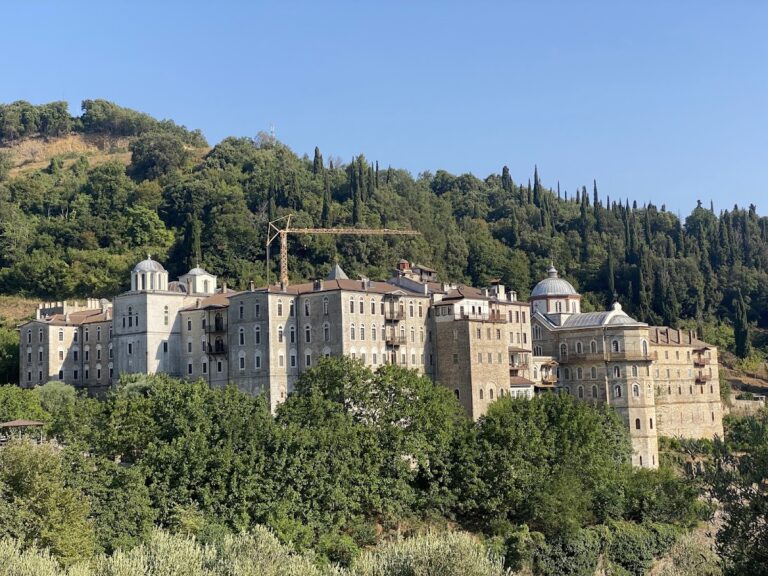
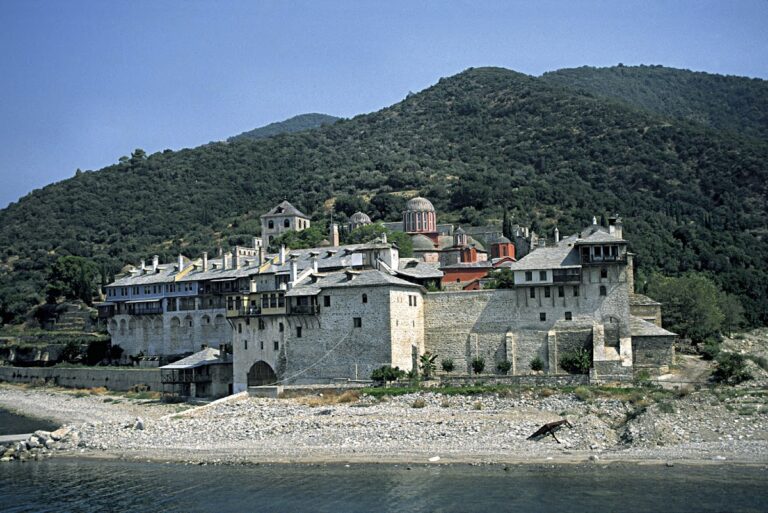
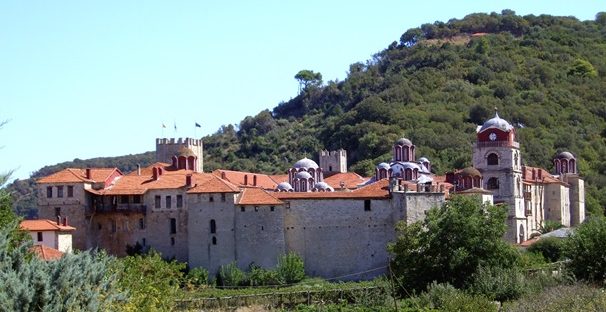
Esphigmenou stands beside the sea at the northernmost point of the Athonite monasteries, near the entrance to a ravine and between three hills. A stream passes close to the central building, while Hilandar Monastery lies to the southwest. The present complex is enclosed by a roughly rectangular wall around a spacious courtyard. Its catholicon, the principal church of a monastery, occupies the centre, with wings containing monks’ cells, the guesthouse, and the refectory. Although the institution is medieval, most of the visible buildings were built or extensively renewed during the first half of the nineteenth century.
The central church and courtyard
The catholicon
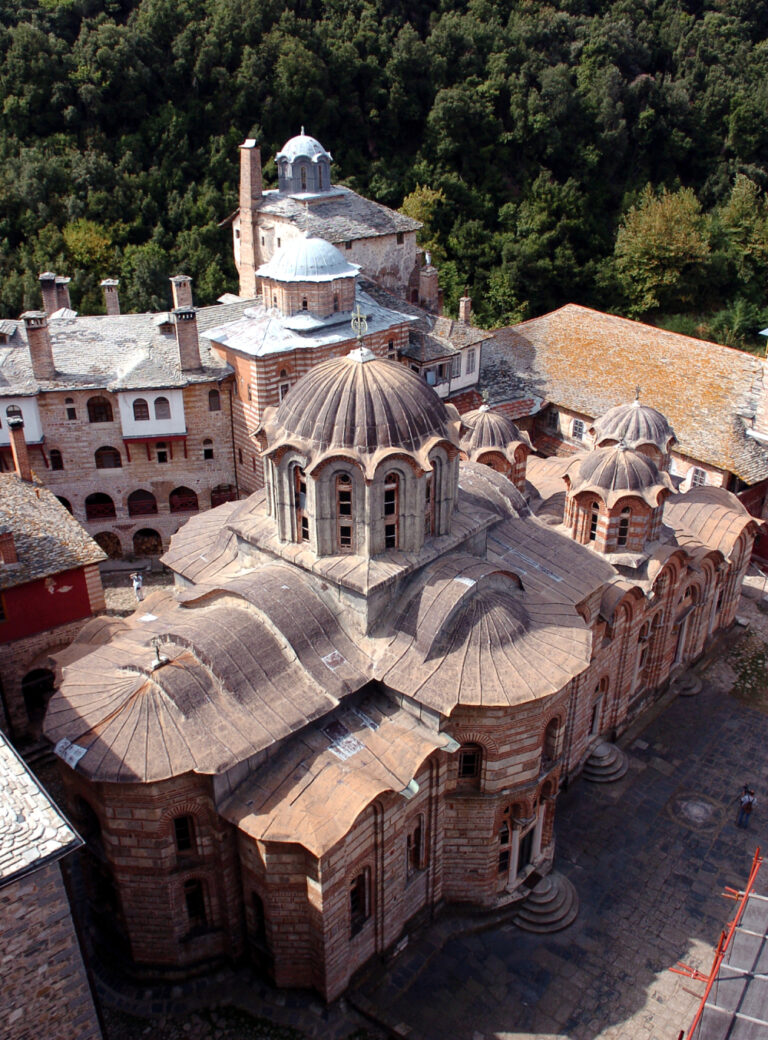
The catholicon was built between 1806 and 1810 by Abbot Theodoritus on the site of an earlier church and consecrated by Patriarch Gregory V in 1811. Bishop Ignatius of Kassandreia helped finance the work. Built in the Athonite church manner, it has a lead-covered roof with eight domes, including a large central dome. Marble for the building came from Tinos, the home of its architect, Paul.
Veniamin, Zacharias, and Makarios decorated the nave with religious images in 1811 and the sanctuary in 1818. Ioasaf, Nikiforos, Gerasimos, and Anthimos completed the decoration of the narthex, the entrance area of the church, in 1841. The altar, iconostasis, and other furnishings belong to the same period. The carved wooden iconostasis, a screen separating the sanctuary from the nave and carrying icons, is gilded and shows scenes from the Old and New Testaments. It is regarded as one of the important post-Byzantine iconostases on Mount Athos.
In 1845, Ecumenical Patriarch Anthimus VI added two chapels, a vestibule, and a porch. He had previously been a monk of Esphigmenou. A holy-water font stands outside the southeastern corner of the catholicon. Abbot Euthymius built it in 1815 on the site of an older font associated with the time of John V Palaiologos. Its dome rests on eight marble columns joined by carved marble panels.
The refectory
Across from the catholicon, in the west wing, stands the refectory, the monastery’s oldest building. It is a rectangular, semi-detached structure renovated by Abbot Euthymius in 1810. Its sixteenth- and seventeenth-century religious decoration survives in badly damaged condition after fires lit by Ottoman soldiers during the Greek revolutionary war.
Chapels and associated traditions
The monastery has 13 chapels, eight within the main complex and five outside it. The Chapel of the Presentation of Mary and the Chapel of the Archangels stand beside the catholicon. Other interior chapels contain important icons. Across from the monastery, the outer Chapel of Saint Anthony of Kiev is associated by Esphigmenou tradition with a secluded sea-facing cave nearby. The cave is still shown to visitors, although Saint Anthony’s residence there remains historically disputed. The chapel commemorates him on the feast of All Saints of Esphigmenou.
Treasury and library
The treasury and library are temporarily housed above the catholicon’s narthex. Among the monastery’s Byzantine and post-Byzantine icons is a small Byzantine mosaic icon of Christ, approximately 0.15 by 0.07 metres. The standing figure is surrounded by a silver frame showing the Apostles, with holy relics set along its lower edge. The catholicon’s altar contains the so-called Cross of Pulcheria, cases of holy relics, and the mosaic icon of Christ. Relics attributed to various saints of Orthodox Christianity are also preserved at Esphigmenou.
The treasury includes two pieces of Napoleon Bonaparte’s tent, forming a section measuring 3.05 by 2.80 metres. Patriarch Gregory V of Constantinople donated them. Once each year, the monks use this section as a canopy over the catholicon entrance during the celebration of the Ascension.
The library holds 372 manuscripts, including 75 on parchment, several with religious decoration. Its notable holdings include the Minologion, manuscript number 14, which contains 80 miniatures. Approximately 2,000 printed books are kept in the library, with another 6,000 on the second floor of the northern wing. The condition of the cultural treasures, archive, and buildings has remained uncertain because representatives of the responsible archaeological service have been prevented from entering the occupied monastery.
Nearby sites