Hilandar: A Serbian Orthodox Monastery on Mount Athos


Site at a Glance
- Rating
- 4.9
- Popularity
- Medium
- Country
- Greece
- Primary era
- Medieval
- External website
- Open
- Eras represented
- Medieval, Early Modern
- Civilizations
- Serbian
- Site type
- Religious
- Remains
- Fortified Monastery
On this page15 sections
History
Hilandar is a Serbian Orthodox monastery in Greece, on Mount Athos, refounded by Serbian rulers between 1198 and 1200 in the Byzantine monastic tradition. It ranks fourth among the twenty sovereign Athonite monasteries, belongs to the jurisdiction of the Ecumenical Patriarchate of Constantinople, and is dedicated to the Entry of the Theotokos into the Temple. Mount Athos is an autonomous Eastern Orthodox monastic territory whose monasteries are governed collectively through Athonite institutions.
Byzantine Origins and Serbian Refoundation
An earlier Byzantine monastery stood on the site, probably from the early eleventh century. Its founder was a Greek Athonite monk named George Hilandarios. The name Hilandar may derive from him or from chelandion, a Byzantine transport ship whose captain was known as a chelandaris.
In 1198, Byzantine Emperor Alexios III Angelos granted the abandoned monastery of Helandaris to the Serbs as an eternal gift, with the consent of the Athonite monastic community. The charter defined it as a monastery for people of Serbian origin who wished to become monks and exempted it from the authority of the Athonite protos, the leading administrative office of the peninsula.
Stefan Nemanja, the former grand prince of Serbia who became the monk Simeon, and his son Saint Sava refounded the monastery between 1198 and 1200. Stefan, later known as Stefan the First-Crowned, supplied financial support. Simeon issued the founding charter in 1199, and Sava wrote it with the consent of his brother Stefan. The original charter was later destroyed in the bombing of the National Library in Belgrade on 6 April 1941, although its loss has also been associated with the First World War.
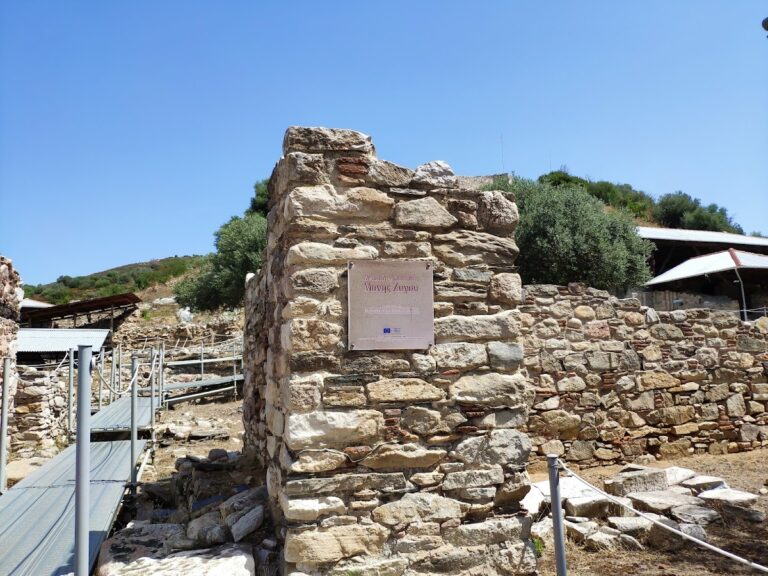
Simeon brought many monks from Serbia to the renewed community. Hilandar received villages near Prizren, including the Velika Hoca metochion. A metochion was a dependent estate or outlying property belonging to a monastery. Sava subsequently obtained an imperial charter that placed Hilandar on an equal footing with the other Athonite monasteries and granted it the abandoned monastery of Zygos, later called Ivanica, as another metochion.
Simeon died at Hilandar on 13 February 1199, after about eight months in the monastery. He was first buried in the old Church of the Entry of the Theotokos. In 1208, Sava transferred his remains to Serbia, where they were reburied at Studenica Monastery. After Simeon’s death, Sava moved to Karyes and established a hermitage. He wrote the Karyes Typikon and the Hilandar Typikon in 1200. A typikon is a set of rules governing worship, communal discipline, administration, and daily life. The Hilandar rule followed the model of the Constantinopolitan Monastery of the Theotokos Evergetis.
Medieval Expansion and Serbian Patronage
The Fourth Crusade captured Constantinople in 1204 and brought Mount Athos under Latin control. The peninsula was exposed to raids, and Sava eventually left Mount Athos permanently in the early thirteenth century. During a pilgrimage to Palestine, he obtained the icon of the Three-Handed Theotokos from the Monastery of Saint Sabbas the Sanctified and gave it to Hilandar. The icon is traditionally associated with the miraculous healing of Saint John of Damascus and later came to be regarded as the monastery’s abbess.
Serbian rulers repeatedly increased Hilandar’s endowments. King Stefan Uros I built the large Transfiguration Tower in 1262, while Stefan Dragutin and King Milutin expanded the monastery’s lands. In the early fourteenth century, Catalan mercenaries attacked Mount Athos but failed to destroy Hilandar. Its fortifications and the efforts of its deputy hegumen Danilo, later Serbian Archbishop Danilo II, helped preserve the monastery.
King Milutin substantially enlarged Hilandar around 1320. He rebuilt the principal church, extended the complex northward, strengthened its defenses, built the dining hall, and added the Milutin and Hrussiya towers. Byzantine Emperor Andronikos II or Andronikos III Palaiologos also granted the monastery extensive estates in Greece. These gifts strengthened Hilandar’s material position and connected its central community with a wide network of lands and dependencies.
Hilandar reached its greatest prosperity under King and Emperor Stefan Dusan, whose rule brought Mount Athos under Serbian authority. Dusan granted the monastery extensive possessions in Serbia, present-day Macedonia, and Greece. Its estates were said to cover one-fifth of Mount Athos, while Serbian nobles including Vlatko Paskacic, Nikola Stanjevic, and Despot Dejan also provided support.
In 1347, during a plague epidemic, Dusan took refuge at Hilandar with Empress Jelena. Her presence violated the Athonite avaton, the traditional rule excluding women from the peninsula. A cross and an imperial olive tree commemorate the place where the monks received them. Around 1350, Hilandar built the Church of the Holy Archangels and enlarged its hospital. Jelena also endowed the Karyes cell of Saint Sava to the monastery.
Hilandar’s deputy hegumen Sava was elected Serbian patriarch in 1354. After Dusan’s death in 1355, the monastery continued to prosper. Prince Lazar Hrebeljanovic founded the outer narthex of the principal church around 1380. A narthex is an entrance or vestibule area attached to a church. During the late fourteenth century, Hilandar also became a refuge for members of Serbian ruling and noble families.
Ottoman Rule and Changing Patronage
The Ottoman conquest of the Athonite peninsula in 1430 brought violence and disorder, and some monks returned to Serbia. Sultan Mehmed II restored the monasteries’ former rights and liberties by a decree of 1457. After the Serbian Despotate fell in 1459, Hilandar lost important Serbian patrons and sought assistance from Russian rulers and other Orthodox benefactors.
Angelina Brankovic appealed to Grand Prince Vasili Ivanovich of Moscow in 1503. In 1550, deputy hegumen Paisios travelled to Moscow with three monks to request help from Ivan IV. Ivan intervened with the Ottoman sultan, sent substantial aid and gifts in 1556, and later granted Hilandar property in Moscow. Tsar Feodor Ivanovich issued a charter in 1591 permitting donations to Hilandar and supporting the Russian monastery of Saint Panteleimon on Mount Athos.
Serbian patriarchs and bishops supported Hilandar during the seventeenth century. Under Abbot Viktor, from 1652 to 1678, several buildings were renovated, with assistance from a Venetian Serbian merchant who became the monk Nikanor in 1662. Hilandar then had more monks than any other Athonite monastery.
Serbian migration northward during the Great War and the decline of Serbian institutions contributed to a reduction in Serbian monks. During the eighteenth century, Greek and Bulgarian monks increasingly joined the community. By the late eighteenth and early nineteenth centuries, Hilandar remained formally Serbian, although most of its monks were Greek or Bulgarian. Bulgarian monks helped preserve its spiritual life, especially after fires in 1722 and 1776.
Hilandar maintained close relations with the Karlovci Metropolitanate and Serbian ecclesiastical communities in southern Hungary and Bosnia. The Bulgarian monk Paisius of Hilandar wrote Istoria Slavyanobolgarskaya at the monastery in 1760 to 1762. In 1765, Dositej Obradovic visited Hilandar and described the dispute between Serbian and Bulgarian monks over control of the community.
From the late eighteenth century, the Three-Handed Theotokos was treated as Hilandar’s abbess, and the office of abbot was not regularly restored until 1991. The monastery suffered another major fire in 1891. The establishment of a modern Serbian state in the early nineteenth century encouraged a renewed Serbian presence. In 1820, the brotherhood asked Prince Milos Obrenovic to become its patron and protector. Hilandar’s support for the Greek struggle for independence led to the stationing of an Ottoman garrison in the monastery for several years.
Renewal, Monastic Reform, and Fire
A prolonged dispute between Serbian and Bulgarian monks over administration, together with a separate dispute over the monastery’s boundaries, caused serious financial difficulties. Serbian support helped resolve the crisis. King Alexander Obrenovic’s visit in 1896 settled the administrative dispute, while Serbia paid the monastery’s debts. Monks again came from Serbia and other Serbian regions.
The Czech monk Sava Hilandarac reorganized and catalogued the library and archive and received the Order of Saint Sava for this work. By the beginning of the twentieth century, Serbian monks were again a majority. King Peter I visited Hilandar in 1910 with Prime Minister Nikola Pasic and donated liturgical objects and money.
From 1883 until 26 March 1933, Hilandar followed an idiorrhythmic system. Under this arrangement, a council of elders and two supervisors administered the monastery, while individual monks managed their own property. The system replaced the communal order established by Sava and contributed to financial hardship. In March 1933, the brotherhood formally returned to a cenobitic order, in which property is held communally under an abbot. The newly elected abbot Raphael was ordained archimandrite.
Hilandar was converted from an idiorrhythmic monastery to a cenobitic monastery in 1990, and restoration of the abbatial office began in 1991. The recorded abbots since 1989 are Paisios Tanasijevic, who served from 1989 to 1992; Moses Zharkovic, from 1992 to 2010; and Methodius Markovic, from 2010 onward.
During the night of 3 to 4 March 2004, a catastrophic fire destroyed more than half of the monastery’s built area, approximately 5,897 square metres out of 10,500 square metres. Numerous dependencies, chapels, monastic cells, and entrance buildings were damaged or destroyed. The fire was attributed to a blocked or displaced chimney. Monks, workers, and five fire brigades from Karyes and Polygyros extinguished it.
Restoration began immediately under chief architect Mirko Kovacevic. The work included repairs to surviving buildings as well as reconstruction of the burned structures. With major assistance from Serbia, the Serbian Orthodox Church, Greece, Russia, the Republic of Srpska, Serbian citizens, and the diaspora, more than 80 percent of the damaged complex had been restored by 2020, while reconstruction continued. Hilandar has formed part of the UNESCO World Heritage property covering Mount Athos since 1988.
Remains
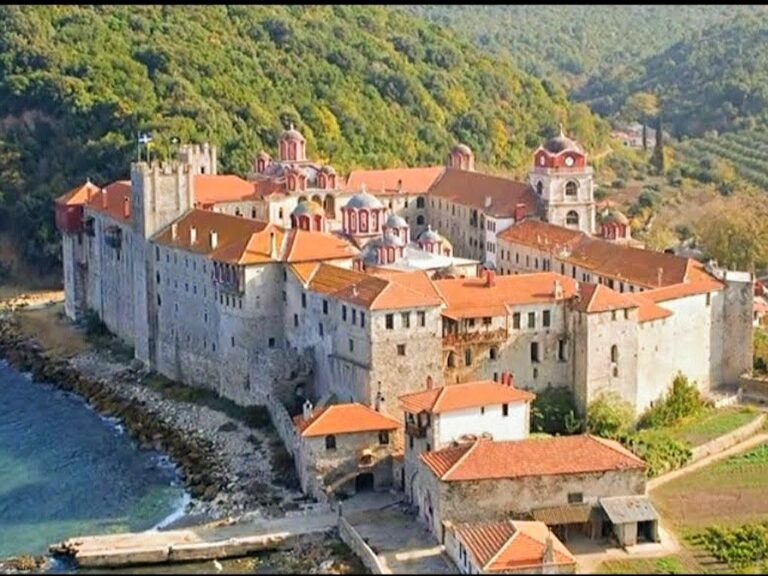
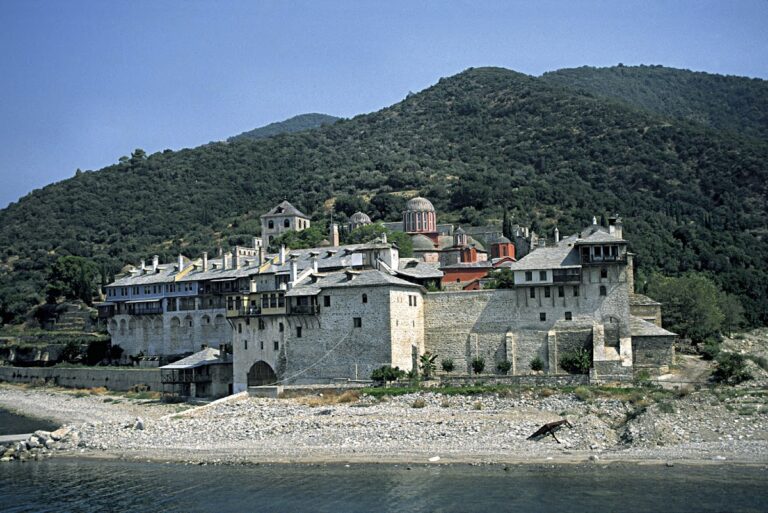
Hilandar stands in a wooded valley beside a perennial stream, about 2.5 kilometres from the Aegean Sea and approximately five kilometres from the monastery’s small harbor. Forest surrounds the settlement on three sides, while the northern side opens through a valley toward the sea. Vineyards, olive groves, and citrus plantations occupy nearby land. The complex has an approximately square plan with a triangular upper extension and the appearance of a medieval fortress.
Fortifications and Monastic Enclosure
The defensive walls are about 140 metres long, enclose an area approximately 75 metres wide, and rise to about 30 metres or more. They protected the monastic settlement from pirates. The lower outer walls are largely without openings except at the gate. Residential spaces are concentrated on the third and fourth floors, and some fourth-floor cell walls exceed 1.5 metres in thickness. The towers have small openings and low, heavy doors, giving them a strongly military character.
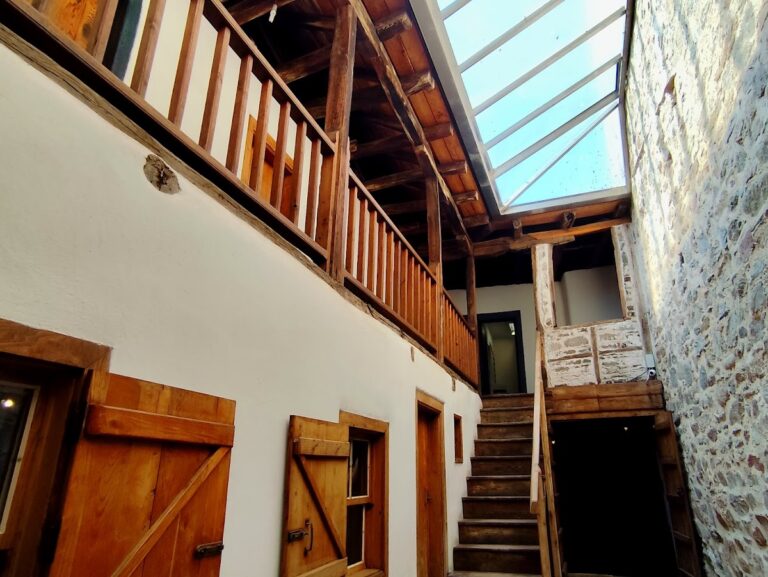
Buildings were constructed in a Byzantine or Serbian-Byzantine manner from dressed stone alternating with courses of brick. Floors and balconies are wooden. Residential wings were built inward against the defensive walls and generally opened toward the courtyard until the nineteenth century. The oldest surviving fabric includes the Saint George Tower on the southwestern side, sections of the southern and western outer walls, and structures built against their inner faces, including lodging wings and the dining hall.
Defensive Towers and Entrance
The surviving defensive towers include the Saint Sava Tower, Saint George Tower, Milutin Tower, and Jovan Tower. The Milutin Tower stands on the route toward the sea, while the Hrussiya, or Basil, Tower stands on the seacoast and served defensive and observation purposes. The Saint Sava Tower and the Kambanski bell tower form additional vertical landmarks within the complex.
The entrance built under Milutin had a tower with a chapel dedicated to Saint Nicholas. An earthquake destroyed the chapel in the second half of the sixteenth century. The monastery also contains a hospital, service buildings, agricultural installations, and many monastic cells.
Principal Church and Painted Buildings
The Church of the Entry of the Theotokos into the Temple replaced the original church on its foundations. Its construction is generally placed around 1320 and is traditionally attributed to King Milutin, who rebuilt it at that time. It became Hilandar’s katholikon, the principal church of an Orthodox monastery. The building combines features associated with the Constantinopolitan Byzantine school with elements of Thessalonian and Athonite practice.
Katholikon Interior
The church has a spacious, well-lit interior created without an exonarthex, lateral chapels, or a front portico. Marble ornament surrounds the doors and windows, and the floor contains a carefully laid mosaic. Its white-marble pavement has a large central cross surrounded by bands made from different stones. The carved wooden iconostasis, the screen separating the sanctuary from the nave, dates from 1774.
The church, dining hall, and cemetery chapel were painted in 1321. Their frescoes are associated with the Macedonian school and with the painters Eutychios and Michael. The church paintings were overpainted in 1804, and part of the southern choir was cleaned of this later layer in the 1970s. Fragments of the original architectural sculpture survive.
Lazar’s Narthex and Dining Hall
Prince Lazar Hrebeljanovic added the western outer narthex, known as Lazar’s Narthex, around 1380, integrating it with the main church. The dining hall was built around 1320 and repainted in 1621 by Georgije Mitrofanovic, a Hilandar monk and one of the leading Serbian painters of his period. The dining-hall porch, entrance, katholikon, and chapels contain interior frescoes, with some exterior painting also preserved.
The oldest surviving frescoes date from the thirteenth century and are located inside and outside the Saint George Tower and its chapel. The Church of the Holy Archangels contains paintings from the mid-fourteenth century, while much of the surviving chapel painting dates from the seventeenth and eighteenth centuries. Paintings in chapels affected by the 2004 fire were severely damaged.
Chapels, Tombs, and Sacred Features
Hilandar contains the main church and approximately twelve additional churches, chapels, or parakleses, smaller places of worship associated with a monastery. Many occupy upper levels of towers and residential wings. The Church of the Holy Archangels stands at the eastern corner of the enclosure, in front of the Saint Sava Tower. Eleven further chapels are distributed through the monastery wings, and nine were frescoed between the thirteenth and eighteenth centuries. The chapel of the Forty Martyrs contains portable icons and a sanctuary door dated 1623.
Outside the principal enclosure stand the cemetery Church of the Annunciation, with an ossuary, and the Chapel of Saint Tryphon, dated 1719, in the garden. The original burial place of Saint Simeon lies beside the southern wall of the katholikon. A silver-plated sarcophagus made in 1973 stands above the tomb, while the earlier wooden sarcophagus is kept in the monastery’s skevophylakion, a repository for sacred vessels and ecclesiastical treasures.
The Saint Simeon chapel stands beside the bell tower above the historic monastery well. Tradition says that Sava discovered the well during construction of the monastery. Beside Saint Simeon’s former grave, a grapevine is traditionally believed to have grown from the tomb after his remains were transferred to Serbia. Its grapes are regarded as miraculous and distributed as a blessing to childless married couples.
Cells, Estates, and Agricultural Lands
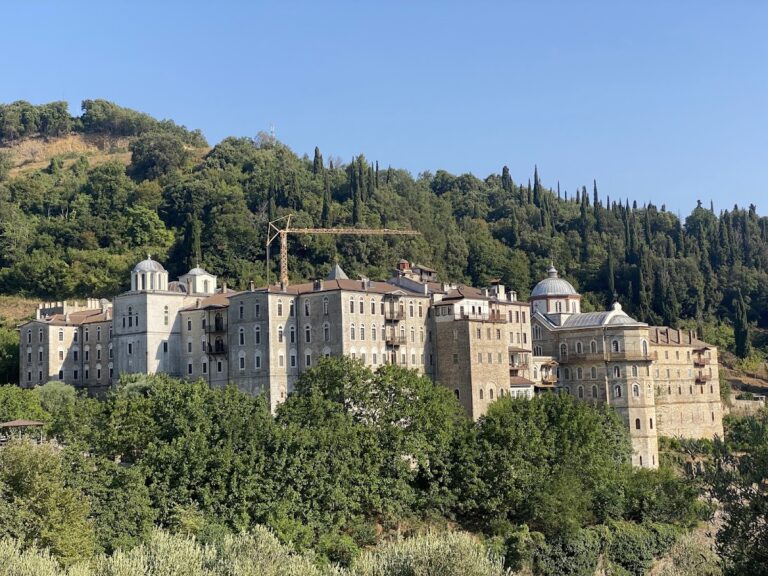
Hilandar maintains links with approximately forty cells, most of them active, along with ruined cells in the Hilandar Valley, Karyes, Great Zygos, Great Vigla, and Chalkidiki. A cell is a small monastic establishment occupied by one monk or a small group. About fifteen active cells lie in the Hilandar Valley, ten in Karyes, and approximately fifteen in the Great Zygos area. Named dependencies include cells dedicated to the Nativity of the Theotokos, Saint Andrew, the Holy Archangels, Saint George, Saint Sabbas the Sanctified, Saint Thomas, Saint Nicholas, Saint Demetrios, the Holy Trinity, Saint Ignatius of Antioch, the Transfiguration, Saint John the Theologian, Saint John Chrysostom, Saint John the Baptist, the Holy Apostles, and the Three Hierarchs.
The Hilandar lands around Karyes include approximately thirty cells and about fifty-five buildings of different functions. They contain water sources serving Karyes and its surroundings, as well as extensive forests north of the settlement. The Hilandar Valley contains about twenty cells, fifteen belonging to Hilandar. Sava’s Karyes hermitage, later called the Typikario, has operated under its own typikon since 1199 and remains attached to the monastery. Tradition connects it with the icon of the Milk-Feeding Theotokos and the staff of Saint Sabbas the Sanctified.
Hilandar’s external metochia include Komitsa, Zoodochos Pigi near Ierissos, Saint Nicholas at Sozopolis in Chalkidiki, Kumitsa, Kakovo, and Kalamaria. Kakovo, with approximately 1,500 hectares of forest, was donated in 1585 and became the subject of a long land-use dispute that Hilandar won in 1897. The monastery revived the vineyard at Savina Polje in 2008, planting fifteen hectares with grape varieties used for wine production, together with new plum, hazelnut, and olive trees. One surviving olive tree is traditionally attributed to Emperor Dusan.
Icons, Manuscripts, and Treasury
Hilandar’s collections include approximately 3,500 icons, about 1,500 of them medieval, and approximately 500 icons dated from the twelfth to the nineteenth century. Eight are regarded as wonderworking. The Three-Handed Theotokos is kept in the katholikon, while the mosaic Hodegetria, made around 1200, is the oldest icon preserved in the monastery’s treasury.
Other icons include a Hodegetria and a Pantokrator from the third quarter of the thirteenth century, an Entry of the Theotokos from around 1320, and images of the Archangel Gabriel and the Evangelists Matthew and Luke from the third quarter of the fourteenth century. Seventeenth-century icons portray Saint Mina, Saint Victor, Saint Vincent, Saint Paraskeva, Saint Sava, Saint Simeon, Saint Lazar, and Saint George. An icon of Saint Demetrios dates from 1763.
The archive and treasury preserve medieval rulers’ charters, manuscripts, printed books, liturgical textiles, reliquaries, crosses, and other ritual objects. Inventories include hundreds of medieval documents, approximately 1,041 manuscript books in one count, and about 1,200 Slavic manuscripts in another. Greek and Serbian medieval charters are preserved alongside printed books from the fifteenth century onward.
The bilingual library contains works in Serbian Church Slavonic and Greek, written on parchment and paper, as well as Ottoman documents, archival records, early Serbian printed books, and copperplate and woodblock printing plates. The Serbian variant of Old Church Slavonic developed in Hilandar’s scriptorium.
The treasury includes a carved wooden diptych associated with the nun Jefimija and dedicated to her son Ugljesa Despotovic. It also preserves an embroidered iconostasis curtain associated with Despot Jelena, later the nun Jefimija, from around 1400; a curtain embroidered for Tsar Ivan IV; two triangular crusader banners donated by Emperor Dusan during visits in 1347 and 1348; and an ivory cup attributed to Dusan.
Other sacred holdings include the icon of the Akathist Theotokos and relics and objects associated with Christ and numerous saints. These include fragments identified with the True Cross, the Crown of Thorns, the Holy Mandylion, and other Passion relics. The monastery’s continuing religious life follows Sava’s typikon, combining services such as vespers, communal supper, compline, the midnight office, and the Divine Liturgy with work in administration, agriculture, beekeeping, winemaking, icon painting, candle-making, and care of the estates.
Fire Damage and Restoration
The 2004 fire destroyed or severely damaged the Great Guest Quarters, White Quarters, Old Quarters, Abbot’s Quarters, Dohia, Synodikon, guesthouse, entrance complex, four chapels, and authentic monastic cells dating from the late sixteenth century. It reached the area of Milutin’s dining hall on one side and was stopped near the walls of the Saint Sava Tower.
Restoration has rebuilt or repaired the damaged wings and surviving buildings. More than 80 percent of the burned portion or monastery complex had been restored by 2020, while reconstruction remained in progress. The surviving architecture, sacred images, manuscripts, and estates together preserve Hilandar’s role as a major center of Serbian religious, educational, literary, and cultural life and as one of the principal repositories of Serbian medieval culture.