Gordion: Capital of Ancient Phrygia
Site at a Glance
- Popularity
- Very High
- Country
- Turkey
- Primary era
- Iron Age
- Eras represented
- Bronze Age, Iron Age, Classical, Medieval
- Civilizations
- Achaemenid, Ancient Greek, Hittite, Phrygian, Roman
- Site type
- City
On this page25 sections
History
Gordion is an ancient city and archaeological site at Yassıhüyük in Türkiye. It became the capital of Phrygia, an ancient kingdom in central Anatolia, and the center of a kingdom that controlled much of the region west of the Halys River during the ninth and eighth centuries BCE. Its location connected routes between Lydia and Assyria or Babylonia, where an ancient road crossed the Sangarius River near the meeting of the Sakarya and Porsuk rivers.
Early settlement and Hittite influence
People occupied Gordion from around 2300 BCE, though settlement was interrupted at times. During the Middle Bronze Age, the city came under Hittite influence, a connection indicated by administrative seals. In the Late Bronze Age it belonged to the Hittite Empire, near the western edge of the empire’s heartland. Burials dating to the MH III-IV periods were placed in the northeastern cemetery.
Material culture changed sharply in the Early Iron Age. Differences in buildings and pottery, alongside linguistic and ceramic links with southeastern Europe, point to the arrival of migrants from the Balkans, possibly including the Brygians.
Phrygian capital and rebuilding
During the tenth and ninth centuries BCE, Phrygian rulers undertook major building projects at the citadel, including perimeter defenses and a substantial gate complex. Around 850 BCE, they built Tumulus W as an elite burial mound. It is the earliest known example at Gordion.
A major fire on the eastern citadel mound marks the transition from the Early to the Middle Phrygian period. Radiocarbon measurements on short-lived seeds place it between about 840 and 795 BCE, with the most likely range narrowed to 830/815-810/800 BCE. Tree-ring dating, comparisons of finds, and pottery from later layers support a date around 800 BCE. The blaze was probably accidental, and the evidence does not indicate a military attack. Although it was once linked to a Cimmerian invasion around 700 BCE, that explanation no longer fits the revised dating; a small number of scholars have disputed the revision.
After the fire, residents rebuilt the citadel, raising its mound with as much as five metres of clay while retaining much of the earlier layout. In the Middle Phrygian period, the settlement reached about 100 hectares. Around 700 BCE, an unknown enemy destroyed houses on the Northeast Ridge.
Midas and the later Phrygian kingdom
Midas, the best-known Phrygian king, was probably ruling at Gordion by about 740 BCE. Assyrian records from approximately 718-709 BCE name him as Mit-ta-a. The Greek historian Herodotus related that Midas made an offering at Apollo’s sanctuary at Delphi, giving the sanctuary the throne from which he judged cases. The Greek geographer and historian Strabo later wrote that Midas sought help from the Assyrian king Sargon II against the Cimmerians in 710/709 BCE. After the Cimmerians overran the city, Midas reportedly killed himself by drinking bull’s blood.
An ancient tradition also connects Alexander the Great’s visit in 333 BCE with the Gordian Knot. In the story, Alexander cut or otherwise loosened a knot joining the yoke and pole of a Phrygian wagon on the city’s elevated citadel. The wagon was associated with Midas, the legendary king Gordias, or both. A prophecy promised rule over Asia to whoever loosened the knot.
Burial customs changed over time. People continued to bury intact bodies until the late seventh century BCE, when cremation began; both practices remained in use through the sixth century BCE. Phrygian political influence later weakened as Lydia expanded across Anatolia.
Persian rule and Hellenistic change
Cyrus the Great’s campaigns, beginning in 546 BCE, ended Lydian control and Gordion’s political independence. The city became part of the Achaemenid Persian Empire, ruled by the Achaemenid dynasty, within the province of Hellespontine Phrygia. That province was governed from Daskyleion, not Gordion. Despite losing its former status, Gordion initially prospered under Persian rule, and monumental construction and elite burials continued through the sixth century BCE.
The fourth century BCE opened with an earthquake and an attack by the Spartan king Agesilaus II. In the following century, large-scale building on the citadel mound stopped, and builders reused stone from older structures in smaller buildings elsewhere. Alexander’s arrival in 333 BCE brought Greek religious practices, inscriptions, and pottery into use in place of their Phrygian predecessors. The Hellenistic period, when Greek cultural influence spread after Alexander’s conquests, also brought new settlers: Galatians, a Celtic people, began arriving in Phrygia, including at Gordion, from the mid-third century BCE.
In 189 BCE, the Roman commander Gnaeus Manlius Vulso led a campaign through Galatia that forced Gordion’s inhabitants to leave temporarily. People returned for a short time, but the settlement was abandoned again sometime in the first century BCE.
Roman and medieval occupation
Gordion saw renewed settlement and abandonment during the Roman period, from the first through the fourth centuries CE. A Roman road between Ancyra, ancient Ankara, and Pessinus passed through the area. The settlement may then have been called Vindia or Vinda. A deliberate refoundation involved leveling the western part of the citadel mound. People also lived at Gordion in the thirteenth and fourteenth centuries CE.
Battle, excavation, and heritage
During the 1921 Battle of the Sakarya, a turning point in the 1919-1922 Greco-Turkish War, Gordion lay on the front line. Fighting lasted three weeks, and troops used the citadel mound and several burial mounds as defensive positions. Bebi, the principal nearby village in the nineteenth and twentieth centuries, stood west of the citadel mound and was destroyed in the battle. Modern Yassıhöyük was established after the Turkish War of Independence.
Gustav and Alfred Körte excavated at Gordion in 1900. The University of Pennsylvania Museum returned under Rodney S. Young from 1950 to 1973. Later excavation directors were Keith DeVries from 1977 to 1987; G. Kenneth Sams and Mary M. Voigt from 1988 to 2006; G. Kenneth Sams and C. Brian Rose from 2006 to 2012; and Rose from 2012. Remote sensing begun in 2007 helped reveal defenses and settlement beyond the citadel. Renewed excavations from 2013 examined the southern defenses and uncovered the South Gate and its approach. Gordion was added to the UNESCO World Heritage List in 2023 under criterion (iii), which recognizes exceptional evidence of a cultural tradition or civilization.
Remains
The archaeological remains center on a citadel mound covering about 13.5 hectares, with defensive lines and settlement extending into the surrounding Lower and Outer Towns. At the city’s greatest extent, these occupied areas covered approximately 100 hectares. The Sakarya River once flowed east of the mound, beyond Küçük Höyük fort, but shifted course several times and probably moved to the west side during the nineteenth century.
Citadel gates and defenses
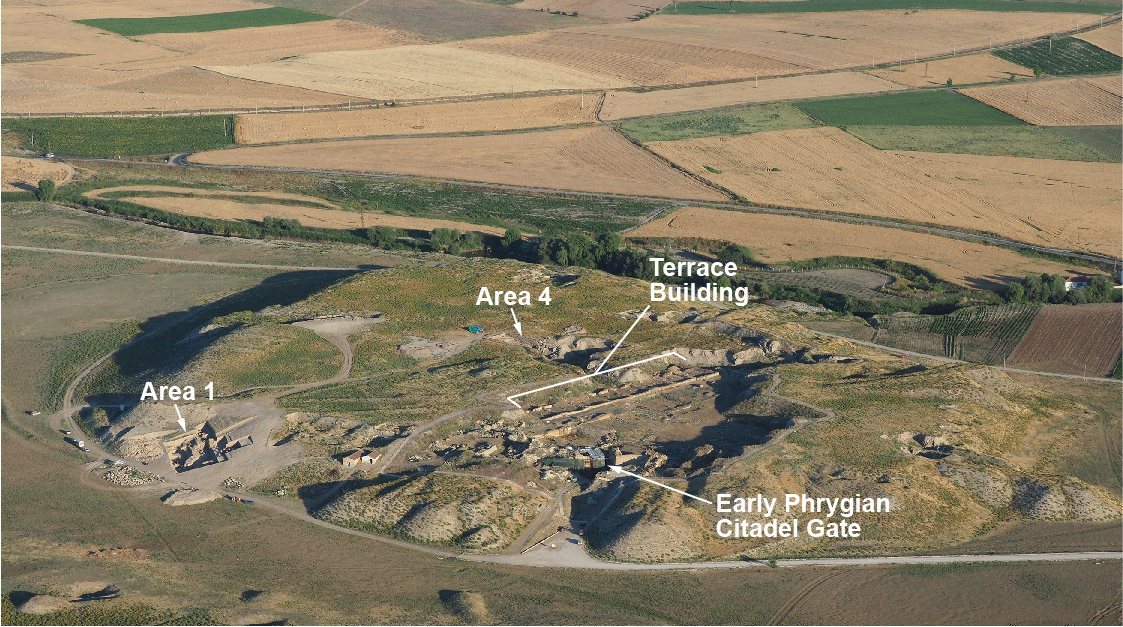
East Citadel Gate
The Early Phrygian East Citadel Gate survives to a height of about ten metres. It formed part of the defenses enclosing the citadel mound. Between 2014 and 2019, conservation work on its South Bastion stabilized cracked stones and secured them back into the wall faces with stainless-steel supports. The work also repaired damaged masonry and added a new capping support system to address drainage.
South Gate
The South Gate was first built in the ninth century BCE, around the same period as the East Citadel Gate. Bastions were added along its approach in the eighth and sixth centuries BCE. Its walled causeway runs for more than 65 metres, making it the longest known approach of its type for a citadel gate in Anatolia. In the Middle Phrygian phase, builders used large blocks of several colours. A carved stone lion was found at the entrance in 2017.
Citadel circuit walls
The Early Phrygian circuit walls enclosed the citadel mound and incorporated an extensive gate complex. The surviving gates and wall remains reflect the scale of the defensive building works undertaken at Gordion during the tenth and ninth centuries BCE.
Lower and Outer Town defenses
Middle Phrygian defenses included forts to the north and south of the citadel, connected by a circuit wall enclosing more than 25 hectares of the Lower Town. Farther out, a wall and ditch protected the Outer Town. Another wall-and-ditch system has been identified around the Outer Town to the west, while a second fort at Kuş Tepe defended the Lower Town to the north. A large Persian siege ramp, still visible, was built to attack the fortress at Küçük Höyük during the siege of 546 BCE.
Elite buildings and the burned district
Megaron buildings
East of the East Citadel Gate stood elite buildings that included several megarons, rectangular structures organized around a principal hall. They probably served administrative functions, and Megaron 3 may have been used as an audience hall. Their pebble-mosaic floors carry elaborate geometric patterns. The mosaics were removed from Gordion and installed in the Gordion Museum.
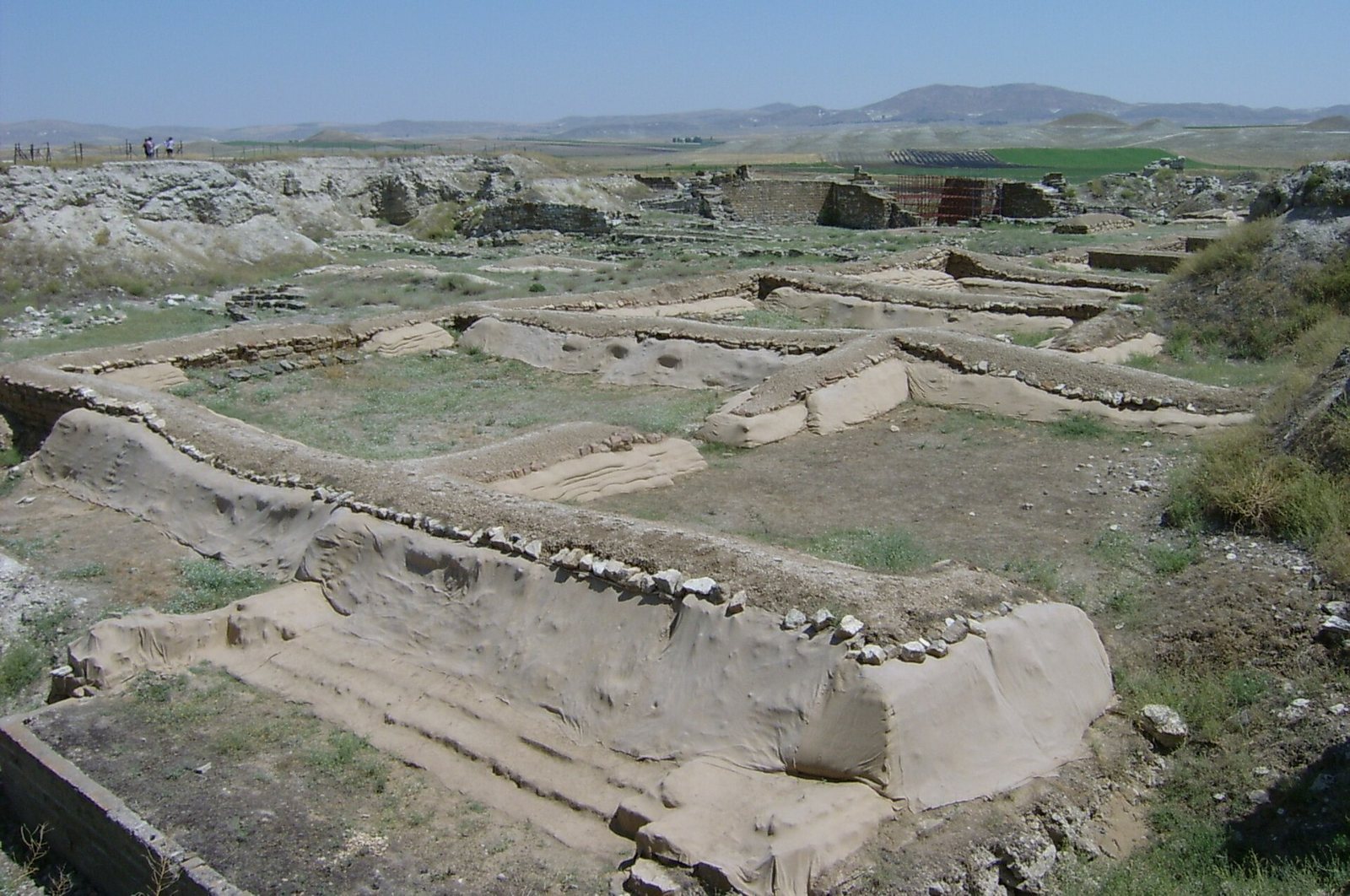
Terrace Building Complex
The Terrace Building Complex consists of eight connected buildings extending for more than 100 metres. People used the rooms for grinding, cooking, weaving, and storage. The complex was sealed beneath the Early Phrygian burned layer and the clay deposited above it, preserving its remains.
Eastern citadel destruction layer
The burned area on the eastern citadel mound preserves buildings and hundreds of objects from an Iron Age elite district. As much as five metres of clay covered the burned level, protecting the remains beneath it.
Burial mounds and cemeteries
Tumulus W
A tumulus is a mound raised over a burial. Built around 850 BCE, Tumulus W is the earliest known tumulus at Gordion and the earliest known in Anatolia.
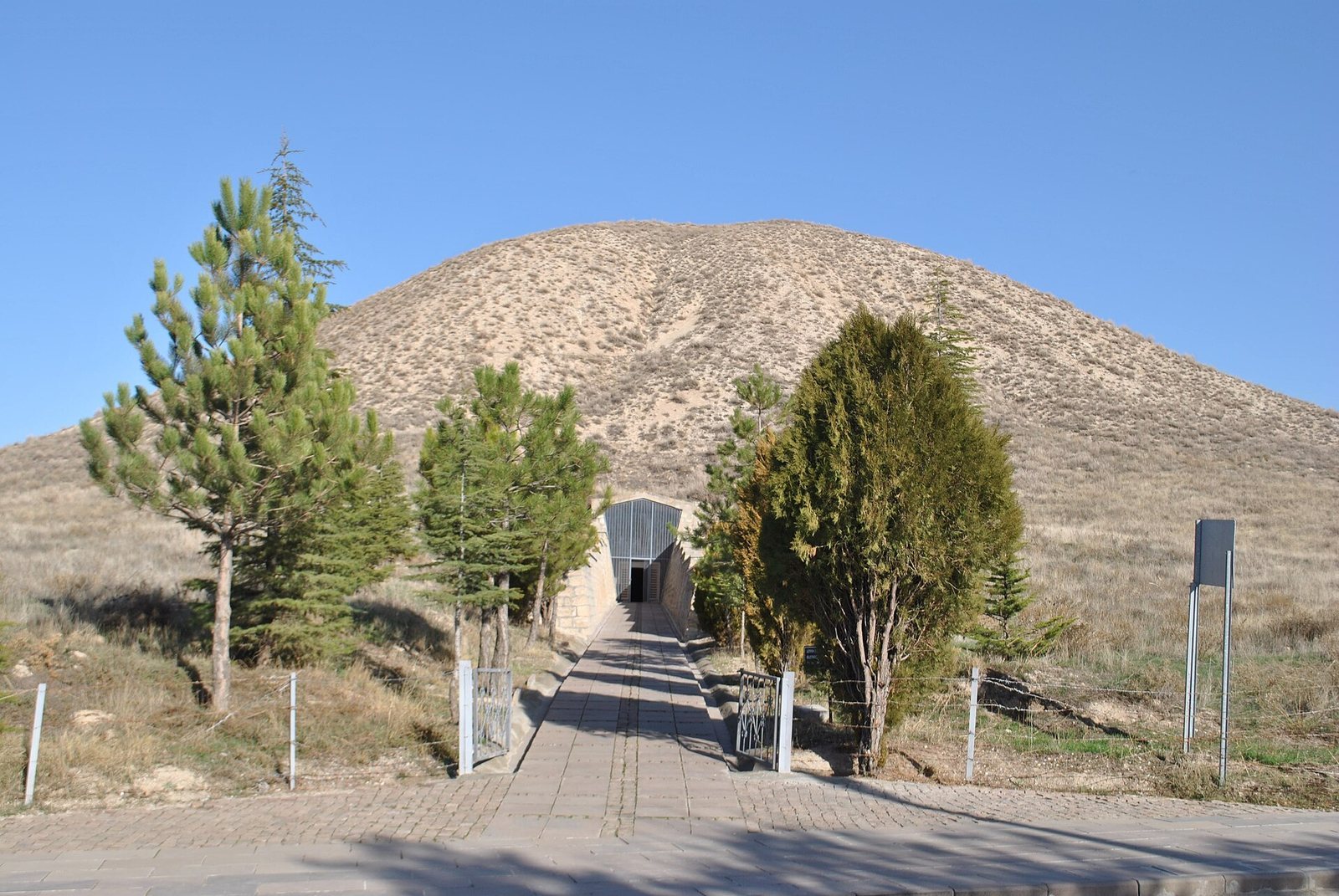
Tumulus MM
Tumulus MM, also called the Great Tumulus or Midas Mound, was built around 740 BCE. Gordion’s largest burial mound rises more than 50 metres and measures about 300 metres across. Excavators found a royal occupant in 1957, laid in an open log coffin on purple and gold textiles. The grave goods included pottery and bronze vessels with organic residues, bronze brooches, leather belts fitted with bronze, and carved, inlaid wooden furniture in exceptional condition. The tomb is commonly attributed to Gordias, Midas’s father, but that identification remains uncertain. Analysis of food remains indicates that guests at the funeral feast ate lamb or goat stew and drank a mixed fermented beverage.
Necropoleis and other tumuli
More than 100 burial mounds around Gordion date from the ninth to the sixth centuries BCE, and the largest have traditionally been linked with kings. The principal cemeteries are on the Northeast Ridge and South Ridge. Phrygian tombs dated to approximately 725-550 BCE have entrance passages and square underground chambers made of wood and covered with stone and earth. Finds from Gordion are displayed at the Museum of Anatolian Civilizations in Ankara, the Istanbul Archaeological Museums, and the Gordion Museum at Yassıhüyük.
Persian and Hellenistic buildings
Painted House
Built around 500 BCE on the eastern side of the citadel mound, the Painted House is a partly underground structure. Its wall paintings, or frescoes, show a procession of women. The building may have been connected with religious activity, though the nature of that use is uncertain.
Hellenistic houses
During the Hellenistic period, large houses were built over public buildings on the citadel mound. Later houses followed Greek-style plans and were decorated with wall paintings.
Roman and medieval remains
Roman buildings on the western citadel mound were laid out along the cardinal directions. The Common Cemetery contains Roman burials dated to the second through fourth centuries CE. On the western side of the mound, medieval remains include lime-coated pits and ovens associated with preparing and storing food.