Todi Castle: A Historic Fortress and Monastery in Italy
Site at a Glance
- Rating
- 5
- Popularity
- Very Low
- Country
- Italy
- Eras represented
- Classical, Medieval, Modern
- Civilizations
- Italian, Roman
- Site type
- Military
- Remains
- Castle
History
Todi Castle, located in Località Porchiano near Todi, Italy, originated in Roman times as a defensive tower. It was built to guard the southern border of the Roman settlement Colonia Julia Fida Tuder, overseeing the land between the Tiber and Arnata rivers and the Via Amerina, a key Roman road connecting Todi to the Lazio region.
In the early medieval period, the castle maintained its military importance. In the 8th century, King Desiderius transferred the territory to the Papacy, marking a shift in control. By 1275, the area became part of the Diocese and Municipality of Todi, which mobilized thousands of men to strengthen defenses. During the 10th to 13th centuries, the original tower was expanded into a larger fortress with three corner towers and a bastion wall. The castle was actively involved in the 13th-century conflicts between the Guelph and Ghibelline factions.
Designed for prolonged sieges, the fortress had no windows and featured narrow openings for archers. Secret underground passages allowed defenders to escape if needed. Large food stores and rainwater collection systems supported soldiers and animals living within the walls. The castle also benefited from its location on a pilgrimage route to Rome and from 13th-century commerce.
The Black Plague of 1348 and the resulting municipal decline led to the castle’s abandonment by soldiers. It was then occupied by wanderers and fell into disuse. In the 15th century, the fortress was converted into a monastery, with the courtyard roofed and a church dedicated to Saints Julietta and Quiricus established inside. The monastery was deserted in the 17th century, after which local noble families contested control until the Landi family acquired the property.
Following about three centuries of neglect, during which the castle suffered from bandit occupation and damage, it was purchased in the 18th century by the Paparini family. In 1974, Ambassador Giuseppe Santoro and his family took ownership and initiated restoration efforts.
The Landi family, whose origins predate the commune of Todi, held the nearby Castrum Ilionis, a fortified site linked to earlier conflicts between Lombards and Byzantines. This area was abandoned in the 14th century, likely due to plague and economic hardship. The 1337 statute of the Comune of Todi records the Landi family’s relations and feuds with other noble houses.
Local legend tells of Lucrezia, wife of Gerolamo Landi, who died in childbirth in 1723 and was buried in the castle chapel. She is said to haunt the castle, adding a layer of folklore to its history.
Restoration work from 1975 to 1980, led by architects Marcello Confetti, Giorgio Leoni, and Vittorio Garatti, preserved the castle’s structure. In 1980, it was declared a national monument and recognized as a Residenza d’Epoca, joining the Italian Castle circuit under UNESCO.
Remains
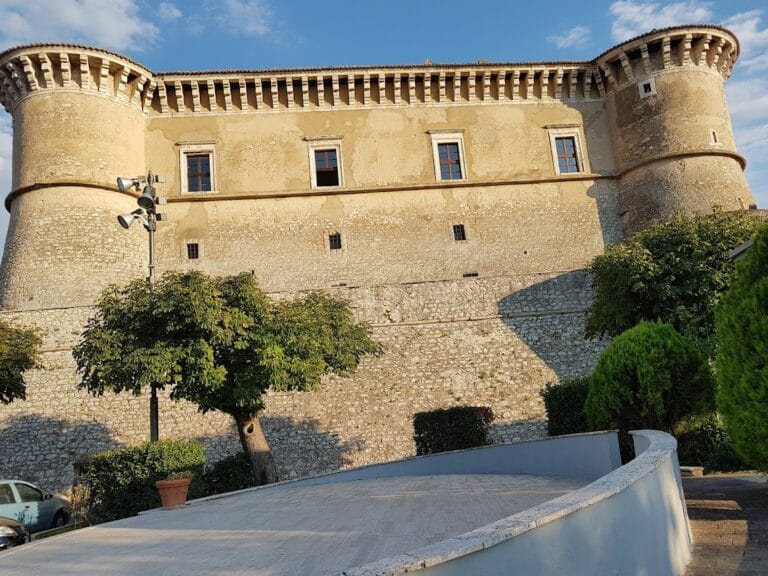
The castle estate covers about 45 acres and is surrounded by 250 acres of vineyards, olive groves, fruit trees, and cypress trees. The original Roman tower, known as Torre d’Orlando, occupies a strategic position overlooking the Tiber and Arnata rivers and the Via Amerina.
The fortress evolved into a larger complex with three corner towers and a substantial bastion wall. Its defensive design includes no windows and narrow openings for archers to shoot arrows. Beneath the walls, secret underground passages provided escape routes for soldiers during sieges.
Inside the castle, large storage areas held food supplies for both soldiers and animals. Rainwater collection systems ensured a reliable water source. Soldiers lived in the towers, while animals were kept in open spaces within the castle grounds.
When converted into a monastery in the 15th century, the courtyard was roofed over and transformed into a church dedicated to Saints Julietta and Quiricus. This religious adaptation altered the castle’s internal layout.
The nearby Castrum Ilionis, part of the 13th-century fortified system, retains a well-preserved tower, masonry, underground structures, and defensive bastions. Remains of a fortified village, a parish church (pievania), and a cemetery are also present but less intact.
Several historic estate buildings within the castle grounds have been restored. These include Villa Cipresso, a former olive oil mill; Villa Pianesante, a 19th-century stone farmhouse; Villa Campo Rinaldo, a farm; and Villa Carina, a cottage. These structures contribute to the estate’s historical landscape and were restored by photo-artist Mario Santoro-Woith.