Ratu Boko Temple: A Fortified Palace and Settlement Complex in Indonesia
Site at a Glance
- Rating
- 4.7
- Popularity
- High
- Country
- Indonesia
- Primary era
- Medieval
- External website
- Open
- Eras represented
- Medieval
- Civilizations
- Unclassified
- Site type
- Military
- Remains
- Fort
On this page17 sections
History
Ratu Boko Temple is an archaeological complex on a plateau in Sleman Regency, Yogyakarta, Indonesia. Associated with the ancient Mataram kingdom and occupied during at least the eighth and ninth centuries, it has the character of a settlement or fortified palace rather than a conventional temple. Its original name is unknown. Local people named it after King Boko, the legendary ruler of the Roro Jonggrang story, while Ratu Boko means “Stork King” in Javanese.
An early Buddhist refuge
The site’s early history is connected with Buddhist institutions and the Shailendra and Mataram political powers of Central Java. Five inscriptions in pre-Nagari script and Sanskrit describe the construction of a shrine dedicated to Avalokitesvara. Another inscription refers to a Buddhist monastery modeled on Abhayagiri Vihara in Sri Lanka. A vihara was a Buddhist monastic residence, and the Sri Lankan model was associated with ascetic monks who lived in forest settings.
The inscription dated 792 names Tejahpurnapane Panamkarana, also known as Rakai Panangkaran, who ruled from 746 to 784. It describes a vihara on the hill called Abhayagiri Vihara, meaning a monastery on a hill free from danger. The inscription has been understood as evidence that Panangkaran established a spiritual refuge there late in his reign. Panangkaran followed Mahayana Buddhism, and a Dhyani Buddha, a meditation Buddha associated with esoteric Buddhist traditions, supports an early Buddhist character for part of the complex. Hindu elements were also present, indicating that different religious traditions coexisted at the site.
Fortress and royal authority
Ratu Boko was later apparently transformed into a hilltop fortress by Rakai Walaing Pu Kumbayoni, a local landholder. A Shivagrha inscription issued by Rakai Kayuwangi on 12 November 856 describes a defensive fort made from hundreds of stacked stones. The place was involved in a power struggle during the later period of the Mataram kingdom. Defensive walls, a dry moat, and settlement remains around the complex support the interpretation of Ratu Boko as a fortified palace or court complex, although its exact function remains uncertain.
Three inscriptions in Old Javanese and poetic Sanskrit record the erection of two lingas in 778 Saka, corresponding to AD 856. A linga is a Hindu symbol associated with Shiva. Another undated inscription records the installation of a linga called Hara on the order of King Kalasobhawa. These records, together with the site’s Buddhist remains, show the presence of both Buddhist and Shaiva religious practices.
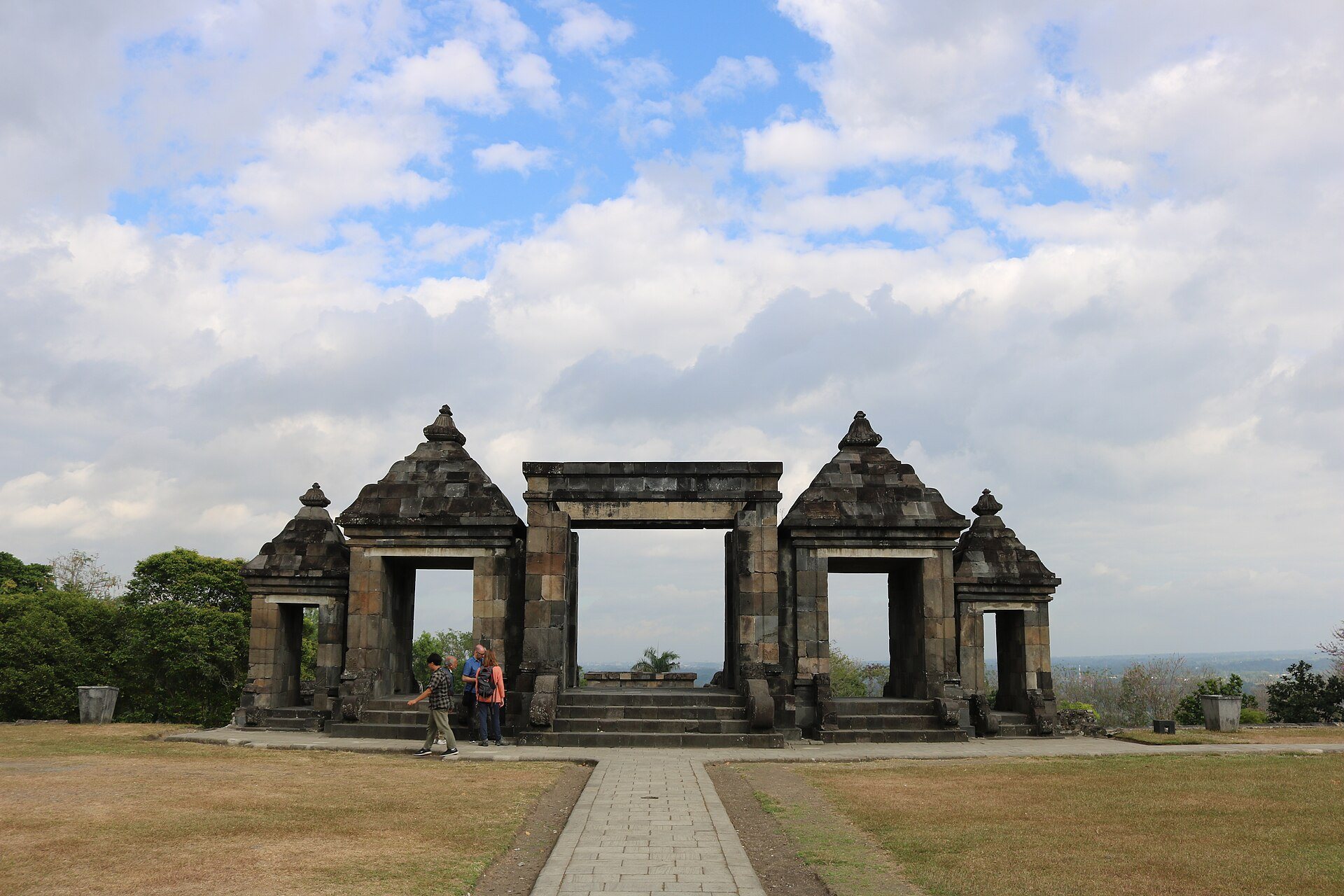
The main gateway also preserves evidence of royal claims. Its inscription names Panabwara, a descendant of Rakai Panangkaran, and was intended to legitimize his authority over the palace. The complex therefore belonged not only to religious history but also to changing struggles over political control in Central Java.
Legend and modern rediscovery
European travelers to Java associated the site with King Boko in seventeenth-century accounts. In 1790, the Dutch researcher F. Van Boeckholtz became the first recorded discoverer of the ruins on the summit of Ratu Boko Hill. The publication of this discovery led Colin Mackenzie, Franz Wilhelm Junghuhn, and Brumun to investigate the site in 1814. During the early twentieth century, F. D. K. Bosch studied the complex extensively and published Keraton Van Ratoe Boko, identifying the remains as a palace, or kraton, a Javanese royal court complex.
Ratu Boko is traditionally linked with the Roro Jonggrang legend, which also connects the site with the Durga statue at Prambanan and the origin of the nearby Sewu temple complex. In the story, Prince Bandung Bondowoso kills King Boko and takes control of his kingdom before seeking to marry the king’s daughter, Princess Loro Jonggrang. She agrees only if he builds one thousand temples in a single night. With the aid of spirits, he completes 999, but Loro Jonggrang deceives them into believing that dawn has arrived. Bandung curses her and turns her to stone, and local tradition identifies her with the Durga image in the northern chamber of Prambanan’s Shiva temple.
The complex also retains Hindu ritual significance through the Amerta Mantana pool. Hindus use its water during the Tawur Agung ceremony on the day before Nyepi, in rites associated with self-purification and the restoration of the earth to its original harmony.
Remains
Ratu Boko occupies a plateau 196 metres above sea level, described as the northwestern branch of the Sewu Mountains, and covers about 16 hectares. The complex is arranged in central, western, southeastern, and eastern sections across terraces divided by stone walls and sloping retaining walls called talud. A steep approach rises along the northwestern slope toward Prambanan. The central area contains the principal gateways, Candi Pembakaran, a pool, a stone pedestal, and the audience hall known as the paseban. The southeastern area includes the pendopo, small shrines, pools, and a walled compound traditionally called the kaputren.
Terraces and gateways
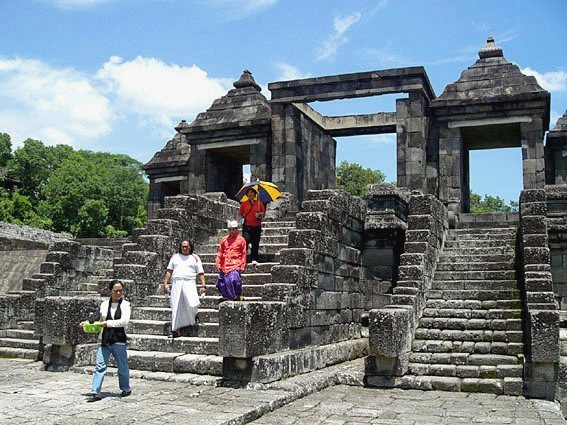
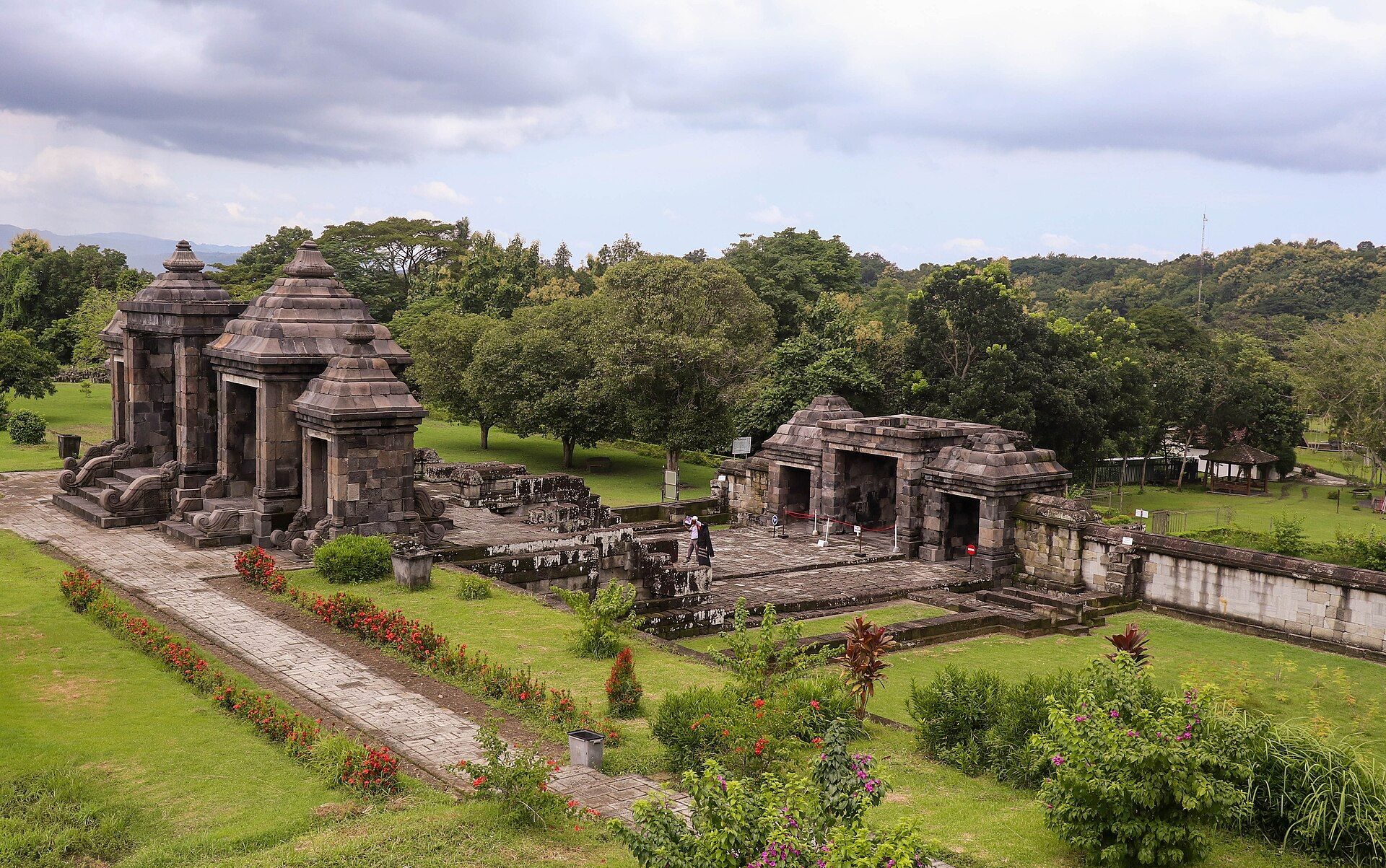
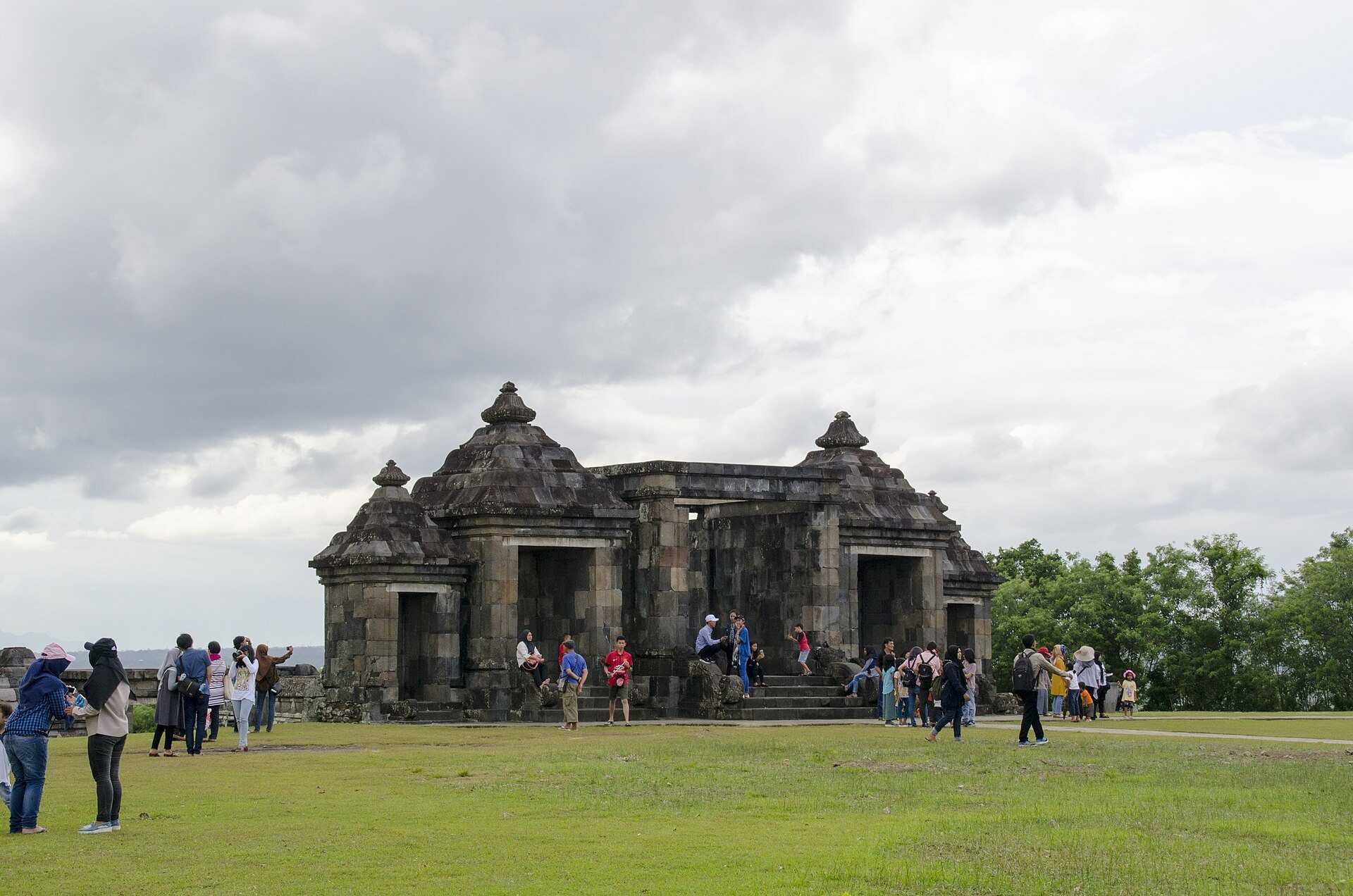
The main approach crosses three terraces. The first begins at a massive two-level gateway, alongside a high western talud built of soft white limestone. The second terrace is separated from it by an andesite wall and entered through a paduraksa, a Javanese gateway with a roof-like upper form and a central passage. This gateway has three openings, with a larger entrance in the middle and two smaller ones at the sides.
The third terrace is the largest and contains the greatest concentration of remains. Another andesite wall and talud separate it from the second terrace. Its second paduraksa has five entrances, with the central opening larger than the four side entrances. The name Panabwara is inscribed on the main gate, linking the structure with the descendant of Rakai Panangkaran who sought to establish his authority over the palace.
Central terrace structures
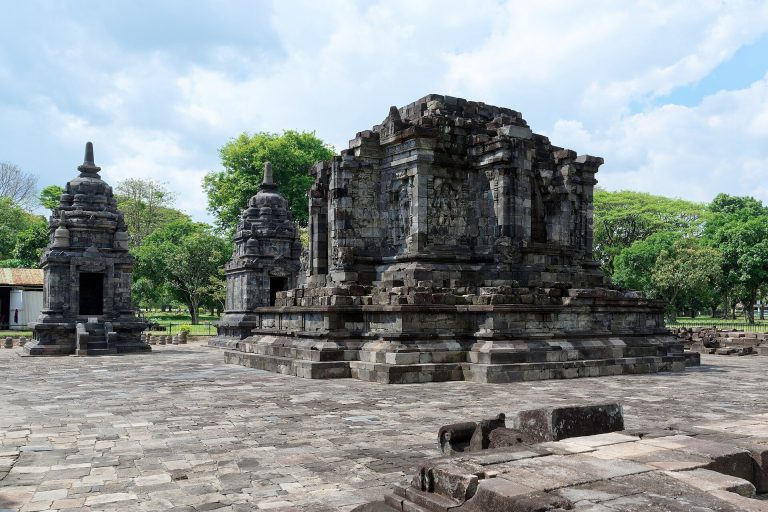
Candi Batu Putih
Candi Batu Putih, meaning “White Stone,” stands on the northern side of the first gate row on the second terrace. It is made of white limestone and forms part of the architectural group encountered before the higher terraces.
Candi Pembakaran
Candi Pembakaran lies on the northern side of the third terrace beyond the second row of gates. It resembles the base of a temple and consists of two terraces, each about 26 by 26 metres. A square opening descends from the centre of the upper terrace. The structure probably served as a crematorium.
Paseban and column bases
The paseban, or audience hall, is a group of structures beside Candi Pembakaran. Its surviving square stone bases indicate buildings that once had wooden columns, walls, and roofs. Several other square stone structures nearby contain umpak, stone pedestals with holes for wooden columns. Their stone floors and bases survive, while the organic upper parts have disappeared.
Southeastern enclosures and shrines
Pendopo
The pendopo occupies the southeastern side of the second terrace. It is a square enclosure bounded by an andesite wall, with small paduraksa gates on its northern, western, and southern sides. At its centre is a stone platform made of two separate terraces, the southern one smaller than the northern one. Umpak show that the platform supported a wooden structure. Its columns, walls, and roof, probably covered with wooden shingles or ijuk palm fibre, no longer survive.
Miniature temples
Three small shrine-like miniature temples stand south of the pendopo, with a square stone basin in front of them. They probably served a Hindu or Buddhist religious purpose, linking this southeastern group with the complex’s wider mixture of religious features.
Kaputren and pools
East of the pendopo, on a lower terrace, are andesite-walled enclosures with paduraksa gates and a gallery leading to several pools. Local tradition calls the walled compound the kaputren, or women’s quarter, and interprets the pools as a pleasure garden for the king and his concubines. A pool or well within the bathing area is known as Amerta Mantana. Hindus regard it as sacred and believe that its water brings good fortune. Two stone-base structures east of the pools probably belonged to wooden buildings, of which only the bases remain.
Caves and archaeological finds
Gua Lanang and Gua Wadon
Two caves formed in sedimentary rock lie north of the pendopo, separated from the rest of the complex. The upper cave is Gua Lanang, or Male Cave, and the lower is Gua Wadon, or Female Cave. A pond and three effigies stand in front of Gua Lanang. One of them has been identified as Aksobhya, one of the principal Buddhas of the Buddhist cosmological pantheon. The caves probably served as meditation spaces.
Statues, inscriptions, and small finds
Finds from Ratu Boko include Hindu statues of Durga, Ganesha, and Garuda, along with a linga and a yoni. A yoni is a related pedestal or symbolic counterpart to the linga, and together they commonly form a Shaiva ritual installation. Three unfinished Dhyani Buddha statues, ceramics, and inscriptions were also found. A gold plate bears the words “Om Rudra ya namah swaha,” expressing worship of Rudra, another name for Shiva.
Colin Mackenzie found a statue of a man and woman with golden heads embracing one another. A stone pillar from the ruins is decorated with animals including elephants and horses. Together, the surviving stone platforms, walls, gateways, bases, pools, caves, religious images, and inscriptions represent both probable secular buildings and religious features, while the organic parts of several structures have disappeared.