Harappa: A Major Indus Valley Urban Center
Site at a Glance
- Rating
- 4.5
- Popularity
- Low
- Country
- Pakistan
- Primary era
- Bronze Age
- Eras represented
- Bronze Age
- Civilizations
- Indus Valley
- Site type
- City
On this page12 sections
History
Harappa is a Bronze Age settlement of the Indus Valley Civilization in Punjab, Pakistan, near an earlier course of the Ravi River. Its earliest recognizable occupation dates to approximately 3300 BC, and the settlement developed through successive archaeological phases before becoming a major urban center between approximately 2600 and 1900 BC.
Early occupation and urban development
Archaeologists distinguish a Ravi aspect of the Hakra phase, approximately 3300–2800 BC, followed by a Kot Dijian, or Early Harappan, phase from approximately 2800–2600 BC. During the Mature Harappan phase, approximately 2600–1900 BC, Harappa grew into an urban settlement covering about 150 hectares and may have had a population of approximately 23,500. Its development formed part of a wider tradition whose cultural roots reached back to earlier farming communities such as Mehrgarh, dating to around 6000 BC.
Harappa later passed through a Transitional Phase, approximately 1900–1800 BC, and a Late Harappan phase, approximately 1800–1300 BC. The end of the Harappan tradition at the site is broadly placed between 1900 and 1500 BC. Harappa is also associated with the later Cemetery H culture, an archaeological tradition of the Punjab identified through its material remains and burial practices.
A center of the Indus Valley Civilization
Harappa is the type site of the Bronze Age Indus Valley Civilization, meaning that its excavated remains became a principal reference for defining the culture. The site was the first Indus Valley Civilization settlement excavated by the Archaeological Survey of India, India’s government institution for archaeological research and heritage protection, during the British Raj. After the discovery of Mohenjo-daro, the importance of Harappa and other settlements became clear, and the Indus Valley Civilization also came to be called the Harappan Civilization.
Official attention reached Harappa in 1826, while early excavations are associated with the Indian archaeologist Daya Ram Sahni. Excavations at Harappa and Mohenjo-daro during the 1920s revealed extensive urban centers, drainage infrastructure, distinctive seals and signs, and varied systems of production and exchange. These discoveries reshaped understanding of South Asian Bronze Age history.
Economy, society, and exchange
Harappa’s urban system depended on surplus agricultural production, specialized crafts, and long-distance trade. Routes along the Indus connected Harappan communities with the Persian Gulf, Mesopotamia, Elam, Sumer, and Egypt. Cotton textiles and agricultural products were important commodities, while carnelian and lapis lazuli were among the valuable goods exchanged. Harappan merchants also maintained procurement colonies in Mesopotamia and traded with communities in southern India for gold and copper.
Standardized weights and measures supported exchange, while small seals may have identified property and shipments. Copper and bronze were used in tools and objects. Cultivated products included wheat, rice, vegetables, and fruit, and cotton was woven and dyed. Humped cattle and other animals were domesticated. The wider late Harappan cultural area connected with Harappa extended from Daimabad and Maharashtra in India to Badakhshan in Afghanistan, covering approximately 2,400 kilometers.
Human remains provide evidence of difficult conditions in parts of the settlement’s later history. Skeletal material indicates an injury rate of about 15.5 percent, including wounds probably caused by conflict. Paleopathological study, the examination of disease and injury in ancient human remains, identified leprosy and tuberculosis. Both disease and traumatic injury were most prevalent in remains from Area G, and increasing craniofacial trauma and infection accompanied the period of social decline, possibly reflecting post-collapse stress, resource scarcity, and unequal access to health and safety.
Decline, damage, and modern protection
During the later Harappan period, changing environmental conditions contributed to the abandonment of some regions. Evidence from the wider civilization points toward natural processes, including progressive drying and desertification in areas now forming part of the Thar Desert, rather than the destruction of Harappa by invading forces. In the later stages of the civilization, writing and hydraulic engineering declined, while settlements in the Ganges Valley gained importance.
Harappa suffered severe physical damage in 1857, when bricks from the ruins were removed for track ballast during construction of the Lahore–Multan Railway. Many artefacts were nevertheless recovered. In 2004, the site was added to Pakistan’s tentative list for UNESCO World Heritage Sites. A proposed amusement park was abandoned in 2005 after archaeological artefacts emerged during preliminary construction work, and restoration followed an appeal by Pakistani archaeologist Ahmad Hasan Dani to the Ministry of Culture. Harappa remains a ruined archaeological site under public management in Punjab.
Remains
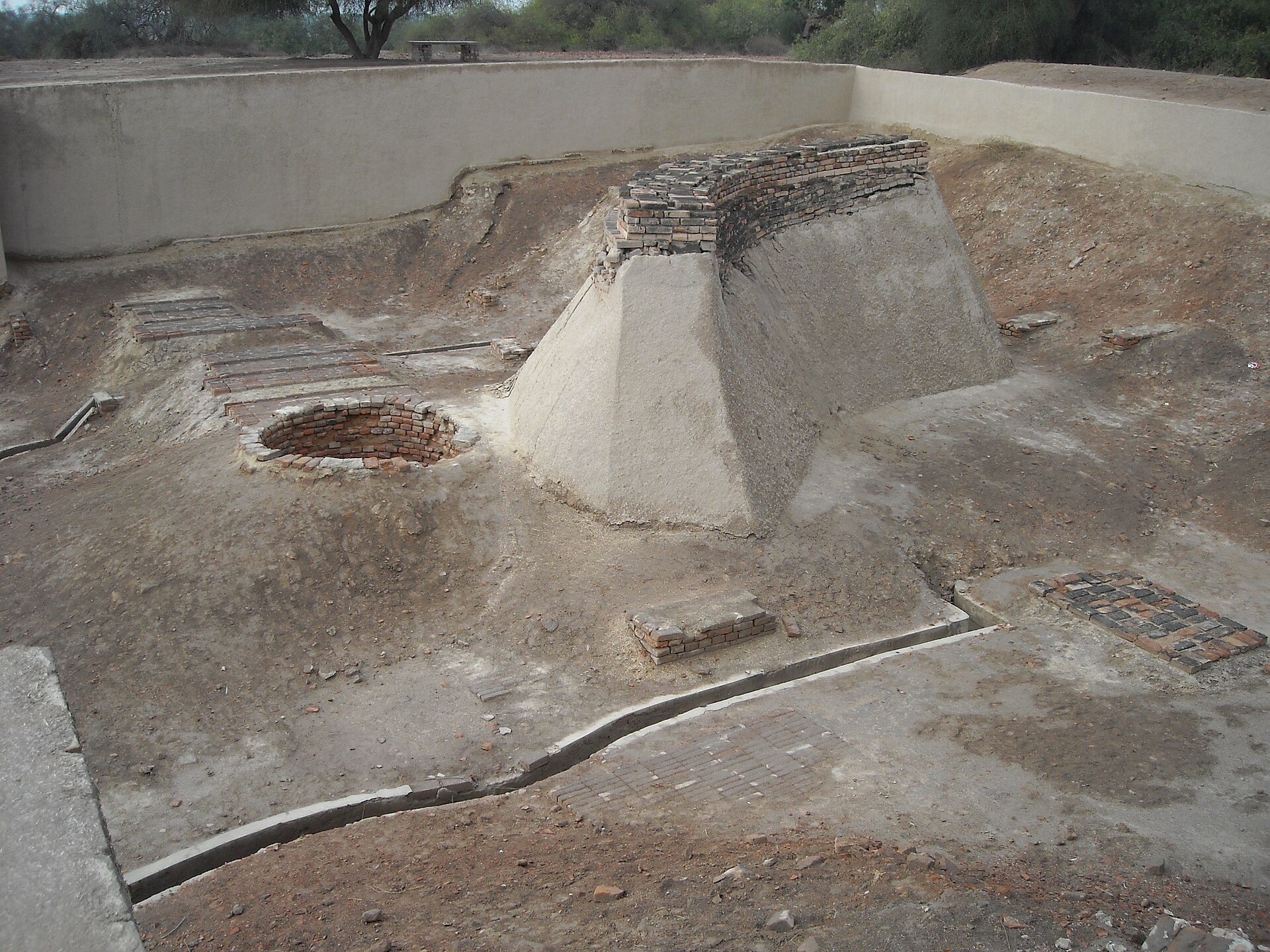
Harappa preserves the remains of a fortified Bronze Age city that reached approximately 150 hectares. Its urban fabric included clay-brick houses, differentiated residential areas, and fortified administrative or religious centers. The settlement expanded through successive phases, while later removal of bricks for railway construction substantially damaged the ancient buildings.
Settlement mounds and civic buildings
During the Ravi or Hakra phase, occupation was first estimated at 7–10 hectares. Excavations and pottery from Mounds E and AB later extended the estimated area of this early settlement to approximately 25 hectares across the two mounds. The Kot Dijian phase covered more than 27 hectares across Mounds AB and E. During the Mature Harappan phase, the settlement expanded to approximately 150 hectares. Buildings were made with bricks formed from red sand, clay, and stone and fired at very high temperatures. A granary and Great Hall are among the structures identified at the site.
Symbols, seals, and human remains
Early tablets and symbolic markings
Excavated clay and stone tablets bear trident-shaped and plant-like markings dated by carbon dating to approximately 3300–3200 BC. These early symbols resemble forms later associated with the Indus script, the undeciphered system of signs found on artefacts from the Indus Valley Civilization. Whether the early markings constitute true writing remains uncertain.
Steatite seals
Small square seals made from steatite, a soft stone also called soapstone, are among Harappa’s most distinctive artefacts. Their engraved human and animal motifs are often accompanied by pictographic signs generally interpreted as writing or script. The signs remain undeciphered, and their language affiliation, including a possible connection with Proto-Dravidian or another non-Vedic language, remains uncertain.
Area G ossuary
Area G lies southeast of the city walls and includes an ossuary, an area used for the deposition of human bones after burial or the decomposition of the body. Skeletons recovered there show Harappa’s highest concentrations of disease and traumatic injury, including evidence associated with leprosy, tuberculosis, and craniofacial wounds.
Material culture
Wheel-made pottery forms part of the Harappan material tradition represented at the site. Vessels were decorated with animal and geometric motifs, while the seals and tablets preserve evidence of the symbolic practices associated with the settlement. Together, these remains connect Harappa’s residential, administrative, craft, and exchange activities with the wider cultural system of the Indus Valley Civilization.