Lachish: An Ancient Canaanite and Judahite City in Israel
Site at a Glance
- Rating
- 4.5
- Popularity
- Medium
- Country
- Israel
- Primary era
- Iron Age
- External website
- Open
- Eras represented
- Stone Age, Bronze Age, Iron Age, Classical
- Civilizations
- Achaemenid, Assyrian, Babylonian, Canaanite, Israelite
- Site type
- City
On this page17 sections
History
Lachish is an ancient Canaanite, Israelite, and Judahite city at Tel Lachish in Israel. Occupation began during the Pottery Neolithic period, approximately 5500–4500 BCE, and the settlement developed into a major city of the southern Levant during the Bronze and Iron Ages. The mound is identified with ancient Lachish through its location, written references, Assyrian reliefs, excavated remains, and inscriptions, although the identification remains circumstantial.
Early settlement and the Bronze Age city
A settlement existed at Lachish during the Chalcolithic period, and major development began in the Early Bronze Age, approximately 3300–3000 BCE. By the close of that period, Lachish had become a large settlement. During the Middle Bronze Age, the city was resettled and expanded. A cult place in Area D received votive vessels during Middle Bronze I, while Lachish became a major southern Levantine city during Middle Bronze IIB–C, approximately 1630–1550 BCE. The city was destroyed by fire at the end of Middle Bronze IIC.
Lachish was re-established during the Late Bronze Age, approximately 1550–1200 BCE, and gradually became one of the large and prosperous cities of the southern Levant. It stood under Egyptian hegemony, meaning that Egypt exercised political authority over the region. During the Amarna period, around the fourteenth century BCE, Lachish functioned as a Canaanite city-state or petty kingdom within the Egyptian empire. The Amarna letters, diplomatic and administrative texts exchanged between Egyptian authorities and eastern Mediterranean rulers, record political conflicts involving Lachish and neighboring cities.
Egyptian and Amarna-period records mention Lachish under forms such as Lakisha. Zimri-Haddu ruled the city before being killed by servants allied with the Habiru. Shipti-Ba’lu, another ruler, held the title “Man of Lachish” and succeeded him. Egyptian control weakened during the late New Kingdom, and Lachish was destroyed by fire around 1150 BCE. Canaanites rebuilt the settlement and established two cultic places, but another fire destroyed it around 1130 BCE. The forces responsible remain uncertain. Proposed explanations include internal Canaanite conflict, incursions by Sea Peoples, Habiru groups, and other forces.
Rebuilding as a city of Judah
After the Late Bronze Age destructions, Lachish remained unfortified and sparsely occupied for a prolonged period. Archaeological evidence indicates substantial population continuity between the Late Bronze and Iron Ages, although the relationship between the communities has been debated. The city was later rebuilt and became part of the Kingdom of Judah. Biblical tradition describes an earlier Israelite conquest followed by the city’s assignment to the tribe of Judah, but the archaeological evidence does not securely identify the Late Bronze Age destroyers.
During the tenth and ninth centuries BCE, Lachish became an important Judahite city. Royal authorities fortified it as a stronghold guarding the valleys leading toward Jerusalem and the interior of Judah from enemies approaching across the coastal plain. Its history became associated with the reigns of Asa and Jehoshaphat and with the fortification program attributed to Rehoboam. An earlier unfortified settlement may have been destroyed around 925 BCE during the campaign of Shoshenq I, the Egyptian pharaoh who invaded parts of the region.
In the eighth century BCE, Lachish was a fortified and prosperous city. It suffered serious damage in an earthquake traditionally associated with the earthquake during the reign of Uzziah and was subsequently rebuilt. Under Hezekiah, the king of Judah who revolted against Assyria in the late eighth century BCE, Lachish remained a major military and administrative center.
The Assyrian siege
In 701 BCE, during Hezekiah’s revolt against the Neo-Assyrian Empire, Sennacherib besieged and captured Lachish despite determined resistance. Sennacherib ruled Assyria from 705 to 681 BCE, and his campaign against Judah formed part of the empire’s effort to suppress rebellion. Some scholars place Lachish’s fall during a second Assyrian campaign around 688 BCE. The conquest was commemorated in a major series of reliefs made for Sennacherib’s palace at Nineveh. They depict the city, siege ramps, battering rams, sappers, soldiers, and the final surrender.
The Assyrian attack left a siege ramp, massed weapons, and destruction remains at Lachish. Approximately 1,500 human skulls were found in a nearby cave. More than 400 royal storage-jar seals also connect the city with Hezekiah’s reign and the period immediately before the conquest. These events made Lachish one of the best-documented ancient sieges in the Near East.
Babylonian conquest and later occupation
Lachish fell to Nebuchadnezzar II during the Babylonian campaign against Judah in 586 BCE and was finally destroyed in 587 BCE. Nebuchadnezzar II was the Neo-Babylonian king whose campaigns conquered Judah, destroyed Jerusalem and Lachish, and led to the exile of many Judahite inhabitants. The Lachish letters, written shortly before the conquest, preserve communications concerning signals from Lachish and the neighboring city of Azekah. Their precise meaning remains debated.
During the Babylonian occupation, a large residence was built on the platform that had previously supported the Judahite palace. After the exile, some Jewish inhabitants returned and established a fortified settlement during the Persian period. Lachish then served as the capital of a province. A large altar known as the Solar Shrine was built in the eastern part of the mound during the Achaemenid, or Persian, period. It was abandoned after the region came under the control of Alexander the Great, and the tell was subsequently unoccupied. Lachish declined during the Hellenistic period as other towns in the Shephelah gained prominence.
Identification and excavation
The site was first identified with Tell el-Hesi by Flinders Petrie. In the 1920s, William F. Albright proposed identifying it with Tell ed-Duweir, an interpretation later accepted by most scholars. Tel Lachish and Tell el-Duweir refer to the archaeological mound associated with the ancient city. A tell is an artificial mound formed through repeated settlement, construction, destruction, and rebuilding.
The first major excavation was the British Starkey-Tufnell expedition of 1932–1939, directed by James Leslie Starkey and including Olga Tufnell, Gerald Lankester Harding, and Charles Inge. The expedition recovered well-stratified pottery and the Lachish letters. Starkey was murdered while traveling to Jerusalem in 1938, and the expedition ended with the outbreak of the Second World War. Tufnell later studied and published the finds.
Yohanan Aharoni directed excavations in 1966 and 1968, chiefly investigating the Solar Shrine. From 1973 to 1994, David Ussishkin directed a large expedition of Tel Aviv University and the Israel Exploration Society that concentrated on the Late Bronze and Iron Age levels while combining excavation with restoration. Excavations resumed in 2012. Yosef Garfinkel, Michael G. Hasel, and Martin G. Klingbeil began another expedition in 2013 to investigate the Iron Age history of Lachish. Later projects examined the Middle and Late Bronze Age strata, the city gate, and the Iron Age gate shrine. An Austro-Israeli project began in 2017 under Felix Höflmayer and Katharina Streit. Lachish is now an Israeli national park maintained by the Israel Nature and Parks Authority and was declared a national park in 1994.
Remains
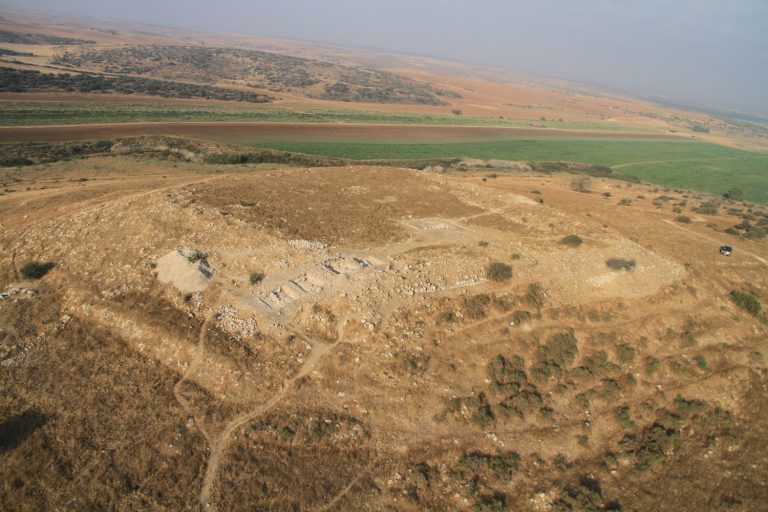
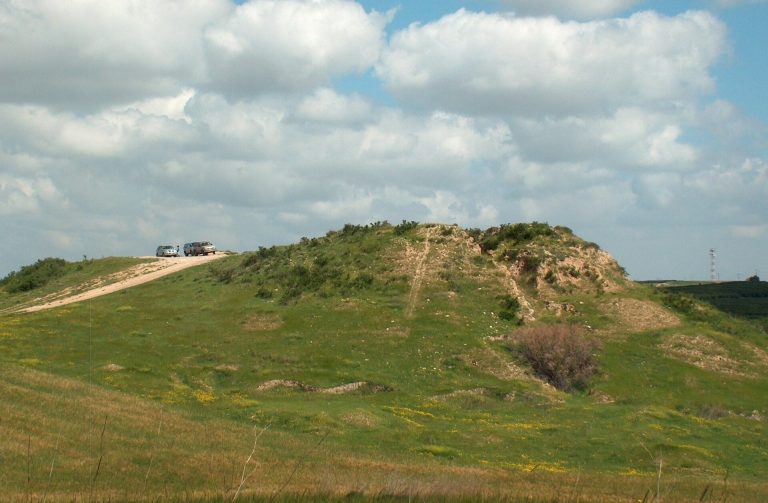
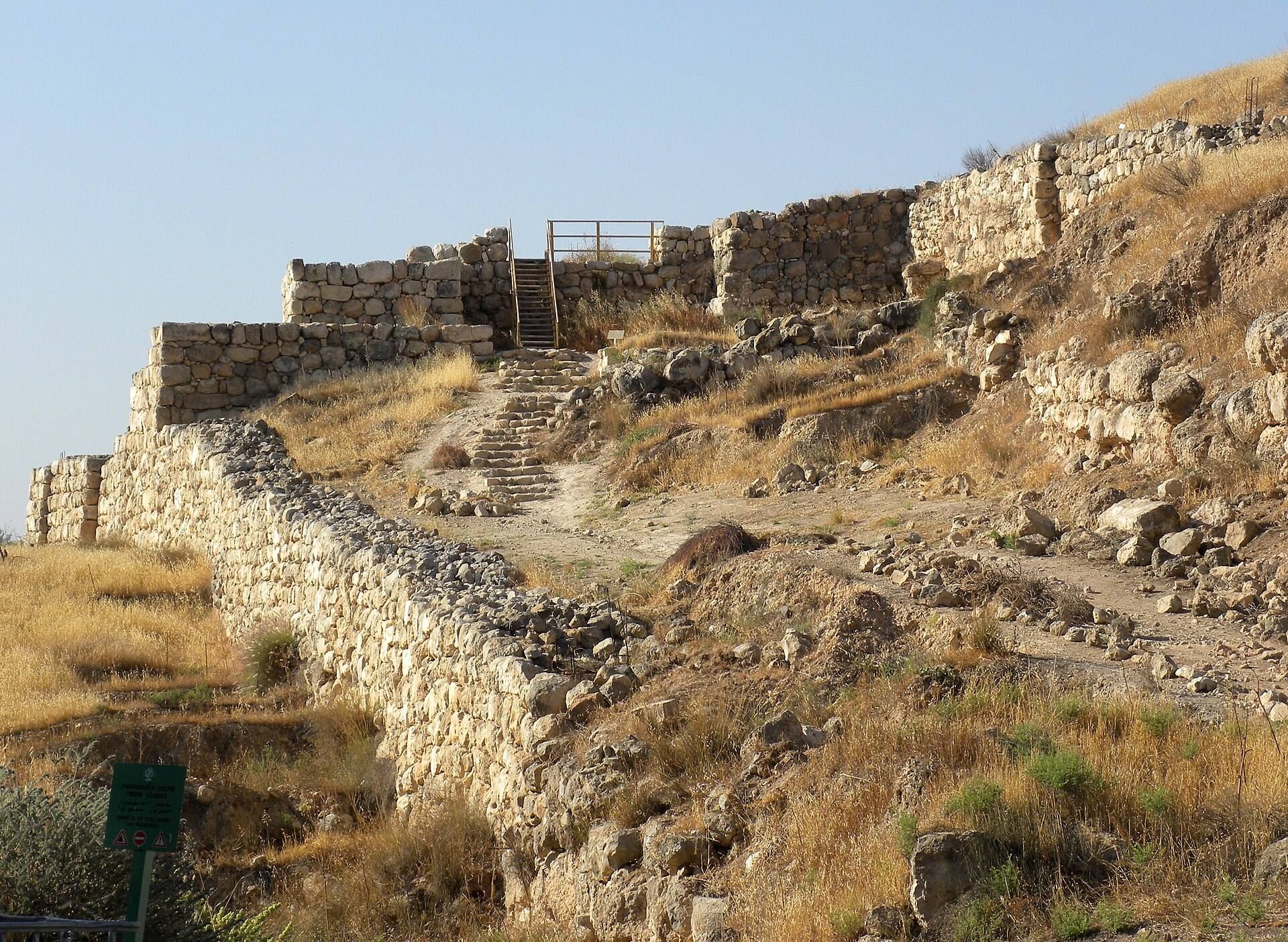
Tel Lachish is a large archaeological mound in the Shephelah, the zone of low hills between the Judean highlands and the Mediterranean coastal plain. The site covers approximately 20 hectares, while the Iron Age city occupied about 8 hectares. It rises to approximately 150 metres above sea level. Its surviving remains include successive settlement levels, fortifications, temples, administrative buildings, water installations, writing materials, and evidence of the Assyrian assault.
Bronze Age fortifications and temples
Middle Bronze Age Lachish included a large mudbrick fortress or palace in Area P. Four scarabs and numerous scarab sealings were found there, including examples in local Canaanite Middle Bronze IIC and Hyksos styles. Radiocarbon dating places the fortress in the mid-sixteenth century BCE. A massive glacis, a sloping defensive earthwork built against or in front of a fortification, surrounded the city. It created steep slopes and sharp corners around the mound and stood before a city wall made from large stones.
Middle Bronze cult place
The Middle Bronze I cult place in Area D contained votive cultic vessels. These deposits belong to the phase when Lachish was being resettled and developed into a major urban center. Their location provides physical evidence for religious activity within the expanding city.
Late Bronze temples
The Late Bronze levels contain a sequence of three Fosse Temples. Fosse Temple I belonged to an early, sparsely populated phase, while Fosse Temple II was associated with Level VII and Fosse Temple III with Level VI. A Canaanite temple dated to approximately 1250 BCE contained a cultic object called the “divine staff,” apparently intended to be held by a statue of the god Baal. The temple also produced a vessel bearing a Canaanite inscription written before firing, with the word “scribe” identifiable.
Iron Age city and water supply
The Iron Age city was enclosed by massive walls and ramparts. A large royal palace stood on a central platform, and a substantial city gate controlled entry to the settlement. A smaller gate structure from the seventh or sixth century BCE was built above the large gate associated with Hezekiah’s period. Excavated tenth-century BCE houses contained pottery, cooking stoves, animal bones, and olive seeds, while spearheads and fortress walls reflect the city’s military character.
Gate shrine
A gate shrine discovered near the city gate in 2016 contained two altars with broken horns. The inner altar room also held a toilet installation. This arrangement appears to relate to Hezekiah’s campaign against local idolatry and the symbolic desecration and closure of the shrine.
Water installations
A well supplied much of the city’s water and has a preserved depth of more than 40 metres. Other installations include water pits and channels associated with the administrative and shrine areas. Beneath the Persian-period Solar Shrine, earlier excavations revealed a structure interpreted as storage rooms and an administrative building, together with two water pits and a channel leading outside the city.
Assyrian siege works
The Assyrian siege ramp was built against the city’s relatively gentle southwestern slope from piled stones and earth. Its upper stone surface was coated with mud to aid movement, and a reddish-brown earthen platform at the top supported battering rams. The fan-shaped ramp is approximately 70–75 metres wide at its base, 25 metres wide at its upper end, and 16 metres high. It is the only known Assyrian siege ramp of its kind in the ancient Near East and the oldest known siege ramp. A cleared section exposes the mound slope and the layers of stones forming the ramp.
Lachish’s defenders constructed an inner earth ramp over city houses, raising their position above the attacking forces. Hundreds of arrowheads were found on the siege ramp and at the top of the city wall. The Assyrian reliefs at Nineveh preserve images of the city’s architecture and the assault, including the ramps, battering rams, sappers, soldiers, and surrender. Most of the relief slabs are now in the British Museum.
Burials and inscribed objects
Four mass graves contained more than 1,500 individuals, approximately half of them women and children. The tombs date to the Late Bronze Age, although the burials contain few objects that can establish the date of interment more precisely.
The site has produced at least twelve purported Proto-Canaanite inscriptions. Some may be figural pottery designs or pseudo-inscriptions. Recognized examples include the Lachish Ewer, Lachish Bowl, Cypriot Bowl Fragment, and Ivory Lice Comb. An inscribed ivory comb found in 2016 probably dates to about 1700 BCE. Its proposed fifteen-letter text has been interpreted as a wish to remove lice from the hair and beard. This reading has been described as the earliest known sentence in an early Canaanite alphabet, although the interpretation remains provisional.
An inked rim fragment from a Cypriot White Slip II bowl dates to the mid-fifteenth century BCE and bears nine letters. Proposed readings include words meaning “servant” and “honey” or “nectar,” but the fragment is too incomplete for a secure fuller interpretation. An inscribed ewer from Fosse Temple III belongs to Level VII and dates to the thirteenth century BCE. The Lachish Bowl, found in Tomb 527 in Level VII, also dates to the thirteenth century BCE, while another Level VII bowl fragment dates to the twelfth century BCE.
A jar sherd found in 2014 in Level VI dates to approximately 1130 BCE and bears nine discernible letters arranged in three lines. The text cannot be securely read as words, but it contributes to the study of alphabetic writing. A small potsherd from a Late Bronze Age temple bears letters of a twelfth-century BCE alphabet. Another pottery sherd, found in 2018, dates to the fifteenth century BCE and bears alphabetic writing. A hieratic ostracon from 2019, dating to the Egyptian Eighteenth Dynasty, appears to preserve a Canaanite name list with allocated provisions.
Letters and royal storage jars
The Lachish letters consist of twenty-one Paleo-Hebrew ostraca, meaning pieces of pottery used as writing surfaces. Eighteen were found in 1935 and three in 1938. They came from the latest occupational level before the Babylonian siege and were addressed to the commander of the city garrison. One letter mentions watching the beacon of Lachish while the signals from Azekah could no longer be seen. The broader meaning of the report remains disputed.
More than 400 LMLK seal impressions were found on the handles of a distinctive type of storage jar, more than at any other site in Israel. The abbreviation means “of the king” and refers to marks associated with the administrative system of Hezekiah’s reign. Eight jars were restored, showing that their capacities varied by approximately 12 litres and that the stamps were not reliable indicators of volume. The jars belong to Hezekiah’s reign and the period immediately before the Assyrian conquest.
Persian-period remains
The Solar Shrine occupied the eastern part of the mound during the Achaemenid, or Persian, period. Its construction followed the return of some Jewish inhabitants and the establishment of a fortified settlement that served as a provincial capital. The shrine was later abandoned after Alexander the Great brought the region under his control.
The site has also produced a dark-blue Egyptian New Kingdom diorite scarab from unstratified topsoil. A potsherd found in 2022 was initially interpreted as an Aramaic inscription referring to the twenty-fourth year of Darius, which would have indicated 498 BCE. Laboratory examination initially supported its authenticity, but the Israel Antiquities Authority later determined that the text had been engraved on an ancient pottery fragment by a researcher demonstrating inscription techniques and then discarded at the site. It is therefore a modern forgery rather than an ancient Lachish inscription.