Cetho: A Fifteenth-Century Javanese Hindu Temple Complex
Site at a Glance
- Rating
- 4.7
- Popularity
- High
- Country
- Indonesia
- Primary era
- Medieval
- Eras represented
- Medieval, Modern
- Civilizations
- Majapahit
- Site type
- Religious
- Remains
- Temple
On this page15 sections
History
Cetho is a fifteenth-century Javanese Hindu temple complex on the western or northwestern slope of Mount Lawu in Indonesia, near the border of Central and East Java. Built around 1451–1470 during the late Majapahit period, it belongs to a group of mountain temples associated with the final major phase of temple construction in Java before the island’s courts converted to Islam in the sixteenth century.
The Late Majapahit Setting
Construction took place while Majapahit, a major Javanese kingdom, was experiencing severe social, political, cultural, and religious disorder before its final collapse in 1519. During this period, Javanese religion and art moved away from the Indian-influenced styles that had dominated the eighth to tenth centuries. Local Indonesian and Javanese traditions became increasingly prominent, and Cetho combines Hindu imagery with older local forms.
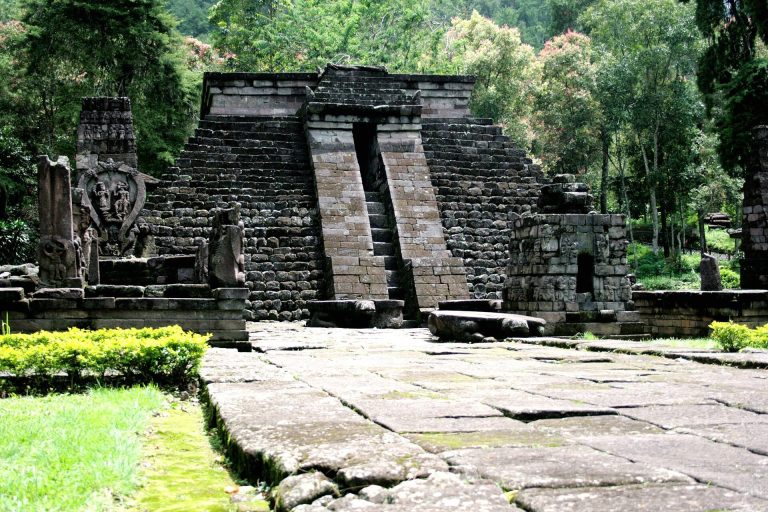
Cetho is closely associated with the lower-lying Sukuh temple. The complex is interpreted as having begun as a sacred place connected with ancestor veneration before developing into a Hindu-Javanese monument concerned with freeing ancestral spirits from worldly bonds. Other interpretations understand it as a place devoted to Shiva, spiritual rites, and ascetic retreat rather than ordinary public worship.
The site is also associated with ruwatan, a Javanese purification rite intended to remove spiritual danger, misfortune, and worldly or supernatural impediments. The Sudamala narrative, whose episodes appear in relief at the complex, is connected with this ritual tradition. Cetho’s religious meaning remains difficult to define precisely, but its layout and imagery reflect the syncretic character attributed to the late Majapahit temples of the Mount Lawu region.
Rediscovery and Rebuilding
Van de Vlis made the first scientific report on Cetho in 1842. The site later drew the attention of W. F. Sutterheim, K. C. Crucq, N. J. Krom, A. J. Bernet Kempers, and Riboet Dharmosoetopo. In 1928, the Dutch East Indies Archaeological Service excavated and studied the complex to support reconstruction and recover buried objects. The investigation did not provide enough evidence to reconstruct the stone buildings that had stood at the summit.
Sudjono Humardani directed a major restoration, more precisely a rebuilding, in 1975–1976. Archaeologists widely criticized the work because it proceeded without sufficient archaeological study and substantially changed the original structures. New additions included wooden buildings resembling Balinese temple structures, a monumental entrance gate, statues of Sabdapalon, Nayagenggong, and Brawijaya V, a phallus, and a cubic building at the summit.
The rebuilding retained the concept of a stepped pyramid, but the archaeological authenticity of much of the reconstructed form remains uncertain. The present complex therefore combines surviving remains with modern additions. During Rina Iriani’s tenure as regent of Karanganyar from 2003 to 2008, a statue of Saraswati, the Hindu goddess associated with knowledge, learning, language, and the arts, was installed on the eastern side after being donated by Gianyar Regency.
Cetho is protected as a nationally ranked Indonesian cultural heritage site. It was registered under ministerial decisions issued in 2007 and 2015 and is managed by the Museum and Cultural Heritage institution of Indonesia’s Ministry of Culture.
Name and Mountain Setting
The name Cetho comes from a Javanese word meaning “clear.” It refers to the elevated location, approximately 1,495 metres above sea level, which provides broad views in several directions. Karanganyar and Solo, together with Mount Merbabu, Mount Merapi, and Mount Sumbing, lie to the north; green hills extend to the east and west; and the ridges and subsidiary peaks of Mount Lawu rise to the south.
Remains
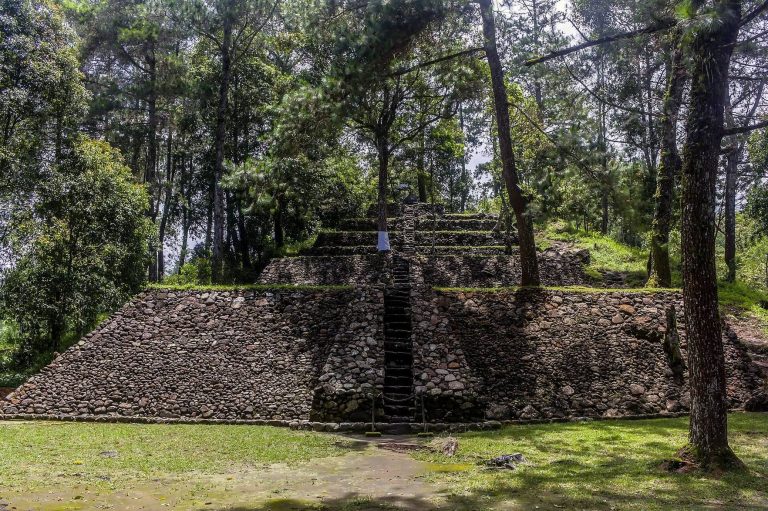
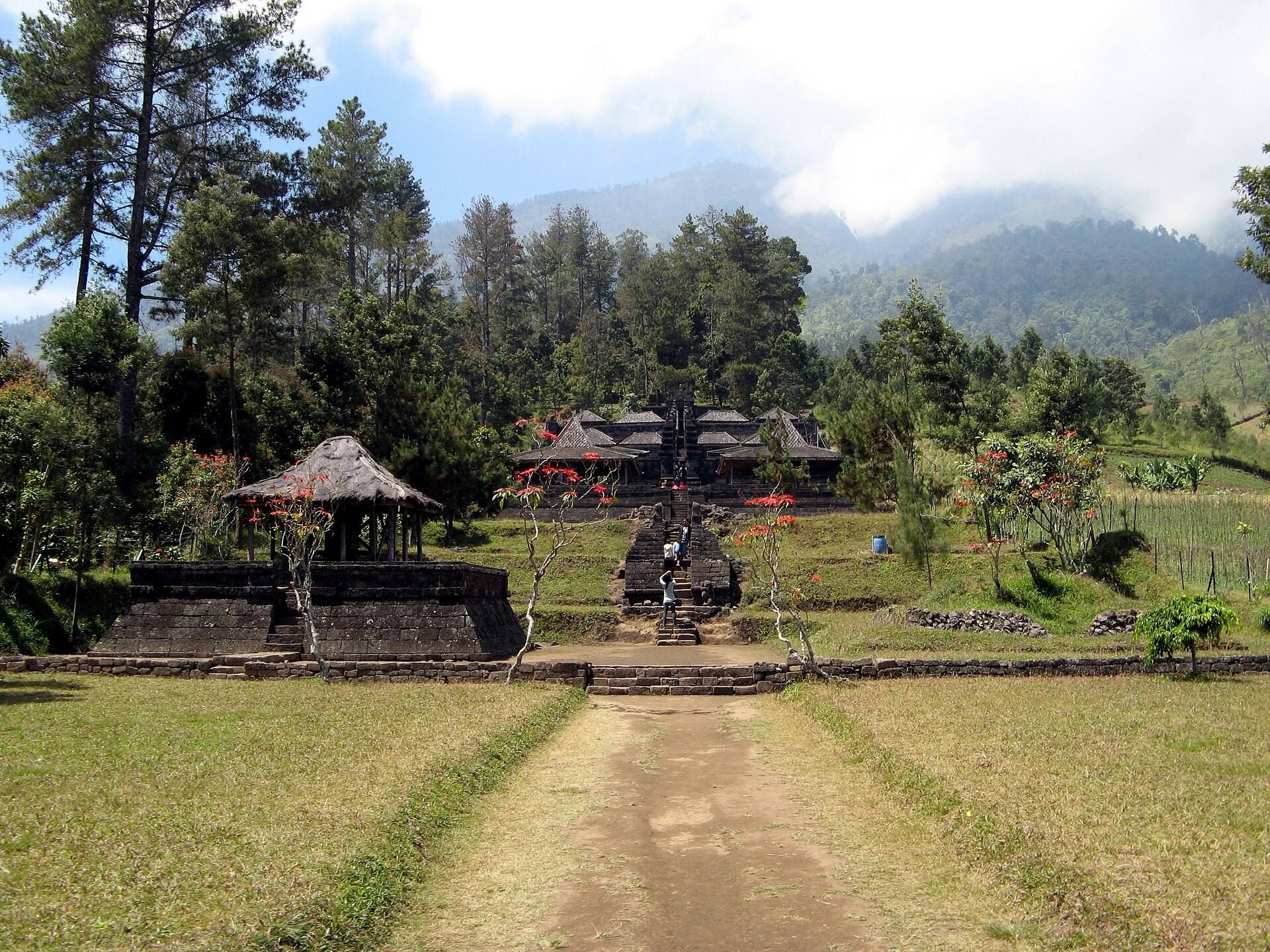
Cetho occupies a mountain slope and is organized as a stepped, pyramid-like sequence of terraces known as a punden berundak, an Indonesian monument form built from ascending platforms. The terraces extend from west to east, with the lowest level on the west. Fourteen stone terraces were identified when the ruins were first examined, while thirteen remain identifiable today and nine were reconstructed. The post-restoration arrangement has nine stepped levels.
Terraces and Entrance
Gateway and Lower Courts
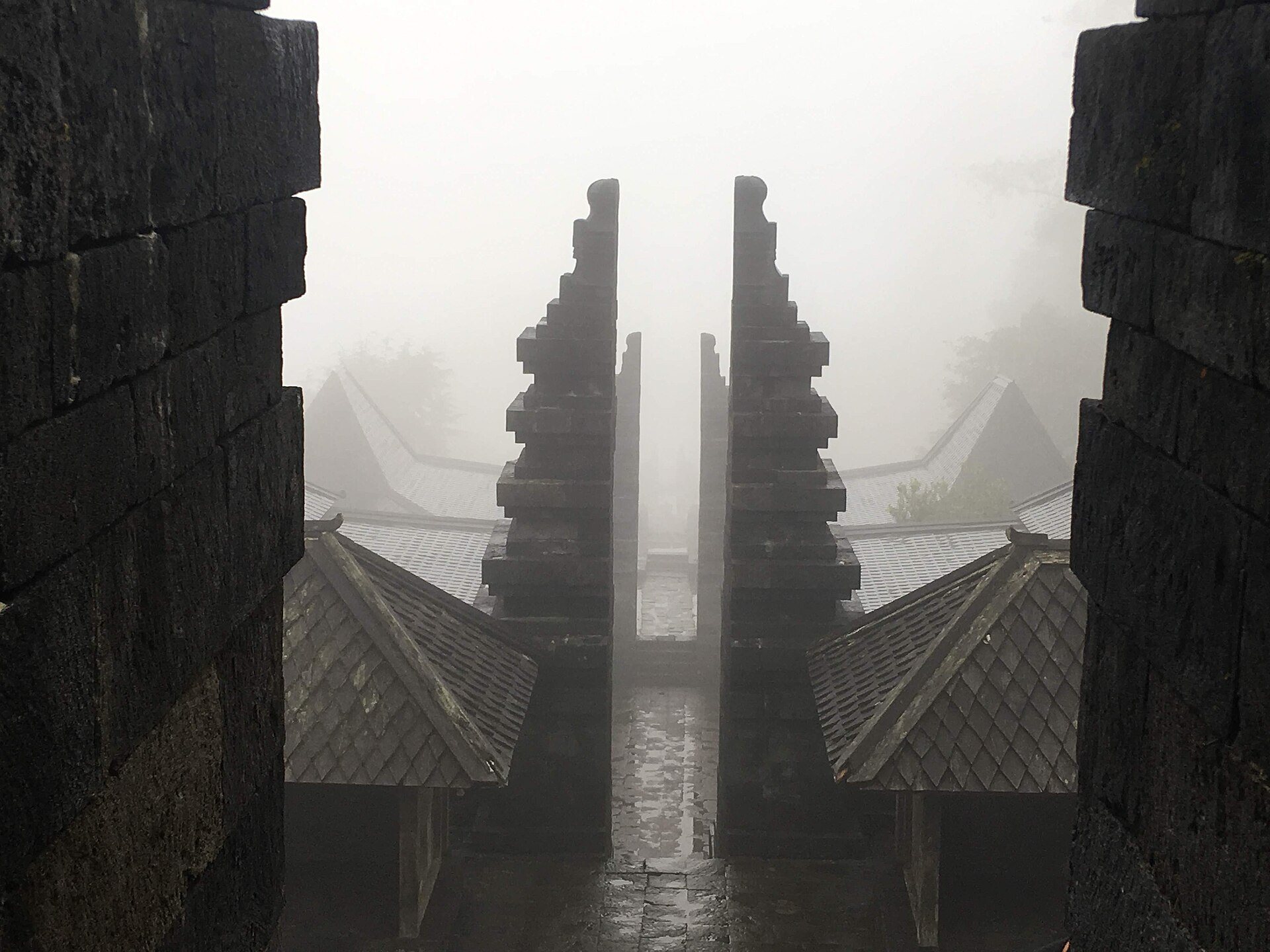
A large candi bentar, or split gateway made of two matching structures with an open passage between them, forms the entrance. Two pairs of guardian statues stand before it. The first level after the gateway, identified as the third terrace in the site sequence, is an open temple courtyard. The next level is also an open court, while the following terrace contains a memorial or shrine associated with Ki Ageng Krincingwesi, regarded as an ancestor of the inhabitants of Cetho hamlet.
Inscribed Approach
An inscription in Old Javanese script is carved into the right wall of the gateway leading toward the seventh terrace. It has been interpreted as referring to ritual purification and gives the gateway’s construction date as 1397 Saka, equivalent to AD 1475. The inscription provides a chronological point within the complex’s development.
Symbolic and Ritual Features
Seventh Terrace
The seventh terrace contains a horizontal stone arrangement at ground level with a giant tortoise, a Surya Majapahit, or radiating sun emblem associated with Majapahit, and a two-metre-long phallic symbol decorated with an ampallang-type piercing ornament. Other animal representations include a mimi, a frog, and a crab. Together, these images have been read as a chronogram, a symbolic arrangement that encodes a date, giving 1373 Saka, or AD 1451. This interpretation suggests that the complex was built or renovated in several stages.
The tortoise has been interpreted as an image of cosmic creation, while the phallic representation expresses human creation. The phallic imagery also relates to fertility and hopes for abundant fertility in the surrounding land. On the northern and southern sides of the terrace are statues of Sabdapalon and Nayagenggong. Local tradition regards these semi-mythical figures as servants and spiritual advisers of Brawijaya V, traditionally considered the final ruler of Majapahit, while some interpretations identify them as the same figure.
Sudamala Reliefs
At a higher level, two adjacent stone platforms carry reliefs showing episodes from the Sudamala story, a Javanese narrative associated with purification and the removal of spiritual affliction. The figures have profile faces but bodies that tend toward frontal presentation, a style resembling wayang kulit, the Javanese tradition of shadow-puppet theatre. Comparable imagery occurs at Sukuh and belongs to the late Hindu-Buddhist artistic tradition of Java.
Upper Terraces and Summit
Two further levels contain wooden pendapa, open-sided pavilions used for communal, ceremonial, or religious activities, positioned along the approach route. The eighth terrace contains a phallic statue called Kuntobimo on its northern side and a statue of Brawijaya V represented as a mahadeva, an epithet of Shiva meaning “Great God.”
The uppermost, ninth terrace is used for prayer and contains a stone building shaped as a cube. The cube and several other features are considered additions from the late twentieth-century rebuilding rather than securely authenticated survivals of the original complex. At the top is a patirtan, a ritual bathing or cleansing structure formerly used before worship.
Art and Related Structures
Sculpture and Religious Imagery
Large, relatively simply carved sculpture is characteristic of the period. The Bima statue in the first courtyard is a clear example. The complex also includes lingga-yoni imagery, a Hindu symbol of generative power and the complementary union of masculine and feminine principles, along with cosmological motifs, floral patterns, mythological figures, and figures shown in meditation. Their combination joins Hindu iconography with local Javanese and pre-Hindu traditions.
Kethek Temple
Northeast of Cetho, farther down the slope, stands another temple complex now called Kethek Temple, or “Monkey Temple.” Cetho’s stepped arrangement and reliefs have been compared with the stepped sanctuaries of Mount Penanggungan and Mount Arjuna in East Java, as well as with Sukuh in its restored form.