Xochitecatl: A Pre-Columbian Ceremonial Center in Tlaxcala, Mexico
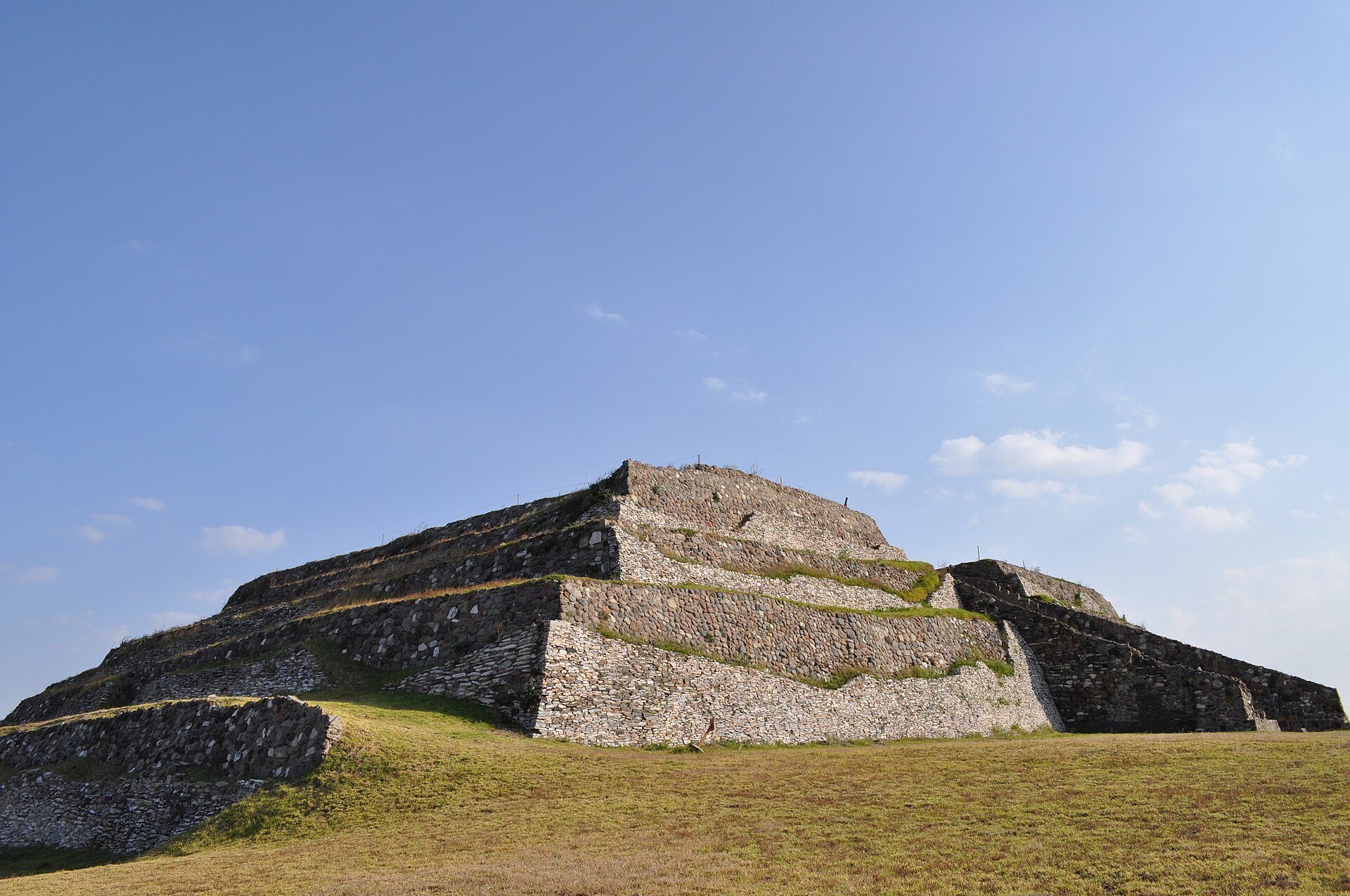
Site at a Glance
- Rating
- 4.6
- Popularity
- Medium
- Country
- Mexico
- Primary era
- Iron Age
- External website
- Open
- Eras represented
- Iron Age, Classical, Medieval
- Civilizations
- Unclassified
- Site type
- Religious
- Remains
- Sanctuary
On this page10 sections
History
Xochitecatl is a pre-Columbian archaeological and ceremonial center on a volcanic dome near San Miguel del Milagro in Tlaxcala, Mexico. Construction began around 800 BC during Mesoamerica’s Middle Preclassic period, when the site developed as part of a productive agricultural region between the Atoyac and Zahuapan rivers. Its name is associated with Nahuatl terms meaning “lineage of flowers.” Rather than serving chiefly as the center of a dense urban settlement, Xochitecatl appears to have provided a ceremonial focus for a dispersed rural population.
Early settlement and the chiefdom
Xochitecatl grew from earlier agricultural communities in the Puebla–Tlaxcala Valley. Regional settlements existed by approximately 1600–1200 BC, and the population increased between the eleventh and eighth centuries BC. Evidence of an Olmec presence has also been identified at the site. Its position on the summit gave it visual connections with the surrounding valleys and major volcanoes, while its proximity to Cacaxtla, about 1 kilometer to the east, placed it within a wider regional landscape.
The first major construction began around 800 BC with the Pyramid of Flowers, the Serpent Building, and the Spiral Building. Further structures were added between approximately 550 and 400 BC. From about 350 BC to AD 100, Xochitecatl became the center of a powerful chiefdom that controlled a substantial part of western Tlaxcala. During this period, the Pyramid of Flowers was greatly enlarged between approximately 200 and 150 BC, and the Serpent Building underwent additional changes.
Abandonment and later ceremonial use
Beginning around the first century BC, environmental changes associated with an eruption of Popocatepetl contributed to the gradual abandonment of Xochitecatl. The process was complete by approximately AD 150. The site was reoccupied between approximately AD 600 and 950, during the Epiclassic period, an era when Cacaxtla expanded and Xochitecatl functioned as a secondary ceremonial center within its wider urban area. The Platform of the Volcanoes was built during this phase, and the Pyramid of Flowers again became a focus of ritual activity, including the sacrifice of children.
Xochitecatl and Cacaxtla were abandoned around AD 950. Ritual activity nevertheless continued at Xochitecatl during the Postclassic Period and into the Spanish Colonial Period. The Pyramid of Flowers in particular preserves evidence of use into the Colonial period. Major excavations carried out in 1993 and 1994 by Mari Carmen Serra Puche examined the principal buildings around the site core and revealed areas for working obsidian in the Pyramid of Flowers and the Serpent Building. The archaeological center is administered by Mexico’s National Institute of Anthropology and History as part of the protected Cacaxtla–Xochitecatl archaeological zone.
Remains
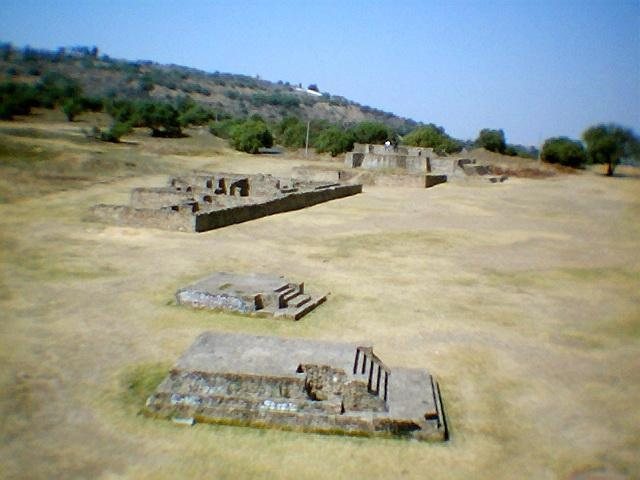
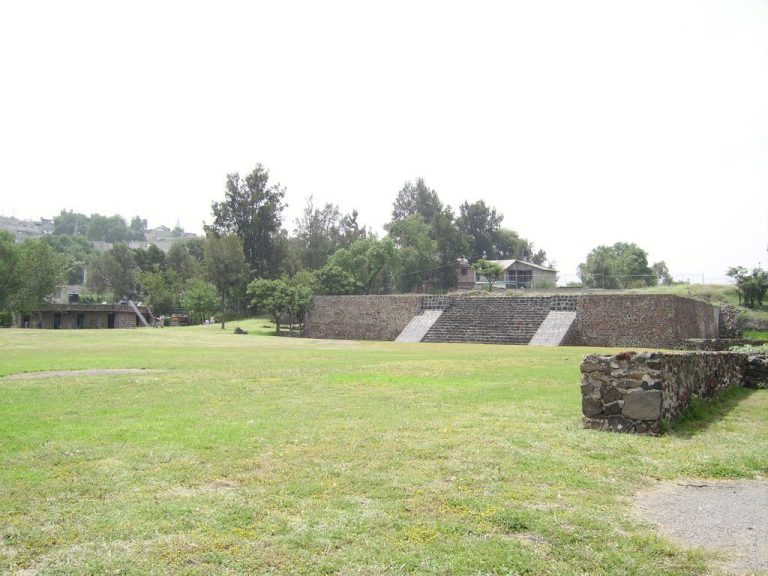
The ruins cover approximately 12 hectares on the summit of the volcanic dome. The ceremonial center is arranged around two plazas. The main plaza contains the Pyramid of Flowers, the Serpent Building, and the Platform of the Volcanoes, while the western plaza is bordered by the Spiral Building. The surviving structures combine earthen construction, stone elements, mud coverings, and later stucco. Their arrangement preserves the changing ceremonial organization of the center from the Preclassic period through its later reuse.
Structures of the main plaza
Pyramid of Flowers
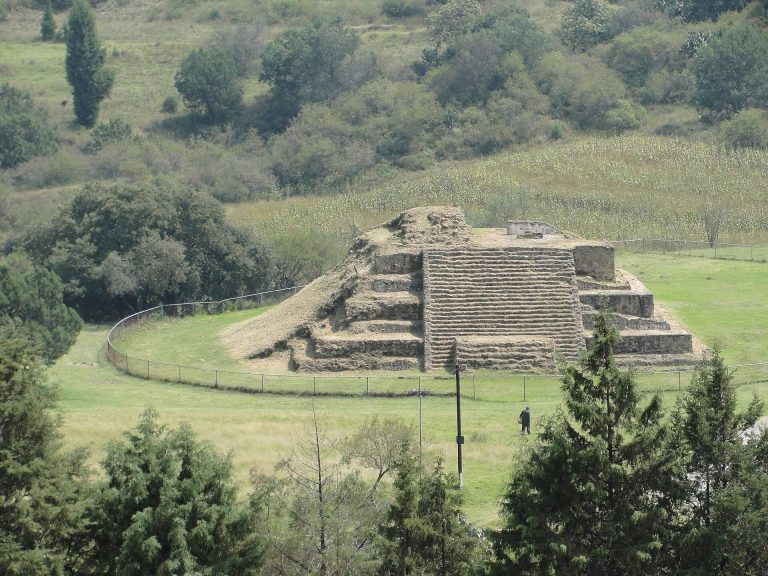
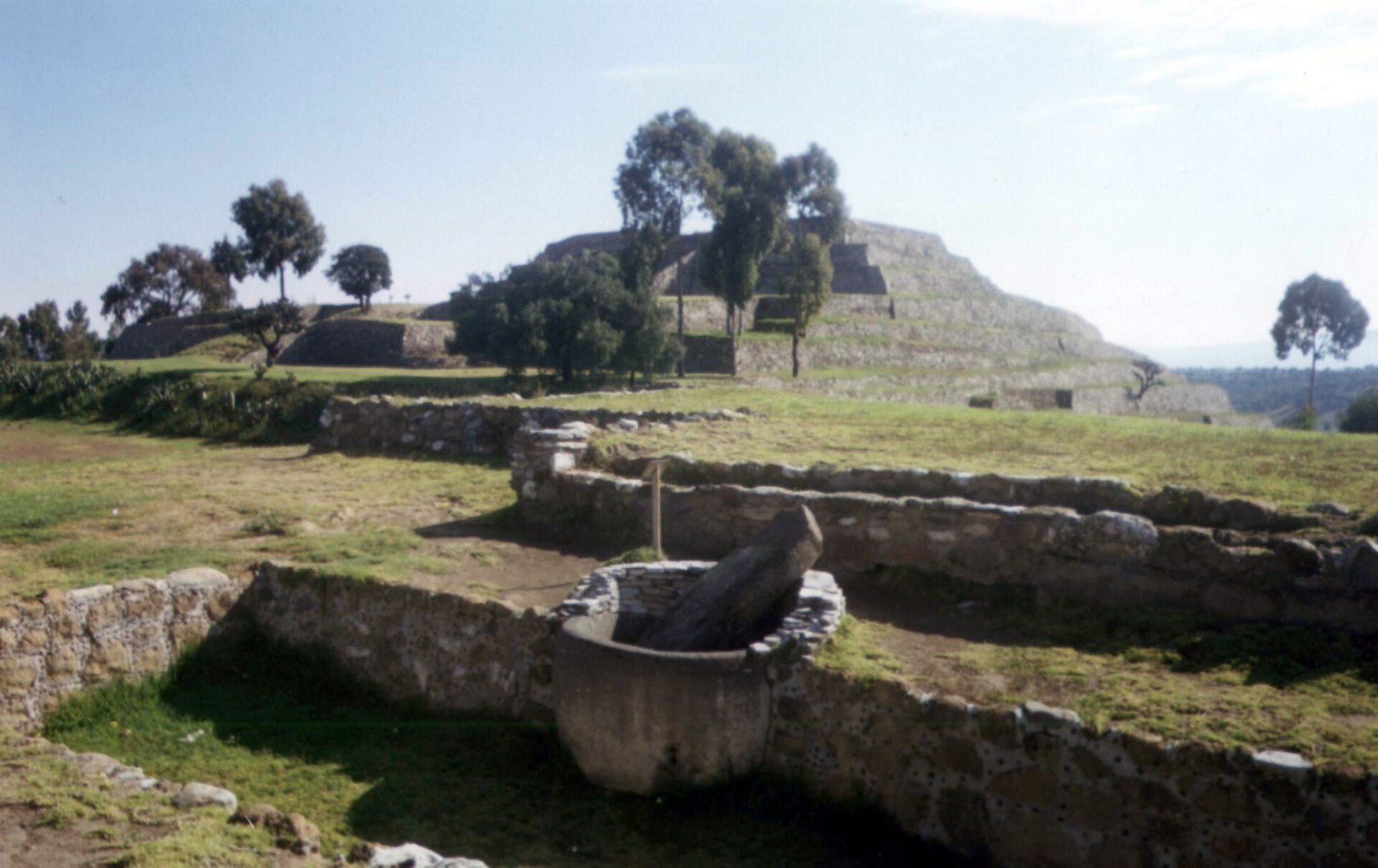
The Pyramid of Flowers, also called Building E1, was begun during the Preclassic Period and has a base measuring about 100 by 140 meters. Its long history of ritual use continued through the Spanish Colonial Period. More than thirty child burials and one adult burial were found within the pyramid, together with offerings. Some of the children had green-stone beads placed in their mouths, an accompaniment intended for their journey to the underworld.
The stairway produced more than 2,000 clay figurines and 15 stone sculptures depicting humans and animals. Many of the figurines represent females at different ages, from infancy to old age. They include babies, richly dressed women, pregnant women, mothers carrying children, and women shown with elaborately dressed infants inside openings in their abdomens. Their clothing and adornment are rendered in detail, including pleated or geometric skirts, decorated blouses, colored hair bows, and four- or five-petalled flowers.
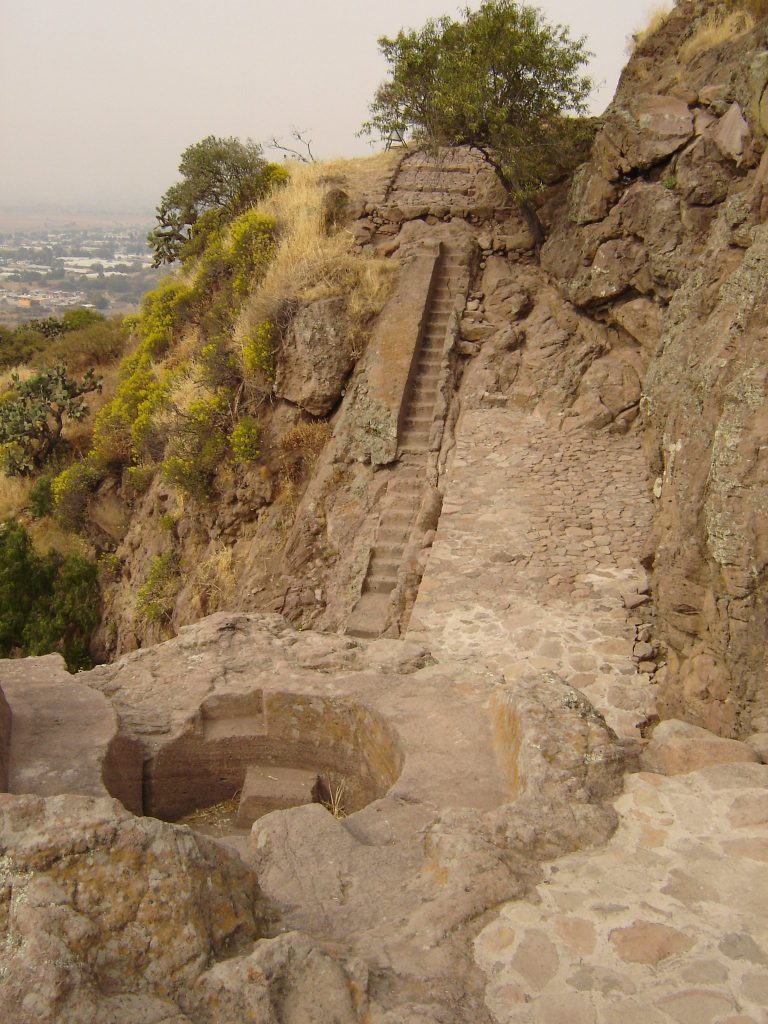
Two large monolithic basins stood before the stairway. One was about 1.7 meters across and had been fractured and consolidated along one edge in pre-Hispanic times. Four sculptures were placed inside it: an anthropomorphic toad, a mythological serpent releasing a human face from its jaws, and two human faces. One of those faces shows paralysis affecting the nose and mouth. The basins may have served for astronomical observation, since water in them could reflect the stars.
Excavation also recovered more than 200 gray, black, and green obsidian projectile points, hundreds of additional obsidian fragments, and more than twenty stone sculptures, most of them mutilated. The sculptures include a canine, amphibians, a monkey, anthropomorphic figures, and a mythological rattlesnake with a fleshless human face. The rattlesnake has been associated with local traditions concerning the goddess Xochitl.
An astronomical alignment connects the pyramid with the surrounding landscape. Seen from its summit, the sun rises in the direction of La Malinche volcano on September 29. This date coincides with the annual festival at San Miguel el Milagro, approximately 2 kilometers to the east.
Serpent Building
The Serpent Building, or Building E2, dates to around 700 BC and measures approximately 80 by 50 meters. A monolithic stone basin on its summit is about 1.3 meters in diameter and 60 centimeters high. A mutilated stela placed inside the basin bears the carved fangs and forked tongue of a serpent.
Two stone sculptures were found north of the basin. One represents an anthropomorphic figure dressed as a jaguar, while the other shows a man with a pronounced forehead and lips holding a scepter or staff in his right hand. Two clay bowls were associated with the same offering.
A ground-level room was built against the building’s west side. Large quantities of worked obsidian in its northeastern corner indicate that the structure probably included a workshop. The material comprises cores, flakes, knives, projectile points, scrapers, bone tools, antlers, blades, and a flint knife. Associated ceramics place this activity in the Late Preclassic, approximately 350 BC to AD 100.
The first version of the building was square and could be entered only by a stairway on the north. An eastward extension was later added, and the original stairway was blocked. A replacement stairway was built from tepetate, a relatively soft volcanic earth or rock, and covered with mud.
Platform of the Volcanoes
The Platform of the Volcanoes, or Building E4, occupies the center of the main plaza and runs broadly north to south. It measures approximately 50 meters along its north–south axis and 35 meters from east to west. Construction began during the Middle Preclassic, while later reuse in the Classic Period created two superimposed architectural phases.
The earlier phase, including stairways on the east and west sides, used tepetate covered with mud. The later builders reused earlier stone walls and coated them with stucco. The platform deviates by approximately 16 degrees from magnetic north, particularly in its earlier form.
Excavations carried out in the 1960s by archaeologist Bodo Spranz recovered more than 200 female figurines. Among them was a representation of a flayed woman identified as Tlazolteotl, a Mesoamerican goddess associated especially with fertility and sexuality. A looted offering from the upper part of the platform contained remains consistent with the burial of human infants.
Spiral Building and western plaza
Spiral Building
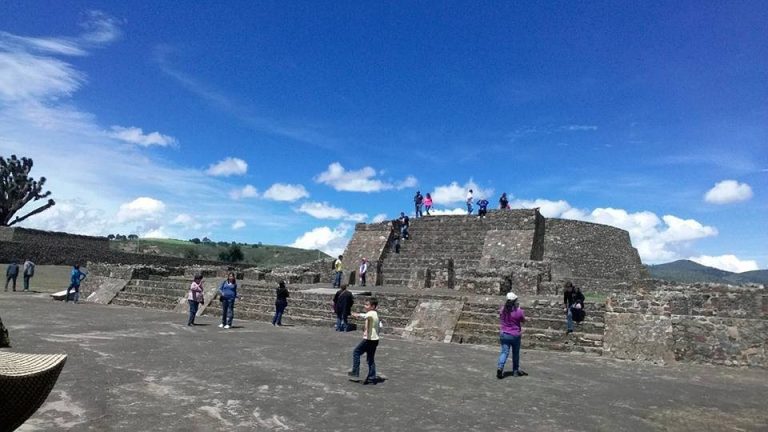
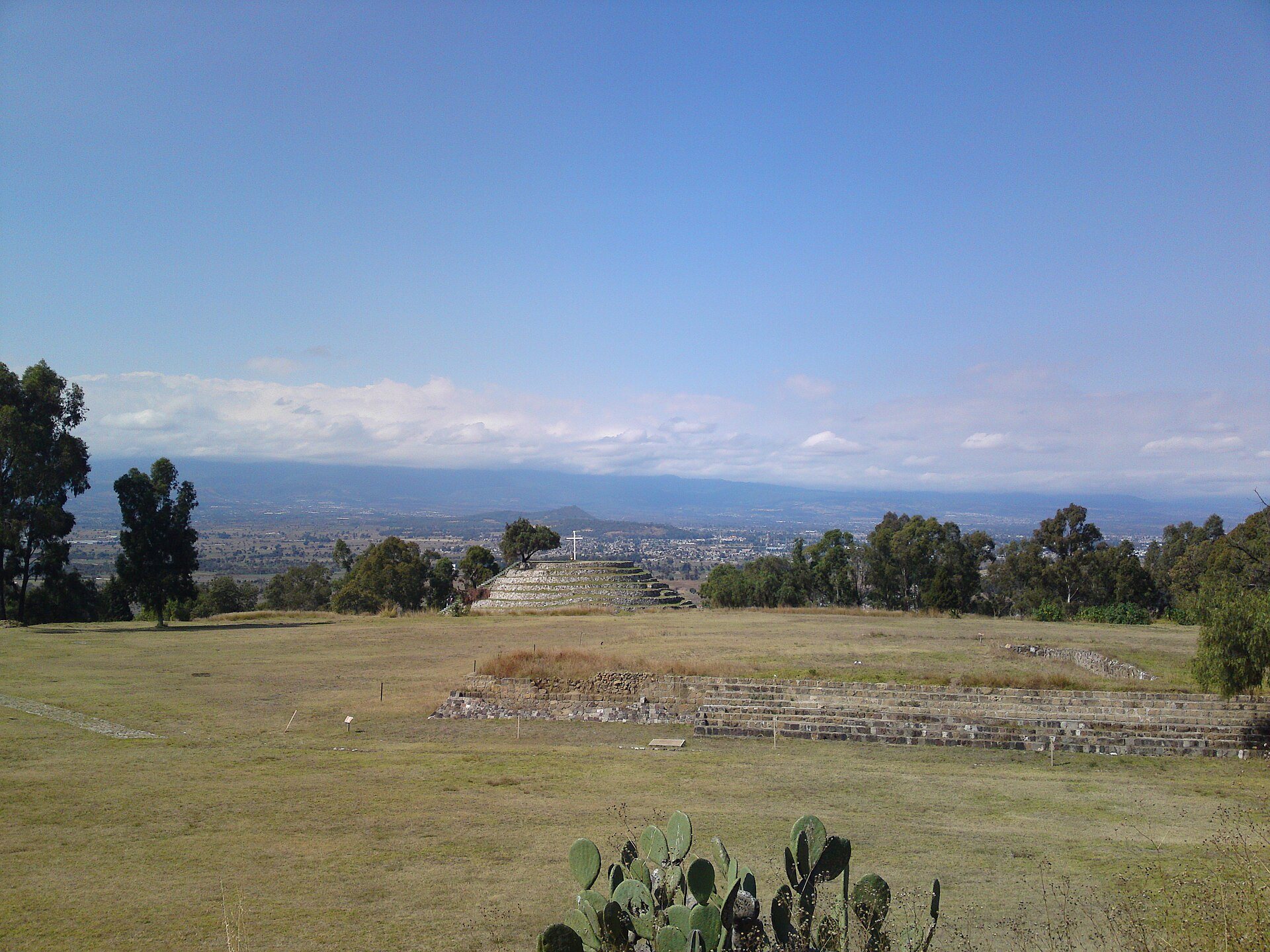
The Spiral Building, or Building E3, is a circular stepped pyramid on the western side of the ceremonial center. Built around 700 BC, it follows the slope of the hillside, so its western side has more levels than its eastern side. Its interior consists of volcanic ash. Two human burials were placed within the structure, and one was accompanied by an incense-burner vessel.
The building has no conventional stairway. Its summit was reached by following the spiral form of the structure. It was probably dedicated to Ehecatl, the Mesoamerican wind deity commonly understood as a manifestation of Quetzalcoatl, and may also have been connected with observing the stars.
A Christian cross was placed on the summit in 1632 and remains there. Ceramics recovered from the building include Spiral White, vessels showing differential firing, and Tezoquipan Red. A copy of the Codex Xochitecatl displayed in the site museum records the cross on the summit, linking the building’s later Christian use with its long ceremonial history.