Actun Tunichil Muknal: A Maya Ceremonial Cave in Belize
Site at a Glance
- Rating
- 4.9
- Popularity
- Low
- Country
- Belize
- Primary era
- Medieval
- External website
- Open
- Eras represented
- Medieval
- Civilizations
- Maya
- Site type
- Religious
- Remains
- Sanctuary
On this page11 sections
History
Actun Tunichil Muknal is a Maya archaeological cave in Belize, within the Tapir Mountain Nature Reserve near Roaring Creek and south of Teakettle in the Cayo District. Maya activity at the site extended over several centuries, with most identified remains and artifacts dating to the Late Classic period, approximately AD 700–900. Rather than serving as an ordinary settlement, the cave functioned as a restricted ceremonial place associated with offerings, bloodletting, and human sacrifice.
Maya ceremonial use
Material near the entrance may be about 1,700 years old, while the principal period of ritual activity lasted roughly 100 to 150 years. The cave appears to have been reserved for high-status people from nearby settlements rather than used as a destination for the general population. Secret blood offerings may have taken place during periods of unrest or other exceptional circumstances.
Ritual activity included bloodletting at altar-like stones. Blood was collected on amatl, a bark-based paper used in parts of Mesoamerica, and burned in small bowls. The resulting smoke was understood as a means of producing visions through which the gods could be addressed. The many water vessels found in the cave may indicate petitions to Chaak, the Maya deity associated with rain, storms, and agricultural water, particularly during drought. This interpretation remains an archaeological inference rather than a direct identification of every ritual.
The cave’s entrance and inner spaces may have been understood as a passage into Xibalba, the Maya underworld. In Maya religious tradition, caves and water-filled natural cavities could serve as entrances to this realm, whose gods required appeasement. The treatment of the human remains and their association with offerings place Actun Tunichil Muknal within this wider religious understanding of caves as sacred places.
Exploration and protection
The geomorphologist Thomas Miller first explored the cave in 1986. A British speleological expedition, devoted to the scientific exploration of caves, investigated the underground system in 1989 and published its first map in 1991. Archaeological excavations followed between 1993 and 1998, and the first underwater excavations took place in 2000.
Belize designated Actun Tunichil Muknal a natural monument in 2004, protecting an area of approximately 1.84 square kilometres. The site is also an IUCN Category Ia protected area, a classification intended for places under strict protection primarily for biodiversity and ecosystem conservation. Access has been deliberately restricted to protect the fragile archaeological remains.
Remains
The underground network extends for approximately 4.8 to 5 kilometres. Its main river passage runs for about 3.2 kilometres before ending at an upstream siphon, a water-filled passage that blocks the route. Upper passages continue for about 1.6 kilometres beyond the siphon through collapsed rocks and very large chambers. A separate exit leads through a narrow passage to a large collapsed sinkhole in the jungle, while the upper passage lies about one-third of the distance between the lower entrance and this exit.
Entrance and underground passages
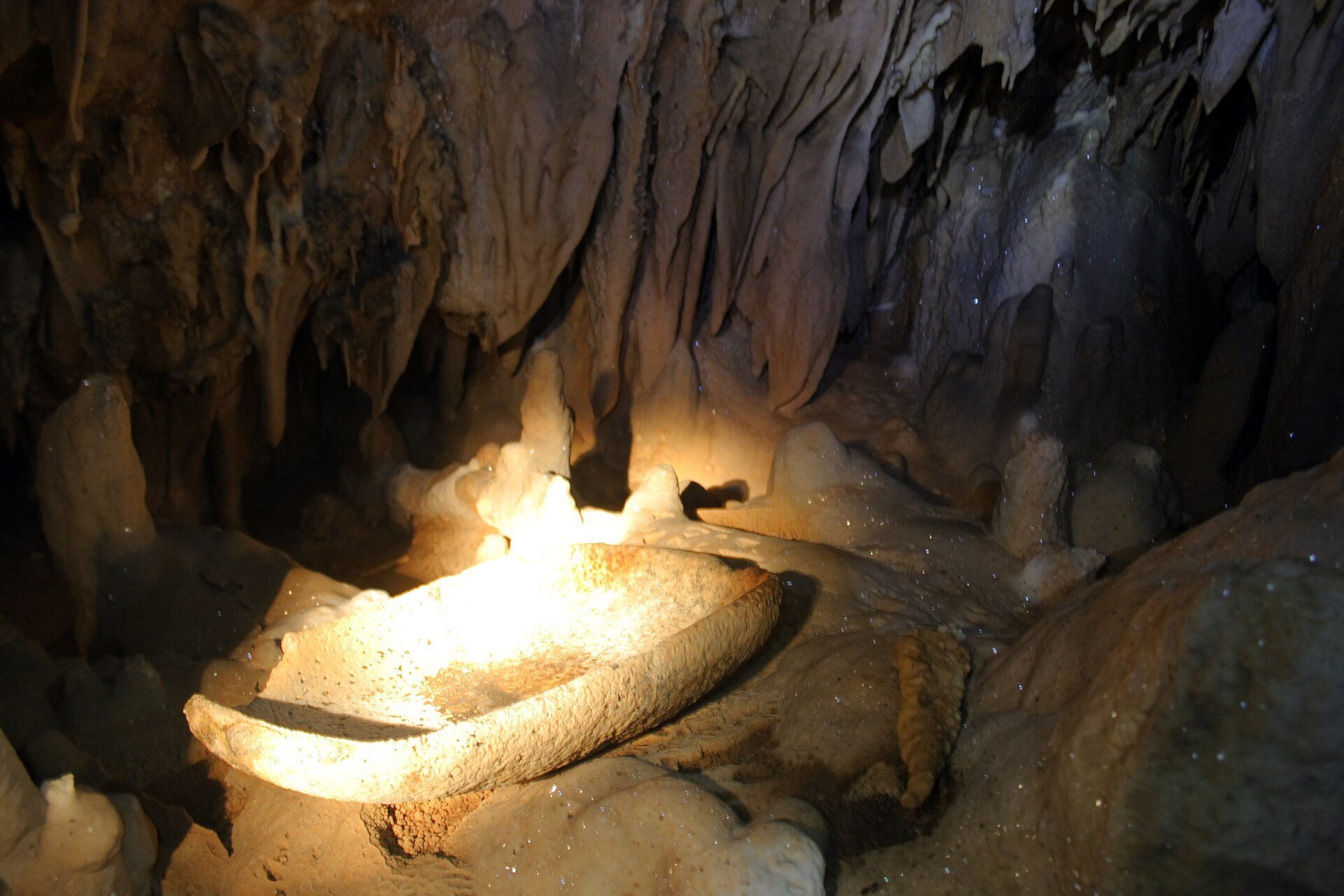
The lower entrance contains a pool approximately two metres deep and a narrow, hourglass-shaped opening. The route continues through river passages where movement involves wading or swimming, and rising rainfall can periodically flood sections of the cave. Natural formations decorate the upper passages, while many artifacts and human remains are fixed to the floor by calcite, a mineral deposited by mineral-rich water.
Archaeological chambers
Upper Entrance Chamber
The Upper Entrance Chamber contains pottery fragments and the remains of an adult. It also shows evidence of looting. These materials are associated with the early Classic phase of activity at the cave.
Stelae Chamber
The Stelae Chamber contains engraved slate slabs, ceramic fragments, and obsidian blades. Obsidian is volcanic glass that breaks into extremely sharp edges and was widely used in ancient Mesoamerica for cutting tools. Further pottery fragments were recovered in the siphon tunnels.
Main Chamber
The Main Chamber measures approximately 200 metres long and 50 metres wide and contains numerous alcoves. Human remains belonging to 14 individuals were found there, including seven children and seven adults. Six of the children were under three years old, while the seventh was approximately seven years old. The adults were estimated to be between 20 and 40 years old.
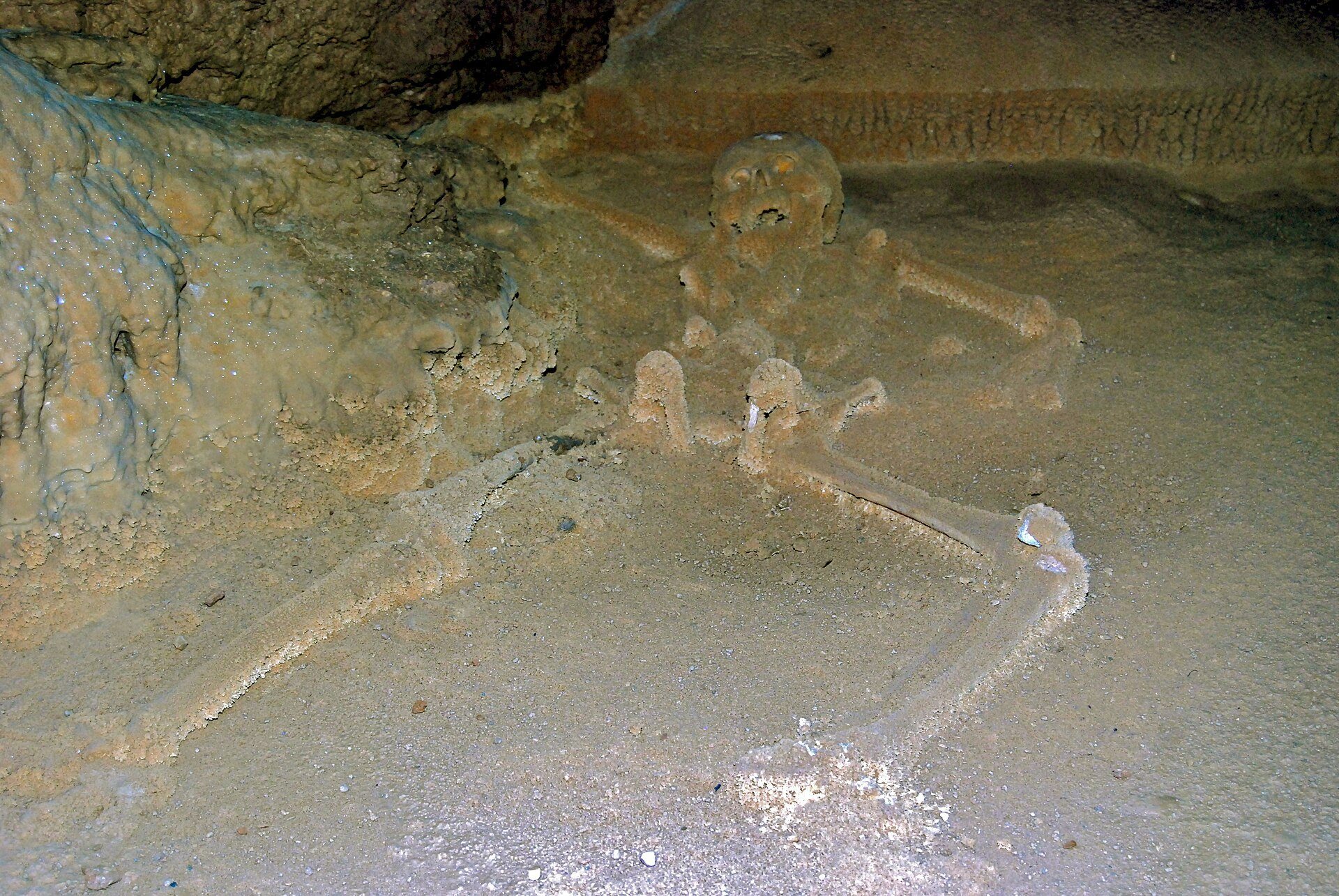
The bodies were not treated as ordinary ceremonial burials. Their condition varies considerably, and calcite formed over many of the bones in the humid cave, fixing them to the floor and complicating examination. Water movement may also have displaced some skeletal elements. Trauma and the arrangement of the bodies have been interpreted as evidence that the individuals were sacrificial victims. Both females and males are represented, although calcite deposits prevent the secure determination of sex for some individuals.
Crystal Maiden
The best-preserved individual is known archaeologically as Individual 13 and popularly as the Crystal Maiden. Brownish calcite heavily covers the bones, creating a sparkling, crystallized appearance. The individual’s age and sex have not been securely established.
Offerings and modified formations
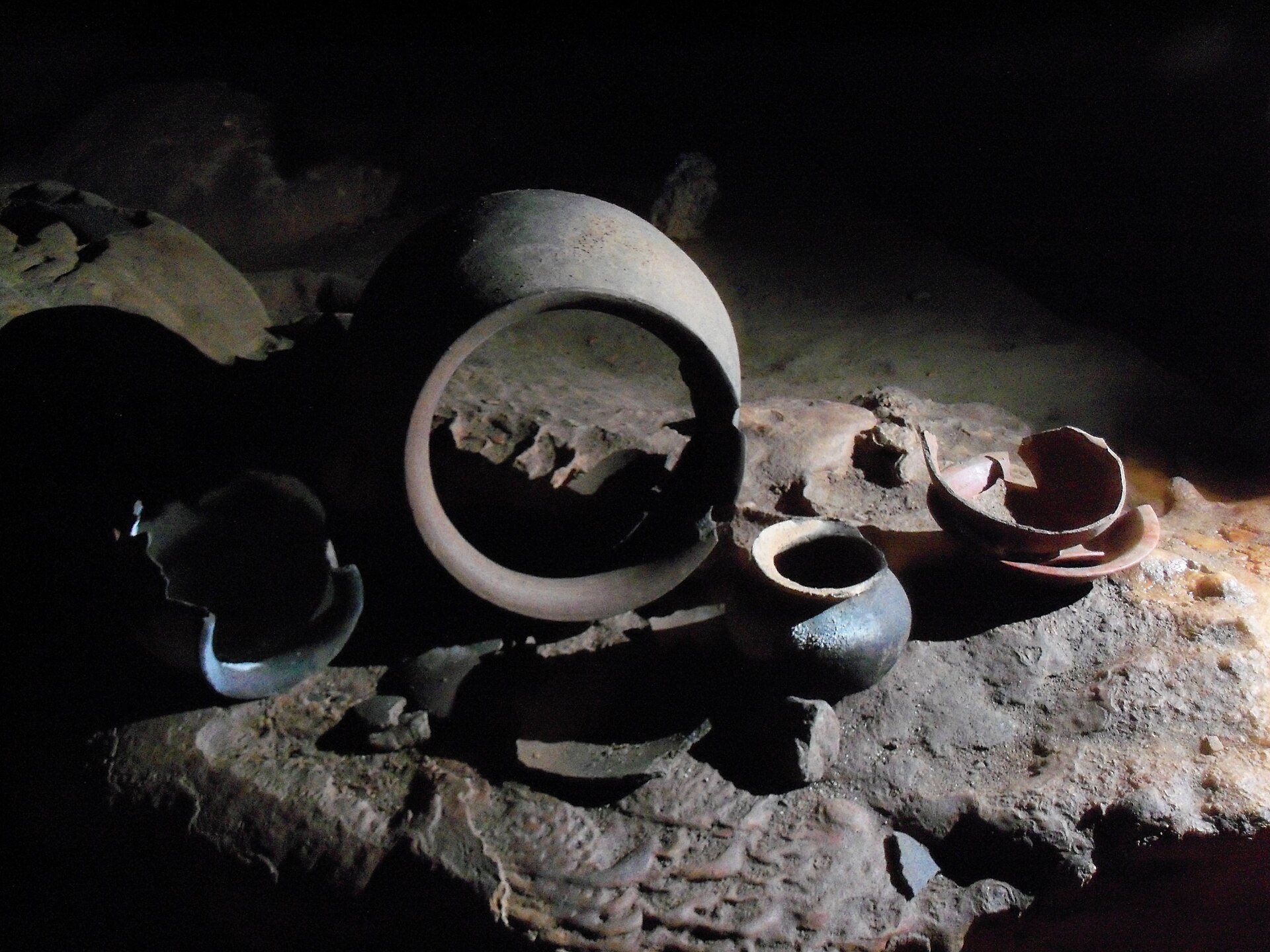
Ceramics from the cave consist predominantly of broken offering vessels. Some have deliberate perforations known as “kill holes,” which were associated with the ritual release of a vessel’s spirit. Approximately 400 of the more common vessels were water containers. Another artifact, the Monkey Pot, is described as one of only four examples of its type found in Central America.
Maya users altered some cave formations, apparently shaping altar-like surfaces for offerings. Certain formations may have cast shadowed silhouettes resembling faces or animals, although that interpretation has not been proven. Calcite has also cemented numerous artifacts to the cave floor, preserving them in place within the humid underground environment.
Approximately 700 to 800 metres south of Actun Tunichil Muknal lies Actun Uayazba Kab, or Handprint Cave. This separate cave forms part of the surrounding Maya archaeological landscape.