Aquae Calidae: An Ancient Thermal Settlement and Bath Complex in Bulgaria


Site at a Glance
- Rating
- 4.5
- Popularity
- Medium
- Country
- Bulgaria
- Primary era
- Classical
- External website
- Open
- Eras represented
- Classical, Medieval, Early Modern
- Civilizations
- Byzantine, Ottoman, Roman
- Site type
- Sanitation
- Remains
- Baths
On this page18 sections
History
Aquae Calidae is an ancient thermal settlement and bathing complex in Bulgaria, located in the present-day Burgas districts of Banevo and Vetren. Developed around hot mineral springs, it became a Thracian sanctuary, a Roman bathing center and road station, a fortified medieval settlement, and later an Ottoman bathing site. Its history extends from prehistoric use of the springs to the modern archaeological reserve and museum complex.
From prehistoric springs to a Thracian sanctuary
The springs were used during the Neolithic period, when three nearby settlements existed between the sixth and fifth millennia BC. In the first millennium BC, Thracian communities established the Sanctuary of the Three Nymphs around the hot water. The nymphs were nature spirits associated with springs, waterways, and healing places, and the sanctuary attracted pilgrims for centuries.
Philip II of Macedon conquered the region in the fourth century BC. A later tradition associates him closely with the springs and states that he visited them frequently. The sanctuary continued to draw religious activity as the settlement developed around its thermal resources.
Roman expansion and the baths of Anchialos
The first Roman baths were established during the Roman conquest of the region, traditionally placed in 72 BC during the Third Mithridatic War, a conflict between Rome and the kingdom of Pontus. Construction of the Roman thermae, or public bath complex, is also associated with the reign of Nero. In the late fourth or early fifth century, the complex was restored and enlarged.
During the reign of Trajan, from AD 98 to 117, nearby Anchialos became the region’s administrative center. The baths were expanded with two swimming pools, while the Via Pontica, the Roman road along the western Black Sea coast, was developed nearby. A road station called Aquae Calidae formed part of this network and appears as Aquis Calidis on the Tabula Peutingeriana, a medieval copy of an ancient Roman road map. The station lay between Anchialos and Kabyle.
The spring sanctuary continued in the Roman period as the Nymphaeum of Anchialos, a sanctuary or monumental feature dedicated to nymphs. The baths were also called the Baths of Anchialos. Under Septimius Severus, three years of games and celebrations known as the Severia Nymphaea took place at the baths from AD 209 to 211. Further games were held there under Geta and Caracalla.
Late antique fortification and imperial visitors
During the Gothic incursions of approximately AD 257 to 270, the Goths moved from Anchialos to Aquae Calidae and stayed for several days to recover in the hot baths. One historical account places this episode specifically in AD 270. The baths survived an attack that severely affected the settlement.
In the sixth century, under Justinian I, the previously unfortified settlement and baths were enclosed by defensive walls. Justinian, who ruled the Eastern Roman Empire from AD 527 to 565, sponsored extensive building and fortification programs. Procopius of Caesarea explained the walls as protection for local inhabitants and sick visitors who had previously reached the springs at considerable risk.
Around AD 580, Anastasia, wife of the Eastern Roman emperor Tiberius II Constantine, was successfully treated at the baths. She reportedly gave her imperial robes to a local church. In AD 584, the Avars under Khan Baian plundered Aquae Calidae but spared the baths, reportedly at the request of Baian’s harem. The later claim that Baian wore Anastasia’s robes and asserted imperial authority remains disputed.
Therma and Thermopolis in the medieval period
In the early medieval period, the settlement was known as Therma or Thermopolis. It became involved in the rivalry between the Bulgarian and Eastern Roman empires. In 705, Justinian II ceded the region of Zagora to the Bulgarian ruler Khan Tervel, and Aquae Calidae was incorporated into Bulgaria with it.
Near Therma, Tervel’s forces defeated Justinian II’s army in AD 708. The victory helped consolidate Bulgarian expansion south of the Balkan Mountains. In 921, a Byzantine detachment sent by the commander Pothos Argyros to observe Bulgarian movements was ambushed and defeated near the city.
In 1093, the Byzantine emperor Alexios I Komnenos stationed troops in fortified Thermopolis to defend the eastern Balkan Mountain passes against Cuman incursions. During the twelfth century, the Arab geographer al-Idrisi called the settlement Megali Thermi and described it as small, well ordered, beautiful, and prosperous.
After the Fourth Crusade captured Constantinople in 1204 and established the Latin Empire, its second emperor, Henry of Flanders, captured Thermopolis in 1206 during a retaliatory campaign against Bulgarian towns. He remained for three days and ordered the city to be burned. Thermopolis did not recover as an urban settlement, although the baths were restored later. In 1356, the Catalan Company conquered and plundered the region before transferring it to the Byzantines.
Ottoman bathing traditions and modern archaeological work
For a long period after Thermopolis was destroyed, the baths remained in ruins. In 1562, Sultan Suleiman I visited the springs and was successfully treated for gout. He ordered a new bathhouse to be built over the partially ruined earlier pools and issued a decree endowing the mineral-spring area. During the Ottoman period, the settlement beside the baths was called Ladja, a name derived from a Turkish term for a hot mineral spring.
An Ottoman document of 1502 placed present-day Burgas within Ladja in the Aytos district. In the seventeenth century, Ladja formed part of the estate of Yusuf Bashe and contained 16 Christian families; by 1666, the number had risen to 26. After Bulgaria’s liberation, the baths were known as the Aytos Baths. The settlement was renamed Banya in 1934 and Banevo in 1950. The baths became part of Burgas in 1900 and were known as the Burgas Mineral Baths from the 1980s. Banevo became a district of Burgas in 2009.
Bogdan Filov carried out the first archaeological investigations in 1910. Large-scale excavation resumed in 2008 under Tsonya Drazheva and Dimcho Momchilov. By 2010, more than 3,800 square metres had been exposed, including the ancient baths, the north gate, and sections of the fortification walls. In July 2011, the ancient and medieval settlement and an area of 36,000 square metres became the Aquae Calidae–Thermopolis Archaeological Reserve. A program of excavation, conservation, restoration, and presentation followed from 2012. The restored museum complex opened in 2015.
Remains
Aquae Calidae occupies the area between the southern foothills of the Aytos mountain massif and Lake Atanasovsko. The ancient settlement covered approximately 10 square kilometres, while its walled section occupied about 2 square kilometres. Around the hot springs, the site brought together a sanctuary, Roman baths, a road station, and later defensive walls. Excavations have also recovered more than 4,000 coins, jewelry, and everyday objects, creating a chronological span from the fifth century BC to the thirteenth century.
Sanctuary and archaeological finds
Sanctuary of the Three Nymphs
The Sanctuary of the Three Nymphs was established around the hot spring during the first millennium BC. In the Roman period it continued beside the baths and road station as the Nymphaeum of Anchialos. The sanctuary’s long use reflects the religious and healing associations of the springs.
Coins and small finds
The coins include issues from Apollonia, Kabyle, Mesembria, Odessos, Histria, Tomis, Byzantion, Abdera, Maroneia, the Aegean islands, and ancient Italy. The oldest identified coin comes from fifth-century-BC Apollonia. Jewelry and other everyday objects complement the coins, while additional finds from the 2020 excavations include coins and objects associated with fourth-century AD buildings.
Roman thermal complex
Central bath building
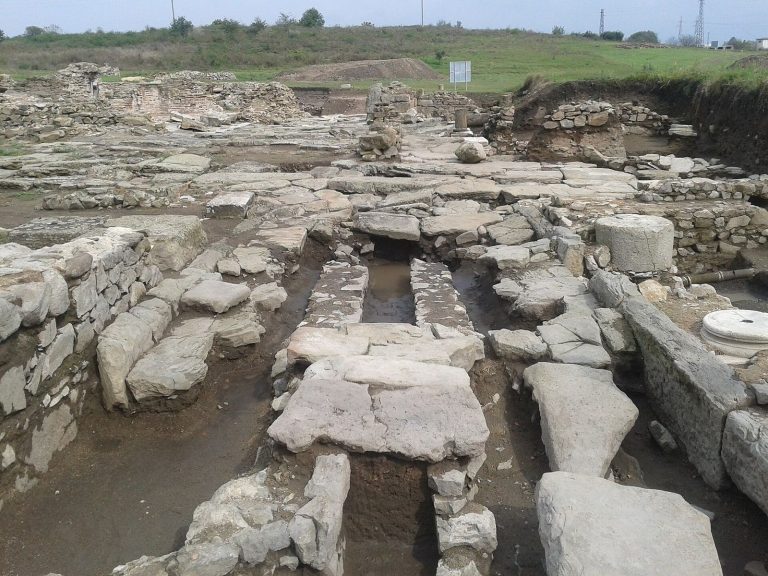
The central Roman building, identified as a caldarium, or hot room, measured approximately 220 square metres. It included two pools, each measuring 3 by 5 metres. The main ancient bath pool had a floor secured at a depth of approximately 6.3 metres.
Heating and water systems
The baths used a hypocaust, an underfloor heating system in which hot air circulated through channels or pipes. Clay pipes led toward two hot springs approximately 30 metres west of the caldarium. The springs had temperatures of approximately 53 and 42 degrees Celsius. A cold-water spring in the northern part of the baths lay at a depth of approximately 5.3 metres and supplied the frigidarium, the cold-water bathing area.
Eastern rooms
Eight adjoining rooms in the eastern wing were probably used as shops and a kitchen between the tenth century and Henry of Flanders’s destruction of the baths in 1206. Bronze coins, glass and bronze bracelets, and other objects were found in these rooms.
Fortifications and later bathhouse
North gate and defensive walls
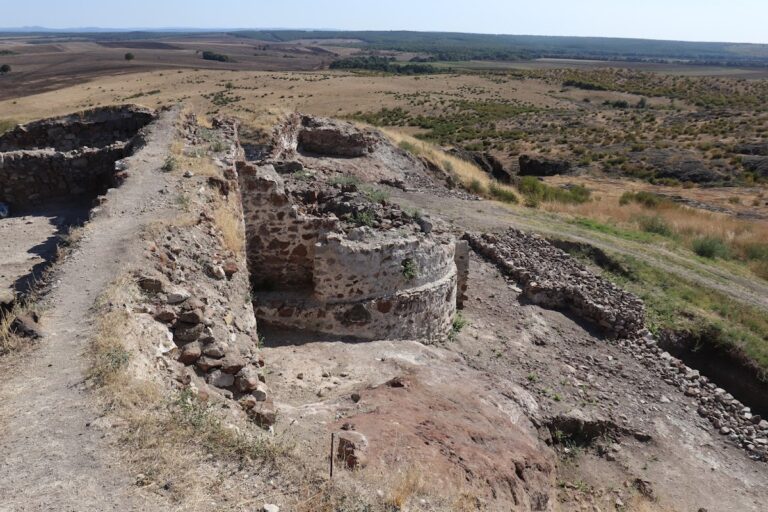
The north gate and sections of the late antique fortifications survive from the walls built around the settlement under Justinian I. The walls were approximately 5 metres thick and formed part of the defenses surrounding the baths and settlement.
Sultan’s Hammam
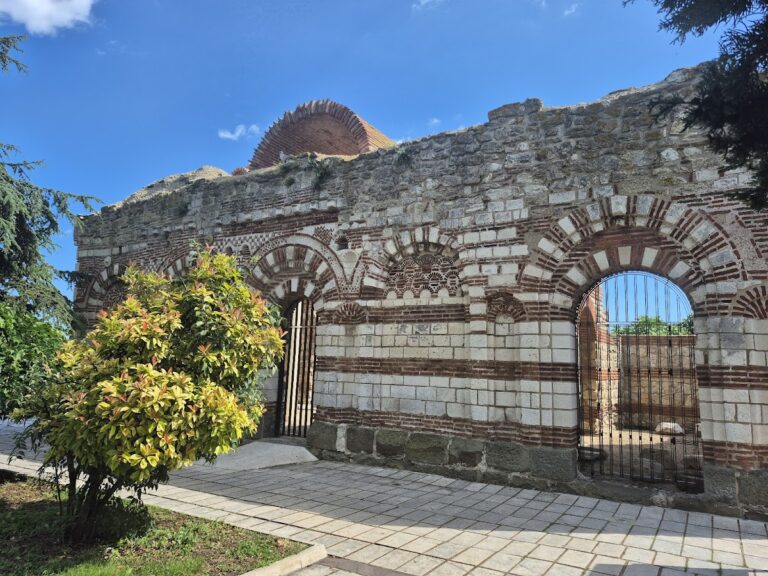
Suleiman I’s bathhouse was built over the partially ruined earlier pools in 1562. Known as the Sultan’s Hammam, it remains preserved within the modern museum complex and represents the Ottoman phase of bathing at the springs.
Modern presentation complex
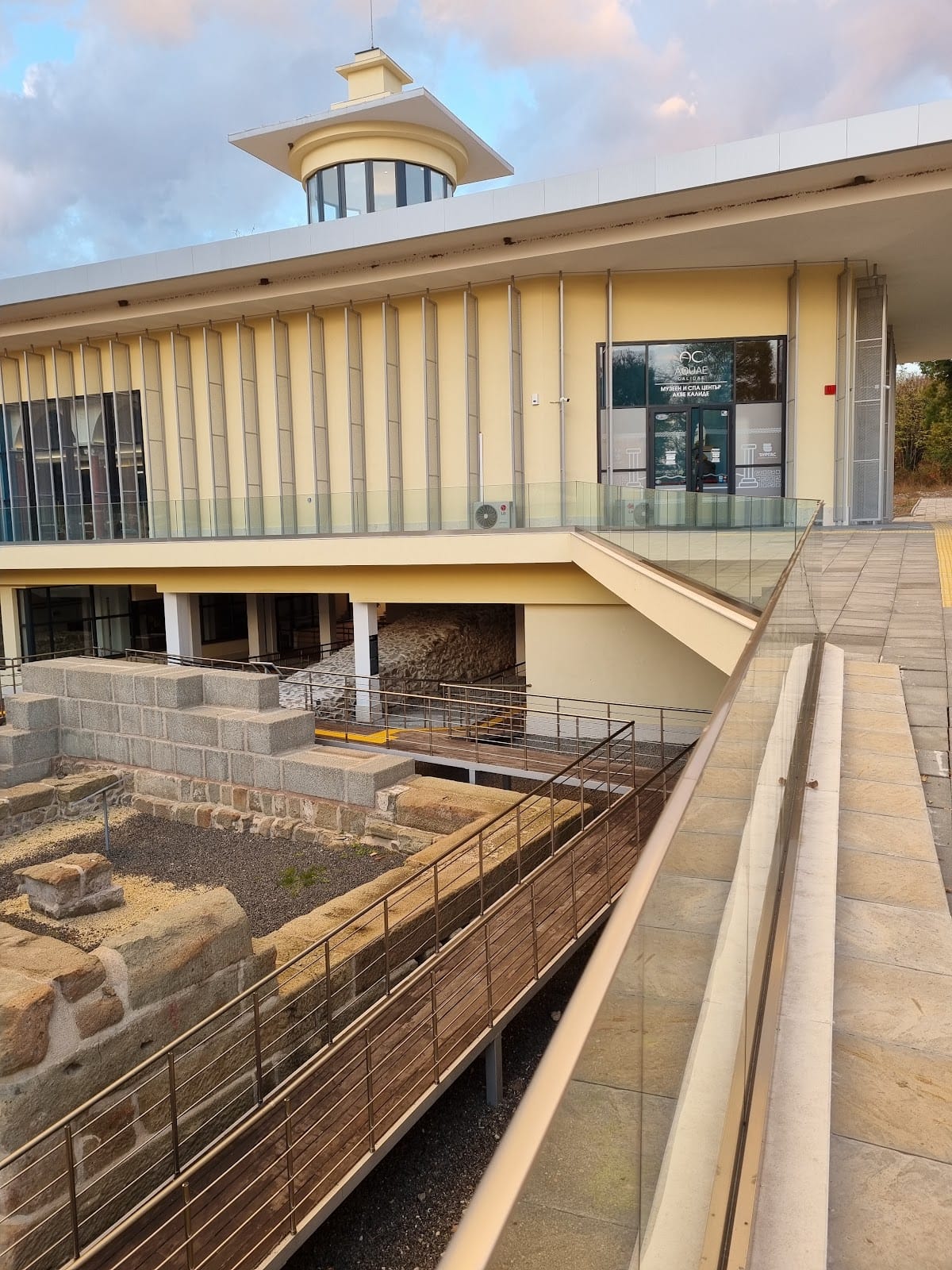
The restored complex incorporates the Sultan’s Hammam, mineral-water fountains, and an open-air stage built above the excavated remains. A glass floor allows the archaeological area beneath the stage to be viewed. Excavations in 2020 also revealed a monumental step with a roof-supporting structure and remains of Roman-period buildings.