Rusokastro: A Byzantine Frontier Fortress in Bulgaria


Site at a Glance
- Rating
- 4.5
- Popularity
- Low
- Country
- Bulgaria
- Primary era
- Classical
- Eras represented
- Classical
- Civilizations
- Byzantine
- Site type
- Military
- Remains
- Fort
On this page5 sections
History
Rusokastro is a Byzantine fortress in Bulgaria, near Burgas, built during the fifth century as part of a wider chain of frontier fortifications. The Byzantine Empire, the eastern Roman Empire centred on Constantinople, used such elevated strongholds to watch its borders and road networks and to communicate between fortresses by fire signals.
Byzantine Frontier Fortress
A sixth-century plaque found within the fortress identifies Justin, the great-grandson of Emperor Justinian I, as its commander. Justinian ruled from 527 to 565 and was associated with extensive building and military activity across the Byzantine Empire. Coins depicting the Byzantine emperor Phocas, who ruled from 602 to 610, indicate that Rusokastro remained in use from the late sixth to the early seventh century.
Medieval Stronghold and Battle
The earliest written reference to the name Rusokastro appears in the work of Muhammad al-Idrisi, a twelfth-century Arab geographer and cartographer. He described the site as a fortified stronghold of considerable size with a substantial population.
On 18 July 1332, Rusokastro witnessed a battle between the forces of Ivan Alexander, tsar of the Bulgarian Empire, and the Byzantine army of Emperor Andronikos III Palaiologos. Ivan Alexander was a fourteenth-century Bulgarian ruler, while Andronikos III ruled as Byzantine emperor from 1328 to 1341. The battle ended in a Bulgarian victory.
Destruction and Archaeological Study
The fortress was definitively destroyed in 1443 after its capture by the Ottomans, the ruling dynasty and forces of an empire that expanded across southeastern Europe, Anatolia, and the eastern Mediterranean. Rusokastro is now the subject of archaeological investigation by a research team from the Regional Historical Museum of Burgas, with joint funding from the municipality of Kameno and Bulgaria’s Ministry of Culture.
Remains
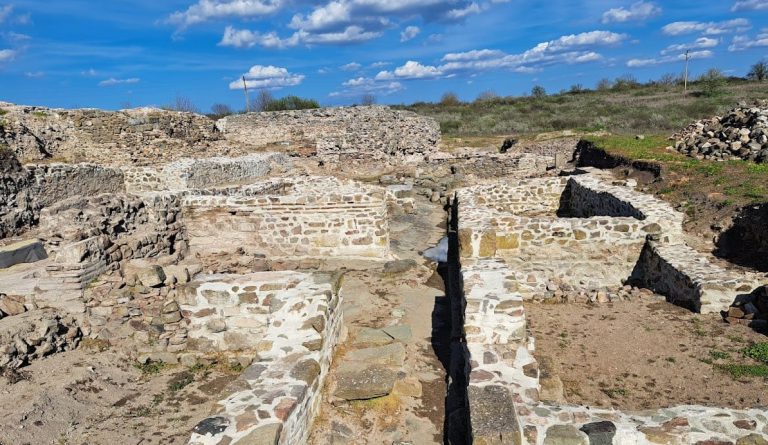
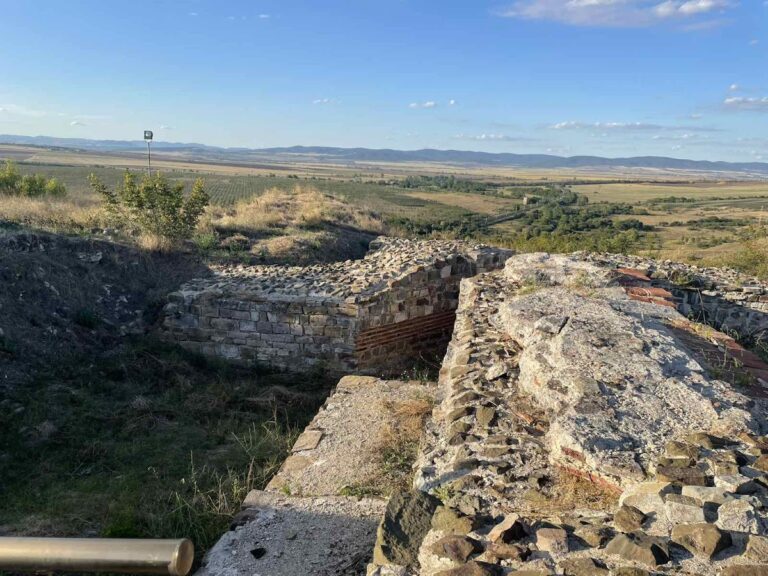
Rusokastro occupies the summit of a hill near the village and river that share its name, close to the Black Sea coast and approximately 20 kilometres northwest of Burgas. This elevated position formed the physical setting for the fortress’s frontier surveillance and communication role. Surviving fortification walls rise to more than 5 metres in height.
The archaeological work has also brought important movable and inscribed evidence from inside the fortress. A sixth-century plaque records Justin’s command, while coins bearing the image of Emperor Phocas help place the fortress’s continued use between the late sixth and early seventh centuries.
Nearby sites