Argos: An Ancient Greek City and Regional Power in Greece


Site at a Glance
- Rating
- 4.5
- Popularity
- Medium
- Country
- Greece
- Primary era
- Classical
- External website
- Open
- Eras represented
- Bronze Age, Iron Age, Classical, Medieval, Early Modern
- Civilizations
- Ancient Greek, Byzantine, Mycenaean, Ottoman, Roman, Venetian
- Site type
- City
On this page22 sections
History
Argos is an ancient Greek city in Greece, continuously inhabited from the Neolithic period and a major Mycenaean centre during the Late Bronze Age. The Mycenaean settlement occupied the hills of Aspis and Larissa and probably reached its peak in the fourteenth and thirteenth centuries BC. After the decline of the Bronze Age Collapse around 1100 BC, Argos remained occupied and developed into one of the important political, religious and military centres of the Peloponnese.
Neolithic and Mycenaean Argos
Early habitation was concentrated on Aspis, where an early Mycenaean settlement dates approximately from 2000 to 1600 BC. Later occupation extended to Larissa, whose summit was fortified and used as an acropolis during the later Mycenaean period. Domestic remains at the foot of the hills and rock-cut tombs reflect the wider settlement around these elevated centres.
Argos declined during the wider upheavals that affected the eastern Mediterranean around 1100 BC, but the settlement continued. During the post-Mycenaean period, smaller communities at the foot of Aspis and Larissa were brought together. This reorganization helped the city expand to its greatest extent in the eighth century BC.
Archaic political and military power
In the Archaic period, Argos was a polis, an independent Greek city-state with its own territory, institutions and citizen body. Its government developed from monarchy toward aristocratic and oligarchic rule, and later became more democratic. The population was predominantly Dorian, while surrounding inhabitants, including perioikoi and other groups, were incorporated into the citizen body. The Assembly, councils and magistracies gradually gained authority, while the traditional monarchy survived for a time with mainly military and religious powers.
Pheidon, an Argive king or tyrant of the eighth or seventh century BC, expanded Argive influence and was traditionally associated with military and economic reforms. He is credited with promoting hoplite tactics, in which heavily armed infantry fought in a close formation called a phalanx, and with standardizing weights and measures. Six iron weights found at the Argive Heraion may have been connected with these reforms or offered by Pheidon, although the attribution remains uncertain.
Argos defeated Sparta at the Battle of Hysiae in 669 or 668 BC and became the leading power in the Peloponnese. At the height of its influence, it controlled much of the Argolid and parts of the wider Peloponnese, including periods of dominance over Corinth, Aegina, Tiryns, Mycenae, Nauplia and Nemea. Fertile land, regional trade and access to the harbour of Nauplia supported this power. Argos was known for pottery, bronze sculpture, leatherworking and clothing production, and its civic life included numerous religious and public festivals.
The city also belonged to a religious and political league centred at Calauria and associated with the cult of Apollo Pythaios. For a period, Argos controlled the organization of the Olympic Games. After absorbing Nemea, it organized the Nemean Games, which were transferred permanently to Argos in 271 BC.
Conflict with Sparta and democratic change
Sparta progressively reduced Argive power. It defeated Argos in the so-called Battle of the Champions around 546 or 545 BC and won a decisive victory at Sepeia in 494 BC. Herodotus gives approximately 6,000 Argive dead at Sepeia, a loss that produced a severe demographic and political crisis.
The aftermath widened participation in government among perioikoi and other inhabitants and contributed to democratic changes, although the precise institutional transition remains uncertain. Argos remained neutral during the Persian Wars and became diplomatically isolated as a result. It later recovered control of Mycenae, Tiryns and Nemea, while shifting alliances connected it at different times with Athens, Sparta, Corinth, Mantinea and Elis.
Alliances, war and political instability
Argos joined an alliance with Athens in 462 BC. During the Peloponnesian War, the conflict between Athens and Sparta and their respective allies, Argos was initially neutral. In 421 BC it entered an anti-Spartan coalition with Mantinea, Elis, Corinth and later Athens. The coalition was defeated at Mantinea in 418 BC, and a Spartan-backed oligarchy briefly took power in Argos. Democratic forces restored control the following year.
Argive forces fought alongside Athens at Tanagra and Oenoe, took part in the Sicilian Expedition of 415 BC, and joined the unsuccessful campaign against Miletus in 412 BC. Political instability continued, including the Argive skytalismos, a purge in which as many as 1,200 to 1,500 aristocrats, oligarchs and demagogues may have been killed. During the Corinthian War, Argos fought Sparta alongside Athens, Corinth and Thebes, but afterwards declined as a major political power.
Macedonian, Roman and late antique Argos
Argos remained neutral during the rise of Macedon and was at times governed by rulers supported by Macedon. In 272 BC, Pyrrhus, king of Epirus, attacked the city and died during the fighting. Argos joined the Achaean League in 229 BC. This federation of Greek city-states lasted in Argos until the Roman conquest of the Peloponnese in 146 BC.
Under Rome, Argos was first included in the province of Macedonia and later in Achaea, the imperial province covering much of mainland Greece and the Peloponnese. It remained the principal city of the Argolid and flourished during the Roman period, particularly under Emperor Hadrian, whose patronage supported an aqueduct, baths and other construction. Goths or other Germanic forces plundered the city in 267 AD, and the Visigoths caused major destruction in 395 AD. Settlement nevertheless continued through the Byzantine, Frankish, Venetian and Ottoman periods.
Larissa Castle and modern historical change
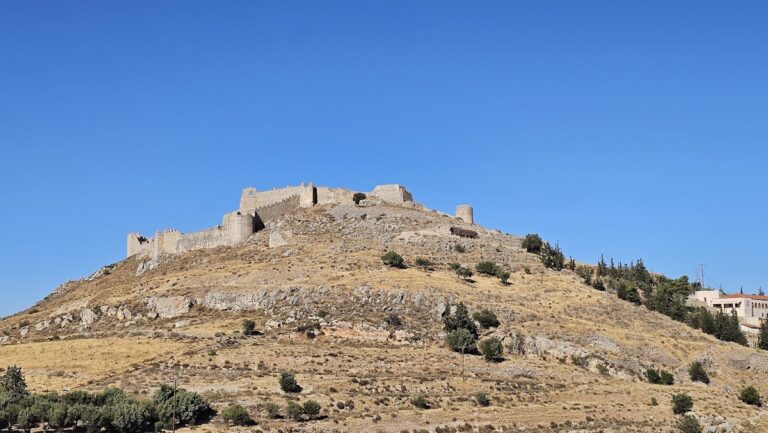
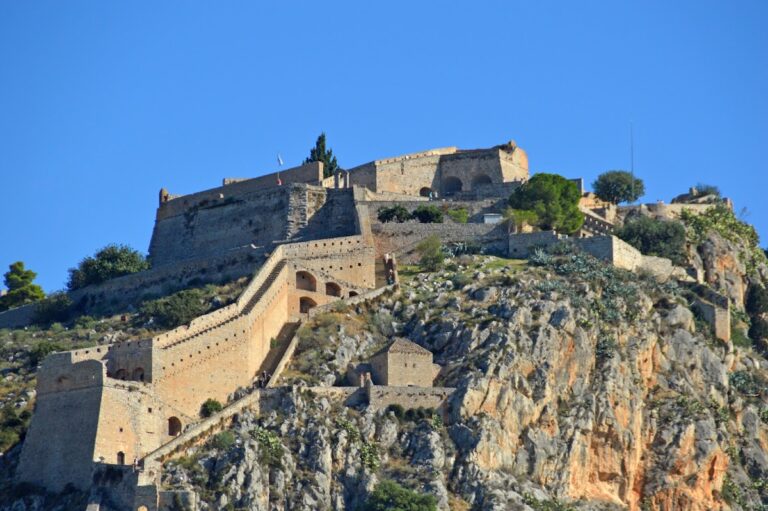
A castle was built on the summit of Larissa hill in the twelfth century AD. The Venetians later enlarged it, and Ottoman rulers added further fortifications. In 1821, during the Greek War of Independence, Dimitrios Ypsilantis rapidly captured the castle after wealthy Ottoman residents had left Argos for Nafplion.
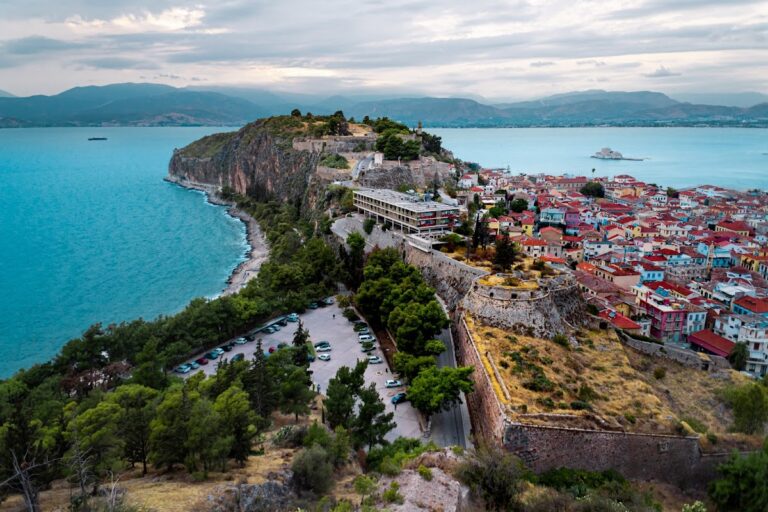
Argos formed part of the provisional Greek government during the War of Independence. Nafplion became the first capital of independent Greece, and Argos was later considered as a possible capital before Athens was selected.
Continuous settlement has placed the modern town directly over much of the ancient city, limiting the area available for excavation. Systematic excavation of the theatre began in the 1890s, followed by campaigns by the French School of Archaeology in 1930, 1954 to 1956, 1981 to 1982 and 1986 to 1987. A major restoration and conservation programme took place in 2004. Most excavated artefacts are held in the Archaeological Museum of Argos, while the surviving archaeological area represents only a small part of the ancient settlement.
Remains
Ancient Argos occupied the eastern and southeastern slopes of Larissa and Aspis, with both hills functioning as acropoleis. Larissa rises to approximately 289 metres and Aspis to approximately 80 metres. The ridge between them was called Deiras, and the valley between the hills was known as Koile. A defensive wall enclosed the two acropoleis and the lower city, with gates leading toward Tegea, Sparta, Nauplia, Epidaurus, Mycenae, Nemea, Corinth, Mantinea and northern Arcadia. Excavated remains lie mainly southwest of the modern town, near the southern slope of Larissa, the ancient agora and theatre, and on the saddle southwest of Aspis, where the Apollo complex stood.
Acropoleis and early settlement
Larissa and Aspis
Larissa contained the principal acropolis and was fortified during the Mycenaean period. The lower portions of the walls incorporated into Larissa Castle are partly ancient. Aspis had a smaller fortified enclosure, together with the early Mycenaean settlement dating approximately from 2000 to 1600 BC. Neolithic and Bronze Age habitation, later occupation on Larissa, domestic remains and rock-cut tombs reveal the long development of the settlement across the two hills and their lower slopes.
Theatres and performance buildings
Main theatre
The principal theatre was cut into the eastern slope of Larissa and was probably built in the late fourth or early third century BC. Its circular orchestra and semicircular plan followed Greek theatrical conventions. Approximately 81 to 83 rows of seats accommodated about 16,000 to 20,000 spectators, with special seats reserved for honoured citizens.
Odeon
A smaller theatre south of the main theatre was built in the fifth century BC. It originally had straight seating rows, a rectangular plan and capacity for approximately 2,500 spectators, and it may also have served as a meeting place. In the first century AD it was roofed and converted into an odeon, a building intended chiefly for music and performances. A reconstruction in the third century gave it a semicircular form. Plant-pattern mosaics decorated its floors and orchestra, along with a composition showing tables, a vase, a shield and palm leaves. The odeon seated approximately 1,800 people.
Sanctuaries and civic terraces
Serapeum and Roman baths
In front of the main theatre stood a Serapeum, a sanctuary dedicated to Serapis, a Hellenistic deity whose cult combined Egyptian and Greek elements. Built after approximately 280 BC, it contained a large colonnaded court and rooms at its western end leading to a larger vaulted room. The walls of this room survive to approximately 11 metres because the complex was later adapted as a Christian church. During Hadrian’s reign, Roman baths were inserted into the colonnaded court. The complex later came under the protection of Asclepius, and mosaic pavements remain within it.
Kriterion
North of the theatre, the Kriterion formed a rock-cut rectangular terrace approximately 35 by 21 metres. A polygonal retaining wall supported it, and carved steps provided access. Dating from the sixth to third centuries BC, it served as a civic place of judgement and assembly. Hadrian later built a monumental fountain, or nymphaeum, along its western side. A road ran from the Kriterion along the slope of Larissa toward the theatre, beside which a surviving relief depicts an armed horseman and a vessel containing a snake.
Aphrodite sanctuary
Approximately 50 metres south of the odeon, a sanctuary of Aphrodite occupied a rock-cut terrace built around 430 to 420 BC. The stepped temple foundation measures approximately 13.40 by 6.20 metres, and a six-metre-long altar stood in front of it. The sanctuary was destroyed during the Gothic invasion, while its foundation remains part of the archaeological area.
Agora and lower-city sanctuaries
Agora
The agora lay southeast of the theatre and was constructed in the fifth century BC. This principal public and commercial space included at least 18 temples, a colonnaded hall probably used by the council, a long stoa, a gymnasium, a stoa with a semicircular orchestra for musical performances and a monumental fountain. The agora was destroyed in 395 AD. Foundations, monument bases and part of its drainage system survive.
Apollo Pythaios complex
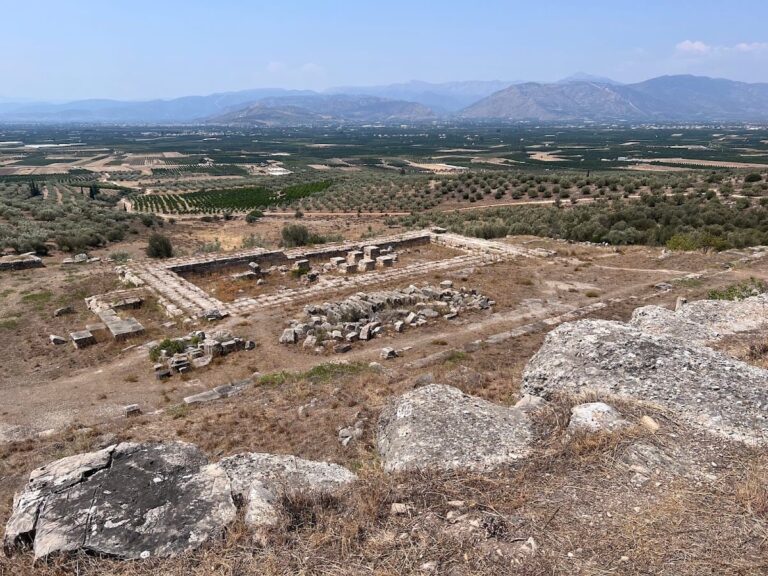
On the southwestern slope of Aspis, the sanctuary complex of Apollo Pythaios was developed during the Archaic period across four terraces. Monumental stairs led to a central terrace, and the stairs to the third terrace had ten rock-cut steps and were approximately 27 metres wide. A manteion, or place connected with prophecy, stood north of the temple area. A Byzantine church was later built above the sanctuary, with fragmentary remains surviving.
The lower city contained sanctuaries of Apollo Lykeios, Apollo Pythaios, Athena Oksyderke, Demeter, Aphrodite, Eileithyia and Hera. Hera Akraia stood on the acropolis slope, while Hera Antheia was located in the lower city. Outside Argos, the principal sanctuary of Hera, the Argive Heraion, stood at Prosymna between Argos and Mycenae, although closer to Mycenae. Its sanctuary area was established in the seventh century BC, its first temple was built in the sixth century BC, and a replacement followed a fire in 420 BC. A major procession from Argos to the Heraion took place every fourth year.
Recorded monuments and religious traditions
Argos contained many temples, tombs, monuments and statues described by Pausanias, the second-century AD Greek geographer and travel writer. His account preserves local traditions alongside descriptions of religious places. Among the recorded temples were those of Zeus, Hera, Aphrodite, Apollo, Athena, Artemis, Demeter, Dionysus, Poseidon, Asclepius, Hecate, Eileithyia and the Dioscuri, together with shrines of Serapis and Adonis.
Pausanias described a temple containing the throne of Danaus, a statue of Biton carrying a bull, the so-called fire of Foroneus, wooden statues of Aphrodite and Hermes, a statue of Ladas, a relief of a bull fighting a wolf, and wooden images of Zeus and Artemis. He also mentioned tombs attributed to Linus and a sanctuary of Apollo Agieus. Other features included the sanctuary of Zeus Hietios, a statue of Zeus the Merciful made by Polykleitos, and a nearby relief of Kleobis and Biton pulling their mother toward the temple of Hera.
The statue of Zeus the Merciful was associated with purification after the civil conflict between the Argive people and the elite known as the One Thousand. Nearby stood a temple of Nemean Zeus with a bronze statue made by Lysippus. Monuments linked with the campaigns against Thebes included statues of Polynices and fallen commanders, while other memorials commemorated Danaus, Argives who died at Troy and the poet Telesilla. Her monument showed her holding a helmet, with her books at her feet.
Additional recorded features included the temple of Zeus Soter, the temple of Kephisus, a marble head of Medusa, the Kriterion, temples of Aphrodite and Asclepius, the sanctuary of Athena Salpinx and a monument associated with the musician Sakadas. Pausanias also named tombs and monuments connected with Foroneus, Criasus, Danaus, Hipermnestra, Lynceus, Talaus, Adrastus, Amphiaraus, Batton, Kilarabes, Hirnetho, Likymnius, Gorgophone, Pelasgus, Tantalus, Argus and the Danaids. These figures belong to Argive religious and mythological traditions, and their associations are not uniformly confirmed by surviving archaeology.
Acropolis route and archaeological finds
The Larissa acropolis contained temples of Zeus Larissaios and Athena. Pausanias described a roofless temple of Zeus Larissaios and a wooden three-eyed statue of Zeus, traditionally regarded as having been brought from Troy by Sthenelus. On the route toward Larissa stood temples of Hera Akraia and Apollo Deiradiotes. Prophecy was practiced at the latter, where Pausanias described a woman who drank the blood of a sacrificed ram before entering a divinatory state.
A stadium near the route to the acropolis hosted games dedicated to Nemean Zeus and festivals of Hera. Nearby sanctuaries included a temple of Artemis Orthia, temples of Apollo and Latona, and a temple of Artemis near the spring Erasinos. Outside the city, the gymnasium named Kylarabis stood in the wider urban landscape, while Nauplia served as Argos’s harbour.
Excavated finds include Helladic and Geometric grave goods, small figurines, pottery, an unusually well-preserved hoplite panoply, decorative mosaics and fragments of sculpture. These objects, together with the theatre district, agora, sanctuaries, fortifications and civic infrastructure, represent the limited excavated portion of a settlement that extended beneath the modern town.