Torreón de la Chorrera: A Coastal Fortification in Havana, Cuba
Site at a Glance
- Rating
- 4.3
- Popularity
- Low
- Country
- Cuba
- Primary era
- Early Modern
- Eras represented
- Early Modern
- Civilizations
- Spanish
- Site type
- Military
- Remains
- Tower
On this page7 sections
History
Planning and construction
Torreón de la Chorrera is a Spanish coastal fortification in Havana, Cuba, completed in May 1646 to guard the mouth of the Almendares River, also known as La Chorrera. Together with the Torreón de Cojimar, it was intended to prevent enemy ships from entering the river and obtaining fresh water. The original tower was built as part of Havana’s coastal defenses during a period of concern about attacks on the city.
Governor Pedro Vadés first proposed defenses at the mouths of the La Chorrera and Cojimar rivers during his administration from 1602 to 1608. The project was abandoned when the immediate danger passed. In 1633, the Marquis de Cadereyta and Admiral Carlos de Ibarra inspected Havana’s main fortresses and recommended new defenses at both river mouths. The sites offered suitable landing places for enemy troops and lay beyond the effective range of Havana’s principal fortresses. Governor Francisco Riaño Gamboa received orders to build the towers in 1635.
Renewed concern about possible Dutch or Portuguese attacks led Governor Álvaro de Luna y Sarmiento to complete the two-tower project in 1646. Juan Bautista Antonelli, a Spanish military engineer and the eldest son of Bautista Antonelli, built the towers. The original Torreón de la Chorrera was round, following the form used for Spanish coastal towers designed to resist attacks from North Africa. It carried eleven guns and had a garrison of 50 soldiers.
Capture during the British attack
The tower was heavily damaged and captured during the British attack on Havana in 1762, an operation in which Britain seized the city during the Seven Years’ War. On 6 June, General George Keppel, Lord Albemarle, arrived off Havana with Vice-Admiral Sir George Pocock, a large fleet, and several thousand troops. British artillery destroyed most of the tower, allowing approximately 2,000 troops to land at La Chorrera and advance toward Vedado and the heights of Aróstegui.
The British later captured Morro Castle, after which Havana surrendered. The occupation lasted less than a year. The peace settlements of Fontainebleau and Paris returned Havana to Spain. Spain ceded Florida and Menorca to Great Britain and received French Louisiana in connection with its intervention in the war.
Rebuilding and later military use
After Havana returned to Spanish control, Torreón de la Chorrera was rebuilt in the rectangular, two-storey form that survives today. The renewed fortification was assigned a garrison of approximately 30 soldiers and six cannon. In 1898, during the Spanish-American War, Spain established a nearby artillery battery, a military position equipped with guns, using three 160-millimetre weapons salvaged from the unarmored cruiser Alfonso XII. The battery fired on United States warships reconnoitring the area.
In 1982, Torreón de la Chorrera became part of the UNESCO World Heritage designation for Old Havana and its fortification system. The designation places the site within an international heritage framework that recognizes Havana’s importance in the European conquest of the New World, its defenses, and its distinctive architecture.
Remains
The rebuilt tower
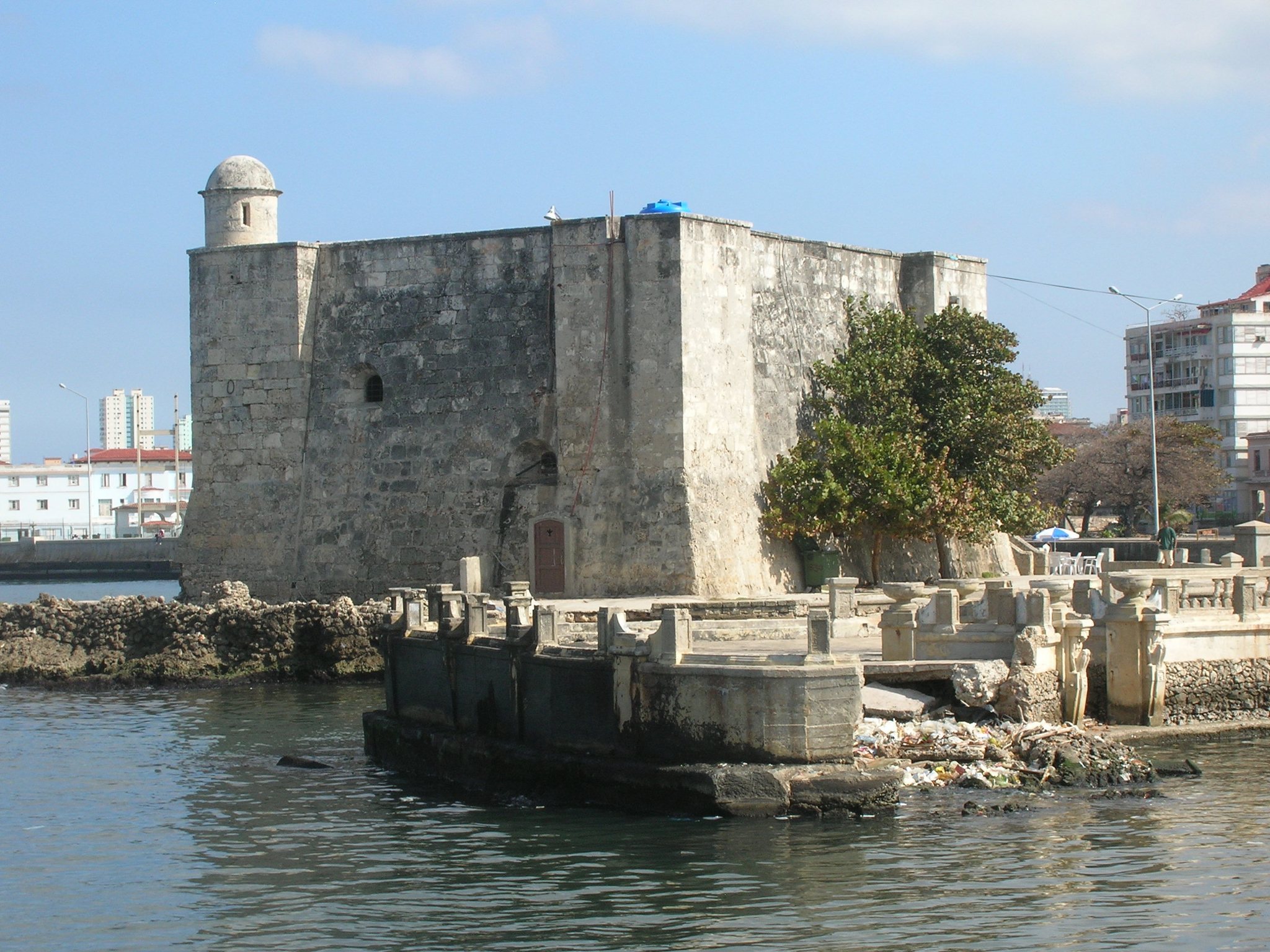
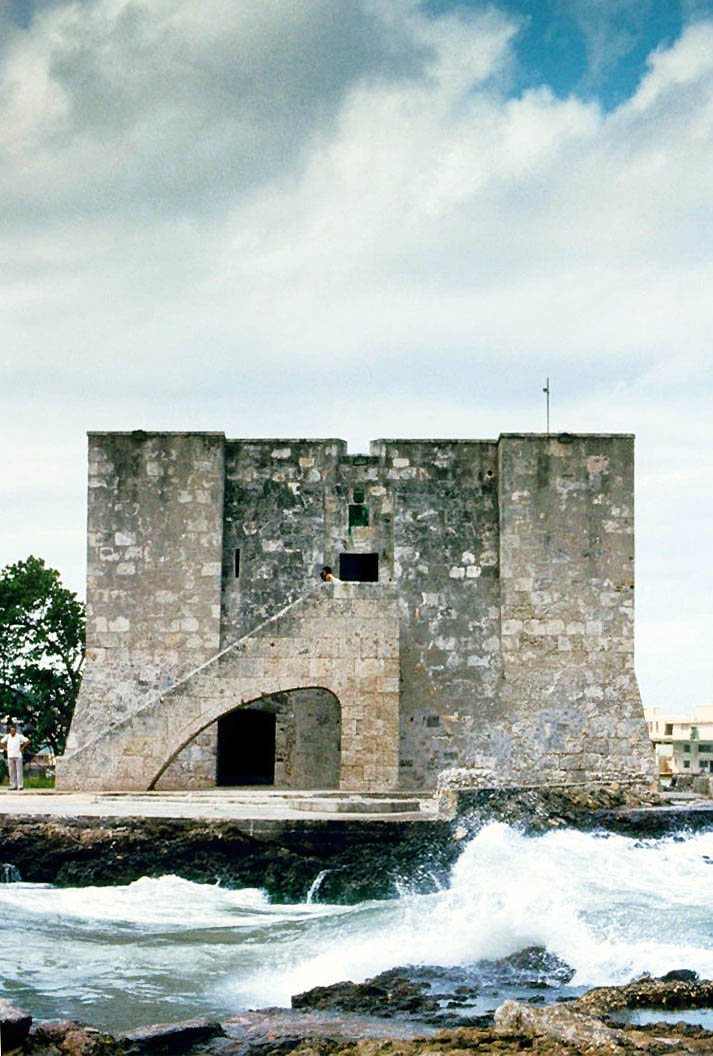
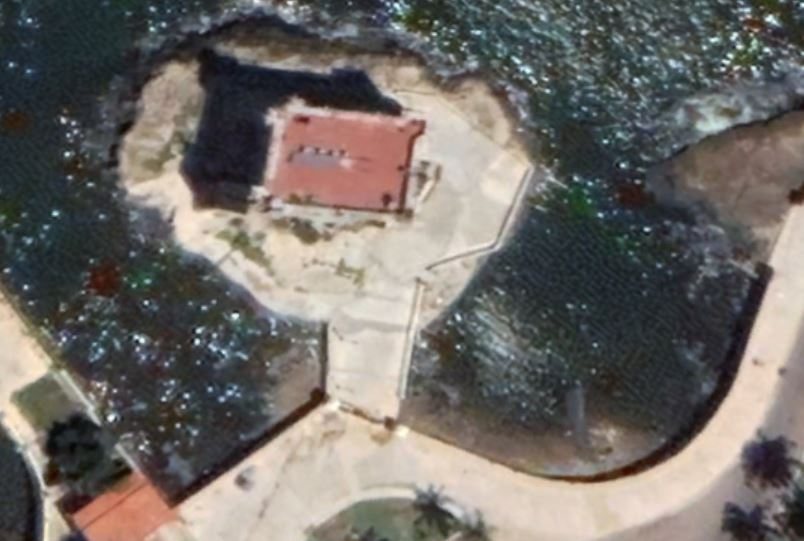
The surviving fortification stands on a coral islet only a few metres from the shore, with the islet only slightly larger than the building itself. The rebuilt tower is a rectangular, load-bearing masonry structure measuring approximately 80 by 60 feet. It has two storeys and a stated floor area of 231.60 square metres. A stone staircase leads to the entrance on the second floor, and a tablet above the entrance identifies the builders and gives the date of construction.
The rebuilt armament consisted of four larger cannon and two smaller ones. These defenses formed part of the tower’s later arrangement after the damage caused during the British attack. The compact masonry structure and its position on the coral islet reflect its purpose as a fortified post controlling access to the river mouth.
The later artillery battery
The Spanish battery established in 1898 stood near the tower rather than inside it. It contained three 160-millimetre guns removed from the unarmored cruiser Alfonso XII. Its separate position allowed the later artillery installation to supplement the tower’s defenses while remaining physically distinct from the earlier fortification.