San Francesco della Vigna: A Renaissance Franciscan Church in Venice
Site at a Glance
- Rating
- 4.6
- Popularity
- Low
- Country
- Italy
- Primary era
- Early Modern
- External website
- Open
- Eras represented
- Medieval, Early Modern
- Civilizations
- Venetian
- Site type
- Religious
- Remains
- Church
On this page31 sections
History
San Francesco della Vigna is a Roman Catholic Franciscan church in Venice, Italy, in the Castello district near the Arsenal. Its name recalls the vineyard that once occupied the site. The present building was reconstructed in the sixteenth century in the Renaissance period, replacing a medieval Franciscan church and becoming one of Venice’s two major Franciscan churches, together with Santa Maria Gloriosa dei Frari.
Foundation and medieval church
In 1253, Marco Ziani, son of Doge Pietro Ziani and Count of Rab, donated the vineyard for a Franciscan monastery. A small chapel already marked the place where tradition held that Saint Mark had found refuge. According to the same tradition, an angel greeted him with the words “Peace to you, Mark, my evangelist,” a phrase later adopted as Venice’s motto.
The first church was a three-aisled Gothic building constructed by Marino da Pisa. Its monastery was occupied by the Franciscan Observants, a reform branch of the Order of Friars Minor that emphasized stricter religious discipline. The Conventual Franciscans, another branch of the order, occupied Santa Maria Gloriosa dei Frari elsewhere in Venice.
Sixteenth-century reconstruction
By the beginning of the sixteenth century, the medieval church required restoration. Its rebuilding followed both the reform of the Observants and the wishes of Doge Andrea Gritti, whose family palace stood beside the church. The new building was also intended to provide a religious centre for people who had settled around the Arsenal.
Gritti laid the foundation stone on 15 August 1534 and financed the reconstruction. He died in 1538 and was buried near the altar, where his funerary monument remains in the choir. The main body of the church was completed in 1554. Jacopo Sansovino designed the project with advice from the Franciscan friar Francesco Zorzi, whose ideas about proportion linked the plan to the Christian doctrine of the Trinity. The church’s later façade was commissioned from Andrea Palladio by Giovanni Grimani in 1562 and built during the 1560s, with completion given as 1568. It was Palladio’s first ecclesiastical commission.
The rebuilding was partly financed through the sale of side chapels to aristocratic patrons for between 200 and 350 ducats. Buyers received the right to place their coats of arms in the chapels and to be buried there with their families. Andrea Gritti paid 1,000 ducats for burial before the high altar. Vettor Grimani and his brother, Cardinal Marino, secured the right to construct the façade in 1542. Giovanni Grimani later transferred the commission from Sansovino to Palladio. Three Grimani sarcophagi once associated with two cardinals and a patriarch are no longer in place.
Suppression and later history
The convent was temporarily preserved by a decree of 28 July 1806, but it was suppressed on 12 May 1810 under a decree of the Kingdom of Italy dated 25 April 1810. The church became a parish and retained that role after the Observant Franciscans returned in 1836. In 1810, following the destruction of Santa Giustina, relics of Saint Christina were transferred to San Francesco della Vigna, together with a stone associated with Saint Justina’s martyrdom.
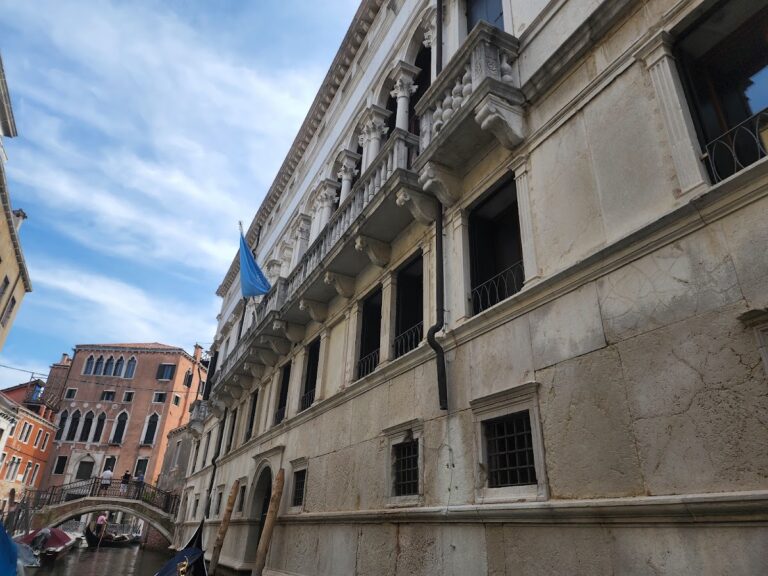
In 1838 the Franciscans took over the former Convento delle Pizzochere. During the mid-nineteenth century, A. Pigazzi built an elevated gallery linking it on the west with the Palazzo Nunciato. The palace had originally been associated with Andrea Gritti and was later assigned to the papal nuncio in Venice. The two buildings were taken over by the Italian government in 1866 for use as the seat of a military tribunal.
The church was damaged by bombing in 1917. During the mid-1990s, serious deterioration of the façade led to securing and restoration work assisted by the Venice in Peril foundation. The Grimani Chapel and Palladio’s façade were also restored. The church remains an active parish church, while the two cloisters have been used for temporary exhibitions, concerts, and Biennale art events.
Remains
Plan, interior, and façade
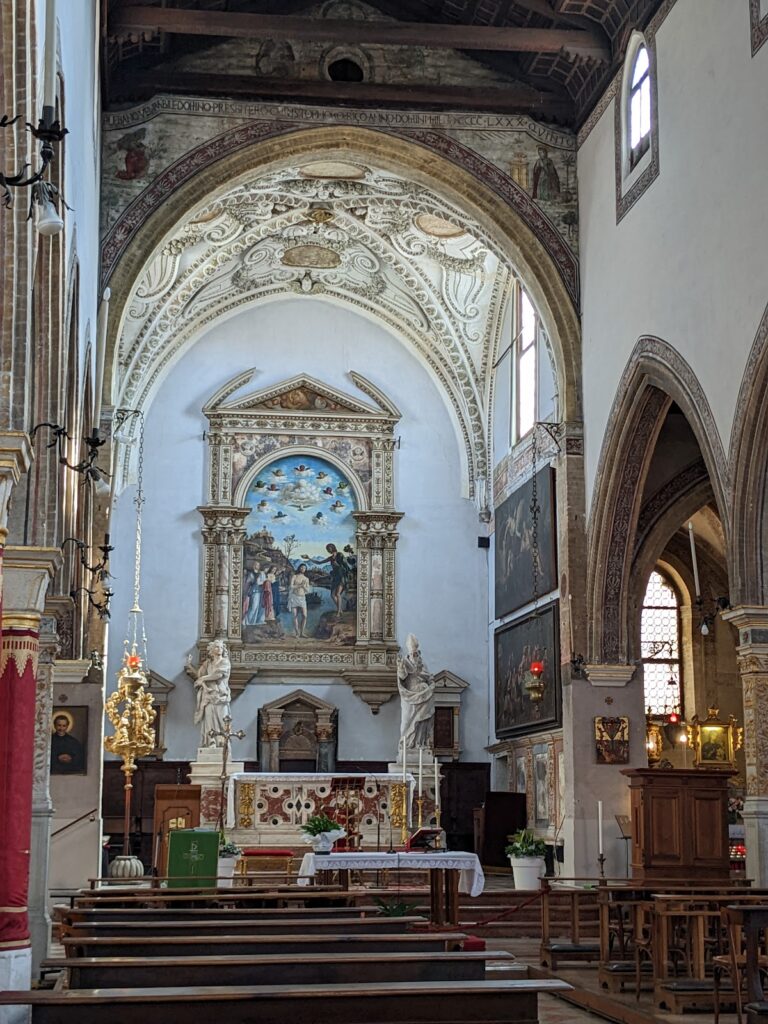
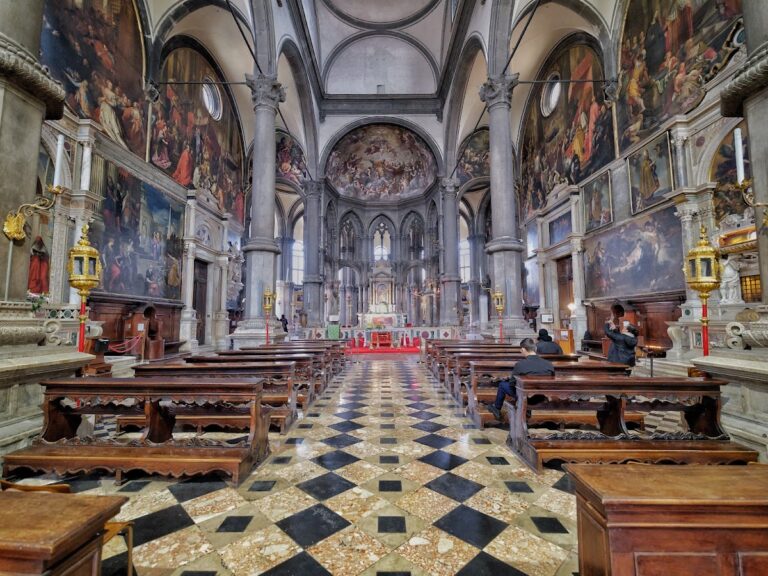
San Francesco della Vigna is built of brick and marble in a restrained Renaissance style. Its Latin-cross plan has a single nave, a deep choir, and five chapels on each side. The former side aisles were transformed into chapels, and a planned dome was never built. Zorzi organized the proportions around the number three in reference to the Trinity. The intended dimensions gave the nave a width of nine paces and a length of twenty-seven, while the side chapels were three paces wide. The nave was also conceived as a T-shaped form associated with salvation and perfection.
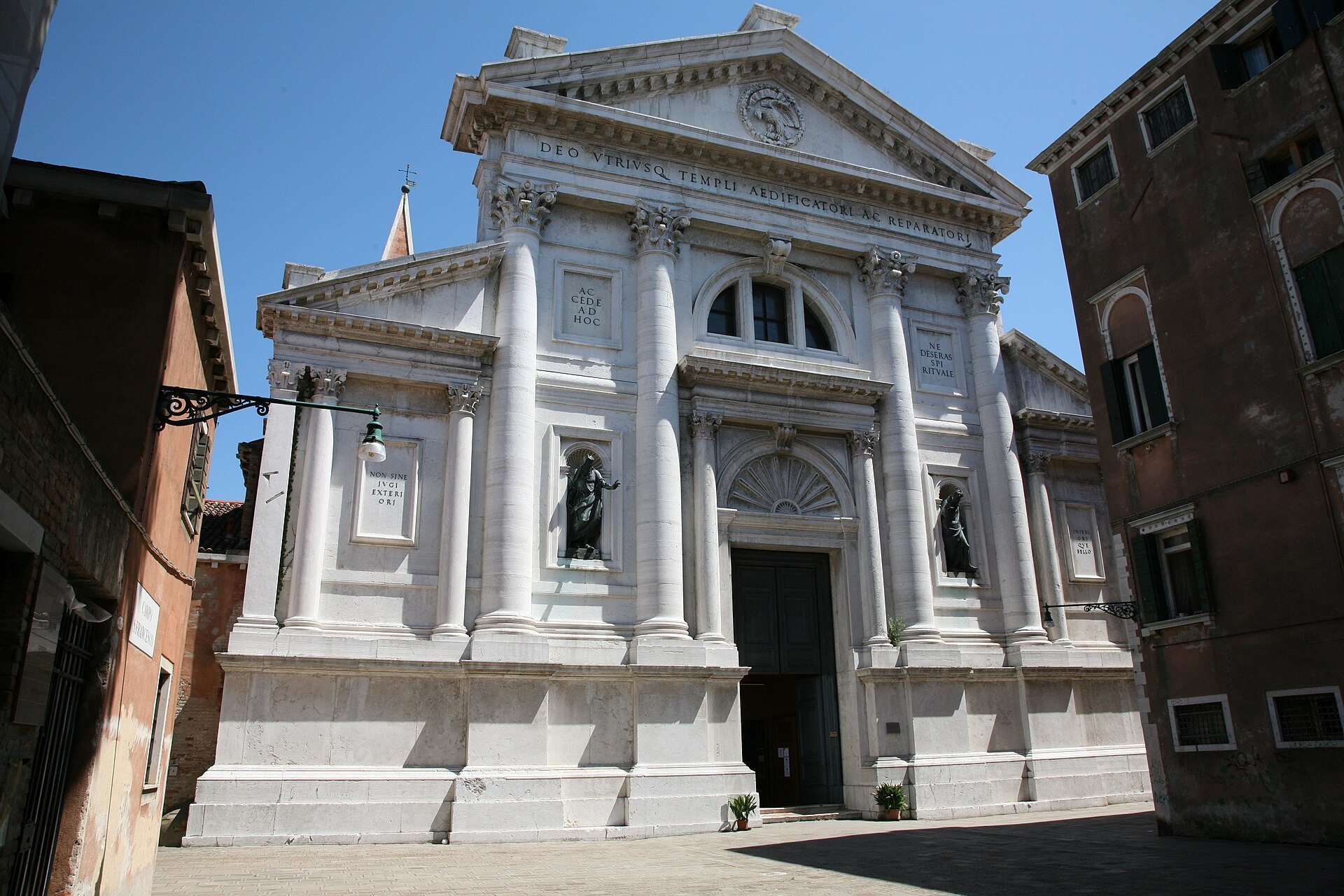
The sober interior is articulated by plain Doric pilasters of Istrian stone. The choir lies behind the high altar and was formerly occupied by the monks during services. Palladio’s façade is faced in white marble. A large central pediment corresponds to the nave, while lower half-pediments on either side correspond to the former aisles. Corinthian columns stand on one high plinth, with the four central columns taller and wider than those at the sides. A large arched window rises above the portal, and a round relief occupies the upper part of the pediment.
The façade contains bronze statues of Moses and Saint Paul by Tiziano Aspetti, dated 1592. Set in niches, the figures are designed as if stepping forward. Other decoration includes an eagle with the inscription “Renovabitur,” the dedication “To God, builder and restorer of both temples,” and four marble plaques with devotional inscriptions.
Bell tower and choir
Campanile
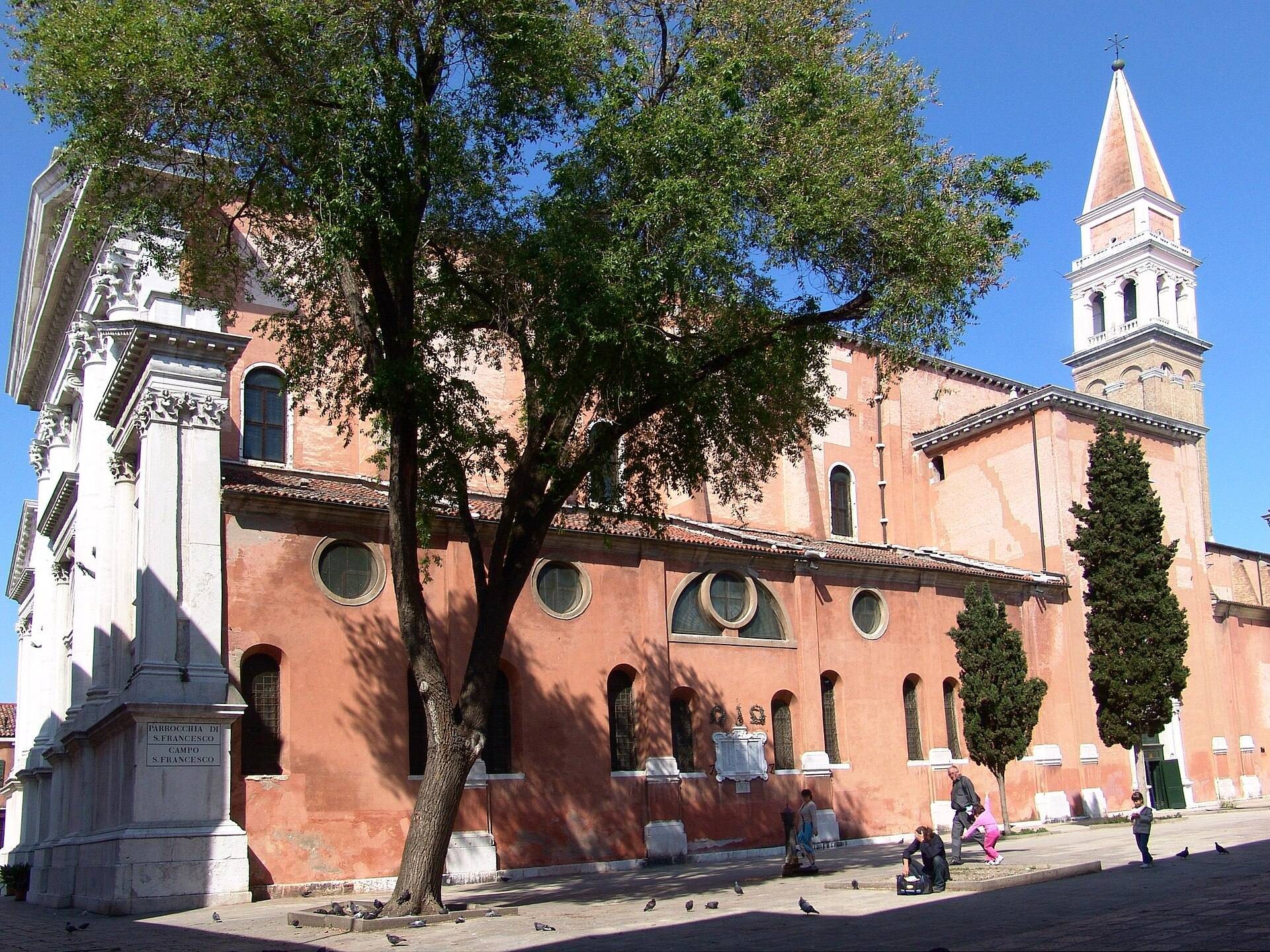
The original thirteenth-century bell tower was repeatedly struck by lightning and demolished in 1489. The present campanile was designed by Bernardo Ongarin and built between 1571 and 1581. It rises approximately 69 to 70 metres, resembles the campanile of Saint Mark’s, and is among Venice’s tallest bell towers. Ongarin was buried at its base, where a commemorative plaque records him. Five bells tuned to B were cast in the 1950s.
Choir and high altar
The choir consists of a liturgical choir and a friars’ choir, separated by the high altar and a partition. A side vestibule and an apsidal chapel serve each choir space. The high altar, attributed in design and sculpture to Girolamo Campagna, dates from the second half of the sixteenth century. It has a stone altar table, groups of four wooden columns at either side, and a central cross in place of an altarpiece. Statues of Saint Francis of Assisi and Saint Anthony of Padua, once positioned among the columns, were later moved to the side doors of the friars’ choir.
Baldassare Longhena altered the altar in 1649 by adding a Baroque cornice above eight Corinthian columns. A large tabernacle from the ruined church of Santa Lucia was installed in the second half of the nineteenth century and removed in 1939 because it was considered too ostentatious for Franciscan ideals. The pediment of the triumphal arch contains the Eternal Father, with a painted wooden Annunciation on either side, works attributed to Campagna.
Choir monuments and paintings
The choir contains the anonymous late-fourteenth-century tempera icon Madonna of Humility and a Flagellation by Palma the Younger. On the left wall is the funerary monument and epitaph of Doge Andrea Gritti, a work of the Palladian school from the mid-sixteenth century. The right wall bears the monument of the senator Tridiano Gritti, who died in 1474.
Side chapels
Grimani Chapel
The first chapel on the left is the Grimani Chapel, dedicated to the Three Kings and acquired by Vettor Grimani in 1537. Battista Franco decorated its vault in 1561 with fifteen Roman medallions. Circular and square coffers alternate around representations of the seven angelic virtues and eight human virtues. The chapel contains Federico Zuccari’s 1564 Adoration of the Magi, painted directly in oil on marble. Its sacristy copy, made by Michelangelo Grigoletti in 1833, is described below. Tiziano Aspetti’s bronze allegories of Peace and Justice stand in niches beside the altar. Franco painted the Resurrection of Christ, Elijah Healing the Widow’s Son, and Elijah and the Chariot of Fire above the altar, while Zuccari painted the 1561 Resurrection of Lazarus on the side wall.
Montefeltro Chapel
The second chapel on the left is the Montefeltro Chapel, associated with Nicola da Urbino, Count of Montefeltro. His unfulfilled testament of 1397 requested a chapel at Saint Mark’s, but one was established here about 150 years later. Francesco Smeraldi made its marble altar in 1561. Its statues of Saint Anthony the Great, Saint Sebastian, and Saint Roch were made by Alessandro Vittoria in 1563. Works attributed to Parrasio Micheli represent the Fall of the Manna and the Sacrifice of Melchizedek.
Basso-Sagredo Chapel
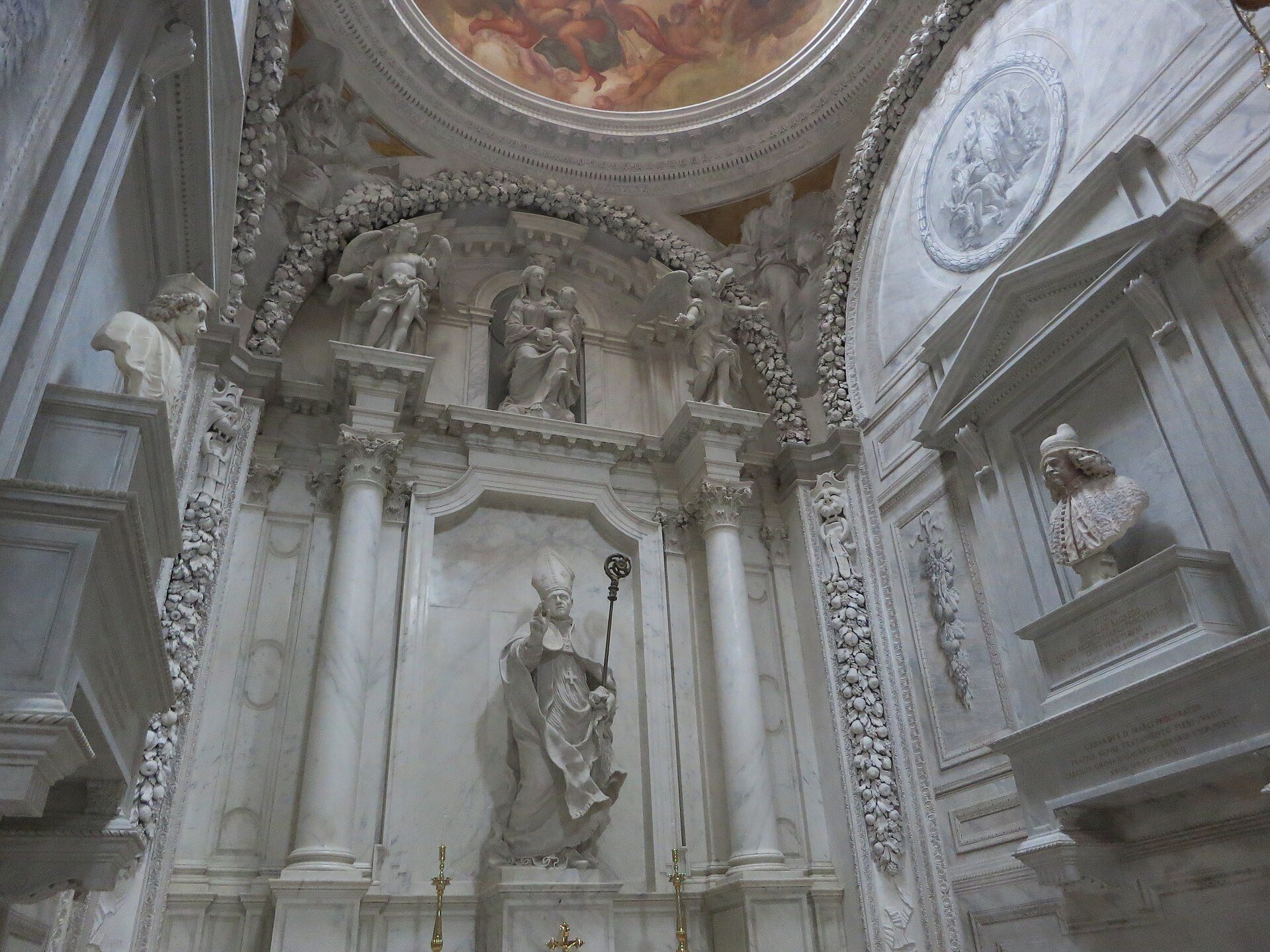
The third chapel on the left is dedicated to Saint Gherardo Sagredo. It contains a statue of the saint and a group of the Virgin and Child with musical angels by Andrea Cominelli. Girolamo Pellegrini painted the 1741 Apotheosis of Saint Gherardo on the dome. Tiepolo painted the four Evangelists on the pendentives, curved triangular surfaces supporting a dome, together with grisaille medallions of the virtues. Antonio Gai made the busts of Patriarch Alvise Sagredo and Doge Nicolò Sagredo. The polychrome stone altar follows the seventeenth-century style of the Corbarelli brothers.
Dandolo Chapel
The fourth chapel on the left is the Dandolo Chapel, dedicated to Saint Bernard of Siena. Giuseppe Porta painted its altarpiece, showing the Virgin and Child with Saint Anthony the Great and Saint Bernard, as well as the Prophet Isaiah and the Eritrean Sibyl. Funerary inscriptions commemorate Antonio Dandolo and Bernardo Dandolo.
Giustinian della Salute Chapel
The fifth chapel on the left was acquired by Lorenzo Giustiniani in 1536 and dedicated to the Virgin of Health. Its altar is made of Istrian stone. Paolo Veronese painted the 1551 Holy Family with Saint Catherine and Saint Anthony the Great, while Antonio Vassilacchi painted the Virgin and Child and the Adoration of the Shepherds on the side walls.
Bragadin Chapel
The first chapel on the right is the Bragadin Chapel, dedicated to Saint Catherine of Alexandria. Girolamo Bragadin acquired it as a family tomb in 1537. The family arms flank the altar, which bears Giuseppe Porta’s Saint Catherine of Alexandria with Saints Jerome, John the Baptist, and James the Apostle. The chapel also contains Francesco Rizzo da Santacroce’s Last Supper, Giovanni da Asola’s Resurrection of Christ, and Girolamo Bragadin’s tombstone of 1545.
Badoer-Surian Chapel
Piero Badoer acquired the second chapel on the right in 1535. Its Baroque altar of polychrome marble contains a polychrome wooden statue of the Virgin by an unidentified artist. The altarpiece represents the Immaculate Conception and Saint Christopher. Side paintings include Giambattista Pittoni’s Sacrifice of Isaac, Francesco Polazzo’s Rebecca at the Well with Eliezer, Nicola Grassi’s Samaritan Woman at the Well, and Angelo Trevisani’s Healing of the Blind Man. A 1563 tombstone commemorates Cristoforo Surian.
Contarini Chapel
Zuane Contarini acquired the third chapel on the right in 1536 and dedicated it to Saint Francis of Assisi. It contains the tombs of Doges Francesco and Alvise Contarini, whose busts were made by Antonio Gai. Other works include an alabaster Saint Louis of Toulouse and Palma the Younger’s Virgin in Glory with Saints.
Malipiero-Badoer Chapel
Sebastiano Malipiero acquired the fourth chapel on the right in 1546, and it passed to the Badoer family about a century later. Dedicated to the Resurrection, it contains Paolo Veronese’s Resurrection of Christ, painted about 1560 as the artist’s first Venetian commission.
Barbaro Chapel
The fifth chapel on the right is the Barbaro Chapel. Its altar has Battista Franco’s Baptism of Christ between Saint Francis and Saint Bernardino of Siena. The Barbaro family arms are displayed in the chapel.
Pulpit altar
The right pulpit was erected at the expense of Matteo Goretto. Its underlying altar is dedicated to Saint Matthew and bears a painting of the apostle by Francesco Montemezzano. Above the pulpit is Montemezzano’s late-sixteenth-century Assumption of the Virgin.
Choir chapels, transepts, and sacristy
Badoer-Giustinian Chapel
The Badoer-Giustinian Chapel on the left side of the choir is dedicated to Saint Jerome. Girolamo Badoer completed it in 1509. It contains the tomb of Badoer’s daughter Agnesina and her second husband, Girolamo Giustiniani, who died in 1532. Its marble altarpiece, attributed to the Lombardo family, represents Saint Jerome and four Saints and has a Last Judgment on the altar frontal. The walls contain fifteenth-century reliefs by Tullio and Amedeo Lombardo, Prophets and Evangelists by Pietro Lombardo, and a Christological cycle by the same artist, together with funerary inscriptions from 1688 and 1690.
Priuli Chapel
The left transept contains the Priuli Chapel, dedicated to Saint Paschal Baylon and enclosed by a sixteenth-century balustrade of polychrome marble. Its features include a seventeenth-century Addolorata attributed to Antonio Vassilacchi, the stone associated with Saint Justina’s martyrdom, and a polychrome-marble altar with a red Verona-marble niche. Marchiò Molziner carved the wooden statue of Saint Paschal Baylon in 1691, and it was transferred here from the Giustiniani Chapel in 1898. A glass sarcophagus on the altar contains relics of Saint Christina, who was martyred at the age of thirteen in 297.
Trevisan monument and Holy Chapel
Girolamo Campagna’s monument to Doge Marcantonio Trevisan stands above the entrance from the left transept to the Holy Chapel, sacristy, and cloisters. Trevisan’s tomb occupies the centre of the transept facing the choir, with a statue of Saint Louis of Toulouse beside the entrance. The Holy Chapel contains Giovanni Bellini’s 1507 Madonna and Child with Four Saints and the Donor.
Giustinian dei Vescovi Chapel
The right apsidal chapel is the Giustinian dei Vescovi Chapel, dedicated to Saint Peter of Alcantara and associated with the Giustinian branch, whose members included numerous bishops. Its eighteenth-century stucco vault has a central 1765 medallion of Saint Peter of Alcantara in Glory by Francesco Fontebasso, and eighteenth-century choir stalls line the sides. Fontebasso also painted the Death of Saint Peter of Alcantara, Saint Peter of Alcantara and the Queen of Spain, and Ecstasy of Saint Peter. Other works include Francesco Maggiotto’s 1789 Penance and Meditation, Jacopo Marieschi’s The Theological Virtues, and Sante Peranda’s early-seventeenth-century Saint Francis Receiving the Infant Jesus from the Virgin.
Holy Land Portal
The right transept contains the Holy Land Portal, traditionally attributed to Sansovino but more probably made by Guglielmo dei Grigi. It serves as a funerary monument to Captain Domenico Trevisan, father of Doge Marcantonio Trevisan. The portal includes a 1535 relief of the Lion of Saint Mark, an inscription to Domenico Trevisan, and paintings of Saint Augustine and Saint Lawrence of Rome from the school of Jacopo Tintoretto.
Right transept altar
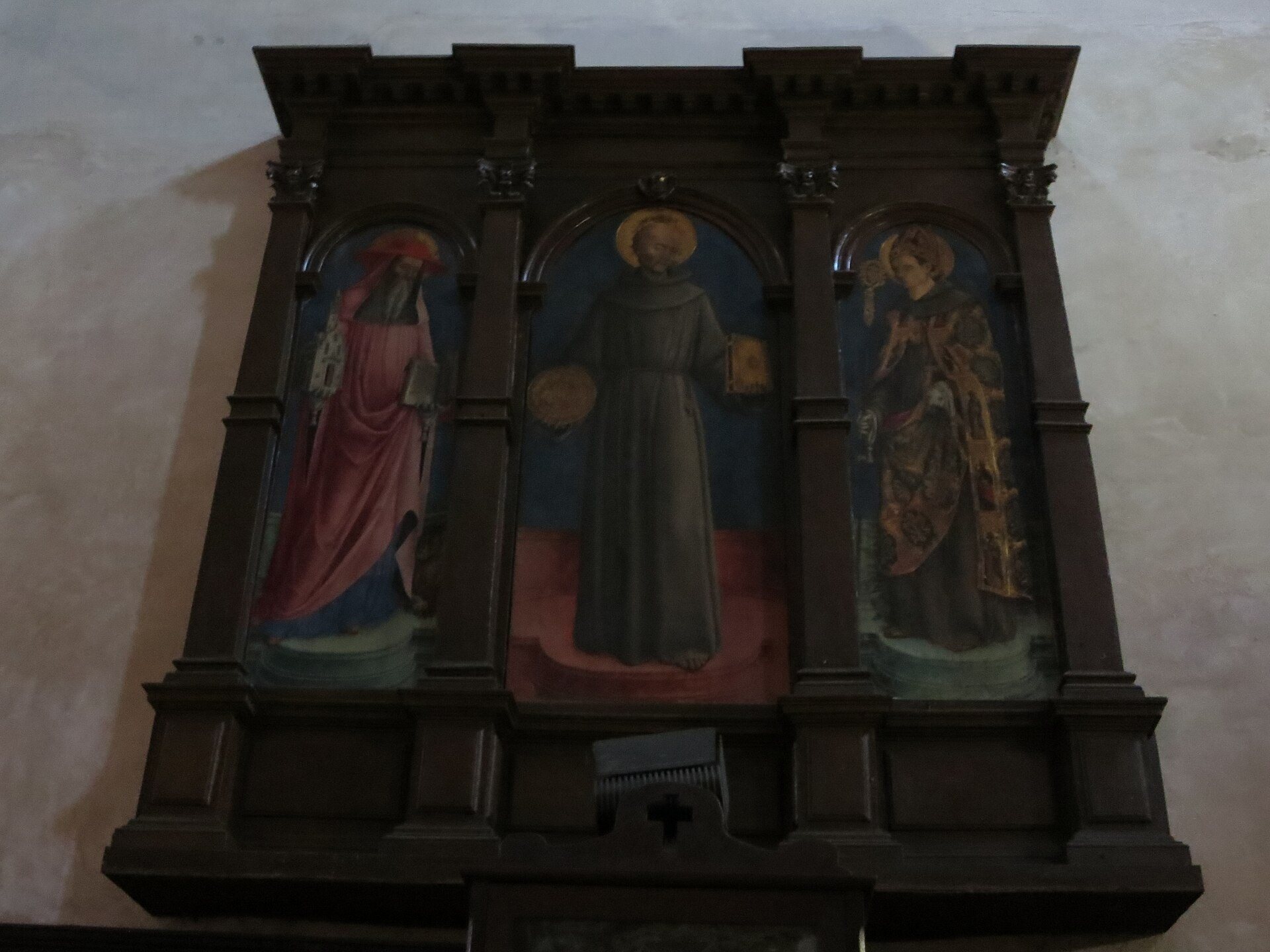
The altar in the right transept contains Antonio da Negroponte’s late-fifteenth-century Enthroned Madonna and Child. Benedetto Rusconi, known as Il Diana, painted the later lunette, a semicircular area above the altar, showing God the Father and the Holy Spirit in the early sixteenth century.
Sacristy
The sacristy has a central altar and two side altars. It contains Michelangelo Grigoletti’s 1833 copy of Zuccari’s Adoration of the Magi, two works by Palma the Younger showing Saint Bonaventure in his study and Saint Diego of Alcalá in ecstasy, and Giuseppe Angeli’s 1760 Immaculate Conception and Saints. Nicola Grassi painted portraits of Saint John of Capistran and Saint Anthony of Padua, as well as the Communion of Saint Bonaventure and Saint Francis Comforted by the Angel. The right altar is attributed to Sansovino and dated 1559.
Cloisters and monuments
The internal façade wall contains a twelfth-century Byzantine relief of the Virgin and Child. The church also preserves numerous tombs, epitaphs, family arms, and monuments. Tomb slabs in the transept commemorate Bernardo Sagredo, Doge Nicolò Sagredo, Doge Marcantonio Trevisan, Bartolomeo Gradenigo, and Leonardo Foscarini.
The monastery complex comprises two large cloisters. One was converted into a cemetery containing the tombs of prominent Venetians. Both cloisters have subsequently served as settings for exhibitions, concerts, and art events, preserving the connection between the church’s religious complex and Venice’s wider cultural life.