San Giovanni in Bragora: A Late Gothic Parish Church in Venice


Site at a Glance
- Rating
- 4.5
- Popularity
- Low
- Country
- Italy
- Primary era
- Medieval
- External website
- Open
- Eras represented
- Medieval, Early Modern, Modern
- Civilizations
- Habsburg, Venetian
- Site type
- Religious
- Remains
- Church
On this page23 sections
History
San Giovanni in Bragora is a Roman Catholic parish church in Venice, Italy, dedicated to Saint John the Baptist and shaped largely by a late Gothic rebuilding carried out between 1475 and 1505. It belongs to the Castello district and remains under the Patriarchate of Venice and the San Marco–Castello vicariate. Saint John the Baptist, regarded in the New Testament as the forerunner of Jesus, is the church’s principal dedicatee, while relics of Saint John the Merciful give it a distinctive devotional association.
Foundation and medieval rebuilding
Tradition attributes the foundation of the church to Saint Magnus, bishop of Oderzo. According to the story, Magnus fled the Lombard invasion and received a vision directing him to build eight churches. The date of San Giovanni in Bragora’s foundation remains uncertain. Traditions place it in the seventh or early eighth century, while another tradition assigns the foundation to 829.
The first written reference to a church in this area appears in a notarial document of 1090 signed by Andrea Martinaci, who is identified as its parish priest. The building was reconstructed in the tenth century under Doge Pietro III Candiano to house alleged relics of Saint John the Baptist. A further rebuilding took place in 1178. The parish probably existed soon after the traditional foundation of the church, or by the eleventh century, when Venice’s parish boundaries and religious administration were being formalized.
Saint John the Merciful, a seventh-century patriarch of Alexandria remembered for charitable works, became another important focus of worship. His relics had been kept in the church since 1249. A chapel for them was built in 1481, and the relics were placed there in 1494. The chapel’s devotional importance continued after the creation of the Scuola di San Giovanni Elemosinano in 1616, a confraternity dedicated to the saint.
The late Gothic transformation
The rebuilding undertaken from 1475 transformed the medieval church into the late Gothic building largely seen today. The nave body was completed in 1479, while the presbytery followed after 1490. The work continued until 1505, when the church was consecrated or reconsecrated by Patriarch Antonio Suriano on 11 November. The event is commemorated by an inscription on the facade.
The renewed church also received an extensive liturgical decoration. Sebastiano Mariani, an architect and sculptor active in the late fifteenth century, created a three-part rood screen, a partition between the nave and the presbytery. During the late sixteenth century, Counter-Reformation reforms, Catholic changes made in response to Protestant criticism and reform movements, encouraged a clearer visual relationship between worshippers and the main altar. The screen was dismantled, although some of its elements were retained and reused inside the church.
In 1595, the Venetian sculptor Alessandro Vittoria redesigned the presbytery. The Chapel of Saint John the Merciful was renovated during the 1740s, probably under the Venetian architect Giorgio Massari. Massari was later buried in the church. Alessandro Vittoria also died there on 20 May 1608, while Massari died there on 6 December 1766.
Parish life and later history
San Giovanni in Bragora retained its parish status during the Napoleonic suppressions and reorganizations of 1807 to 1810, when the number of Venetian parishes was reduced from more than 70 to 30. The church of Sant’Antonin was incorporated as a filial church. Since 1807, the parish has been headed by a priest appointed by the patriarch.
The church is associated with several notable Venetian figures. Pietro Barbo, a Venetian churchman who became Pope Paul II in 1464, was baptized here. Antonio Vivaldi, the Venetian Baroque composer and violinist commonly known as the Red Priest, was born on 4 March 1678 in a house on nearby Calle del Dose and baptized at San Giovanni in Bragora on 6 May. Because he was considered too ill to survive, he had first received a hurried baptism at home; the ceremony at the church subsequently ratified it. The parish was also associated with the birth of the playwright Giacinto Gallina.
The origin of the name Bragora is uncertain. Proposed explanations connect it with a Greek word for a square, the Venetian word for mud, and older terms associated with a market square or fishing. None of these explanations is confirmed by historical evidence. A comprehensive restoration in 1996 treated the church’s paintings and architectural details.
Remains
Plan and exterior
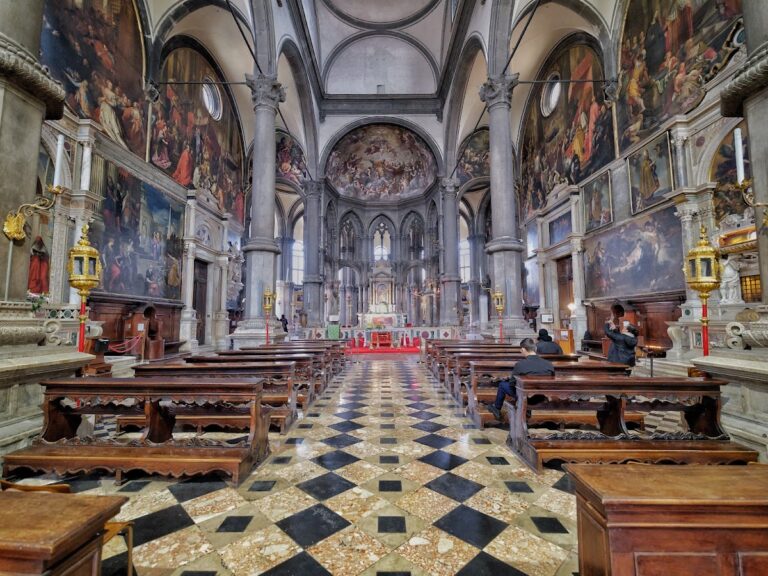
San Giovanni in Bragora is a three-aisled basilica without a transept. In this type of longitudinal church plan, the central nave rises above the side aisles. The building is constructed of brick and covered by a double-pitched roof. Its flat-ended apses and restrained Lombard-inspired exterior belong to the late Gothic parish-church tradition of Venice, while the interior combines late Gothic and early Renaissance forms.
Facade
The brick facade is divided vertically into three sections corresponding to the nave and aisles. A large arch crowns the central section, while smaller half-arches terminate the sides. Pilasters separating the sections carry brick pyramidal finials. Pointed-arch, single-light windows illuminate the side sections, and a large oculus occupies the upper part of the center. Three simple portals open at ground level, with the largest in the central section. Above the main portal, a lunette, the semicircular field over a doorway, preserves remains of a fresco depicting the Baptism of Christ.
Campanile
The campanile, or bell tower, has passed through several rebuilding phases. An earlier tower may have dated from the ninth century. It was extensively altered between 1475 and 1498, then demolished in 1567 because of its poor condition and reconstructed in 1568. Lightning struck the structure on 25 April 1708, leading to further repair or rebuilding. The tower was finally demolished in 1826 and replaced by the lower bell structure visible today.
Nave and late Gothic furnishings
The nave has a wooden trussed ceiling supported by exposed timber roof framing. Arcades divide the central nave from the side aisles, and each aisle contains two chapels. The column capitals carry gilded decoration, while painted details appear on the arcade arches. Four central pairs of columns have elaborately carved and gilded Gothic capitals that probably predate the late fifteenth-century reconstruction and may belong to the twelfth century.
Rood screen remains
Two square piers at the beginning of the central nave originally formed part of Mariani’s rood screen. Decorative panels from the screen were later installed along the apse walls. Their pilasters and reliefs use classicizing forms with gilded animal and plant motifs. One of the screen’s two holy-water stoups survives near the entrance on the right side of the central nave.
Baptismal font
The baptismal font at the beginning of the left aisle combines elements from different periods. Its oldest component probably dates from about 1430 and consists of an octagonal basin set on a Gothic red-marble base decorated with acanthus leaves. This is the font associated with Vivaldi’s baptism at the church.
Left-aisle paintings
The left aisle contains Bartolomeo Vivarini’s signed and dated 1478 triptych, Madonna Enthroned with Child between Saints John the Baptist and Andrew. Four small images by Jacobello del Fiore are placed beneath it. Alvise Vivarini’s Madonna and Child and Blessing Christ are also among the works associated with this part of the church.
Presbytery and principal paintings
Baptism of Christ
Above the main altar, the presbytery contains Cima da Conegliano’s luminous Baptism of Christ, painted between 1492 and 1494 for the parish priest Cristoforo Rizzo. The picture remains in a marble frame made by Sebastiano Mariani in 1492. It is regarded as one of the earliest Venetian altarpieces to remain continuously in its original position.
Altar and vault
The main altar dates from 1685 and was made by Girolamo Livioni. Its large marble statues of Saint John the Evangelist and Saint John the Merciful were sculpted in 1689 by Heinrich Meyring, also known as Enrico Merengo. Elaborate stucco decoration with gilded details covers the presbytery vault. The work is attributed to Ottaviano Ridolfi and probably dates from the late sixteenth century.
Presbytery walls and sacristy
The presbytery walls contain Jacopo Palma the Younger’s Washing of the Feet. The rear of the right aisle holds Alvise Vivarini’s Resurrection. Above the entrance to the sacristy is a thirteenth-century Venetian-Byzantine relief of the Madonna and Child. Inside the sacristy are Cima da Conegliano’s Saints Helena and Constantine at the Cross, dated 1501 to 1503, and an Annunciation with Saints John the Evangelist, Cajetan of Thiene, and Jerome, attributed to Gregorio Lazzarini and probably painted in 1692 for the enlargement of the room. Works associated with Alvise Vivarini, including The Risen Christ, are also preserved there.
Apsidal chapels
Two chapels flank the presbytery. The Chapel of Saint Anthony was formerly dedicated to the Virgin Mary before 1730, while the Chapel of the Sacrament contains a wooden crucifix by Leonardo Tedesco. Their present altars probably came from the former church of Santi Filippo e Giacomo.
The apsidal chapels originally held two triptychs. Bartolomeo Vivarini’s Madonna and Child between Saint John the Baptist and Saint Andrew is now on the right-aisle wall, as is Francesco Bissolo’s Saint Andrew between Saints Martin and Jerome.
Chapel of Saint John the Merciful
The Chapel of Saint John the Merciful was built in 1481 for the saint’s relics. The relics were installed there in 1494, and decoration continued until 1501. Alessandro da Caravaggio produced the altar, sarcophagus, and seating, while Leonardo Tedesco made the relief work. A wooden, gilded reliquary for the saint had replaced an earlier one in 1326, when a more elaborate container was made.
A relief of Saint John the Merciful formed part of the chapel’s decoration. Alvise Vivarini’s Blessing Christ, originally painted for the chapel, is now on the left-aisle wall. The chapel altar contains an eighteenth-century painting of the saint by Jacopo Marieschi. The chapel also became the seat of the Scuola di San Giovanni Elemosinano in 1616.
Later side chapels
Chapel of the Sorrowful Virgin
The Chapel of the Sorrowful Virgin was originally under the patronage of the Navager family. The Compagnia del Santissimo Rosario renovated it in 1684 and installed a new altar. Its altar table contains a polychrome terracotta Pietà from a fifteenth-century German school. A restoration in 1985 removed later layers of paint. The chapel also contains Leonardo Corona’s The Flagellation and The Crowning with Thorns. These works may once have formed a Christological cycle with Palma the Younger’s Christ before Caiaphas and Washing of the Feet.
Chapel of Saint Joseph of Copertino
The chapel dedicated to Saint Joseph of Copertino was built in 1834 and 1835 opposite the Chapel of the Sorrowful Virgin. It partly occupies the area of the adjoining Scuola di San Giovanni Battista. Its altar painting, Saint Bernardino of Siena in Glory with Saints Roch, Anthony the Great, Martha, Vincent Ferrer, and Valentine, is by Francesco Maggiotta.
Chapel of Saint Teresa of Avila
The Chapel of Saint Teresa of Avila was built in 1846 to 1848 as a counterpart to the Chapel of Saint John the Merciful. It had previously been dedicated to the Virgin of Pity and housed an image of the Virgin venerated by sailors. The image had originally stood on the Ponte della Pietà and was transferred to the church by Patriarch Trevisan in 1638.
The chapel contains a seventeenth-century Saint Nicholas and Scenes from His Life, a Crucifixion by an unidentified Cretan-Venetian artist probably dating from the second half of the sixteenth century, and Alvise Vivarini’s Madonna and Child and Blessing Christ. It also preserves Christ and Saint Veronica, made by a Venetian-school artist in the second half of the sixteenth century.
Relics and devotional objects
San Giovanni in Bragora preserves relics of Saint John the Merciful, a thorn from Christ’s Crown of Thorns, and a cross containing particles of the True Cross. These objects remain connected with the church’s devotional history and with the confraternity dedicated to Saint John the Merciful.