San Zaccaria: A Historic Roman Catholic Church in Venice


Site at a Glance
- Rating
- 4.5
- Popularity
- Low
- Country
- Italy
- Primary era
- Medieval
- Eras represented
- Medieval, Early Modern
- Civilizations
- Venetian
- Site type
- Religious
- Remains
- Church
On this page17 sections
History
San Zaccaria is a Roman Catholic church in Venice, Italy, built and rebuilt by the Venetian community from the early ninth century through the early sixteenth century. Dedicated to Zachariah, the father of John the Baptist, it stands in the Castello district near Piazza San Marco and the Doge’s Palace. Its history is closely connected with the Venetian doges, the city’s Benedictine nunnery, and the republic’s effort to present Venice as a new Byzantine center.
Early Foundation and Monastic Community
The first church was founded in the early ninth century, traditionally by Doge Giustiniano Participazio. Its foundation was associated with relics of Zachariah given to Venice by the Byzantine emperor Leo V the Armenian. An earlier foundation connected with Saint Magno of Oderzo is also recorded, placing the church within an older Christian history at the site.
A Benedictine nunnery was established beside the church by Doges Agnello and Giustiniano Participazio. The complex was later rebuilt under Doge Orso I Participazio by Abbess Giovanna, his daughter. The nunnery became associated with prominent Venetian noble families and enjoyed special privileges, while its abbesses exercised direct influence over the institution and its buildings.
In 855, Pope Benedict III took refuge in the monastery while fleeing the conflict surrounding the disputed election of Anastasius Bibliothecarius. In gratitude, he gave the nuns relics that included remains attributed to Athanasius of Alexandria and a fragment of the True Cross. This episode strengthened the monastery’s religious connections and contributed to the accumulation of relics associated with San Zaccaria.
Fire and Medieval Rebuilding
A major fire in 1105 destroyed the church and the monastic complex. More than one hundred nuns who had taken refuge underground reportedly died from smoke inhalation. The church was rebuilt during the twelfth century, and the present campanile, or bell tower, dates from the rebuilding of about 1170.
The monastery was later reformed as a Cluniac house under Enrico Dandolo. A Cluniac house was a Benedictine monastery linked to the reform movement centered at Cluny. The change connected San Zaccaria with a wider programme of Benedictine renewal while preserving the community’s long-standing religious and civic position in Venice.
The Fifteenth-Century New Church
San Zaccaria was rebuilt again in the fifteenth century. The new building was placed beside the earlier church rather than directly over it, allowing substantial remains of the older structure to survive. The project formed part of Venice’s attempt to express republican power and its intended role as a new Byzantine center.
Construction of the present new church officially began on 10 June 1458. Antonio Gambello directed the early work, and Mauro Codussi later took responsibility for the upper parts and facade. Codussi’s work was carried out mainly between about 1483 and 1491, and the church was completed in the early sixteenth century and consecrated in 1534.
The precise division of responsibility between Gambello and Codussi remains uncertain because the surviving documentation is incomplete. Gambello’s initial design is not known, and his absence from the building site after 1477 created uncertainty about his immediate successor before Codussi was appointed in 1483. The nunnery itself controlled the building campaign, arranging contracts with craftsmen and supplying materials.
Republican Ceremony and Later Changes
The doge, the elected head of the Venetian Republic, and his court traditionally visited San Zaccaria at Easter. A procession came from San Marco, followed by the presentation of the corno ducale, the doge’s distinctive ceremonial headdress and a symbol of his office. Tradition held that the nuns made it after donating land for the expansion of the ducal complex. The ceremony continued until the end of the Republic in 1797.
A major Baroque decorative campaign began around 1684 and produced much of the church’s later interior decoration. The monastery’s property was transferred to the state on 14 June 1806 under the decree of 8 June 1805, and the religious community was suppressed by decree on 25 April 1810.
On 30 January 2009, relics attributed to Saints Gregorios, Theodoros, and Leon were found in the church’s ossuary after they had been considered lost since the fourteenth century. San Zaccaria later transferred them to the Greek Orthodox Church. After a temporary stay near Athens, the relics were taken to Kefalonia.
Remains
The surviving complex consists of two adjacent buildings, the older church and the fifteenth-century new church. The remains of the older building stand to the right of the later basilica. Together they preserve medieval spaces, a crypt, the later church’s Gothic and Renaissance structure, and an extensive collection of paintings, sculpture, altarpieces, tombs, and reliquaries.
The Older Church
Chapel of San Tarasio
The former presbytery of the older church now forms the Chapel of San Tarasio, also called the Chapel of the Golden Altar. Its polygonal apse has seven tall, narrow biforate windows, each divided into two lights, and ribbed vaults. The chapel was rebuilt in a Flamboyant Gothic, or late Gothic, style around 1440 on the site of the earlier presbytery. Further spaces were created between 1458 and 1463 and later altered.
The vault frescoes date from 1442 and were painted by Andrea del Castagno and Francesco da Faenza. An image of the Eternal Father with Zachariah, John the Baptist, and the Evangelists introduced Tuscan Renaissance painting into Venice. Remains of the mosaic floor of the earlier Romanesque church survive at the foot of the altar, while the ribbed sections of the apse vault depict the Eternal Father, John the Baptist, Matthew, Mark, Zachariah, Luke, and John the Evangelist.
Altarpieces and Relics
The chapel contains three fifteenth-century polyptychs, altarpieces made from several separately framed or hinged panels. Ludovico da Forli supplied their carved and gilded frames, while Antonio Vivarini and Giovanni d’Alemagna painted them. They are the Polyptych of the Virgin, the Polyptych of the Body of Christ or Sepulchre, and the Polyptych of Saint Sabina.
The central panels of the Virgin polyptych show the Madonna and Child, Saint Martin, and Saint Blaise. These panels date from 1385 and were painted by Stefano di Sant’Agnese. The reverse shows saints whose bodies or relics were preserved in the church, including Zachariah, Stephen, Thomas, Gregory, Theodore, Leo, Sabina, Peter, Claudius, Tarasius, Nereus, Achilleus, and Pancras.
The Polyptych of the Body of Christ includes scenes of Christ in the tomb with the holy women, Saints Pancras, Nereus, and Achilleus, and the Resurrection. An inscription on its marble urn refers to these saints. The Polyptych of Saint Sabina shows Saint Sabina with Saints Jerome and Lizerius below and an angel between Saints Margaret and Agatha above. Its urn contains relics traditionally attributed to Saint Sabina.
Near-life-size wooden statues of Saint Benedict and Saint Zachariah stand among the chapel’s furnishings. Both were carved in 1451 for the nuns’ choir. The chapel also preserves the traditional tomb associated with Saint Zachariah.
Crypt
The crypt beneath the Chapel of San Tarasio was built in the tenth or eleventh century, apparently following the model of the crypt at San Marco. Three aisles are divided by two rows of small columns with simple capitals. These supports carry groin vaults, formed where two barrel vaults intersect. A marble altar surmounted by a Madonna occupies the crypt.
The crypt lies below the average sea level and is flooded during periods of acqua alta, or exceptionally high water. Water remains inside for much of the year and affects its conservation. When the water level is lower, access is possible through a raised passage. The crypt traditionally contained the tombs of eight early doges, and the body of Saint Zachariah was also believed to have rested there.
The Fifteenth-Century Basilica
Plan and Interior Structure
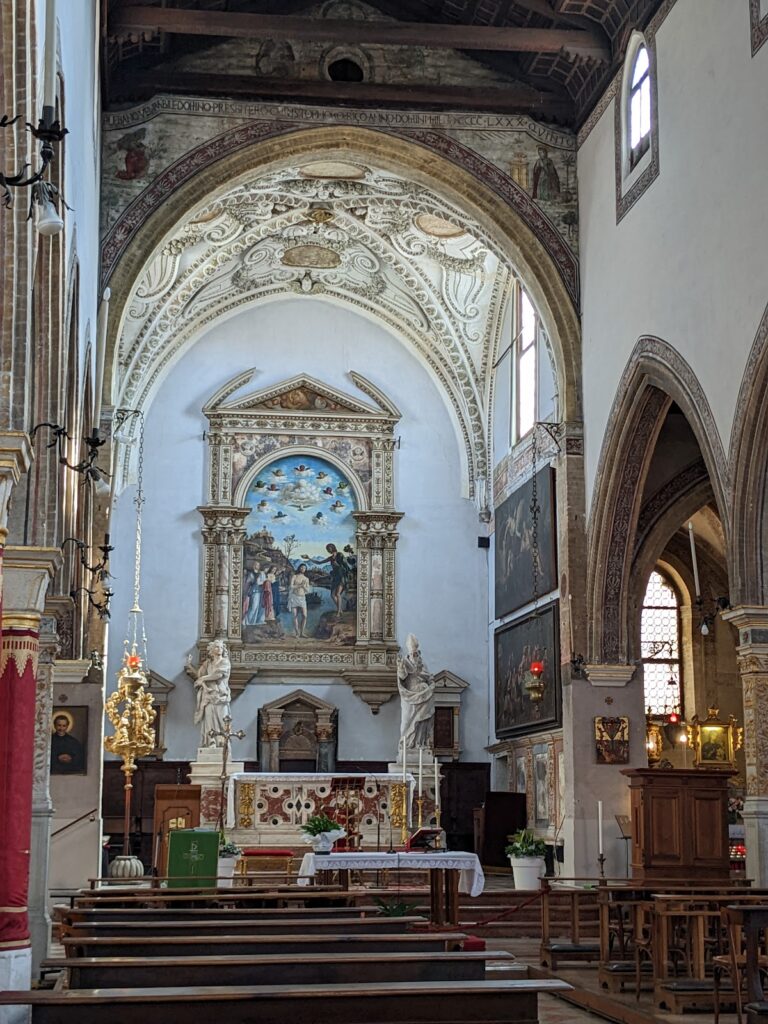
The new church is a large basilica without a transept. Its longitudinal plan contains a single main entrance, three aisles, high vaults, an apse surrounded by an ambulatory, and a ring of semicircular chapels. An ambulatory is a passage running around the sanctuary or apse, allowing circulation behind the high altar. The central aisle is twice as wide as the side aisles.
Columns on polygonal plinths divide the interior. Giovanni Buora made their bases and capitals in 1480. Four principal supports have octagonal lower sections and carry fan vaults, whose ribs spread outward in a fan-shaped pattern. The building also includes a hemispherical dome and groin vaults. Black Verona-stone cornices emphasize the broad surfaces of the interior.
The ambulatory continues the side passages around the polygonal presbytery. Tall Gothic windows illuminate the apse and ambulatory, while the large windows and rounded supports give the interior an open, hall-like character. The choir preserves Gaetano Callido’s organ, opus 270, built in 1790.
Facade
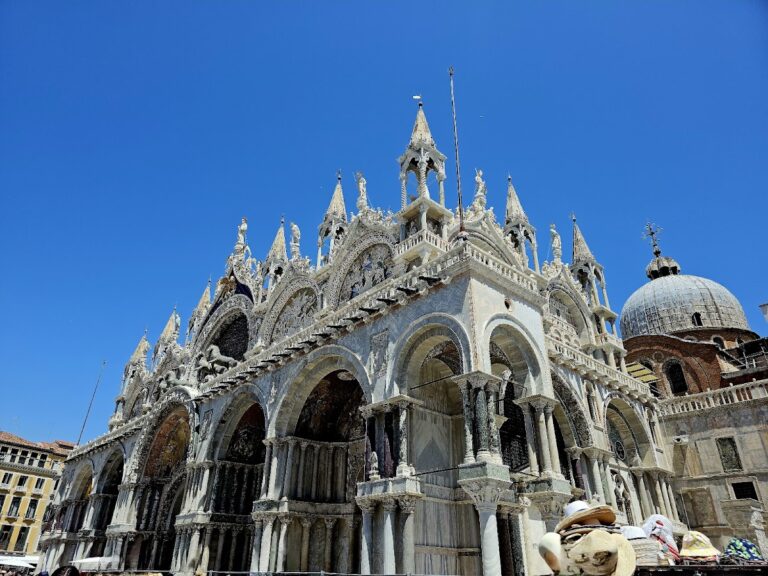
The facade combines late Gothic and early Renaissance elements in several horizontal registers. Its lower register has a strongly moulded base with two large toruses, a projecting entablature, and a grid of pinkish marble inlays set within Istrian stone. Busts of four prophets occupy the outer bays, framed by antique-style ornament and garlands held by putti.
Slender twisted columns replace vertical stone bands at the corners of the buttresses. The entrance portal is framed by pseudo-Corinthian pilasters with beaded and spindle mouldings, vegetal candelabra, and relief decoration. Its relationship to the base and facade grid is irregular, partly because Giovanni Buora was paid for the portal only in 1483.
The portal includes two circular ornamental panels, an eagle, and a phoenix on a brazier. The eagle and phoenix received Christian interpretations associated with the Passion and Resurrection of Christ. Above the portal stands a sixteenth-century marble statue of Saint Zachariah bearing Alessandro Vittoria’s name.
The second register is faced entirely in Istrian stone. It consists of tall arches, most of them blind and occupied by niches, while four arches correspond to the side-aisle openings. The niches do not align precisely with the geometry of the lower register. Variations in pilaster fluting and capitals accommodate the dimensions of the facade.
The upper facade, attributed to Mauro Codussi, contains arched windows, columns, blind niches, and a large semicircular or arched pediment. Quarter-pediments at the sides act as buttress forms for the main vault. Alternating windows rise toward the central round window, balancing solid and open surfaces. The lower sections retain Gothic elements, while the upper parts introduce an early Renaissance vocabulary through differences in composition, materials, colour, and workmanship.
Reliefs of apostles decorate the facade, with the northern relief attributed to Cristoforo Solari. The right side and the area near the lateral entrance use pseudo-Corinthian pilasters, shells, putti and seraphim heads, vegetal motifs, dolphins tied by their tails to a trident, and anthropomorphic vegetal masks. After the first buttress, the treatment changes: shells become simpler and the putti-head decoration gives way to other motifs.
Chapels, Choir, and Works of Art
Side Chapels and Main Aisles
A side chapel identified as the Chapel of Sant’Atanasio contains Palma the Elder’s Madonna and Child with Saints of 1512, Palma the Younger’s David Victorious over Goliath of 1595, Michele Desubleo’s Prayer in the Garden of Olives from about 1660, Leandro Bassano’s Transport of the Body of the Virgin to the Tomb, Giambattista Tiepolo’s Flight into Egypt, Antonio Vassilacchi’s Saint Gregory and Other Saints from about 1600, and Tintoretto’s Birth of Saint John the Baptist from about 1563.
The counterfacade contains Antonio Zanchi’s Saint Zachariah in the Temple Offering Incense of about 1684, Antonio Vassilacchi’s Madonna and Child with Saint John and Saints, Palma the Younger’s The Angel Announces to Saint Zachariah, Andrea Celesti’s Birth of Saint John the Baptist from about 1684, and Vassilacchi’s Sacrifice of Isaac. A fourteenth-century wooden image of Christ stands at the lower right.
The right aisle contains Giovanni Antonio Fumiani’s depiction of Emperor Otto III visiting the monastery with Doge Pietro II Orseolo in 1001. It also includes Daniele Heintz’s depiction of Doge Pietro Lando at the church’s 1543 consecration and Antonio Zonca’s The Doge’s Easter Visit to the Church of 1688, together with works by Giambattista Bissoni, Andrea Celesti, Bernardo Strozzi, Antonio Balestra, and Palma the Younger.
An altar in the right aisle contains an urn with the body attributed to Saint Zachariah. The Saint Zachariah altar and two holy-water stoups near the entrance are works by Alessandro Vittoria. The right stoup is dedicated to John the Baptist and the left to Zachariah; the left is now represented by a copy after the original was stolen. Other stone decoration is attributed to Antonio Gambello and Luca Taiamonte.
The left aisle contains Andrea Celesti’s depiction of Pope Benedict III visiting the monastery and Antonio Zanchi’s depiction of the transfer of the bodies of Saints Pancras and Sabina to the new church in 1628. It also includes Antonio Vassilacchi’s Marriage of the Virgin and Presentation of Mary in the Temple, as well as Giovanni Bellini’s Sacred Conversation, also known as the San Zaccaria Altarpiece, painted in 1505.
Nuns’ Choir
The former nuns’ choir was screened from the nave by grilles and small windows in the wall of the right aisle. This arrangement allowed the nuns to attend services without being seen. The choir stalls date from 1455 to 1464 and were carved and inlaid by Francesco and Marco Cozzi of Vicenza.
Tintoretto’s Birth of Saint John the Baptist, painted about 1563, was originally placed behind the nuns’ choir. It depicts the room immediately after the birth. Elizabeth is cared for on the right, women attend the infant, and Saint Zachariah looks upward toward a divine light. A table bearing bread refers to the Eucharist, while two angels enter from above. The strongly coloured treatment reflects the artistic preferences of sixteenth-century Venice.
Paintings and Monuments
The walls and lunettes contain a cycle of seventeenth-century frescoes begun in the 1680s by several artists. The scenes illustrate historical and legendary episodes connected with the monastery and church. San Zaccaria also contains tombs of doges, the tomb traditionally associated with Saint Zachariah, and Alessandro Vittoria’s self-designed tomb with a marble bust of the sculptor.
Other preserved or displayed works include Michele Desubleo’s Christ in the Garden of about 1660, Leandro Bassano’s Deposition of the Virgin in the Tomb, Palma the Younger’s lunettes Washing of the Feet and Descent of Christ into Limbo, painted between 1620 and 1628, and his 1595 organ shutters showing David celebrated by the women of Jerusalem. Antonio Vassilacchi’s Saint Gregory and Saints from about 1600 is also part of the furnishings.
Giovanni Bellini’s 1505 Sacred Conversation shows the Virgin and Child with a musician angel, Saint Peter, Saint Catherine of Alexandria, Saint Lucy, and Saint Jerome. Napoleon took the painting to Paris in 1797, and it returned to Venice in 1816. The church’s artistic furnishings further include works by Andrea del Castagno, Giuseppe Porta, Anthony van Dyck, Angelo Trevisani, and Giovanni Domenico Tiepolo, alongside those of the artists represented elsewhere in the complex.
Nearby sites