Stift Schlägl: A Premonstratensian Monastery in Austria
Site at a Glance
- Rating
- 4.7
- Popularity
- Low
- Country
- Austria
- Primary era
- Medieval
- External website
- Open
- Eras represented
- Medieval, Early Modern, Modern
- Civilizations
- Austrian Empire, Duchy of Austria, Habsburg, Holy Roman Empire
- Site type
- Religious
- Remains
- Monastery
On this page17 sections
History
Stift Schlägl is a monastery in Austria founded around 1202–1204 as a Cistercian house in the upper Mühlviertel of Upper Austria. The foundation tradition attributes its establishment to Passau bishop Wolfger of Erla, who commissioned his ministerial Kalhoch II of Falkenstein. Monks came from Langheim in Franconia, but the first settlement struggled in its densely forested northern uplands, where a poor endowment and difficult climate contributed to its early failure.
Cistercian Foundation and Premonstratensian Succession
The original foundation stood north of the Große Mühl, between the Wurmbrandbach and Bannzaunbach. The Cistercian community ceased to exist or withdrew around the winter of 1209–1211. Bishops Manegold of Berg and Ulrich II then sought a more favourable location on the Große Mühl and worked to revive the monastery.
In 1218 the foundation passed to the Premonstratensians, canons regular who combined communal religious life with pastoral and educational work. Kalhoch II formally surrendered it on 9 July 1218, after Langheim had renounced its claims on 20 June. The incoming community may have come from Osterhofen in Lower Bavaria or from the Premonstratensian monastery of Mühlhausen, identified in another tradition with Milevsko.
Schlägl was probably assigned as a daughter house of Mühlhausen after 1251 and was explicitly described in that relationship in 1307. Its supervisory affiliation remained disputed between Mühlhausen and Osterhofen. In 1433 the paternal right, meaning the parent house’s authority over an affiliated community, passed from Mühlhausen to Osterhofen. A Roman congregation finally favoured Osterhofen over Strahov, the successor of Mühlhausen, in 1764, although the surviving documentary evidence does not establish the earlier situation conclusively.
Medieval Endowment and Reconstruction
The monastery received substantial support from the Krumau and Rosenberg families. Witiko I of Krumau granted three farmsteads, the church of Lichtenwerd, and the village of Pfaffenschlag in 1258. Wok of Rosenberg left testamentary gifts in 1262, while Budiwoj of Krumau and Perchta of Falkenstein transferred the village of Schintau in 1264. Heinrich I of Rosenberg added the church of Friedberg and further gifts in 1305.
These endowments accompanied an expansion of patronage and pastoral work. Schlägl received the patronage of Lichtenwerd in 1258, the parish of Rohrbach in 1319, and the incorporated Rohrbach parish church in 1321. Further parish rights followed during the later medieval and early-modern periods.
The monastery was damaged during the conflict between Frederick the Fair and Louis the Bavarian from 1314 to 1322 and rebuilt with Rosenberg assistance. Hussite campaigns, religious and political conflicts originating in Bohemia after the death of Jan Hus, caused another destruction in the fifteenth century. Under Provost Andreas Rieder, Schlägl was rebuilt and consecrated in 1448 by Sigismund Pircham, the Passau auxiliary bishop.
Schlägl maintained religious ties with Mühlhausen, Goldenkron, Hohenfurt, Wittingau, and Klosterneuburg. A Premonstratensian provincial chapter met at Schlägl in 1476. Emperor Frederick III placed the monastery and the Rohrbach parish under his special protection in 1465. In 1489 Pope Innocent VIII granted the provost and his successors pontifical insignia, the right to bless liturgical vessels, and authority to confer the minor orders. Further confirmations of the monastery’s privileges followed from imperial and dynastic authorities in 1493 and 1498.
Reformation, War, and Baroque Renewal
During the Reformation, Schlägl fell under secular administration and nearly collapsed under a succession of unworthy provosts. Provost Wenzeslaus Zypser began restoring ecclesiastical discipline in 1589, reduced the debts, built the upper farmyard, repaired economic buildings, and issued regulations for clergy serving the monastery’s parishes. He fled to Bohemia during the Mühlviertel peasant unrest of 1594.
Under Provost Crispin Fuck, Emperor Matthias granted Schlägl the privilege of trading salt to Bohemia. The income helped repay debts, construct part of the monastery buildings, and provide a new high altar. The monastery was then almost completely burned during the Peasant War of 1626. Reconstruction began in 1627 under Provost Martin Greysing and master builder Marx Spaz. The monastery church and provost’s residence were completed in 1637.
Economic recovery supported a wider religious and cultural revival, including the establishment of a philosophical-theological teaching institution. In 1657 Schlägl was raised from a provostry, a religious house governed by a provost, to an abbey governed by an abbot, with Martin Greysing as its first abbot. He founded the Martin Hospital in Aigen, established glassworks, and built the pilgrimage church of St Wolfgang am Stein.
Fires, Dissolution, and Restoration
Fires in 1702 and 1739 created further economic difficulties. A major fire in 1850 largely destroyed the monastery, and Abbot Dominik Lebschy directed its reconstruction. The complex was expanded again under Abbot Norbert Schachinger, who was elected general abbot of the Premonstratensian order in 1906.
An agricultural school operated at Schlägl from 1924 and received a separate building in 1930. Nazi authorities dissolved the monastery on 29 April 1941. After the Second World War, Abbot Cajetan Lang directed a comprehensive restoration of the complex.
Today, Schlägl serves as a spiritual, pastoral, educational, and economic centre of the upper Mühlviertel. Its canons serve eight directly administered parishes, sixteen diocesan parishes, and two parishes incorporated into St Florian, while also working in hospital chaplaincy and education. The monastery has operated a brewery since 1580 and manages extensive forestry holdings, mainly in the Bohemian Forest. Its present economic activities also include hospitality and small hydroelectric facilities. Lukas Dikany was elected abbot on 11 June 2019, and the community numbered approximately three dozen canons in the early 2020s.
Remains
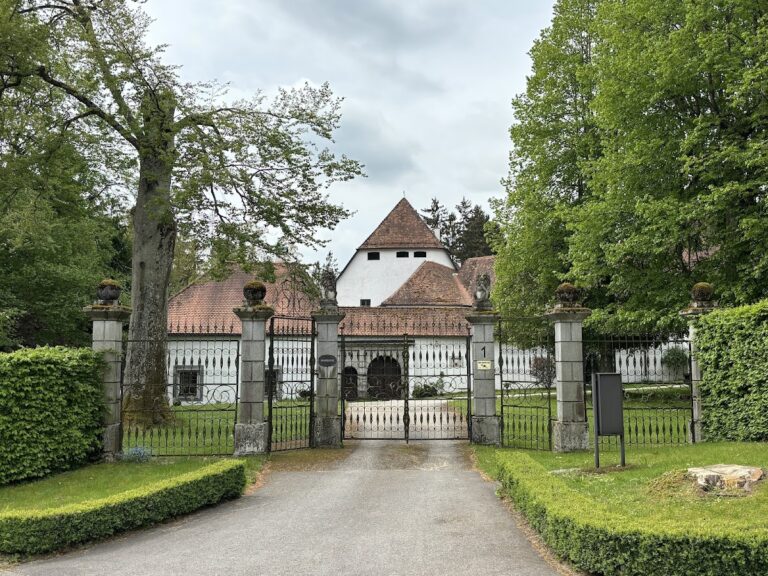
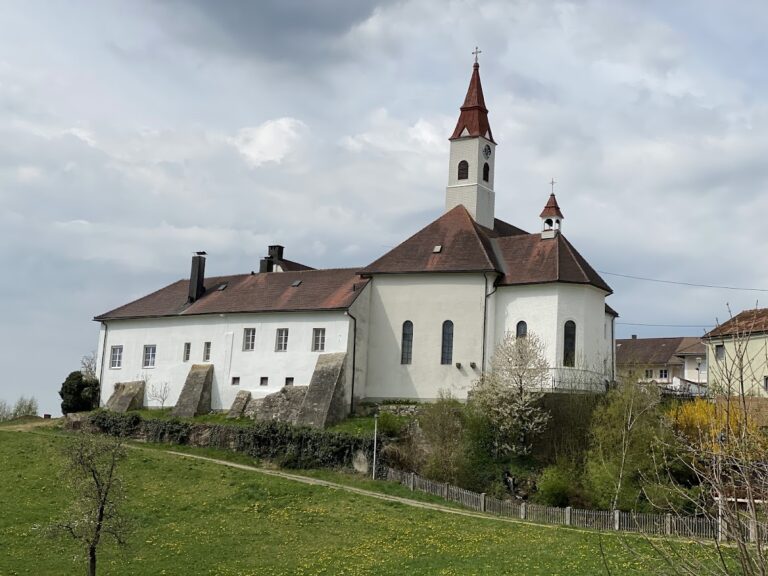
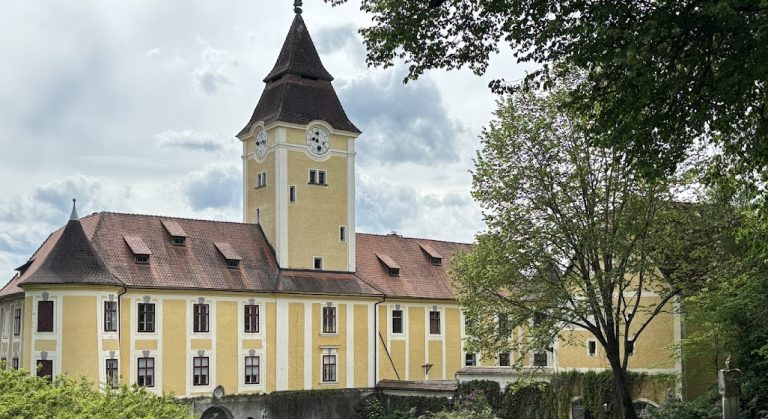
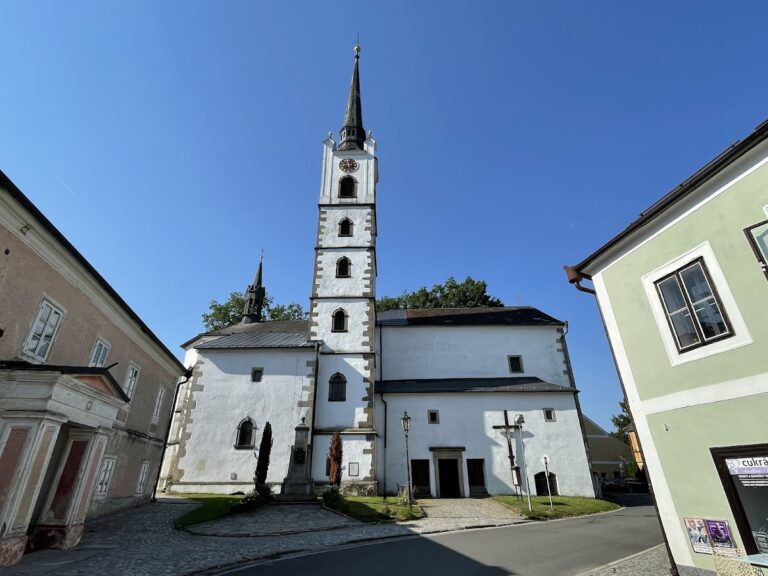
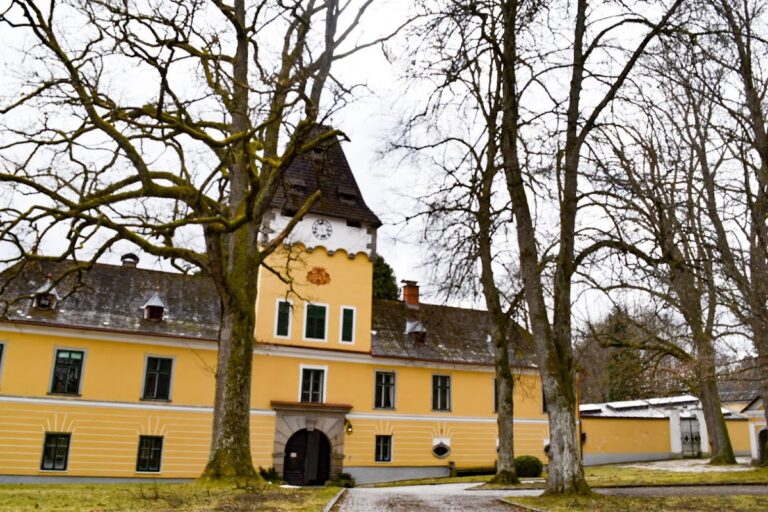
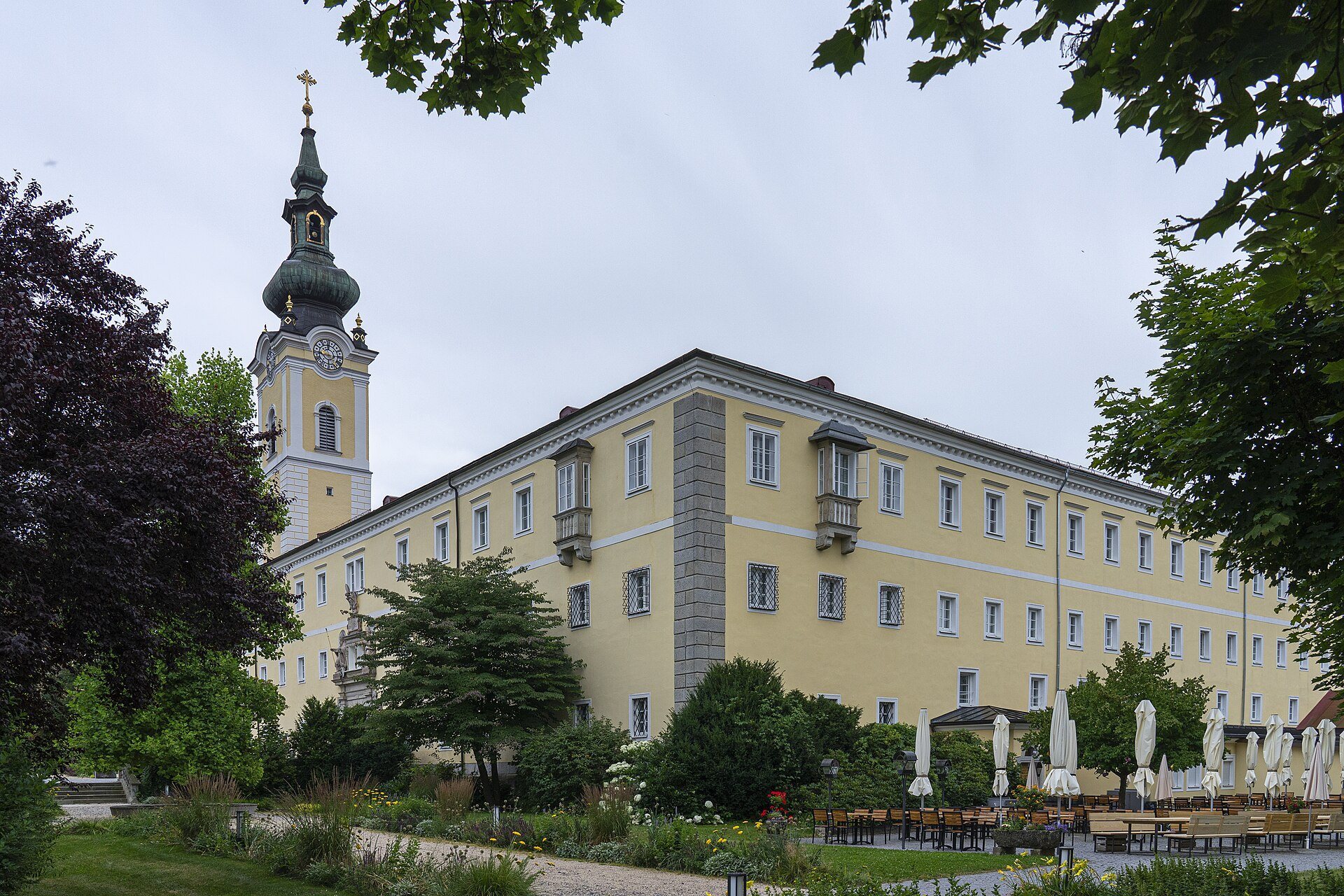
The monastery survives as a compact ensemble arranged around the church and conventual buildings. Stone churches and monastery buildings began to rise within a few decades of the foundation, while later rebuilding followed the Hussite destruction, the unrest of 1594, the Peasant War fire of 1626, and the fire of 1850. The complex therefore combines medieval survivals with later Gothic, Baroque, Neo-Baroque, and Classical elements.
Monastery Church
Romanesque Crypt and Medieval Nave
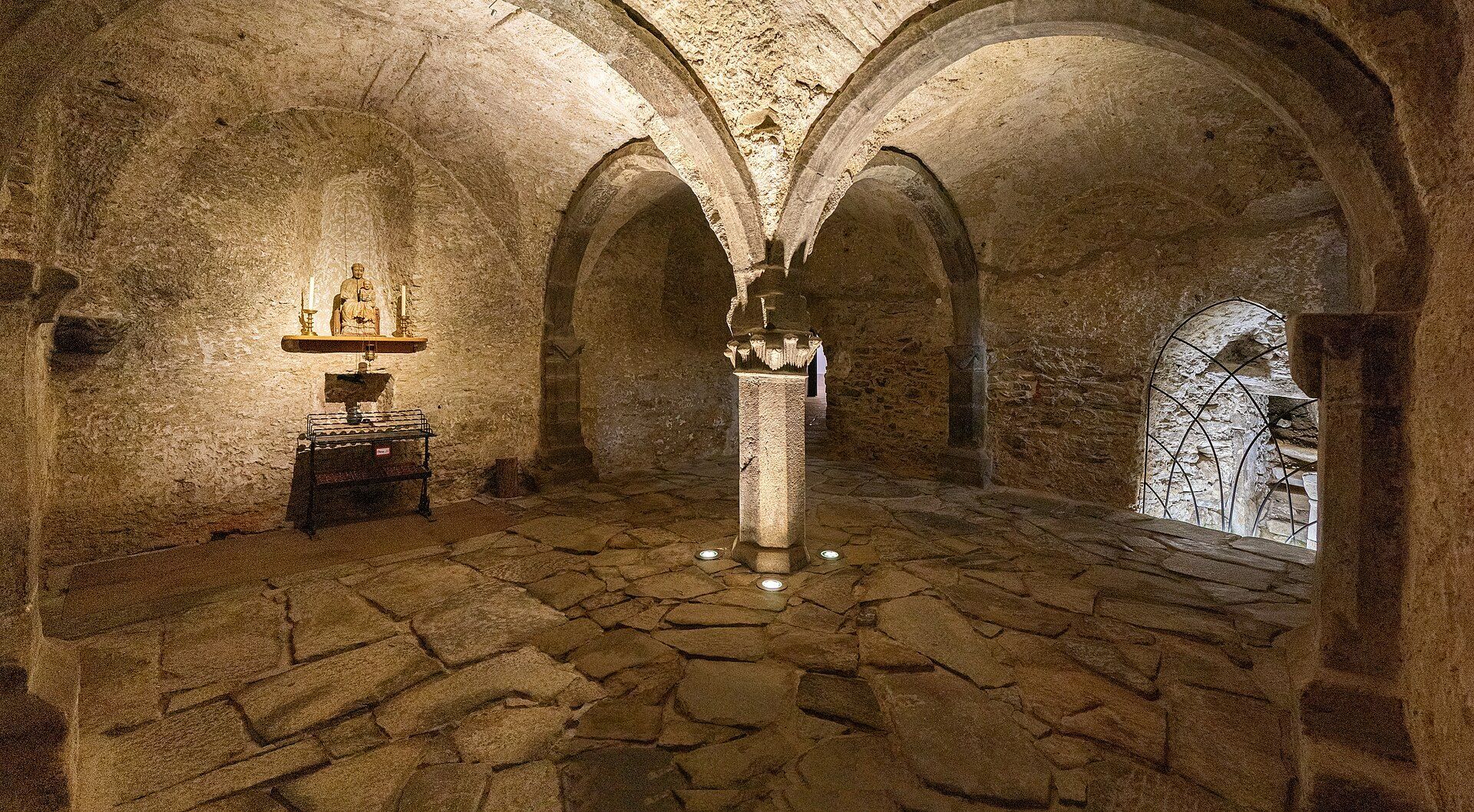
The monastery church is dedicated to the Assumption of the Virgin Mary. Its Romanesque crypt, a vaulted space within or below a church, survives from the medieval complex, as does the central nave, the main longitudinal space of the church, dating from the mid-thirteenth century. Foundations of an early Gothic termination also remain. The three-aisled High Gothic church was substantially remodelled in later periods, preserving the layered form of a building repeatedly altered after damage and reconstruction.
Chapel of St Vitus
The late Gothic Chapel of St Vitus retains its original vault with intersecting ribs. Its founder’s keystone is associated with Nicholas IV of Schestau and dated 1501. The altar contains late Gothic sculptures of the Crucified Christ between the Virgin Mary and John the Evangelist.
Altars and Organ
The high altar contains paintings of the Assumption of the Virgin Mary and the Coronation of the Virgin by Augustin Palme. Most of the remaining furnishings are Neo-Baroque and Classical. On the west gallery stands an organ built by Andreas Butz in 1633–1634. Johann Christoph Egedacher remodelled it in 1708, Josef Breinbauer added three stops in 1853, and Johann Lachmayr added ten pneumatically operated stops in 1904. Orgelmakerij Reil restored the instrument in 1989–1990 and returned it to the 1708 state. It has 21 stops on two manuals and pedal, with mechanical action.
Baroque Monastery Buildings
Main Portal
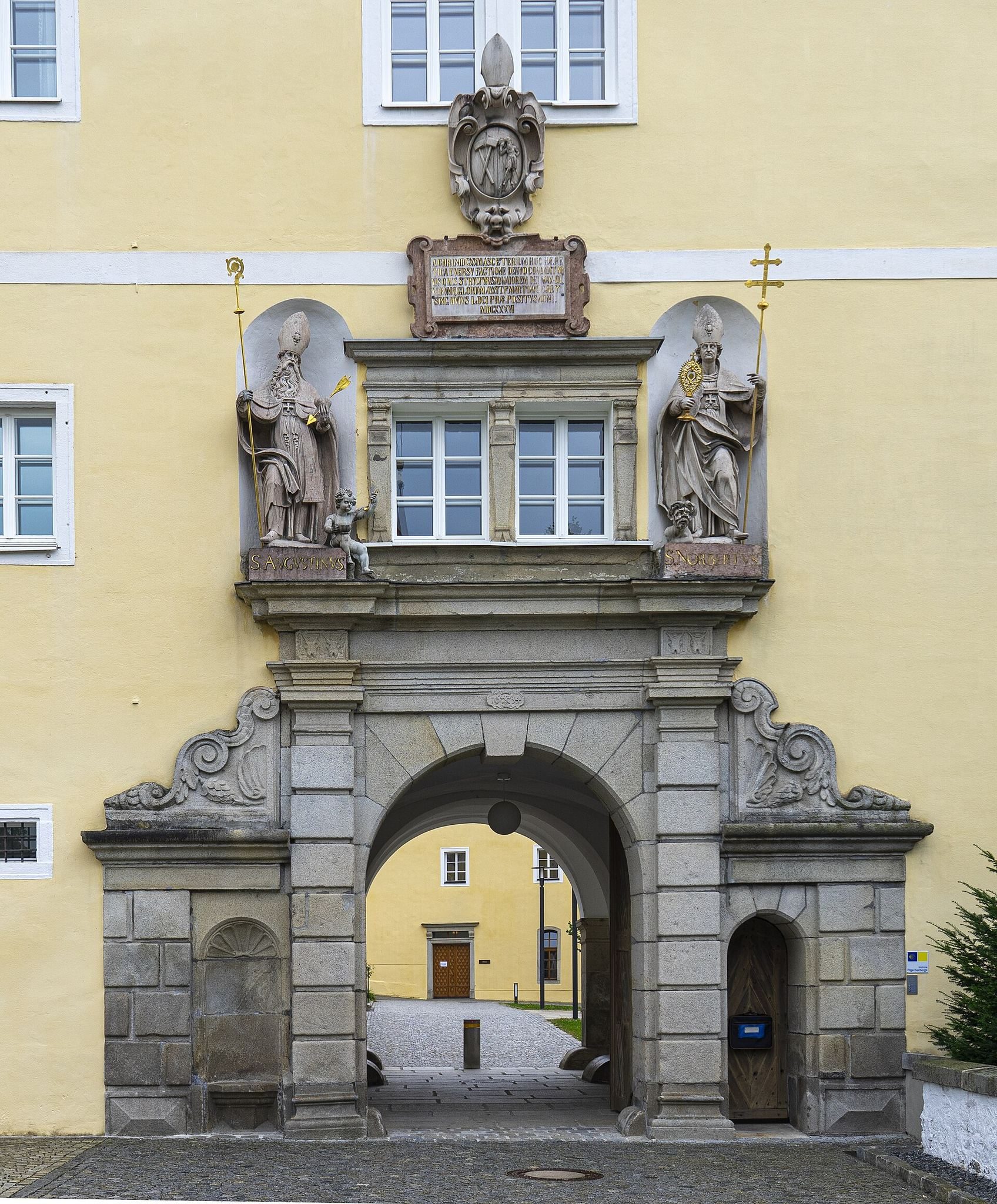
The early Baroque main portal of the monastery buildings dates from 1634–1636. Marble sculptures of Saint Norbert and Saint Augustine by Hans Pernegger decorate the entrance.
Chapter House, Refectory, and Fountain
The chapter house and refectory retain early Baroque interiors. A granite fountain made between 1623 and 1629 was carved by H. Getzinger, who also produced the mascarons on the convent façade.
Library, Gallery, and Memorials
Library
Construction of the library began in 1830, and its furnishings were completed in 1852. The collection contains approximately 60,000 volumes, 390 incunabula, and 263 manuscripts. Alexander Weiss painted the ceiling.
Eastern Gallery
The gallery on the eastern side of the monastery was established in 1898. It contains Gothic panel paintings by Old German and Netherlandish masters and approximately 200 paintings, including works by Albrecht Altdorfer, Paolo Veronese, Moritz von Schwind, and David Teniers the Elder. Its oldest recorded painting is a 1413 Gothic panel of the Virgin Mary as the Madonna of the Ear of Grain.
Founder’s Epitaph
Kalhoch II of Falkenstein and his wife Elisabeth were buried in the monastery church. Their fifteenth-century tomb slab survives as a wall epitaph and serves as a heraldic monument. The Madonna of Schlägl, a sculpture created around 1220, is preserved in the Upper Austrian State Museum in Linz.