Sprinzenstein Castle: A Medieval and Renaissance Residence in Austria

Site at a Glance
- Rating
- 4.9
- Popularity
- Very Low
- Country
- Austria
- Primary era
- Early Modern
- Eras represented
- Medieval, Early Modern
- Civilizations
- Habsburg, Holy Roman Empire
- Site type
- Military
- Remains
- Castle
On this page11 sections
History
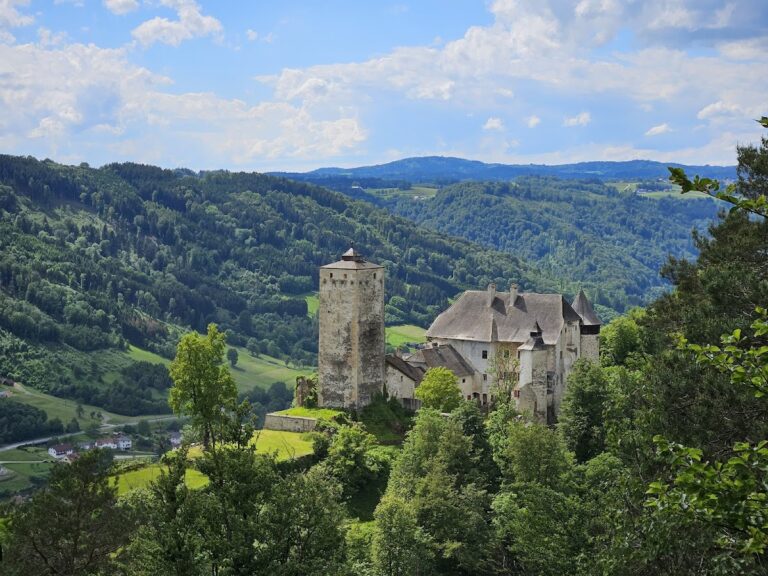
Sprinzenstein Castle is a castle complex in Austria near Sarleinsbach, whose original stronghold was built in the thirteenth century. Rising above the valley of the Kleine Mühl in the Mühlviertel, it later developed into a more comfortable Renaissance residence while retaining elements of its medieval foundation.
Medieval Origins and Passau Allegiances
The knight Siboto von Sprinzenstein, a Passau ministerial, was named as the castle’s first owner in 1253. A Passau ministerial was a noble or administrative dependent serving the prince-bishop of Passau. Around 1264, Chunrad von Tannberg held the property. In 1281, Chunrad had to surrender it to Count Albrecht of Habsburg after disrupting the public peace. Half of the castle then became a sovereign fief, meaning property held directly from the territorial ruler in return for service or allegiance.
In 1328, the castle passed from the Tannberg family to Ortolf von Marsbach as a fief of Passau. His successor, Hans von Marsbach, built the chapel in 1369. After Hans’s death, Wernhard den Grans became lord of Sprinzenstein. Jutta die Marspöckin followed in 1382, and her marriage to Rudolf von Scherffenberg in 1396 brought the property into another noble family.
Division and Reunion of the Estate
The castle’s divided legal status continued into the fifteenth and sixteenth centuries. In 1421, Wolfgang von Scherffenberg sold the sovereign half to his cousins Georg, Hans Ulrich, Ruger, and Gundacker von Starhemberg. The other half, held as a Passau fief, was sold to Dionys Praun in 1525. Praun soon acquired the entire castle.
In 1529, Bishop Ernst of Passau granted Sprinzenstein to Paul Riccio, personal physician to the future Emperor Ferdinand I. Ferdinand I was a Habsburg ruler who later became Holy Roman Emperor. Riccio received the rank of baron in 1530, adding a new social distinction to the castle’s history of changing noble ownership.
Fires and Renaissance Transformation
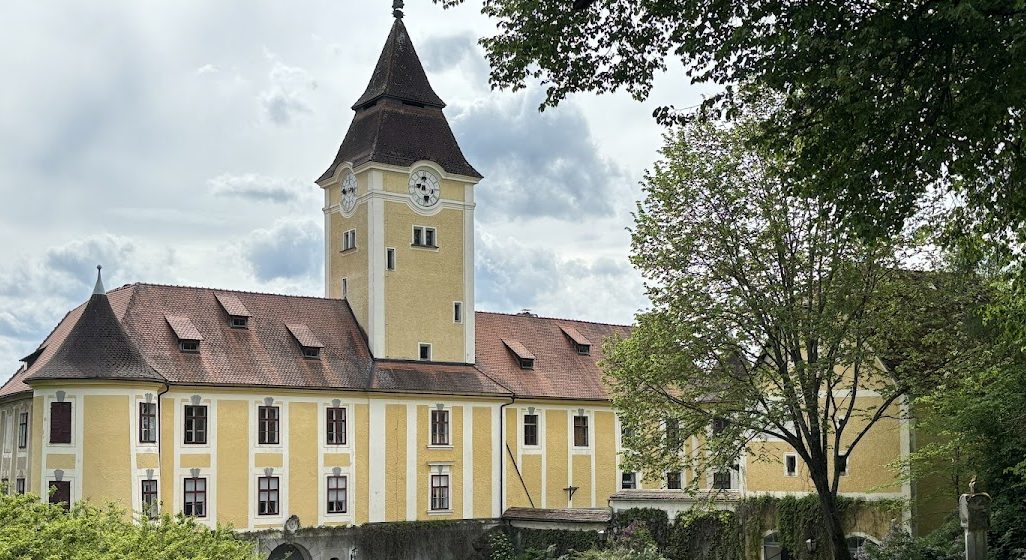
A major fire severely damaged Sprinzenstein in 1583. The rebuilding changed the character of the complex, adapting the medieval castle into a Renaissance residence. The Renaissance was a European cultural and architectural period that revived classical forms and encouraged more comfortable, representative homes. In 1591, the Sprinzenstein coat of arms was joined to that of the extinct Jöchl zu Jöchlsturm family.
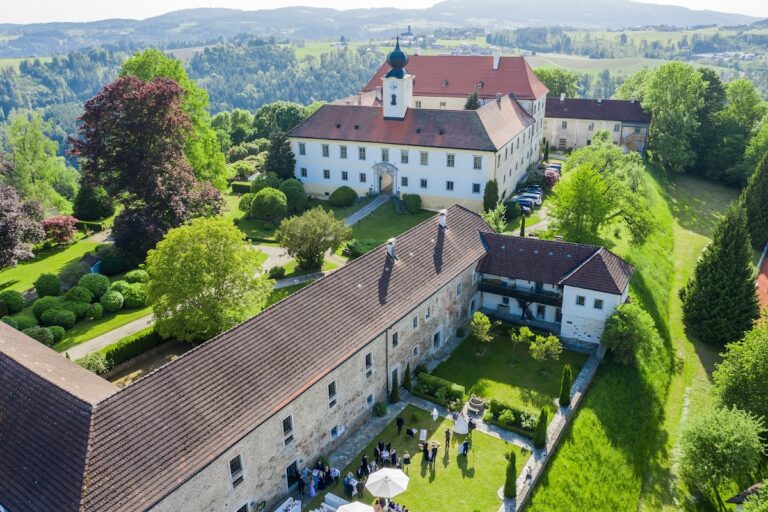
Another fire struck around 1602. Restoration continued until 1632, when the castle had acquired the appearance that largely defines it today. The seventeenth-century work also shaped the courtyard and interior features that remain associated with the later residence.
Counts and Eighteenth-Century Rebuilding
Under Emperor Ferdinand III, Wenzel Reichard von und zu Sprinzenstein was raised to the rank of imperial count in 1646. An imperial count held comital rank within the Holy Roman Empire. In 1672, Wenzel Reichard also received the hereditary office of provincial mint master for Upper and Lower Austria, making him responsible for minting money on behalf of the territorial ruler.
After the family increasingly preferred Neuhaus Castle on the Danube or a residence in Linz, Sprinzenstein stood uninhabited for many years and deteriorated. A fundamental renovation and rebuilding followed in 1735–1738. The work was undertaken under the guardianship of the Hoheneck barons by the master builder Haiberger for Franz Ernst von Sprinzenstein. This occurred after the older Sprinzenstein line died out in 1728.
Family Possession and Local Tradition
The Sprinzenstein family continued to live at the castle until after the Second World War. Maximilian Guido Raimund Maria Graf Sprinzenstein, the last of his line, left the property to his grandson Leopold Hieronymus Graf Spannocchi, the son of Lelio Spannocchi. The castle remains privately owned and is still held by that family.
A local foundation legend connects the name with a small figure called a “Sprinz.” According to the story, a farmer repeatedly saw the figure on a rock and then discovered a great treasure beneath it. He built a castle at the spot, which the tale calls “Sprinz on the Stone,” and was later raised to the nobility.
Remains
Setting and Defensive Framework
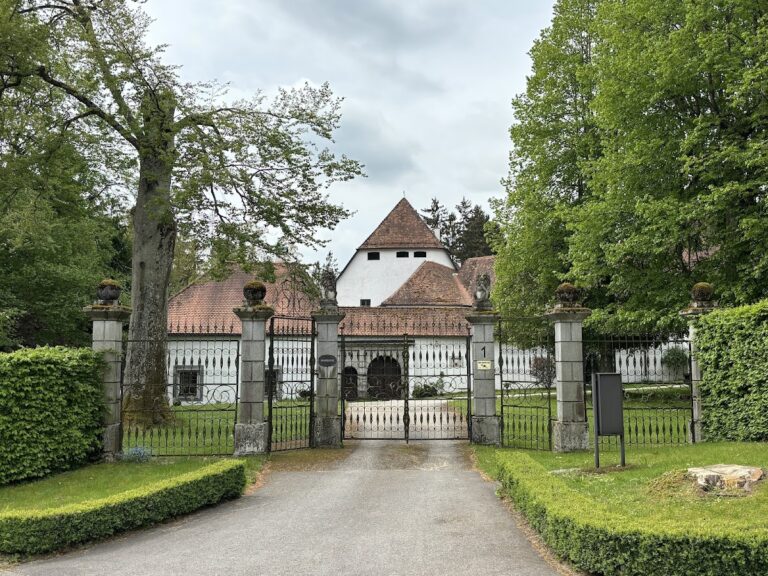
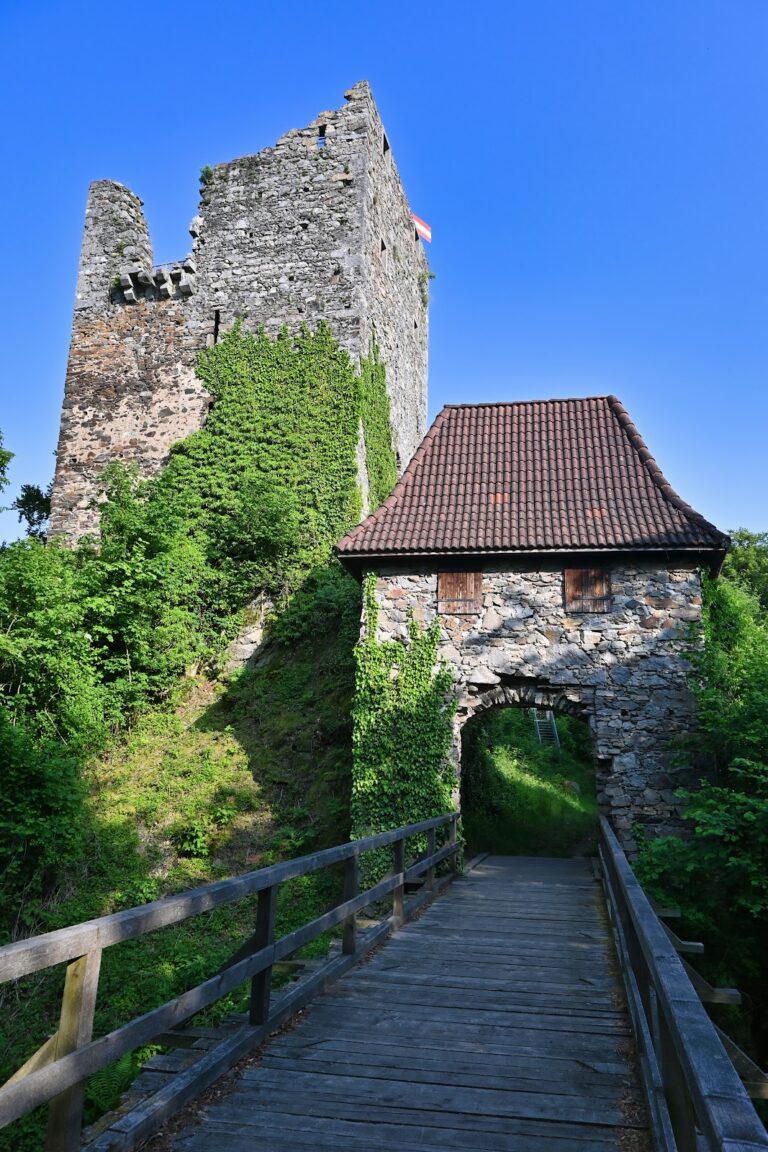
Sprinzenstein Castle occupies a rocky position above the valley of the Kleine Mühl and follows the shape of the terrain. The former drawbridge has been replaced by a stone bridge, while the moat has been filled in. Semicircular towers flank the complex on both sides. A small Sprinz figure on the highest tower serves as the castle’s emblem, linking the visible structure with the local foundation legend.
Entrance and Courtyard
The entrance area preserves features associated with the earlier medieval construction. Within the complex, the hook-shaped palas, the principal residential building of a medieval castle, is incorporated into the west wing. A seventeenth-century colonnade surrounds or adorns the courtyard, and its arcades carry the double coat of arms of the Sprinzenstein and Thürheim families.
Interior Collections
The interior contains the family archive and a library. Much of the former Baroque furnishing has survived, preserving evidence of the period when the castle functioned as a noble residence rather than only as a fortified stronghold.
Chapel and Approach Buildings
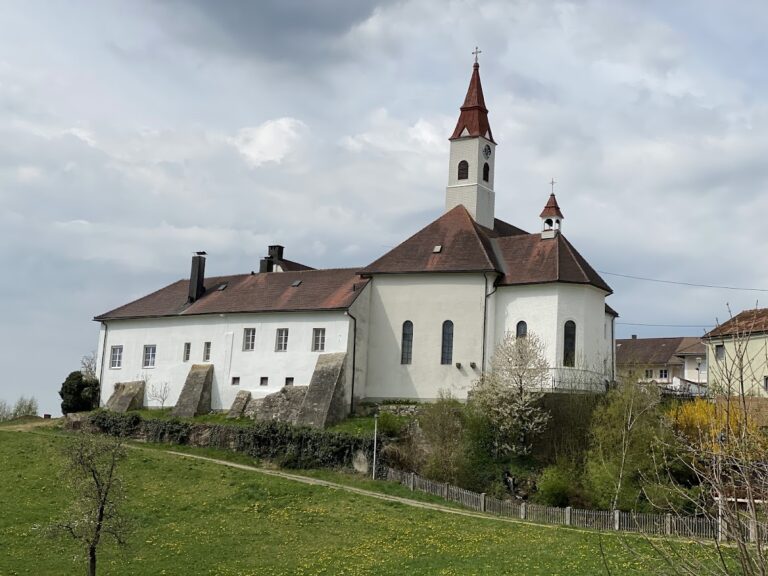
The castle chapel stands west of the keep, the principal fortified tower, and is dedicated to the Blessed Virgin Mary. Its richly figured altar dates from 1631 and depicts the Coronation of Mary. In the nearby village of Sprinzenstein, the former castle tavern was established in 1574 by Johann Albrecht von Sprinzenstein under an imperial license. Agricultural and service buildings line the approach road.