St Peter’s Collegiate Church: Wolverhampton’s Anglo-Saxon Foundation and Royal Peculiar
Site at a Glance
- Rating
- 4.7
- Popularity
- Low
- Country
- United Kingdom
- Primary era
- Medieval
- External website
- Open
- Eras represented
- Medieval, Early Modern, Modern
- Civilizations
- English
- Site type
- Religious
- Remains
- Church
On this page22 sections
History
St Peter’s Collegiate Church is an Anglo-Saxon foundation in Wolverhampton, United Kingdom, established in 994 when Lady Wulfrun endowed a church dedicated to St Mary at Heantune. The foundation helped establish the settlement later known as Wolverhampton and was served by secular clergy rather than monks. The surviving church contains substantial Decorated and Perpendicular Gothic work, reflecting rebuilding from the fourteenth to the fifteenth centuries.
Anglo-Saxon foundation and medieval development
Wulfrun received the land for her endowment from King Aethelred II. Her grant included estates amounting to thirty hides, associated with places including Arley, Bilston, Willenhall, Wednesfield, Pelsall, Ogley Hay, Hilton, Hatherton, Kinvaston and Featherstone. Some of these lands had earlier royal or aristocratic connections, including property granted by King Edgar to Wulfgeat, a kinsman of Wulfrun.
The church remained dedicated to St Mary when it appeared in the Domesday survey. Its dedication changed to St Peter, probably during the middle of the twelfth century, although it was sometimes described as belonging to St Peter and St Paul. The church’s seals generally depicted both saints. The foundation developed into a college of secular priests responsible for pastoral care over a wide area. Despite the use of the Old English term mynster, there was no monastery at Wolverhampton.
After the Norman Conquest, William I granted the church, its lands and its privileges to his chaplain Samson. Samson later became Bishop of Worcester and, during the reign of Henry I, gave the church to Worcester Cathedral Priory while its lands and privileges remained protected. Henry I separately established a chantry for himself and his parents, providing it with a house, forty acres of land and rents worth £20 each year. A chantry was an endowed foundation supporting prayers and Masses for particular founders or the dead.
The church became caught up in the civil war known as the Anarchy, the succession struggle between King Stephen and Empress Matilda. Bishop Roger of Salisbury seized the church and its lands. Around 1139 or 1140, Stephen granted it to Roger de Clinton, Bishop of Chester and Lichfield, but the canons appealed to Pope Eugenius III. Stephen restored the church to Worcester Priory by 1152, possibly as early as 1144.
The college and its royal privileges
By the middle of the twelfth century, the foundation had been reorganised under a dean and prebendaries. A prebend was an endowed share of a church’s revenues assigned to a member of its clergy. Henry II recognised Wolverhampton as his chapel, restored its earlier liberties and immunities, exempted it from secular taxation and confirmed the canons’ right to hold a manorial court. These privileges gave the church a special relationship with the Crown and supported its claim to independence from the ordinary authority of the Bishop of Lichfield.
Peter of Blois was probably the first known dean. Appointed by Henry II, he defended the church’s privileges while criticising the conduct of its prebendaries. Around 1202 he proposed replacing the college with a Cistercian monastery because of corruption and hereditary connections among the clergy. King John approved the plan in 1203 or 1204 and transferred the deanery, prebends, the manor of Wolverhampton and other estates to Archbishop Hubert Walter for the proposed foundation. Hubert Walter died in 1205, however, and the plan was abandoned. John then appointed Henry, son of Geoffrey Fitz Peter, as dean and restored the deanery’s liberties and honours.
The college was dissolved and restored three times before its final abolition. Its independence was repeatedly defended against the Diocese of Lichfield and the Province of Canterbury. In 1260 Dean Giles of Erdington obtained a royal prohibition against interference by the local bishop. In 1280 Archbishop John Peckham was refused entry when he attempted to visit the church. A later agreement recognised Wolverhampton as one of the royal chapels outside the ordinary jurisdiction of the local bishop.
Giles of Erdington also strengthened the college’s economic position. In 1258 he secured a weekly Wednesday market and an annual fair beginning on the vigil and feast of Saints Peter and Paul. Both were held at the foot of the church steps. In 1263 he confirmed the burgesses’ right to succeed freely to their burgages, while in 1268 the church was recorded as paying secular taxation despite its earlier exemptions. By the end of the thirteenth century, the college had six prebends at Featherstone, Willenhall, Wobaston, Hilton, Monmore and Kinvaston. A chantry of St Mary at Hatherton soon became a seventh prebend, giving the college extensive economic and territorial influence across southern Staffordshire.
Decline, reform and late medieval rebuilding
The college later suffered from absentee deans and prebendaries, pluralism, mismanagement and embezzlement. A royal visitation in 1368 examined dilapidated buildings, neglected estates, lost books and vestments, misuse of funds, failures in worship and almsgiving, and the conduct of the clergy. In 1393 Dean Richard Postell was found to have dismissed six priests supported by Henry I’s endowment and diverted their income for nineteen years.
Religious patronage by local people continued during this institutional decline. Chantries were founded at St Peter’s and in dependent chapels at Pelsall, Willenhall and Bilston. The wardens of the light, established in 1385, maintained a light in honour of St Peter. In 1392 William Waterfall and the chaplain Clement Leveson founded St Mary’s Hospital, an almshouse and chantry for a chaplain and six poor people.
Dean John Barningham resumed major work on the church after 1437. In 1439 a royal commission authorised stone to be quarried from prebendal lands for rebuilding, beginning the remodelling that produced much of the present building. His successor, William Dudley, continued the work and obtained confirmation of the church’s important charters from Edward IV in 1461. In 1480 Edward IV permanently united the deanery of Wolverhampton with the deanery of St George’s Chapel, Windsor Castle, under Richard Beauchamp and his successors. Wolverhampton was thereby formally established as a royal peculiar, an institution exempt from the ordinary authority of the local bishop and subject directly to the Crown or another superior authority. It retained its own seal and was not absorbed into Windsor.
Reformation, Civil War and restoration
The Reformation brought the college’s second dissolution. In 1547 Edward VI’s government dissolved it and replaced the dean and prebendaries with a vicar and curates. The Crown confiscated the estates, while many prebendal holdings had already been leased at low fixed rents to the Leveson and Brooke families. Queen Mary restored the college and its property in 1553, and Elizabeth I confirmed that restoration by royal charter in 1564.
During the restored regime, the dean and most prebendaries remained largely absent, leaving daily work to the sacrist and poorly paid clergy. A survey in 1604 found a population of about 4,000, substantial Catholic recusancy, inadequate stipends in dependent chapels and serious clerical misconduct. Religious conflict intensified in the 1630s. Dean Matthew Wren opposed the Puritan preacher Richard Lee, and Matthew’s brother Christopher Wren later succeeded him as dean. In 1635 supporters of Archbishop William Laud conducted a high-church ceremony to consecrate a new altar. The ceremony provoked Puritan opposition and later formed part of the case against Laud.
Parliamentary troops damaged St Peter’s during the Civil War in 1642. Royalist soldiers under Colonel Leveson later attacked the chapter house and destroyed the college’s records. Parliament dissolved the college in 1649, and during the Commonwealth the church functioned as a parish church with Puritan ministers. The Restoration of Charles II brought the college back into existence, but the loss of its records and continuing disputes over its estates weakened it. Attempts to recover property controlled by the Leveson family continued until the college finally abandoned them in 1811.
Industrial expansion and modern parish life
Wolverhampton’s industrial growth and rising population exposed the limits of the old collegiate system. New chapels of ease were built at Wednesfield, Willenhall, Bilston, St John’s and St George’s, ending St Peter’s long-standing position as the town’s only church. Methodism, Protestant dissent and Roman Catholicism also challenged its traditional institutional role.
The Dean of Windsor and Wolverhampton’s Estate Act of 1811 replaced the sacrist with a perpetual curate, abolished three readerships and assigned their income to the curate. The arrangement remained inadequate because the curate depended heavily on fees from the dependent chapels. The Cathedrals Act of 1840 provided for suppression of the deanery after the death of the existing dean. Dean Henry Lewis Hobart died in 1846, and the deanery was then wound up. The Wolverhampton Parish Act of 1848 abolished the ancient college, transferred its assets to the Ecclesiastical Commissioners and established a rectory, with John Dakeyne as rector.
In 1848 St Peter’s and the newly separated parishes became part of the Diocese of Lichfield. The former dependent chapels became independent parish churches, while the Ecclesiastical Commissioners improved clergy incomes and contributed to building repairs. St Peter’s has since formed part of the Anglican Parish of Central Wolverhampton. It is a Grade I listed building and remains an Anglican church in the High Church tradition, which places emphasis on ceremonial worship, vestments, sacramental practice and continuity with historic Catholic forms of worship. A new St Peter’s Collegiate School was established beside the church in 1847. A civic appeal in 1937 raised £10,000 for restoration of the tower and other major repairs, the sanctuary was re-panelled in 1968, and the Parish of Central Wolverhampton was established in 1978.
Remains
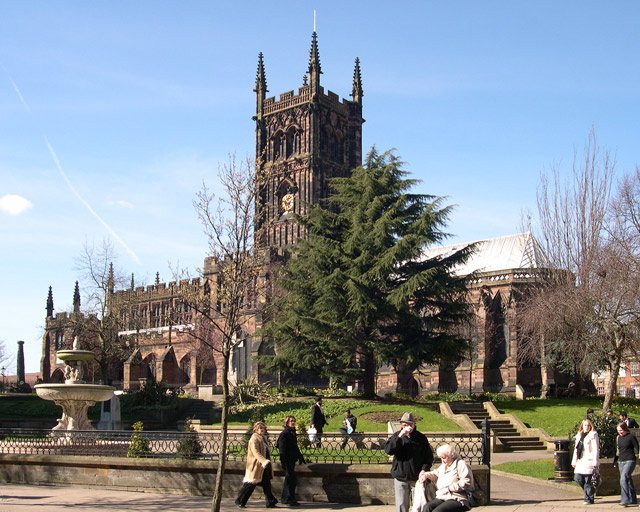
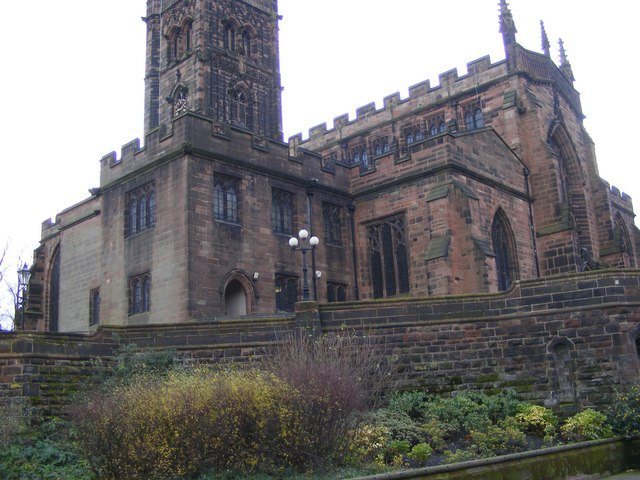
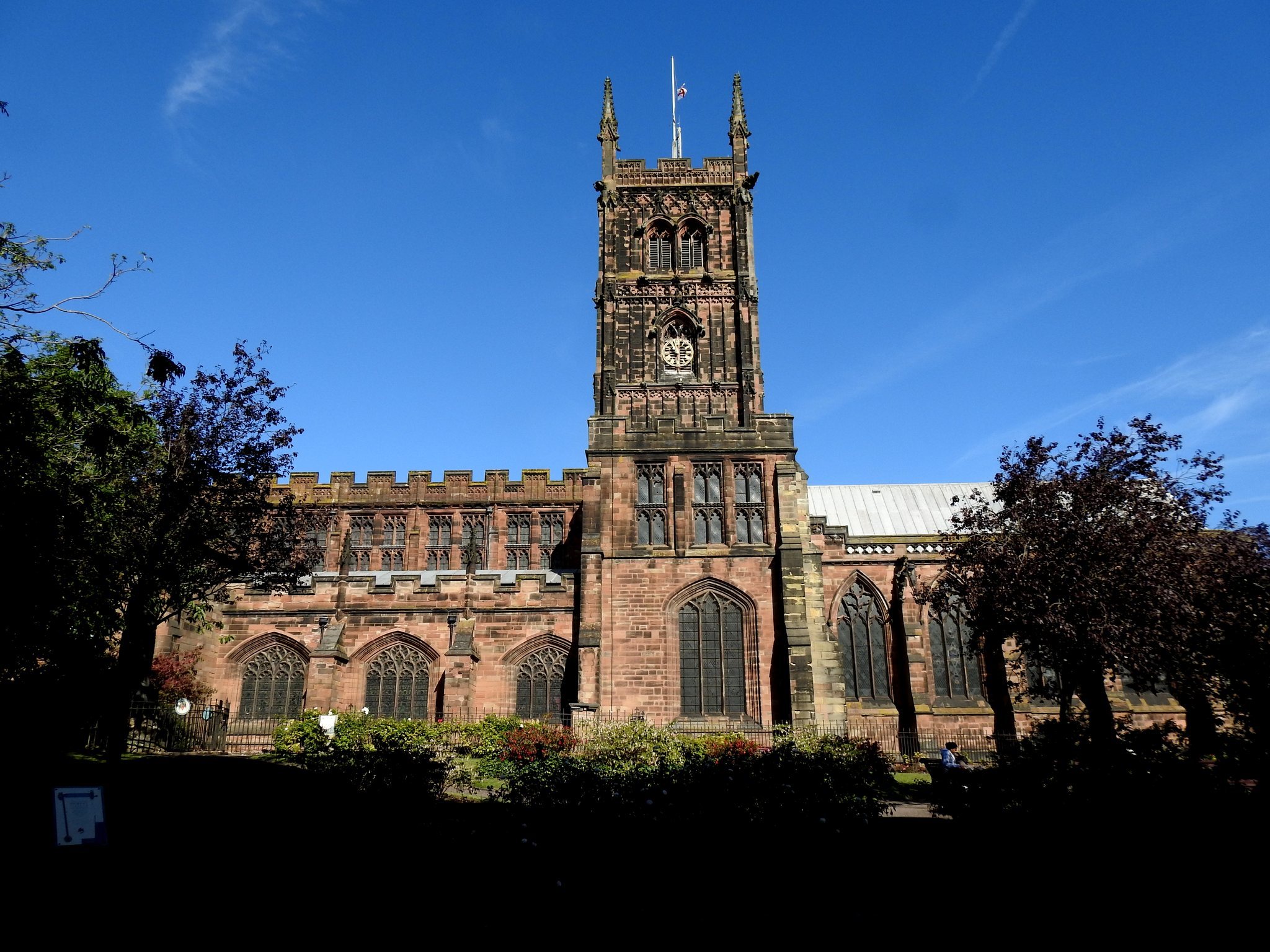
St Peter’s stands on an elevated site in central Wolverhampton and is built principally of red sandstone. Its surviving fabric combines earlier and later work, with much of the present church shaped by Decorated and Perpendicular Gothic rebuilding. The crossing beneath the tower is the oldest surviving part above ground, while the nave, chapels, tower, chancel and internal furnishings represent successive medieval and later campaigns.
Medieval fabric
Crossing, nave and aisles
The crossing beneath the tower dates from the late thirteenth century and forms the oldest surviving part of the building above ground. Much of the church was rebuilt and extended in the fourteenth century in the Decorated style, a phase of English Gothic architecture associated with elaborate tracery and ornamental treatment.
The fifteenth-century rebuilding substantially altered the nave. A clerestory, an upper range of windows above the aisle roofs, was inserted to provide additional light to the central interior. The north and south aisles were reduced in height, and the nave roof was raised to its present level around 1440. This work was associated with the prosperity and patronage of Wolverhampton’s wool merchants. The church’s later Perpendicular character reflects a style marked by strong vertical lines, large windows and panel-like tracery.
Lady Chapel
The Chapel of Our Lady and St George, also known as the Lady Chapel, probably dates from about 1350. It belongs to the fourteenth-century expansion of the building and survives as one of the church’s distinct medieval architectural groups.
Memorial Chapel and tower
The upper part of the tower was rebuilt around 1475, bringing it to a height of approximately 120 feet. The Chapel of St Catherine and St Nicholas, also called the Memorial Chapel, was completed at the end of the fifteenth century. Together, these works belong to the period when the late medieval church was being substantially remodelled.
Chancel
The original medieval chancel was badly damaged during the Civil War. It was reconstructed in 1682 and completely rebuilt again in 1867 in the Decorated Gothic style during extensive restoration directed by the architect Ewan Christian.
Stonework, windows and interior furnishings
Stone column
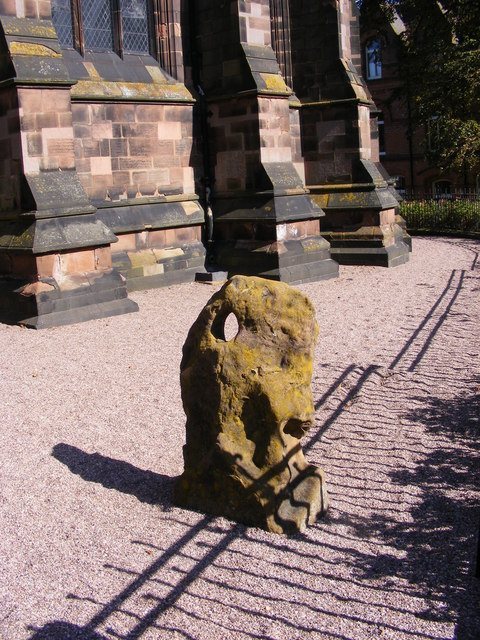
Near the south porch stands a fourteen-foot-high stone column carved in the ninth century with birds, animals and acanthus ornament. It may have been removed from the Roman town of Viroconium, at Wroxeter in Shropshire, and brought to Heantune for use in a preaching cross or memorial. The carvings have deteriorated. A cast made in 1877 is held by the Victoria and Albert Museum in London.
Pulpit, font and west gallery
A carved stone pulpit dates from about 1450. A lion is carved at the foot of its steps and has been described as protecting the minister delivering the sermon. The font dates from about 1480 and incorporates several carved stone figures. The west gallery, built in 1610, was paid for by the Merchant Taylors’ Company for use by the boys of Wolverhampton Grammar School.
Stained glass
The church contains two Arts and Crafts stained-glass windows by Archibald John Davies of the Bromsgrove Guild of Applied Arts. The Sarah Eliza Brevett memorial window, made about 1913, depicts Christian charity. The Archibald Fisher Smith memorial window, dating from about 1920, depicts Sir Galahad before Christ.
Clock and bells
Clock
A clock installed in 1826 by John Moore and Sons of Clerkenwell had a principal wheel two feet in diameter, a ten-foot pendulum and a total weight of about one and a half tons. Its striking hammer weighed 28 pounds and struck the great bell, which weighed 38 hundredweight and was reportedly audible four miles away. John Smith of Derby made the replacement mechanism installed in 1896 in memory of Prebendary John Thomas Jeffcock, rector from 1877 to 1894.
Bells
Five bells were recorded at St Peter’s in 1553. Bells from Much Wenlock Priory were installed around 1540 to replace earlier bells. Abraham Rudhall I cast a new ring of eight in 1698, weighing 23 hundredweight, and Henry Bagley III cast a funeral or hour bell of about 35 hundredweight in 1740. Thomas Mears increased the eight-bell ring to ten in 1827; the bells were rehung in 1889 and partly recast in 1895.
In 1911 Gillett and Johnston recast the bells, added two trebles and created a complete ring of twelve. They were tuned according to the five-tone Simpson principle in C-sharp major, installed in a new steel and iron frame and connected to the clock chime. The full ring was first rung for the coronation of King George V. The front eight were rehung in 1977 and the tenor in 1985. Further maintenance in 2000 included rehanging the ninth, tenth and eleventh bells and replacing their ductile-iron clappers with overhauled wrought-iron clappers. The complete ring of twelve is described as the second-oldest in the country and the third-oldest in the world.
Organ and choral tradition
Organ
Father Henry Willis built the three-manual organ in 1860. It was enlarged in 1882, fitted with an electric blowing installation in 1914, rebuilt in 1970 and restored in 1983. A further restoration campaign began after an appeal launched in 2008, and Michael Farley Organ Builders completed the restoration in 2019.
Choirs and worship
St Peter’s retains a strong choral foundation associated with English cathedral practice. Its continuing tradition involves boys’ and girls’ choirs, lay clerks and choral scholars. The choirs have sung at numerous English cathedrals and other major venues, and in 2023 the church’s choir recorded its first Choral Evensong for BBC Radio Three.
High Church worship at St Peter’s includes vestments, reservation of the sacrament, the sacrament of reconciliation and incense at festival services. Regular services include Holy Communion, Choral Eucharist and Choral Evensong.