Pincian Obelisk: An Ancient Monument to Antinous in Rome
Site at a Glance
- Rating
- 4.6
- Popularity
- Low
- Country
- Italy
- Primary era
- Classical
- Eras represented
- Classical, Modern
- Civilizations
- Papal States, Roman
- Site type
- Civic
- Remains
- Obelisk
On this page11 sections
History
The Pincian obelisk is an ancient Egyptian monument in Italy, made in Roman Egypt during the second century AD on the orders of Emperor Hadrian. Carved from pink granite in honor of Antinous, Hadrian’s favorite and lover, it belonged to the religious world surrounding the young man’s death and deification. Antinous drowned in the Nile under partly mysterious circumstances, after which Hadrian promoted his elevation to divine status, or apotheosis. The monument is now one of the thirteen surviving ancient obelisks of Rome.
Hadrian and the cult of Antinous
The obelisk may have reached Rome during Hadrian’s reign as part of a monument dedicated to Antinous. The appearance and exact location of that monument are unknown. Another tradition places the obelisk in Egypt during Hadrian’s lifetime and connects its later removal to Emperor Elagabalus, who ruled from AD 218 to 222.
Antinous became the focus of a cult promoted by Hadrian, particularly in Hellenized regions, where Greek language and culture had become influential. Sanctuaries were established in several parts of the eastern Roman Empire. The cult continued after Hadrian’s death until the triumph of Christianity. Antinous’s name later suffered damnatio memoriae, the Roman condemnation of a dead person’s memory, but the hieroglyphic text on the obelisk survived.
The Circus Varianus and the obelisk’s fall
In AD 220, Elagabalus ordered the obelisk to be erected on the spina, the long central barrier around which chariot races took place, in the Circus Varianus. This circus formed part of the emperor’s suburban residence near the present Porta Maggiore. The monument therefore became associated with a Roman imperial complex as well as with the earlier religious program created for Antinous.
During the fifth century, in the course of the Visigothic sack of Rome, the obelisk was toppled and broken. Its three pieces were found in 1589 near the Aurelian Walls, close to its former position, and the monument was initially known as the Aurelian Obelisk. The fragments were eventually reassembled in the eighteenth century.
Relocation and modern re-erection
In 1633, members of the Barberini family moved the fragments to the grounds of Palazzo Barberini, where they remained without being re-erected. The family later donated the obelisk to Pope Clement XIV, who ordered its transfer to the Cortile della Pigna in the Vatican.
The inscription was deciphered in 1822, after Jean-François Champollion had identified the key to reading Egyptian hieroglyphs. Pope Pius VII then ordered the monument removed from the Vatican and installed in a public park on the Pincian Hill. Giuseppe Valadier designed its new marble pedestal and supervised the re-erection, giving the ancient shaft the setting in which it survives today.
Remains
The monument on the Pincian Hill
Granite obelisk and setting
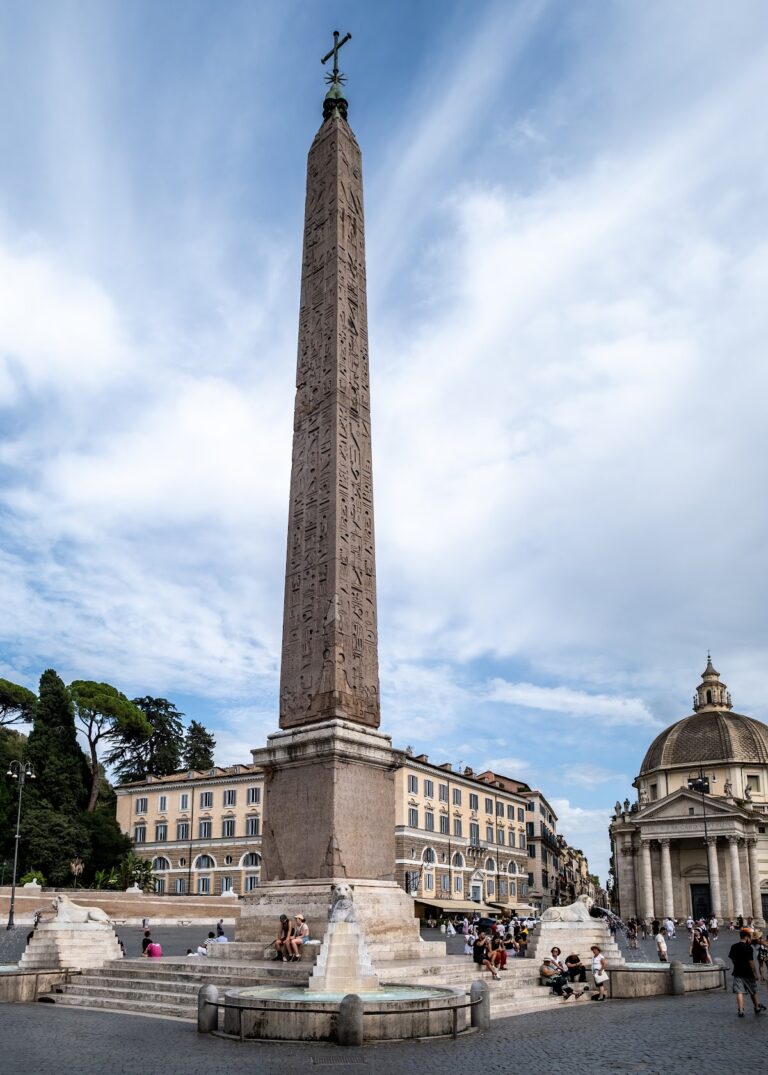
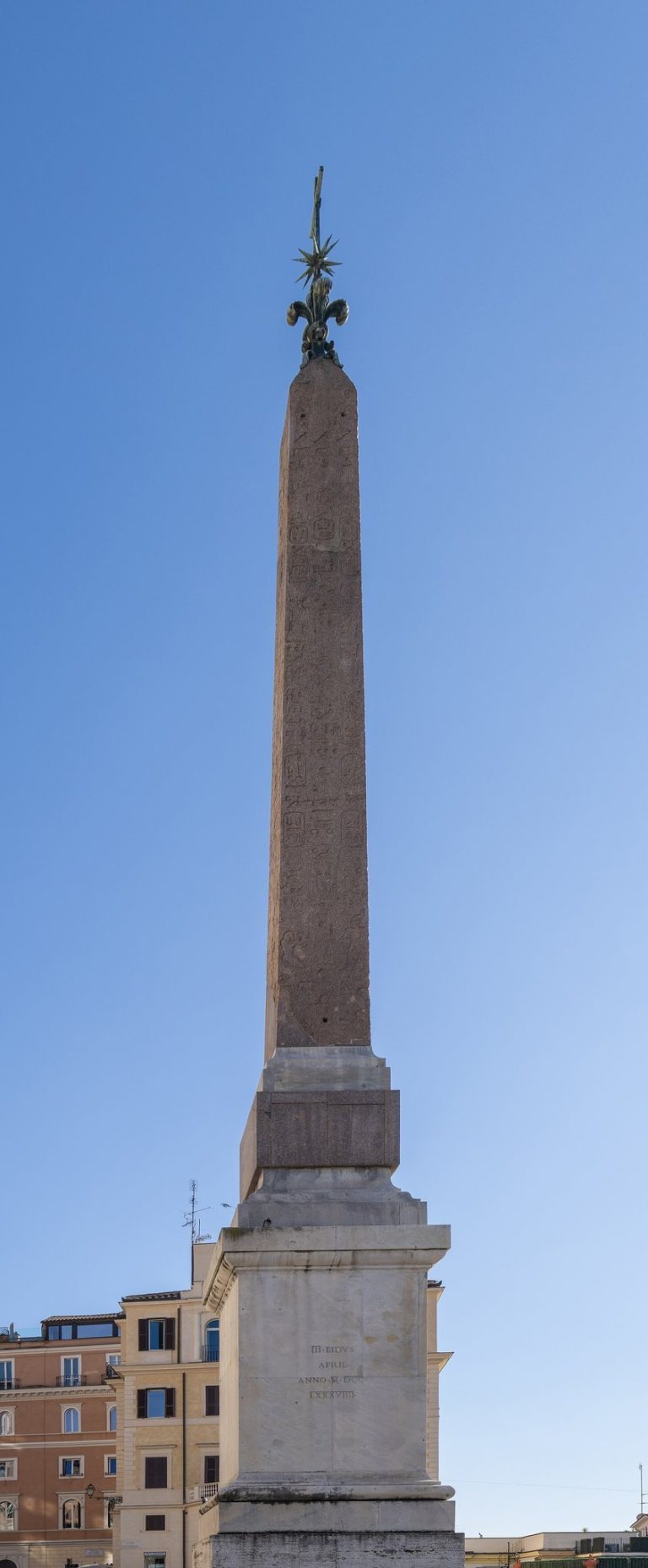
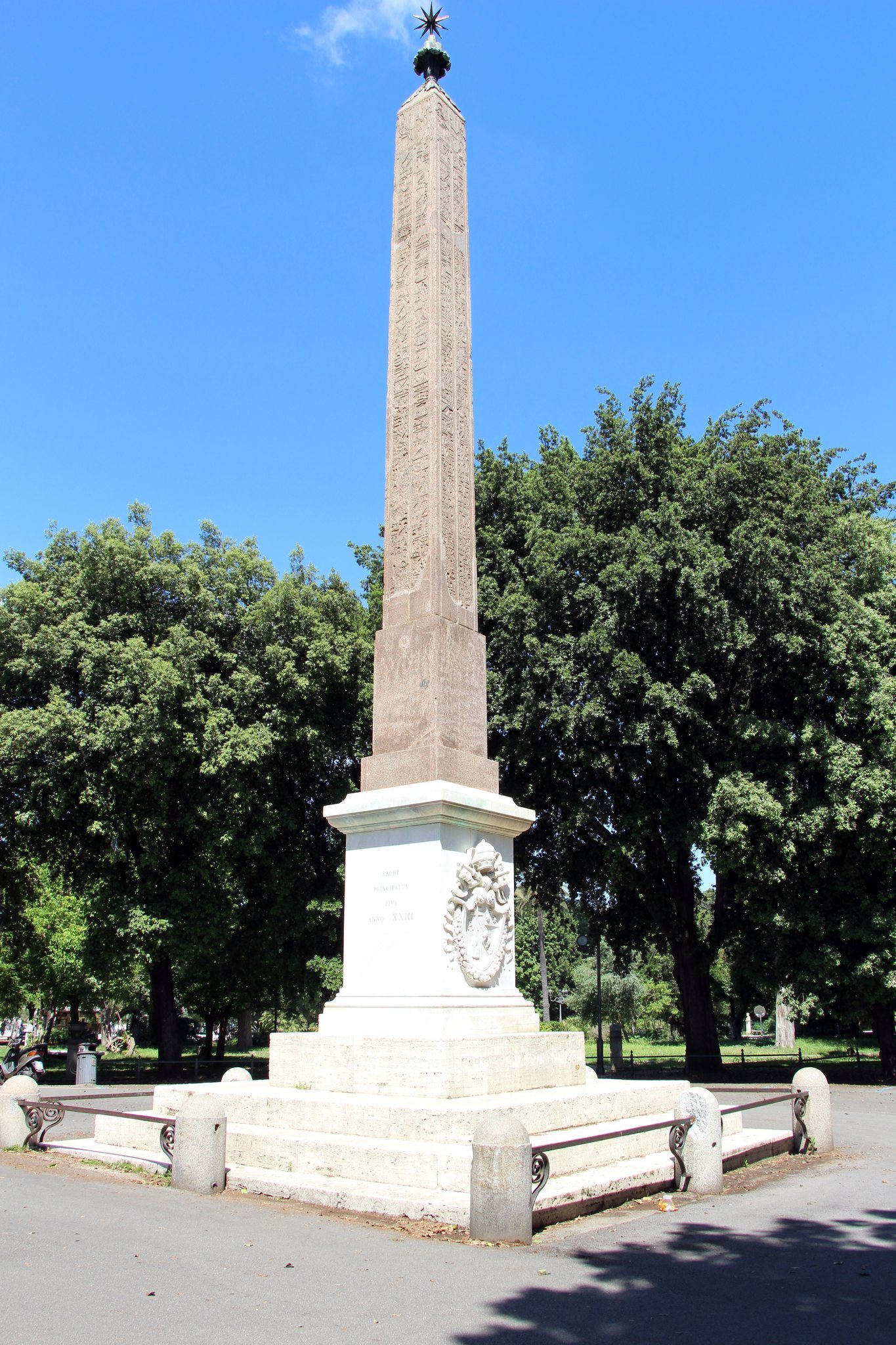
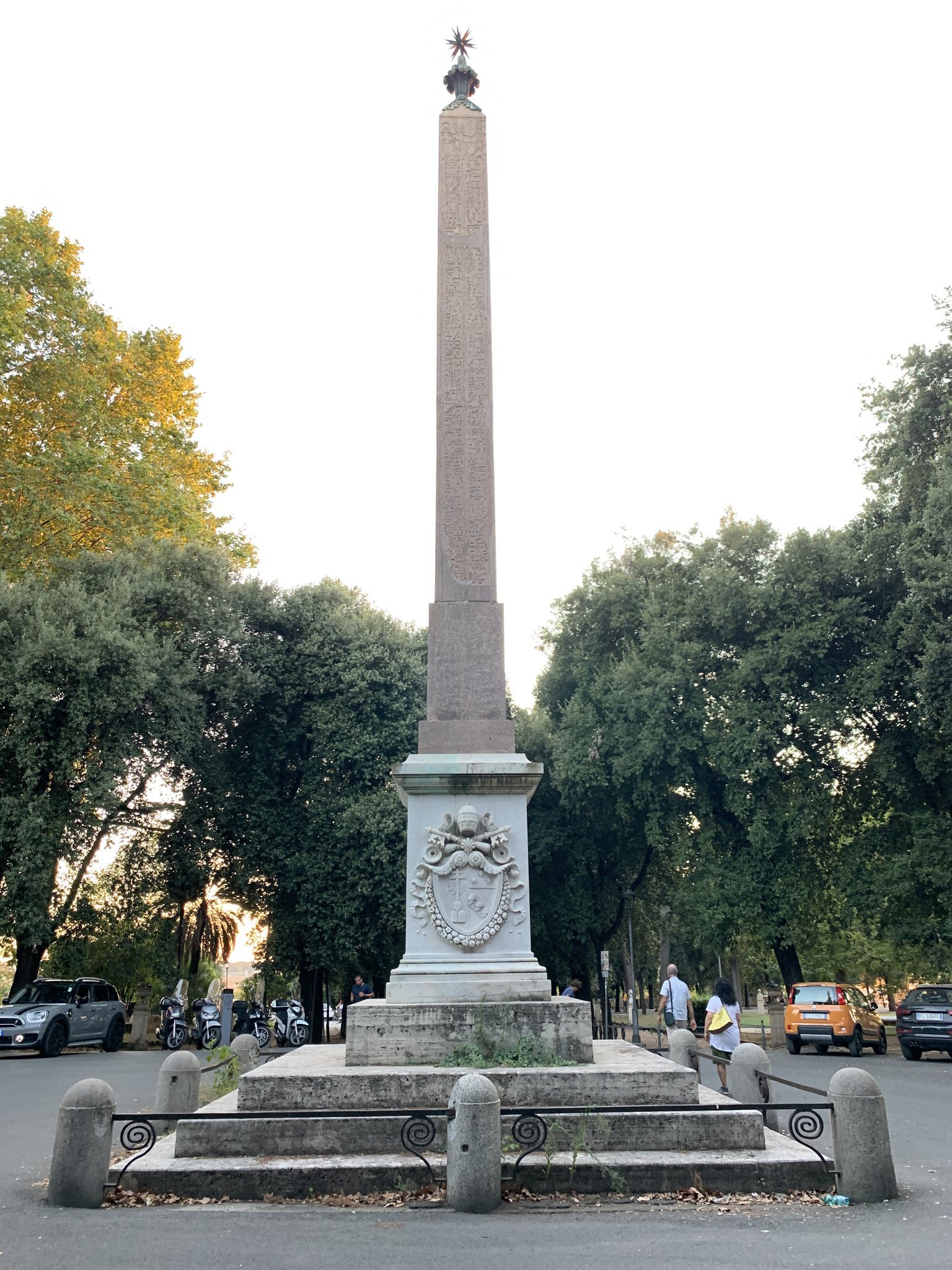
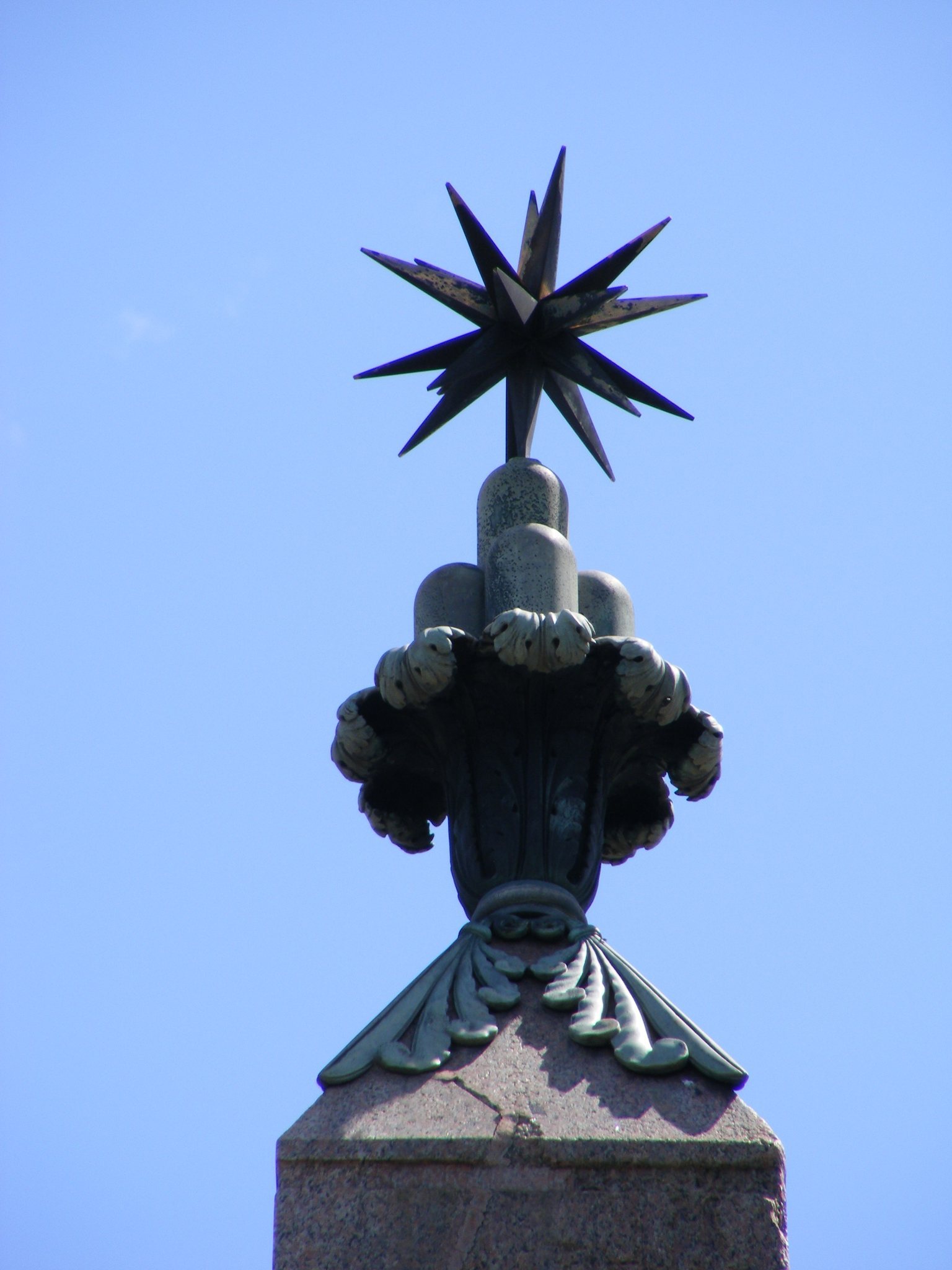
The Pincian obelisk stands in the Pincian Gardens on Pincian Hill, at the small square known as Piazzale del Monte Pincio and also identified as Piazza Bucarest along the avenue of the obelisk. Its ancient shaft is carved from pink granite and rises 9.24 metres. It weighs almost 18 tonnes. With the later pedestal and the bronze star at its summit, the complete monument reaches 17.26 metres.
Pedestal and stepped base
The present monument combines elements from different periods. The ancient shaft rests on a marble pedestal made in 1822, which in turn stands on a stepped stone base. The pedestal carries Latin inscriptions and a bas-relief showing the personal coat of arms of Pope Pius VII. Together, these later elements preserve the form created for the obelisk’s nineteenth-century re-erection while supporting the much older granite monument.
Hieroglyphic inscription
The four sides of the text
Hieroglyphic inscriptions cover all four sides of the shaft and form an unusually extensive text. They describe the death and deification of Antinous, his association with the gods, the foundation of Antinopolis in Egypt, and the establishment of the Osiris-Antinous cult.
The south side asks that Antinous be assimilated to Osiris, who is identified with Amun-Ra. It presents this relationship as connected with the future salvation of Hadrian’s soul and as a reward for the emperor who ordered the obelisk. The north side states that Antinopolis was founded where Antinous drowned, establishing the city as a center for worship and athletic games.
The west side describes the foundation of the city and the construction and furnishing of a temple to Antinous-Osiris. The east side contains a hymn to Antinous-Osiris and a request to Thoth, an important Egyptian deity, for the salvation of his soul.
Hadrian’s Egyptian titulary
The inscription includes an unusual Egyptian titulary, a formal sequence of names and titles expressing a ruler’s identity and status, for Hadrian. Egyptologists including Ph. Derchain and J.-C. Grenier have attributed the text to Petarbeschenis, a priest of Akhmim. A very similar titulary appears on the priest’s funerary stele, and the two examples are described as the only known attestations of this form of hieroglyphic placement.