Flaminio Obelisk: An Ancient Egyptian Monument in Rome


Site at a Glance
- Rating
- 4.8
- Popularity
- Low
- Country
- Italy
- Primary era
- Bronze Age
- External website
- Open
- Eras represented
- Bronze Age, Classical, Early Modern, Modern
- Civilizations
- Egyptian, Papal States, Roman
- Site type
- Civic
- Remains
- Obelisk
On this page9 sections
History
The Flaminio Obelisk is an ancient Egyptian monument in Rome, Italy, commissioned in the late thirteenth century BCE during Egypt’s Nineteenth Dynasty. Probably the oldest or second-oldest of Rome’s ancient obelisks, it was created for the Temple of Re at Heliopolis and later became a landmark of the Circus Maximus before taking its present place at the center of Piazza del Popolo.
Creation at Heliopolis
Pharaoh Seti I ordered the obelisk for Heliopolis, an ancient religious city associated with the solar god Re and now incorporated into Cairo’s metropolitan area. Seti I had three of its four faces inscribed before his death. His son and successor, Ramesses II, completed the fourth face and oversaw the monument’s installation. The inscriptions associate the stone with Re-Harakhte, Atum, and Khepri, forms of solar divinity in ancient Egyptian religion.
The monument was one of the first two Egyptian obelisks transported from Egypt to Rome. In 10 BCE, after Augustus’s conquest of Egypt, it was carried by ship across the Mediterranean at considerable expense. Augustus, Rome’s first emperor, retained its connection with solar worship while adding Latin dedications that presented it as a gift to the Sun after Egypt had come under Roman rule.
The Circus Maximus
In Rome, the obelisk was erected on the spina, the long central barrier of the Circus Maximus. The circus was Rome’s principal chariot-racing venue, and its central barrier guided the racing teams around the course. The obelisk therefore served both as a prominent monument and as a turning marker for the races. It survived the great fire that damaged the Circus Maximus in 64 CE.
After the decline and abandonment of the circus, the obelisk fell and broke into three pieces, probably during one of the Germanic invasions of the Roman Empire. Mud, earth, rubble, and refuse gradually covered the fragments. The former circus area later became waterlogged after the Acqua Mariana, a channelled stream, affected it from about 1122 onward, helping to bury the fallen monument.
Rediscovery and Re-erection
The buried obelisk was rediscovered and excavated in 1471 by the architect Leon Battista Alberti during building work on Piazza Navona. Alberti considered several possible uses for it, but none was carried out at that time. Interest in Rome’s buried obelisks revived under Pope Sixtus V in the late sixteenth century.
In 1589, the obelisk was restored and re-erected at the center of Piazza del Popolo by the architect Domenico Fontana. A proposal to place it before Santa Croce in Gerusalemme was abandoned. Sixtus V used ancient obelisks as focal points in a wider urban system linking important parts of Rome, including pilgrimage churches and the route of the ancient Via Flaminia, whose urban continuation is now associated with the Via del Corso. The Flaminio Obelisk was intended to mark the end of the planned Via Sistina, although the route’s final section to Piazza del Popolo was never built.
After Sixtus V died in 1590, Pope Alexander VII added his family emblems, a mountain and a star, beneath the bronze cross at the summit. Between 1811 and 1822, under Pope Leo XII, Giuseppe Valadier redesigned Piazza del Popolo in a neoclassical form and incorporated the obelisk and surrounding monuments into a unified urban composition. In 1823, he added the fountain and four Egyptian-style lions around its base.
Remains
Granite Shaft and Urban Setting
The Flaminio Obelisk stands at the center of the oval Piazza del Popolo, where it forms part of an ensemble of Egyptianizing elements. The nearly identical Baroque churches Santa Maria dei Miracoli and Santa Maria in Montesanto stand around the piazza in a deliberate design relationship with the monument.
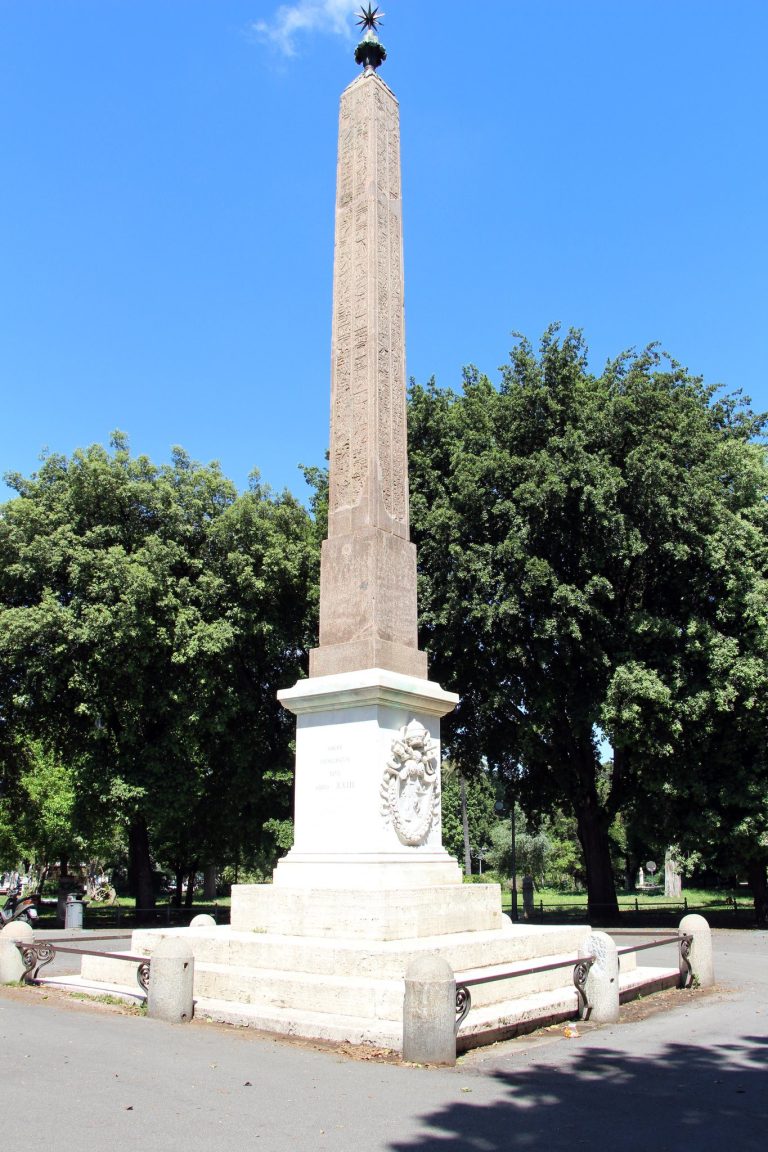
The obelisk is a monolith, a monument carved from one block of stone, made from reddish granite quarried at Aswan. Its square shaft has flat sides and tapers toward a pyramid-shaped summit. The shaft is approximately 24 metres high, while the complete monument, including its base and cross, reaches 36.5 metres. Its weight is approximately 235 tonnes.
The summit is formed by a pyramidion, the small pyramidal cap of an Egyptian obelisk. It was originally covered with gold and associated with the sacred Benben stone of Heliopolis, a pyramidal object connected with that city’s religious traditions. The obelisk stands on a substantial lower structure, an unusual arrangement because relatively few Old Kingdom obelisks stood alone on monumental bases as central cult objects.
Hieroglyphic and Latin Inscriptions
All four sides of the shaft carry vertical hieroglyphic inscriptions. The direction of the animal figures’ movement and gaze indicates how the texts were intended to be read and preserves information about the monument’s original orientation. The inscriptions name Seti I’s erection of the obelisk at Heliopolis and record the accessions of Seti I and Ramesses II. Reliefs and hieroglyphic representations on the upper and lower parts of the faces include Re, Re-Harakhte, Atum, and Khepri.
Latin inscriptions were added after the stone reached Rome. One on the west side records its former position in the Circus Maximus, its excavation under Sixtus V in 1589, and its rededication to the Invincible Cross. Inscriptions on the base preserve the Augustan dedication from 10 or 9 BCE, describing the monument as a gift to the Sun. The bronze cross fixed to the summit during the sixteenth-century re-erection represents its later Christian dedication.
Quarrying and Ancient Transport
At Aswan, workers excavated a long trench around the intended monolith so it could be shaped horizontally and detached from the bedrock in one piece. The final method of separation is uncertain. Proposed techniques include water-swollen wooden wedges, heating and rapidly cooling the rock, and progressively undermining the stone from the trench.
After separation, the monolith was raised with levers and supported on wooden blocks added incrementally until it could be moved. Workers attached sledges and hauled the stone, with hundreds of people taking part. It was prepared in the quarry as far as practical to reduce the weight carried along the approximately 1,500-kilometre route to Heliopolis, which was completed by ship on the Nile.
At Heliopolis, the stone was placed horizontally in the Temple of Re. Its accessible faces were dressed, polished, inscribed, and brought to their final form. It was then raised on a mound of sand around a central rounded beam. As workers gradually removed the sand, the lower part settled onto its foundation while the upper part rose. A sloping retaining wall prevented the monument from slipping and was removed afterward.
For its Roman erection, the obelisk was set on a long ramp and raised with a tall wooden tower, ropes, pulleys, and winches operated by people and horses. More than a thousand workers may have participated, with trumpet signals coordinating the operation.
Fountain Base and Lions
The lower structure is enclosed by four circular fountain basins and four stone lions in an Egyptianizing style. Water issues from the lions’ mouths into the basins. The lions express the obelisk’s Egyptian origin and its associations with power, protection, and martial courage.
The monument is formally associated with the Flaminio quarter and the Flaminian Way, which began near Piazza del Popolo. In antiquity, it was probably one of a pair of Egyptian obelisks, although no companion to it has been identified. Another obelisk transported with it, now called the Montecitorio Obelisk, followed a separate history in Rome.