Chigi Chapel: Raphael’s Renaissance Mausoleum in Rome


Site at a Glance
- Rating
- 4.7
- Popularity
- Low
- Country
- Italy
- Primary era
- Early Modern
- External website
- Open
- Eras represented
- Early Modern
- Civilizations
- Papal States
- Site type
- Religious
- Remains
- Chapel
On this page21 sections
History
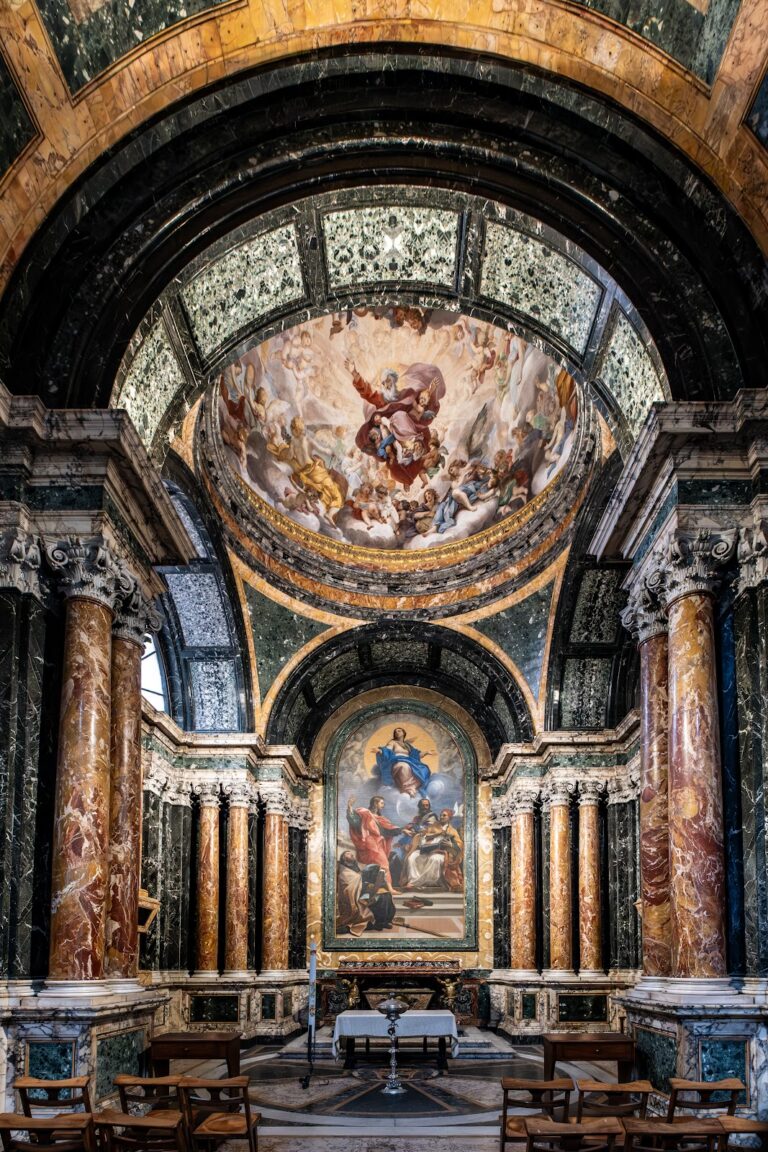
The Chigi Chapel is a Roman Catholic side chapel in the Basilica of Santa Maria del Popolo in Rome, Italy, where it occupies the second chapel on the left side of the nave. Begun in 1507 for the Sienese banker Agostino Chigi, it was designed in the High Renaissance by Raphael and is the only surviving religious building by him preserved in nearly its original form. The chapel served as a mausoleum for Chigi and his heirs, while its imagery joined Christian ideas of resurrection with themes drawn from classical antiquity.
Foundation and Renaissance design
Pope Julius II approved Agostino Chigi’s acquisition of the chapel in 1507. A papal bull issued on 3 December that year changed its dedication from Saints Sebastian, Roch, and Sigismund to the Madonna of Loreto, Saint Augustine, and Saint Sebastian. The new dedication reflected Agostino’s particular devotion to the shrine of Loreto and formally established the chapel as a burial place for him and his family.
The building was probably reconstructed from its foundations according to a design by Raphael. A plan attributed to him, probably drawn around 1512, survives in the Uffizi. Its centralized arrangement and imagery expressed a program concerned with resurrection, eternity, the cosmos, and the soul’s passage after death. An inscription records the completion of the dome mosaics in 1516. Lorenzetto, a sculptor and architect associated with Raphael’s circle, then carried forward the architectural decoration and sculpture under Raphael’s patronage.
Agostino Chigi was buried in the still-unfinished chapel on 11 April 1520, shortly after Raphael’s death. On 31 May, Agostino’s widow Francesca Ordeasca commissioned Luigi da Pace to execute mosaics planned for the tambour, the cylindrical structure supporting the dome, and the spandrels, the curved zones between the arches and their surrounding frames. Francesca died on 11 November 1520, and Agostino’s younger brother Sigismondo Chigi commissioned Lorenzetto to continue Raphael’s program in 1521. Sigismondo’s death in 1526 interrupted the work again.
Completion and interruption
Sebastiano del Piombo began the main altar mural, the Birth of the Virgin, in 1530, using oil applied to blocks of peperino stone in an unusual technique he had devised. He left the work unfinished in 1534. Building and decoration resumed in 1548, when Francesco Salviati was commissioned to decorate the tambour and spandrels and to complete the altar painting. In 1552 Lorenzo Chigi paid the heirs of Lorenzetto, enabling the statues of Jonah and Elijah to be installed. The chapel was first unveiled in 1554.
After Lorenzo Chigi died and was buried there in 1573, the family disappeared from Rome and the chapel fell into neglect. In 1624 the Augustinian friars moved the funeral monument of Cardinal Antoniotto Pallavicini into the chapel from the crossing. Fabio Chigi found the building seriously deteriorated during his first visit in 1626. After a three-year dispute with the Augustinians, he recovered ownership in 1629. The Pallavicini monument was later moved to the nearby baptistery.
Bernini’s Baroque transformation
The chapel was substantially remodeled between 1652 and 1655, after Fabio Chigi became cardinal-priest of Santa Maria del Popolo. Fabio Chigi later became Pope Alexander VII in 1655. Gian Lorenzo Bernini, the leading Roman Baroque sculptor and architect, completed the pyramidal tombs, installed the present pavement, raised the altar, slightly enlarged the windows, renewed the lead roof, and cleaned and regilded the dome. He also introduced painted wooden lunettes by Raffaello Vanni and added the statues of Daniel and the Lion and Habakkuk and the Angel between 1655 and 1661. A further restoration followed in 1682–88.
The chapel’s funerary program connected Christian beliefs with classical ideas of eternity, the cosmos, and the soul’s movement after death. The dome has traditionally been interpreted as the Creation of the World. John Shearman instead understood it as a Christianized Neoplatonic image of the cosmos and the realm of the soul after death, in which God receives Agostino Chigi’s soul. The original furnishings included six gilded bronze candlesticks, gilded wooden altar cards, and a bronze crucifix-tabernacle. Fabio Chigi added eight reliquaries in 1654 and 1656, and the two sets of small crystal pyramids are preserved in the basilica treasury.
In 1996 Antonio Pinelli discovered the original 1552 contract concerning the tombs in the Getty Research Institute. His interpretation that Agostino’s pyramid had originally been intended for Francesca Ordeasca remains disputed. The corrected text refers to an unexecuted female medallion and may indicate that one monument was prepared for her. The chapel is regarded as one of Santa Maria del Popolo’s principal monuments and as an important ensemble of Italian Renaissance and Baroque art.
Remains
The chapel has a centralized octagonal plan, a simple cubic exterior, and a cylindrical tambour supporting a hemispherical dome. Much of the exterior is concealed by the city wall, the Porta del Popolo, and the main body of the basilica. Exposed brick, a stone cornice, and a brick modillion trim surround the tambour. The low conical roof is tiled and was originally covered with lead. A small stone lantern with Tuscan pilasters, niches, and four scrolls crowns the dome, ending in Chigi mountains and a star with a cross.
Central space and entrance
The interior cube rises to a high, windowed tambour and the hemispherical dome. Trapezoidal pendentives connect the lower structure to the dome. Round-headed arches organize the side walls, with the entrance arch open and the remaining arches blind. At the canted corners, shell-headed niches are framed by Corinthian pilasters. Raphael’s design drew on Bramante’s plans for the new Saint Peter’s Basilica and on the Pantheon. Its arrangement encourages the space to be understood from several viewpoints, while colored marble defines the separate parts of the classical composition.
Entrance portal
The entrance portal reinterprets the Pantheon’s entrance bay. Double transverse arches rest on large Corinthian pilasters with cable-fluted shafts and carved capitals. Their entablature and cornice carry egg-and-dart, bead-and-reel, and floral ornament. The pilasters use polished white Carrara marble with grey veining, while the unpolished capitals are pure white Carrara marble. Colored marble revetment between the pilasters is divided by white marble panels.
The portal arches contain a meander, fruit garlands, a mask, rosettes, rectangles with grotesques, interlaced bands, and six-pointed stars. Bernini added a stucco Chigi coat of arms above the portal in 1652. The inscription Unum ex septem identifies the altar as one of the privileged altars regarded devotionally as equivalent to visiting the Seven Churches of Rome.
Balustrade and crypt
A marble balustrade marks the entrance. Its yellow giallo antico frame contains dark red portasanta balusters, which were enlarged and given their present form in the seventeenth century. The threshold is a single block of Egyptian granite for which Agostino Chigi paid 300 scudi. Wooden doors carry central panels carved with dense acanthus foliage.
A circular crypt lies beneath the chapel. In 1974, a plain, empty pyramidal tomb set into the wall directly beneath the altar was discovered. The hypogeum is now concealed, whereas an opening before Bernini’s reconstruction visually connected the chapel with the lower level.
Dome and upper decoration
Dome mosaics
Luigi da Pace executed the dome mosaics after Raphael’s design of 1516. The central roundel shows God the Father surrounded by putti. Eight surrounding panels represent the starry sky, the Sun, the Moon, and six planets personified as pagan deities. Each deity is accompanied by an angel with brightly colored wings and by zodiac signs. The sequence presents Mercury with a caduceus and Virgo and Gemini; Luna with a crescent and bow and Cancer; Saturn with a scythe and Aquarius and Capricorn; Jupiter with an eagle and thunderbolt and Sagittarius and Pisces; Mars with sword and shield and Scorpio and Aries; Sol with a bow and Leo; and Venus with Cupid and a torch and Taurus and Libra.
Richly gilded stucco surrounds the panels, while a blue ground creates the impression of skylights opening onto the sky between gilded ribs. The original cartoons are lost, but preparatory drawings survive in the Ashmolean Museum in Oxford and in Lille. Nicolas Dorigny engraved the mosaics in 1695 for Louis, Duke of Burgundy.
Seasons and Genesis frescoes
Raphael intended mosaics for the tambour and spandrels, but those designs were never executed. Instead, four round paintings in the spandrels represent the Seasons. Spring is a young woman carrying flowers, Summer carries grain, Autumn is a young man beneath a vine, and Winter is an old man warming himself at a brazier. A ram beside Spring refers to Aries and the vernal equinox. The figures may also evoke Flora or Proserpina, Ceres, and Bacchus. Antonio della Cornia restored the paintings in 1653. Autumn suffered the most damage, and a recent restoration removed their seventeenth-century bronze frames. Their imagery draws on Ovid’s Metamorphoses and the medieval image of February beside a fire.
Frescoes painted between the tambour windows around 1552–54 show the Separation of Light from Darkness, the Creation of the Sun and Moon, the Creation of the Earth, the Creation of Adam, the Creation of Eve, the Creation of the Animals, the Original Sin, and the Expulsion from Paradise. The cycle is strongly influenced by Michelangelo’s Genesis scenes in the Sistine Chapel and ends before the three scenes concerning Noah.
The scenes are not arranged in strict chronological order. The Creation of the Animals follows Adam and Eve so that Adam and Eve could flank the entrance and face the Birth of the Virgin on the altar. This arrangement was considered theologically more meaningful. The progressive darkening of the sequence is interrupted by the differently lit Creation of the Animals. The tambour paintings have been interpreted as the temporal, changeable, and corruptible earthly world, set against the perfect and eternal heavenly realm represented by the dome mosaics. The changing light requires the viewer’s gaze to move around the tambour as windows alternately illuminate and obscure the scenes.
Around 1602, Vincenzo I Gonzaga, Duke of Mantua, commissioned Pietro Facchetti to make copies of the Genesis frescoes and dome mosaics. They were taken to Valladolid in 1603 as gifts for the Duke of Lerma. Seven zodiac paintings and five copies of the Genesis frescoes are now in the Museo del Prado.
Altar and prophetic sculpture
Birth of the Virgin
The main altar mural is the Birth of the Virgin. Sebastiano del Piombo began it in 1530 in oil on peperino blocks, and Francesco Salviati completed it by 1554. The upper section, showing God the Father and the angels, is mainly Salviati’s work. God appears above with wingless angels carrying large codices. Below, seven female servants prepare the newborn Virgin for her first bath. Saint Anne rests on a bed, while Joachim is received at a doorway. A classical statue in the courtyard probably represents the Tiburtine Sibyl. Francuccio Francucci made the gilded bronze frame in 1655, decorating it with acanthus leaves and acorns.
Christ and the Samaritan Woman
Lorenzetto made the bronze altar-front relief of Christ and the Samaritan Woman in the early 1520s. Lorenzo Chigi bought it from the sculptor’s heirs in 1552. It was first placed on Agostino Chigi’s tomb, then moved by Bernini to the main altar within a golden-yellow stone frame. The scene shows Christ at Jacob’s Well, the Samaritan woman leading the inhabitants of Sychar toward him, and the disciples offering food. Its imagery draws on the “Water of Life” passage in John 4:10–26. The Samaritan woman and another female figure were modeled on figures from the ancient marble relief known as the Borghese Dancers, then in Rome and now in the Louvre.
Prophets
Four shell-headed niches contain statues of prophets. Lorenzetto created Jonah in 1520 and Elijah following Raphael’s designs. Raffaello da Montelupo completed Elijah around 1523–24. The statues remained in Lorenzetto’s workshop until the Chigis bought them from his heirs and installed them in 1552.
Bernini added Daniel and the Lion in 1655–56 and Habakkuk and the Angel in 1656–61. Habakkuk is shown being carried by the hair to Babylon to aid Daniel. Bernini placed the two later statues diagonally opposite one another, creating a spatial relationship that animates the chapel. The earlier positions of Jonah and Elijah are uncertain.
Chigi tombs and memorial imagery
Pyramidal monuments
Matching pyramidal wall tombs on the side walls commemorate Agostino Chigi, who died in 1520, and Sigismondo Chigi, who died in 1526. Each figure appears in a medallion facing the altar. Raphael probably designed the monuments and Lorenzetto executed them. One was nearly complete in 1522, while the second remained mostly unbuilt in 1552 and was probably erected later by Fabio Chigi for Sigismondo.
The pyramids are about twice as high as they are wide and rest on four small supports of africano marble, modeled on the astragals of the Vatican obelisk. Whether the present pedestals are original or replacements made by Bernini remains uncertain. The tombs draw on pharaonic and Roman pyramidal monuments, Egyptian obelisks, and funerary ideas associated with eternity and immortality.
Bernini completed and simplified the monuments. He replaced their base reliefs with verde antico panels framed by giallo antico moldings. The relief of Christ and the Samaritan Woman survives. A second relief, showing a mourning winged putto leaning on an inverted torch, is known from a photograph and was apparently lost during the twentieth century. A corresponding relief was planned but never executed.
The later tomb medallions are white marble and were made by an assistant from Bernini’s workshop. Freestanding bronze letters form the funerary inscriptions instead of the originally planned gilt-copper plaques. Lucas Holstenius, a humanist and senior custodian of the Vatican Library, assisted with the epitaphs. The Chi Rho, an early Christian monogram formed from the first two letters of “Christ,” was added above the pyramids.
The tombs are faced with portasanta marble in red and grey tones that evoke the smoke and burning of Roman imperial funerals. Their pyramidal shape recalls the imperial funeral pyre, while flying eagles in the friezes refer to the soul’s ascent to heaven. Behind them, rectangles of portasanta with africano borders form the wall revetment. The cornices above the tombs are probably seventeenth-century additions. Between them, a smooth dark red rosso antico frieze contrasts with the older portasanta frieze elsewhere in the chapel.
Lunette paintings
Fabio Chigi commissioned Raffaello Vanni to paint the lunettes on semicircular wooden panels in 1653. The panel above Sigismondo’s tomb represents the royal ancestors of the Virgin, including David with the harp and Goliath’s head and Solomon, probably accompanied by Rehoboam and a child with a sword. Above Agostino’s tomb, the panel represents the sacerdotal ancestors of the Virgin, including a Jewish high priest and assistants offering doves and incense. These paintings complement the Birth of the Virgin and the Old Testament scenes in the tambour. Their gilded bronze frames resemble the frame of the main altar mural.
Pavement, lighting, and stonework
Pavement and altar
Bernini designed the present pavement and closed the former opening before the altar. He raised the altar by two steps, although a third later step interrupts the decorative pattern. The original steps were made from monolithic statuario marble. The white and grey bardiglio pavement forms a geometric design corresponding to the dome.
At the center, an opus sectile roundel uses shaped pieces of stone to depict a winged skeleton raising the Chigi coat of arms. The image represents dynastic virtue overcoming death. A scroll bears the inscription Mors aD CaeLos, “through death to heaven,” whose capital letters give the Roman-numeral date MDCL, or 1650. Gabriele Renzi executed the roundel in 1653–54. Its original inscription, Mors aD CaeLos Iter, encoded 1651, the year Fabio Chigi returned to Rome.
Furnishings and colored marble
The principal surviving furnishing is a bronze eternal lamp shaped like a gilded crown suspended from chains. It bears eight-pointed Chigi stars and is supported by three flying cherubs, an allusion to the Virgin’s crown. Bernini designed it, Peter Verpoorten modeled it, Francuccio Francucci cast it, and Francesco Perone gilded it. A similar lamp was made for the Cybo Chapel, and a copy was produced for Palazzo Chigi in Ariccia in 1885.
Two monumental bronze candlesticks, each 1.5 metres high and marked with Chigi symbols, stand at the entrance on painted wooden plinths. Two white marble flower stands decorated with palm leaves flank the altar. Across the chapel, Carrara marble forms the fluted pilasters, capitals, friezes, arches, entablature, and rings of the dome. Statuario appears in the original altar steps, bardiglio in the pavement, and Egyptian rosso di Syene granite in the entrance threshold. Africano, rosso antico, rosso di Numidia, portasanta, verde antico, and giallo antico complete the colored stonework of the niches, tombs, balustrade, pavement, and wall revetment.
This extensive use of colored and rare stone was intended to recreate the chromatic richness associated with ancient Roman architecture, especially the Pantheon. It represented an exceptional innovation in Rome during Raphael’s period and remained so until the decoration of the Cappella Gregoriana in Saint Peter’s Basilica in 1578–80.
Nearby sites