San Pietro ad Aram, Naples: A Historic Roman Catholic Basilica
Site at a Glance
- Rating
- 4.6
- Popularity
- Low
- Country
- Italy
- Primary era
- Early Modern
- Eras represented
- Classical, Early Modern, Modern
- Civilizations
- Italian, Kingdom of Naples, Roman, Spanish
- Site type
- Religious
- Remains
- Basilica
On this page14 sections
History
San Pietro ad Aram is a Roman Catholic basilica in Naples, Italy, traditionally associated with the earliest Christian community in the city. Dedicated to Saint Peter, one of the principal apostles of Jesus and an early leader of the church, it belongs to the Archdiocese of Naples and is recognized as a minor basilica. Its origins are traditionally placed in the first century, when Saint Peter is said to have prayed at the Ara Petri, an altar preserved by the basilica, and baptized Saint Candida and Saint Aspreno, described as the first Neapolitan converts to Christianity.
Early Christian tradition
The foundation tradition gives San Pietro ad Aram an important place in Neapolitan Christian history. The memory of Saint Peter’s prayer and the baptisms of Candida and Aspreno remained connected with the church through the preserved altar and through a vestibule fresco attributed to Girolamo da Salerno, which depicts the baptism of the two converts.
The church’s antiquity also shaped its relationship with pilgrimage. Pope Clement VII granted it the privilege of celebrating a Jubilee, a formally proclaimed period of special Christian observance associated with pilgrimage and the remission of sins, one year after the Jubilee of Rome. This arrangement helped reduce overcrowding in Rome and spared Neapolitans a difficult journey. The delayed Jubilees took place in 1526, 1551, and 1576, before Pope Clement VIII abolished the privilege in the seventeenth century.
Seventeenth-century rebuilding
The present church was reshaped during a major seventeenth-century restructuring carried out between 1650 and 1690. The work followed designs by Pietro De Marino and Giovanni Mozzetta and gave the basilica much of its Baroque and later Neoclassical character.
Until the nineteenth century, a monumental cloister bordered the basilica. Two ancient cloisters were later demolished during urban-renewal works connected with the opening of Corso Umberto I and Piazza Mancini. Their columns and capitals were transferred to the entrance of the church of Sant’Aspreno, incorporated into the Palazzo della Borsa in Piazza Bovio, where they remain publicly visible. The basilica also received a sixteenth-century secondary portal from the Conservatory of the Art of Wool in Vico Miroballo after that institution was demolished during the same urban changes.
Rediscovery of the early remains
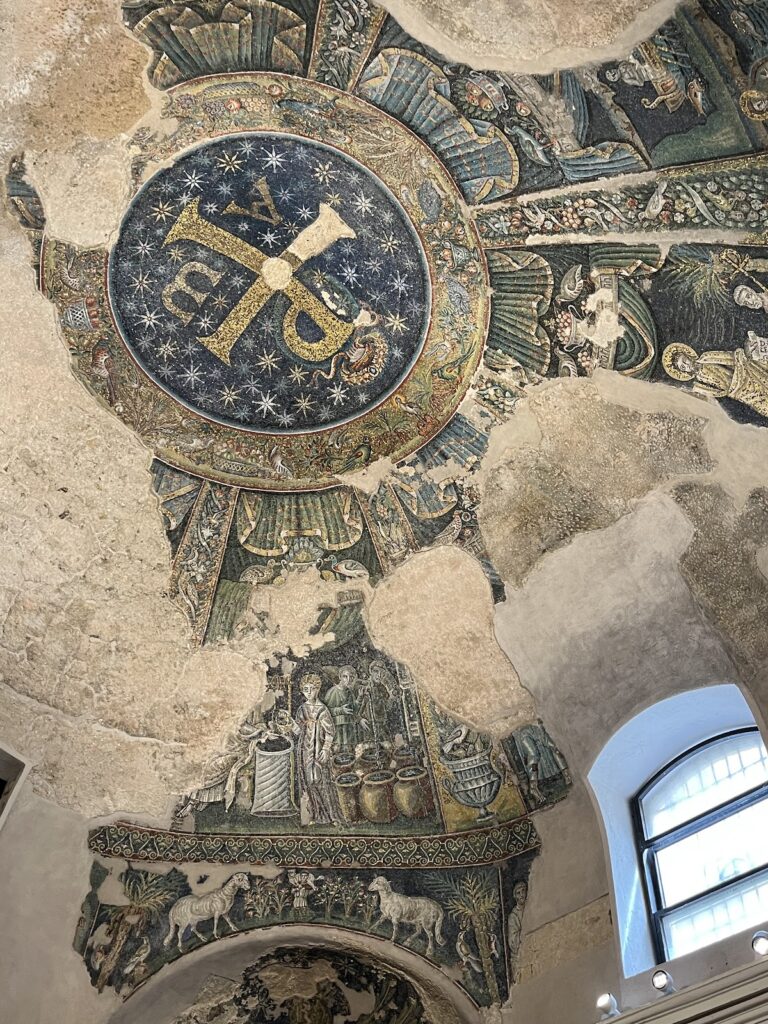
Restoration in 1930 revealed that the crypt incorporated an early Christian church and led to the discovery of catacombs. These underground burial or ritual complexes are associated at San Pietro ad Aram with a cult of the souls in purgatory comparable to the devotional practice linked with the Fontanelle Cemetery. The discovery added an early Christian and subterranean dimension to the history of the later basilica.
Remains
Façade and entrances
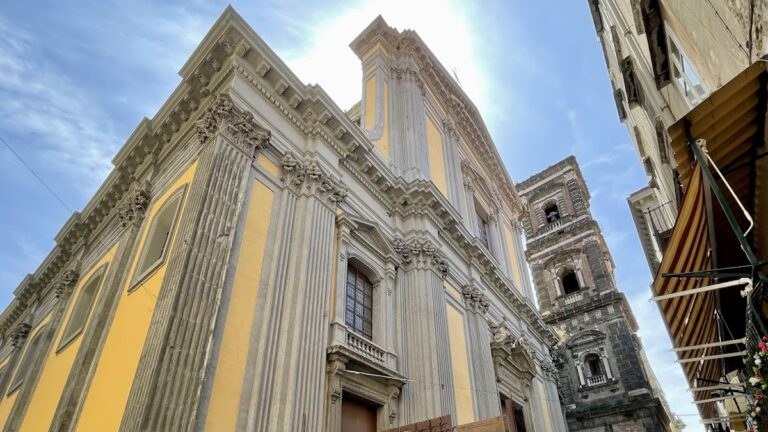
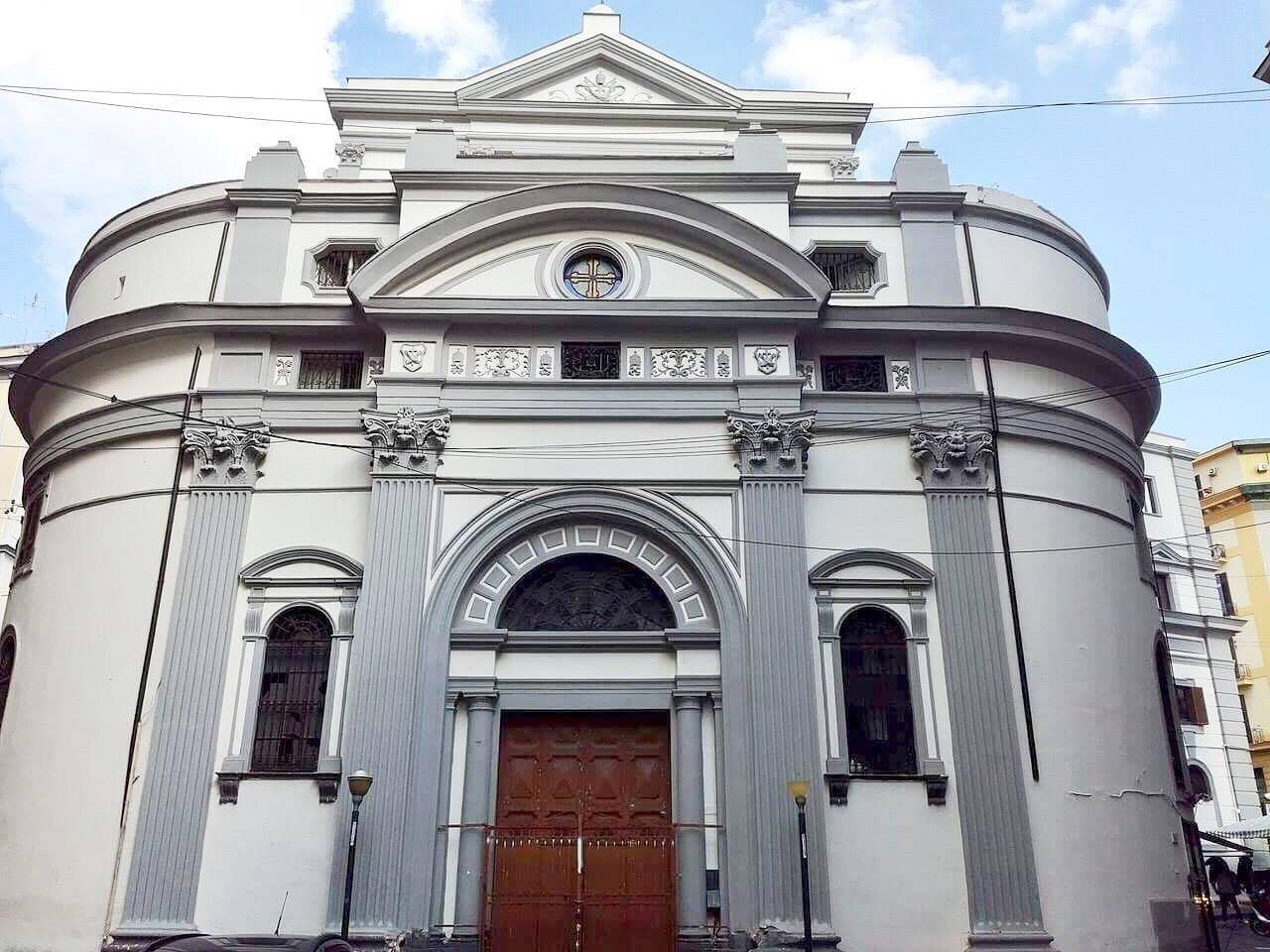
The basilica has a sober Neoclassical façade arranged in lower and upper sections. Four fluted Corinthian pilasters divide the lower section into three vertical bays. The central bay contains the main portal, set within a shallow splayed opening with a round arch supported by two Tuscan columns, while the side bays each hold an arched window. A cornice decorated with bas-reliefs separates the two principal sections. The lower level of the upper section has two octagonal windows and a semicircular pediment with an oculus between them. Above, a large window is surmounted by a triangular pediment.
The secondary portal is a sixteenth-century carved-stone work decorated with vegetal scrolls. It was transferred to San Pietro ad Aram from the demolished Conservatory of the Art of Wool, preserving part of that earlier building within the basilica’s present fabric.
Interior arrangement
The interior follows a Latin-cross plan, with a long nave crossed by a shorter transept to form the shape of a cross. Four chapels open on each side of the nave. The presbytery, the area around the high altar reserved for the clergy, terminates at the apse, the curved end of the church.
Vestibule
The vestibule contains a marble altar with an Angevin inscription and Swabian colonnettes, small supporting columns, beneath a baldachin by Giovan Battista Nauclerio. Two nineteenth-century sculptures of Saint Francis of Assisi and Saint Anthony of Padua stand beside the entrance. Above the door is Giovanni Bernardo Azzolino’s The Vesting of Saint Ildefonsus, while the fresco of the baptism of Candida and Aspreno is attributed to Girolamo da Salerno.
Left-side chapels
The first chapel on the left has a sixteenth-century marble frame enclosing a contemporary Saint Michael the Archangel, flanked by two eighteenth-century paintings by an unknown artist. The second contains a sixteenth-century marble relief of the Deposition, Teodoro D’Errico’s Immaculate Conception, and an Angel Guardian attributed to Antonio Sarnelli. The third chapel holds the Pietà with Saints Peter and Paul, considered a work by Pietro Negroni, together with an anonymous Crucifixion. The fourth contains Antonio Sarnelli’s The Baptism of Saint Candida, Giacinto Diano’s Saint Augustine Converting the Heretic, and a nineteenth-century Saint Anthony of Padua in Glory by an unknown artist.
Right-side chapels
The first chapel on the right contains Giovanni da Nola’s marble relief of the Madonna delle Grazie and Wenzel Cobergher’s Jubilee, dated 1594. The second has the Epiphany, signed by Pompeo Landulfo, and Giacomo Farelli’s Saint Bonaventure in the Desert. Eugenio Viti decorated the third chapel with frescoes and paintings in 1914. The fourth contains Giovanni Vincenzo Forlì’s Saint Francis Receiving the Stigmata and Saint Nicholas with Saints Barbara and Catherine of Siena, attributed to Silvestro Buono.
Transept and presbytery
The right transept altar is surmounted by Giacinto Diano’s Archangel Raphael and Tobias. At its sides are Francesco De Mura’s Penitent Magdalene and Andrea Vaccaro’s Madonna with the Child and Saint Felix of Cantalice. The left transept altar has Antonio Sarnelli’s Immaculate Conception, flanked by Pacecco De Rosa’s The Baptism of Saint Candida and Agostino Ciampelli’s Christ in Limbo. Above it is Domenico Antonio Vaccaro’s Saint Augustine Healing a Possessed Woman.
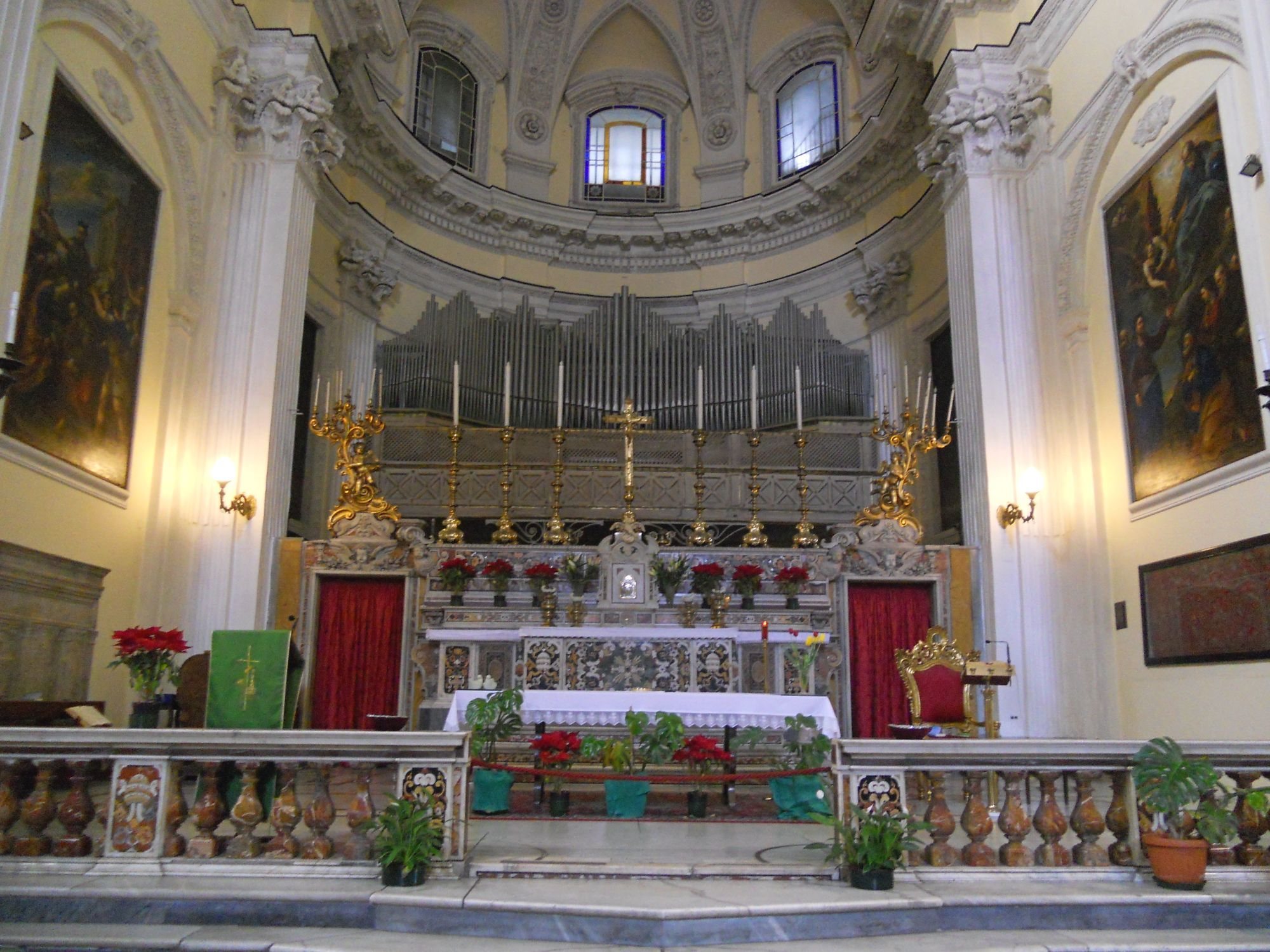
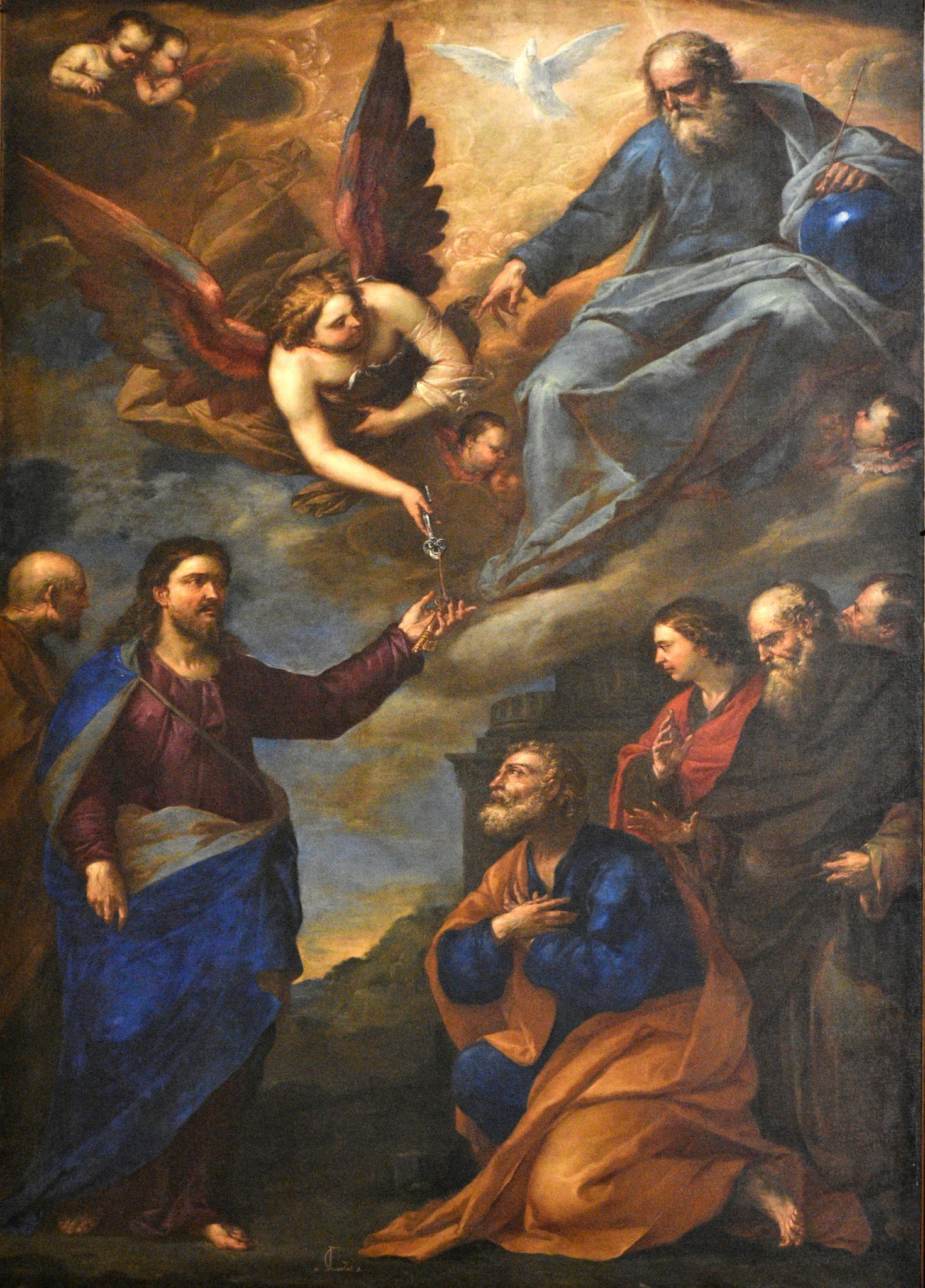
The presbytery contains two youthful paintings by Luca Giordano, Saint Peter and Saint Paul Embracing before Going to Martyrdom and The Delivery of the Keys. The monumental high altar is made of inlaid marble and hard stones. The wooden choir, completed in 1661, was made by Giovan Domenico Vinaccia. In the corridor leading to the sacristy, to the left of the apse, stands the Renaissance tomb of Baldassarre Ricca, carved by Giovanni Giacomo da Brescia in 1519.
Organ and transferred artwork
Behind the high altar is a Tamburini pipe organ, opus 291, built in 1950. It has electric transmission, two 61-note keyboards, and a concave-radial 32-note pedalboard. Its display consists of five cusps of principal and Violoncello pipes without a case. Antonio Rimpatta’s Madonna with the Child and Saints, painted between 1509 and 1511, formerly belonged to the church and is now in the National Museum of Capodimonte.
Crypt and catacombs
The crypt is reached from the left transept. It contains a three-aisled early Christian church, a building from the formative centuries of Christianity, divided by monolithic marble columns. Catacombs extend within this subterranean complex, whose association with a cult of the souls in purgatory connects the physical remains with a continuing devotional tradition.
Former cloister complex
The former cloister complex was a separate architectural component of the basilica. After the cloisters were demolished, surviving columns and capitals were relocated to the Sant’Aspreno shrine or church complex, where they form part of the publicly visible remains of the earlier arrangement.