Santa Maria del Carmine: A Carmelite Basilica and Sanctuary in Naples


Site at a Glance
- Rating
- 4.7
- Popularity
- Medium
- Country
- Italy
- Primary era
- Early Modern
- External website
- Open
- Eras represented
- Medieval, Early Modern, Modern
- Civilizations
- Kingdom of Naples, Spanish
- Site type
- Religious
- Remains
- Basilica
On this page24 sections
History
Santa Maria del Carmine is a Roman Catholic Carmelite basilica, monastery, sanctuary, and pilgrimage centre in Naples, Italy, at the edge of Piazza Mercato. The church was built by the Carmelite order from 1283 into the fourteenth century in the Gothic Angevin period, and it remains dedicated to Our Lady of Mount Carmel. Its history is closely linked with the Carmelite presence in Naples, the devotion to the Madonna Bruna, the revolts and political struggles of the city, and the continuing work of the religious community.
The Carmelite foundation
The Carmelites are a Catholic religious order whose spiritual identity is associated with Mount Carmel in the Holy Land and with devotion to the Virgin Mary as Our Lady of Mount Carmel. Their presence in Naples is first connected with the execution of Conradin of Hohenstaufen on 29 October 1268. Conradin, the last heir of the Hohenstaufen claim to the Kingdom of Sicily and southern Italy, had been defeated by Charles I of Anjou. He and his cousin Frederick of Austria were executed near the site of the Carmelite hermits. Their bodies were initially buried provisionally, and the Carmelites gave them Christian burial in 1269.
A later tradition says that Conradin’s mother, Elisabeth of Bavaria, came to Naples hoping to ransom her son and gave the money to the Carmelites after learning of his death. Her presence in Naples cannot be verified, but the friars later maintained a lasting connection with Conradin. From the fifteenth century into the nineteenth century, they celebrated a daily memorial Mass for “Emperor Conradin.”
On 27 June 1270, Charles I of Anjou granted the community 3,893.76 square metres for a church, oratory, and monastery. Building began in 1283 and continued into the fourteenth century. The Angevin ruling house provided substantial support, including a donation of 1,000 ducats from Queen Margaret of Burgundy. Francesca Seripta and Mauro Frezza also contributed to the foundation. A small church dedicated to Saint Nicholas of Bari stood on the site around 1304 and was later incorporated into the new Carmelite church.
The medieval church was dedicated to the Assumption of the Virgin. Although people had long called it del Carmine, that name became its formal dedication only in 1828. The titles Carmine Maggiore and Santa Maria del Carmine Maggiore expressed the community’s leading position within the Carmelite order. The monastery took part in efforts to establish a southern Carmelite province between 1321 and 1333 or 1336. It became the headquarters of the Province of Terra di Lavoro in 1472, hosted the order’s General Chapter in 1510, and came under the direct jurisdiction of the Carmelite Prior General in 1524.
Learning and the Madonna Bruna
The monastery’s school became a studium generale in 1333. This was an institution of advanced learning authorized to teach beyond the local religious community. The school was especially active during the fifteenth and sixteenth centuries. From 1578, Philip II of Spain provided it with an annual royal grant of 200 ducats. Lay students were admitted in the eighteenth century, and the school continued until the monastery was forcibly closed in 1866. Members of the community later supplied professors to universities outside Naples.
The sanctuary’s central devotional focus is the Madonna Bruna, or Brown Madonna, a representation of the Virgin Mary whose title refers to the dark coloration traditionally associated with her appearance. Carmelite tradition says that the icon was brought from Palestine after the friars left Mount Carmel in 1238. Its arrival in Naples must have occurred before 1268, although its precise date is unknown. A separate tradition places the arrival of Carmelite refugees in an earlier period, while the Carmelite presence connected with the church belongs to the thirteenth century.
Devotion to the Madonna Bruna grew through popular worship and the church’s position beside the market. A papal bull of 1457 describes large crowds visiting the church. During the Jubilee of 1500, the Neapolitan cooks’ confraternity carried the icon to Rome, where it was displayed in Saint Peter’s Basilica. It returned to Naples after drawing exceptionally large crowds. The image was then moved from an underground “little grotto” to the high altar and later to its marble shrine.
On 24 June 1500, many sick people gathered in the church by royal order to pray before the Madonna Bruna. Reported healings made Wednesday the icon’s privileged day of devotion. This practice continues as the Wednesday devotion known as the “Wednesday of Carmine.”
War, the castle, and the Miraculous Crucifix
The church stood near the sea and beyond the principal built-up area of medieval Naples, giving the complex defensive importance. Castello del Carmine was built nearby in 1348 and took its name from the basilica. During the Aragonese siege of Naples in 1439, bombardment damaged the church and surrounding buildings. Between 1439 and 1473, Cristoforo Caetani and Onorato II Gaetani d’Aragona gave more than 4,000 ducats to works involving the monastery, presbytery, and possibly the grotto of the Madonna Bruna. The presbytery was damaged again by the earthquake of 1456.
The tradition of the Miraculous Crucifix relates the survival of a wooden image to an event during the siege. On 17 October 1439, a cannonball fired at the church is said to have been avoided when Christ’s image bent its head. The following day, a shot fired from the bell tower killed the Aragonese prince Pietro, who had ordered the bombardment. Alfonso of Aragon then abandoned the siege. After Alfonso V captured Naples in 1442, he visited the church to venerate the crucifix and commissioned a richly decorated tabernacle.
The tabernacle was completed after Alfonso’s death, and the crucifix was placed inside it on 26 December 1459. Its later concealment behind a veil became a continuing devotional practice. The image is unveiled each year from 26 December to 2 January, on the first Saturday of Lent, and during serious calamities or danger. An extraordinary unveiling took place during the COVID-19 pandemic.
Masaniello and the revolutionary years
Santa Maria del Carmine became a principal setting of the revolt led by Masaniello in 1647. Masaniello was a Neapolitan fisherman and popular leader whose uprising challenged Spanish rule and taxation. The revolt began in Piazza Mercato on 7 July. Negotiations between the rebels, the Spanish viceroy, and Cardinal Filomarino took place in the monastery.
On 16 July, Masaniello sought refuge in the church during Mass and delivered his final speech. He was then killed and decapitated in a monastery corridor. His body was thrown into a ditch outside the Carmelite gate, while his head was shown to the viceroy and carried through the city. The remains were later washed in the Sebeto, reunited, carried in procession, and buried in the basilica.
Masaniello’s remains stayed there until 1799, when Ferdinand IV of Bourbon ordered their removal and dispersal in an effort to suppress the symbolism of popular resistance. Two commemorative plaques were later placed at the presumed burial site and at the place of his killing. During and after the Neapolitan Revolution of 1799, Piazza Mercato became a place of execution. Thirty-five executed revolutionaries were buried in the church atrium, chapter house, and monastery. They included Eleonora Pimentel Fonseca, Luisa Sanfelice, Francesco Mario Pagano, Domenico Cirillo, Ignazio Ciaia, Luigi Bozzaotra, Nicola Neri, Cristoforo Grossi, and the Carmelite mathematician Francesco Saverio Granata.
Suppression, restoration, and modern status
The monastery was repeatedly suppressed and occupied. The friars were expelled in March 1799 but returned later that year. They were expelled again in 1809 under Joachim Murat and restored to the monastery in 1820 after the Bourbon return. A further expulsion followed the Italian state’s suppression of religious corporations in 1866. The church remained under the care of the Archbishop of Naples for several decades, and the church and part of the monastery were returned to the Carmelites in 1896.
Pope Benedict XV raised Santa Maria del Carmine Maggiore to the rank of minor basilica through the brief Templa Dei of 18 December 1917. The associated ceremonies took place on 26 June 1918. Since 1947, the complex has housed the Carmelite commissariat named for Santa Maria La Bruna, which coordinates the monasteries of the religious province. The church became an official parish in 1964 at the request of Cardinal Alfonso Castaldo.
Bombing during the Second World War damaged the church and monastery. The explosion of the ammunition ship Caterina Costa in the port damaged the roof and destroyed the earlier wooden coffered ceiling. Parts of the former Carmelite congregational buildings were also destroyed. Santa Maria del Carmine forms part of the Historic Centre of Naples, which was inscribed on the UNESCO World Heritage List in 1995. The Carmelite community continues charitable work, including assistance and food distribution for people in need.
Remains
Exterior and campanile
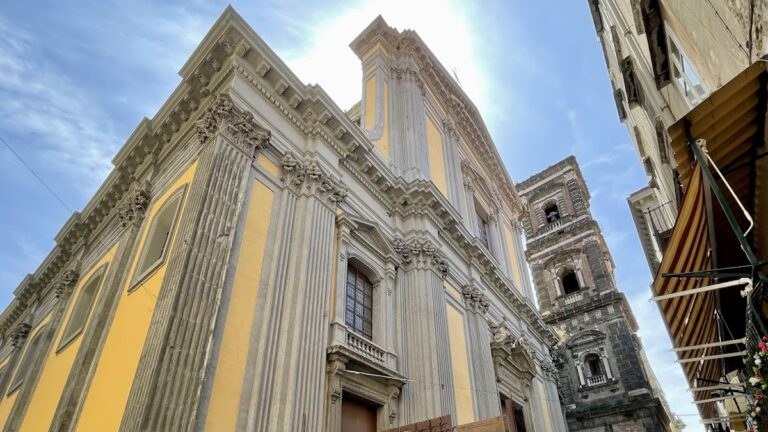
The present church combines a Gothic Angevin foundation with a Neapolitan Baroque interior created through extensive alterations in the seventeenth and eighteenth centuries. Much of the earlier Gothic fabric was covered or transformed between 1753 and 1766. Nicola Tagliacozzi-Canale directed the work with the Cimafonti marble workers and the stucco artist Gargiulo.
Facade
Giovanni Del Gaizo designed the present facade, built in 1766. An earlier facade had been damaged by lightning and by the earthquake of 1456, then rebuilt in 1631. Spanish cannon fire struck it accidentally during Masaniello’s revolt. The entrance formerly included an elaborately carved openwork door.
Bell tower
The campanile rises 75 metres above the church. Its base is made of piperno and belongs to the medieval bell tower destroyed in the earthquake of 1456. Giovanni Giacomo Conforto built the lower square section between 1612 and 1620, arranging its three stories in Ionic, Doric, and Corinthian orders. In the seventeenth century, Fra Giuseppe Nuvolo added two octagonal upper stages and a painted maiolica crown shaped like an onion.
A copper globe 110 centimetres in diameter and a cross top the tower. Its five bells include Sant’Alberto, cast in 1546 and facing the sea, and Sant’Angelo Martire, also cast in 1546 and facing the Loreto quarter. Santa Barbara and Santa Maria del Carmine were cast in 1746, while Santa Maria Maddalena dei Pazzi was cast in 1712. The bells were repeatedly threatened with melting under Joachim Murat and Ferdinand II. During the Murat government, property owners in the neighbourhood paid their equivalent value so that they could remain in the tower.
Nave, chapels, and transept
The church has a single nave with six side chapels on each side, twelve in all, together with an atrium, transept, presbytery, semicircular apse, and the Chapel of the Madonna Bruna behind the high altar. The interior measures approximately 75 metres long, 19 metres wide, and 16 metres high. Rose or pink marble is combined with white, yellow, and green marble, stucco, carved wood, and gilding. Paired Corinthian pilasters with polychrome floral marble frame the chapels, while white angel heads appear above their arches. Balustrades and iron gates with brass ornament separate the chapels from the nave.
Right-hand chapels
The six chapels on the right begin with Saint Nicholas of Bari, which contains an anonymous seventeenth-century altarpiece and a nineteenth-century wooden Mater Dolorosa. The chapel of Saint Simon Stock contains Mattia Preti’s 1684 painting of the Madonna giving the scapular to Saint Simon Stock. The Madonna of Cholera has a seventeenth-century gilded wooden statue attributed to Giovanni Conte.
The chapel of Blessed Franco contains three paintings by Giovanni Sarnelli and a ceiling fresco of the Holy Spirit by Francesco Solimena. The Madonna of Graces has a late-sixteenth-century painting of the Virgin, saints, and souls in purgatory, as well as the 1756 to 1757 tomb monument of Marquis Carlo Danza by Matteo Bottigliero. The chapel of Saints Angelo and Pier Tommaso contains a painting by Francesco De Mura and lateral works by Paolo De Majo.
Left-hand chapels
On the left, the chapel of Saints Januarius and Irene contains an altar painting by Paolo De Majo, the baptismal font, and a funerary portrait monument to Giacomo Carola dated 1631. The chapel of Saints Ursula and Mary Magdalene has a painting by Andrea d’Aste, a 1926 maiolica floor by the Vaccarella firm, and later works by Giuseppe Aprea.
The chapel of Saint Gregory the Great, also called the Purgatory chapel, contains a painting traditionally attributed to Giovanni Bernardo Lama and signed by Giovanni Sarnelli. The chapel of Saints Teresa of Jesus and Maria Magdalene de’ Pazzi has a central painting by Paolo De Majo and lateral scenes attributed to Domenico Viola.
The chapel of Saint Anne contains a painting by Paolo De Matteis, works attributed to Solimena, and a marble-inlaid altar made by the Mozzetti after designs by Cosimo Fanzago. The chapel of the Prophet Elijah contains works by Solimena and Giovanni Sarnelli, together with a Sicilian marble altar bearing a pietra dura coat of arms. Pietra dura is an inlay technique using precisely cut coloured stone and other hard materials.
Transept and crucifix
The two principal transept altars face one another. Solimena’s Assumption, painted in 1708, stands at the right altar. The left altar has frescoes by Solimena and the fifteenth-century gilded wooden Crucifix of the Leatherworkers’ Confraternity, accompanied by the mourning Virgin and Saint John. This area of the left transept was probably Masaniello’s burial place.
The crucifix travelled to Rome with the Madonna Bruna during the Jubilee pilgrimage of 1500. A legend says that it could not be carried back and therefore remained in the basilica. The tabernacle between the nave and presbytery was installed in 1459 in place of an earlier structure and was replaced or substantially renewed in 1766. It houses the limewood figure, which has painted stucco surfaces. The cannonball associated with its miracle is preserved in the underground rooms.
Apse and Madonna Bruna chapel
Apse and high altar
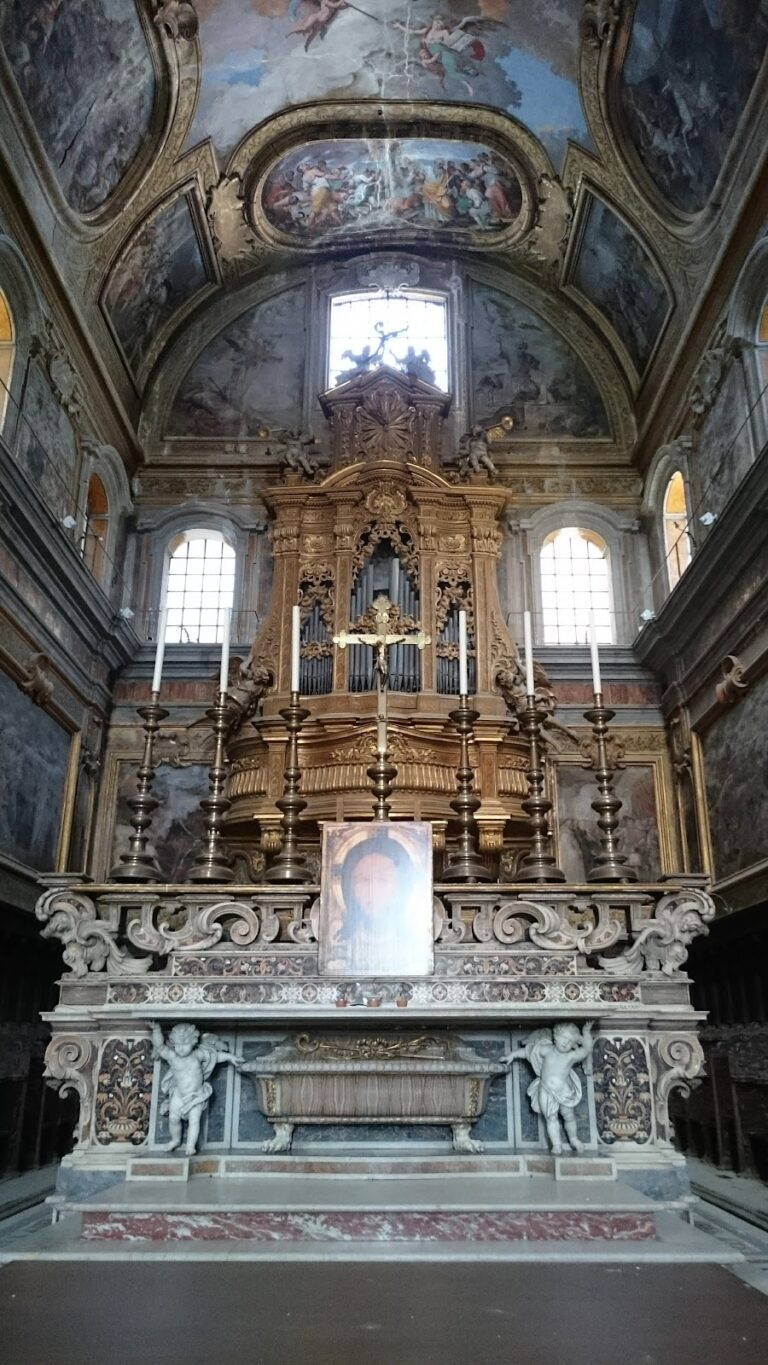
Cosimo Fanzago designed the semicircular apse and its marble decoration in 1670, and the work was executed by Scopetti, father and son. Four niches of Portovenere marble contain alabaster vases with gilded bronze festoons. The high altar is an elaborate pietra dura composition incorporating varied marbles, agate, onyx, lapis lazuli, mother-of-pearl, and amethyst.
Madonna Bruna shrine
An arch behind the high altar opens into the Chapel of the Madonna Bruna. The icon is a rectangular panel approximately 1 metre high and 80 centimetres wide. It shows the Virgin and Child in the Byzantine Glykophilousa, or Eleousa, type, in which mother and child are joined in an intimate gesture of affection. The image is attributed to the thirteenth-century Tuscan school, possibly Siena, and may reproduce an older Byzantine icon.
The icon stands within a white-marble shrine, or aedicule, 3.68 metres high and 2.46 metres wide. Its authorship has been attributed variously to Tommaso Malvito, Bartolome Ordóñez, and Giacomo Brixia. Two outer pilasters contain eight small niches with saints and prophets. The frame also includes a dove of the Holy Spirit, angels, five seraphim, a relief of the Veil of Veronica, and a larger relief of the Resurrection. The chapel contains the tomb of Frederick of Austria.
Ceilings and organs
The earlier seventeenth-century wooden coffered ceiling had five rows of coffers. Two rows contained large sixteen-pointed stars, while the centre showed the Madonna and Child on clouds, inspired by the Madonna Bruna. The ceiling was destroyed during the Second World War. The present ceiling includes a central wooden statue of the Virgin of Mount Carmel made by Mario Coraiola in 1955.
Monumental organ
The monumental organ stands above the entrance gallery. Francesco Mascia and his son built it under a contract dated 1 October 1905, and it was inaugurated publicly in July 1907. Ruffatti modernized it with electric transmission in 1973 and expanded it to 66 registers. The original instrument had three manuals, 30 pedal notes, 44 registers, and 2,824 pipes; the present instrument has approximately 4,800 pipes. It is divided among three sound bodies and incorporates the surviving pipework of Felice Cimmino’s 1714 organ, along with a second Baroque work on the opposite gallery.
Older organs
Two additional organs stand near the apse in carved Baroque cases. Lorenzo di Jacopo da Prato made the earlier instrument in 1483. Felice Cimmino built two later organs in 1714. After the ceiling collapsed in 1762, only the organ on the right remained functional, while the other retained a false pipe facade.
Sacristy and underground rooms
Sacristy
The Rococo sacristy was built in 1736 to designs by Nicola Tagliacozzi-Canale. Giuseppe and Gennaro Cimafonti produced its marble decoration, Pietro Bonocore its stucco, Giuseppe Melillo its wall ornaments, and Gaetano Tacca its gilding. Filippo Falciati, also known as Falciatore, painted the ceiling scene Sacrifice of the Prophet Elijah on Mount Carmel, the wall fresco The Prophet Eleazar during the Famine in Samaria, and six medallions of Carmelite saints. Giuseppe Aprea restored the frescoes in 1937.
Charles III of Bourbon donated the sacristy altar in 1742. Its altarpiece by Falciatore depicts the Madonna with Saints Sebastian, Charles, and Amalia. Walnut false furniture by Giovanni Battista Bisogni and his brothers conceals doors leading to the high altar, the Madonna chapel, the church, and subsidiary rooms.
Underground rooms
The underground rooms include a barrel-vaulted chamber sometimes called the crypt, where the cannonball associated with the Miraculous Crucifix is displayed. They also contain part of an old monastic putridarium, a burial facility where bodies decomposed in special niches before the bones were collected or reburied, and a large Neapolitan nativity scene. The barrel-vaulted chamber may correspond to the former “little grotto” associated with the Madonna Bruna, although that identification remains disputed.
Monastery cloisters and surviving fabric
The principal monastery cloister was built in the fourteenth century and remodelled during the seventeenth and eighteenth centuries. Further work took place in 1775, during the nineteenth century, and in 1957. Its original low buildings had one arcade level and a terrace. The cloister was later raised by one story on all sides and by a second story on three sides. Original granite columns were incorporated into the walls as nearly square pilasters.
Frescoes on the cloister walls depict the lives of the prophets Elijah and Elisha, Carmelite legends, the history of the order, and Carmelite saints. Leonardo de Grazia of Pistoia began the cycle, and Giovanni Balducci completed it. Balducci added grotesque-style vault decoration in 1606. Twenty-three life-size portraits of Carmelite order superiors are also displayed in the cloister.
The cloister contains tombs, sections of fifteenth-century flooring, and a marble figure commemorating the fifteenth-century Carmelite Sionna Grandidoma. A clock turret in the southern wing has eighteenth-century Neapolitan maiolica arabesque decoration. A sundial stands nearby, while the garden contains a sixteenth-century marble fountain with two reclining nymphs.
A western door dated 1631 formerly led to the rooms of the Carmelite Congregation, which were destroyed by bombing during the Second World War. A smaller fifteenth-century cloister was demolished when Via Marittima was widened, while portions of it survive.