Pio Monte della Misericordia: A Historic Charitable Complex in Naples
Site at a Glance
- Rating
- 4.6
- Popularity
- Medium
- Country
- Italy
- Primary era
- Early Modern
- External website
- Open
- Eras represented
- Early Modern
- Civilizations
- Spanish
- Site type
- Religious
- Remains
- Church
On this page12 sections
History
Pio Monte della Misericordia is a historic charitable institution and monumental complex in Naples, Italy, established during the Counter-Reformation, the Catholic Church’s program of reform and renewal following the Protestant Reformation. Founded in the early seventeenth century along Naples’ principal historic east-west route, the institution combined organized assistance to the poor and sick with a major program of religious art and architecture.
Foundation and charitable work
Seven young Neapolitan nobles founded the brotherhood in August 1601: Cesare Sersale, Giovan Andrea Gambacorta, Girolamo Lagni, Astorgio Agnese, Giovan Battista d’Alessandro, Giovan Vincenzo Piscicelli, and Giovanni Battista Manso. Beginning that year, they met each Friday at the Hospital for Incurables and provided food for sick people. The Pio Monte della Misericordia was formally established as an institution in 1602, allowing its members to pool resources and organize their charitable work.
Its activities embraced the traditional Christian corporal works of mercy, practical acts of compassion such as feeding the hungry, caring for the sick, freeing prisoners, burying the dead, and sheltering travelers. The institution assisted poor people, prisoners, and those held for debt, redeemed Christian slaves, buried the dead, and housed pilgrims. Its charitable capital eventually reached 6,328 ducats.
The institution’s thirty-three-article statute, known as the Capitulations, was drawn up in 1603. Viceroy Giovanni Alfonso Pimentel de Herrera approved it in 1604, and Pope Paul V endorsed the foundation in 1605. The Capitulations regulated finances, elections, and administration for more than four centuries. The institution was financed exclusively by laypeople. Seven governors from the Neapolitan nobility, each older than twenty-five, were elected every three and a half years by approximately eighty members over the age of eighteen. The governors rotated every six months through seven responsibilities, including visiting the sick, burying the dead, visiting and redeeming prisoners, assisting the poor, housing pilgrims, and managing the capital fund.
Expansion and institutional relationships
The Pio Monte maintained a long-term working relationship with the Jesuit order and repeatedly supplied funds for buildings administered by the order. During the 1620s, it also helped establish a hospice at Casamicciola on Ischia. Under the direction of Giovan Giacomo di Conforto, the hospice could accommodate up to 300 people without means each year.
The institution’s first headquarters was a small church built by Giovan Giacomo di Conforto between 1607 and 1621. The first major artistic commissions belonged to this phase. In 1607, the governors commissioned Caravaggio, the painter Michelangelo Merisi, to create The Seven Works of Mercy for the church’s presbytery. The institution paid 400 ducats for the painting. In 1613, the governors stipulated that it must remain in the chapel for which it had been created and could not be sold, transferred, copied, or reproduced.
By 1653, the first church and headquarters were no longer adequate for the institution’s expanding activities, and the church was demolished. Between 1658 and 1678, approximately ten adjoining buildings were acquired and reorganized on a larger scale. Francesco Antonio Picchiatti directed the principal enlargement after a proposed project by Cosimo Fanzago was declined because of Fanzago’s other commitments. The palace and renewed church acquired their essential form under Picchiatti.
The present complex
The church’s large dome was completed in 1666. Andrea Falcone produced the exterior sculptures and, with Pietro Pelliccia, completed much of the interior marble decoration between 1668 and 1671. Bonaventura Presti, a pupil of Picchiatti, completed rooms on the third floor between 1678 and 1680. In 1671, Luca Giordano received 200 ducats to paint Entombment of Christ for the church, replacing an earlier work by Giovanni Baglione. Baglione’s painting was subsequently moved to the palace picture collection. Falcone was commissioned to make four further sculptures in 1674, but his death meant that only the statue of the prophet David was completed, in 1675.
Restoration directed by Giovanni Battista Manni continued from the early eighteenth century until 1720, followed by further work in 1763. In 1782, the painter Francesco De Mura bequeathed 180 paintings to the institution for sale at auction in support of its charitable activities. Thirty-three of these works remained at the complex. From 1914, the Pio Monte prohibited the disposal of its artworks.
The institution’s picture collection, the Quadreria del Pio Monte della Misericordia, was established in 1973 under the superintendent Tommaso Leonetti, Count of Santo Janni. In 2005, the entire complex was converted into a museum incorporating the church, first-floor rooms, archival documents, and the foundation’s painting collection. The complex is recognized as an Italian cultural property, while its institutional rooms and collections preserve evidence of the foundation’s administration, charitable mission, and artistic patronage. The charitable institution remains active, and its church remains consecrated.
Remains
Palace, portico, and courtyard
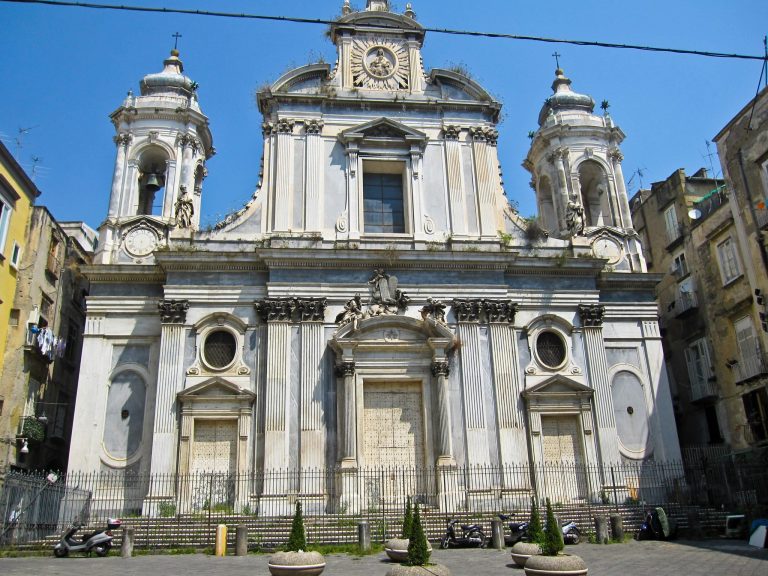
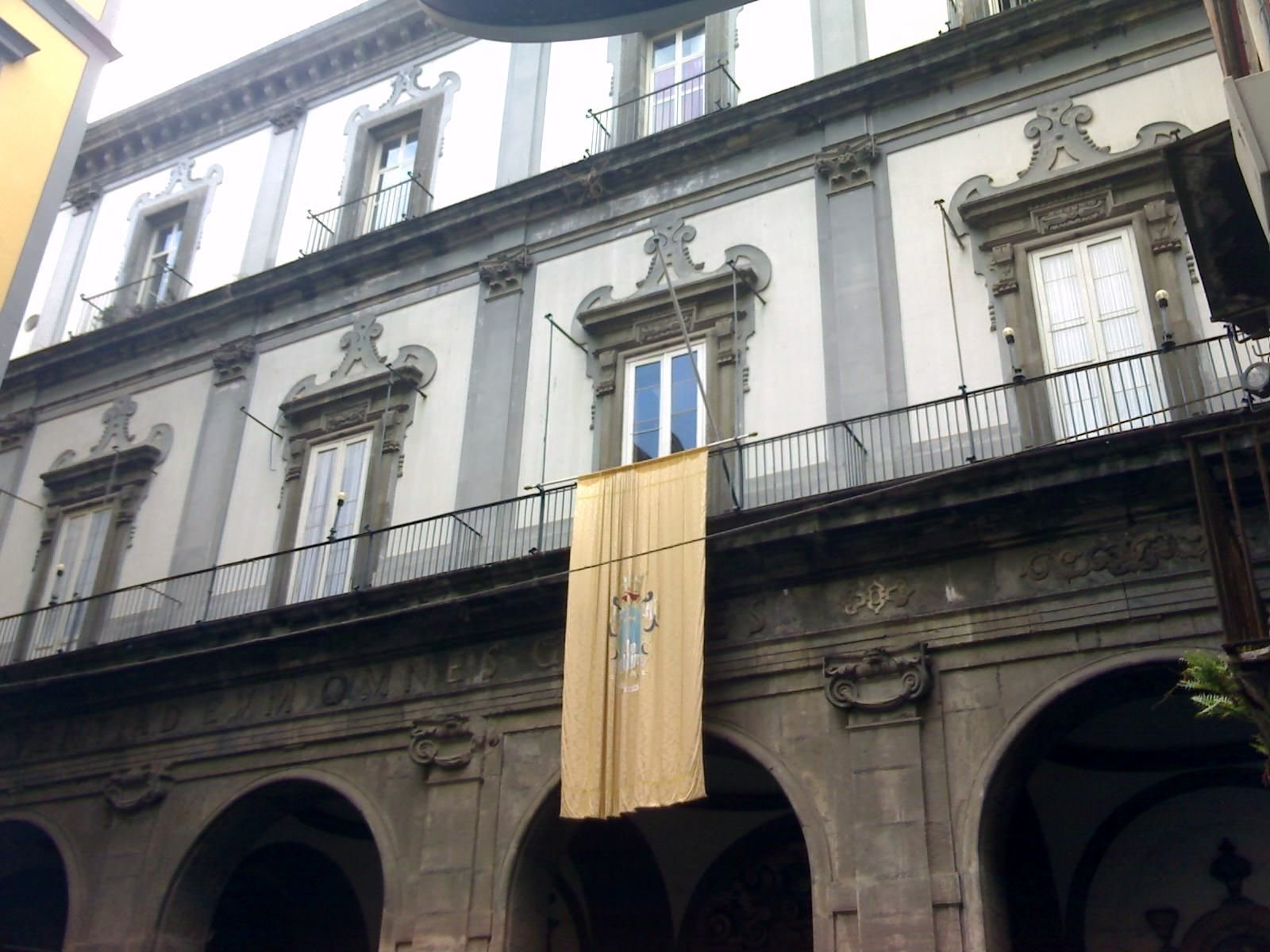
The complex occupies Piazza Riario Sforza on Via dei Tribunali, near the staircase leading to the right nave of Naples Cathedral. It stands opposite the Royal Chapel of the Treasury of San Gennaro and the obelisk of San Gennaro, along the historic east-west route known as the decumanus maximus, a principal street in a Roman town. The church is incorporated into the palace rather than having an independent exterior facade. Entry is through a portal within the palace’s five-arched portico, whose main facade extends for 33 metres across three levels.
The ground-floor portico has Ionic-order pillars designed by Salomone Rapi. Corinthian-order pillars mark the first floor, formerly used for offices, and a frieze carries the biblical phrase “Fluent ad eum omnes gentes,” which became the institution’s motto. The upper level, associated with the institution’s officials, has Composite-order capitals. The portico is built with piperno, a dark volcanic stone widely used in Naples for portals and other durable architectural elements.
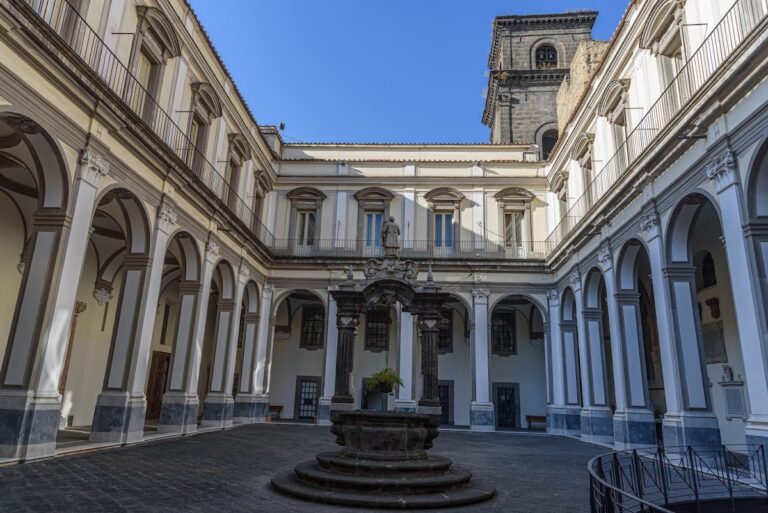
Inside the portico, Andrea Falcone’s sculptural group places a central Madonna of Mercy beneath a marble inscription. Two allegorical figures occupy niches under the outer arches and represent corporal works of mercy. The group may have followed designs by Cosimo Fanzago. The church entrance aligns with the second arch from the right, while a portal at the fourth arch leads to an atrium and the interior courtyard. A seventeenth-century piperno well stands at the courtyard’s centre, surrounded by the institution’s buildings.
Church and paintings
The church has an octagonal plan, a large luminous dome, a presbytery, and six lateral chapels. White and grey marble and stucco provide restrained decoration. Balustrades separate the chapels and presbytery from the central space, while altars and marble frames carry friezes made by Andrea Falcone and Pietro Pelliccia. The spatial arrangement, including the octagonal form, chapels, and dome, has been compared with the nearby Royal Chapel of the Treasury of San Gennaro, designed by Francesco Grimaldi in 1608.
Presbytery
The presbytery contains a Baroque altar behind Caravaggio’s large 1607 canvas The Seven Works of Mercy. The painting brings together the seven charitable actions represented by the institution’s work. The side walls hold Giacomo Di Castro’s Saint Anne, from about 1665, and Andrea Malinconico’s Madonna of Purity, from about 1670. Above the entrance on the counterfacade is a faithful copy of Luca Giordano’s Christ and the Adulteress, from about 1660.
Right-hand chapels
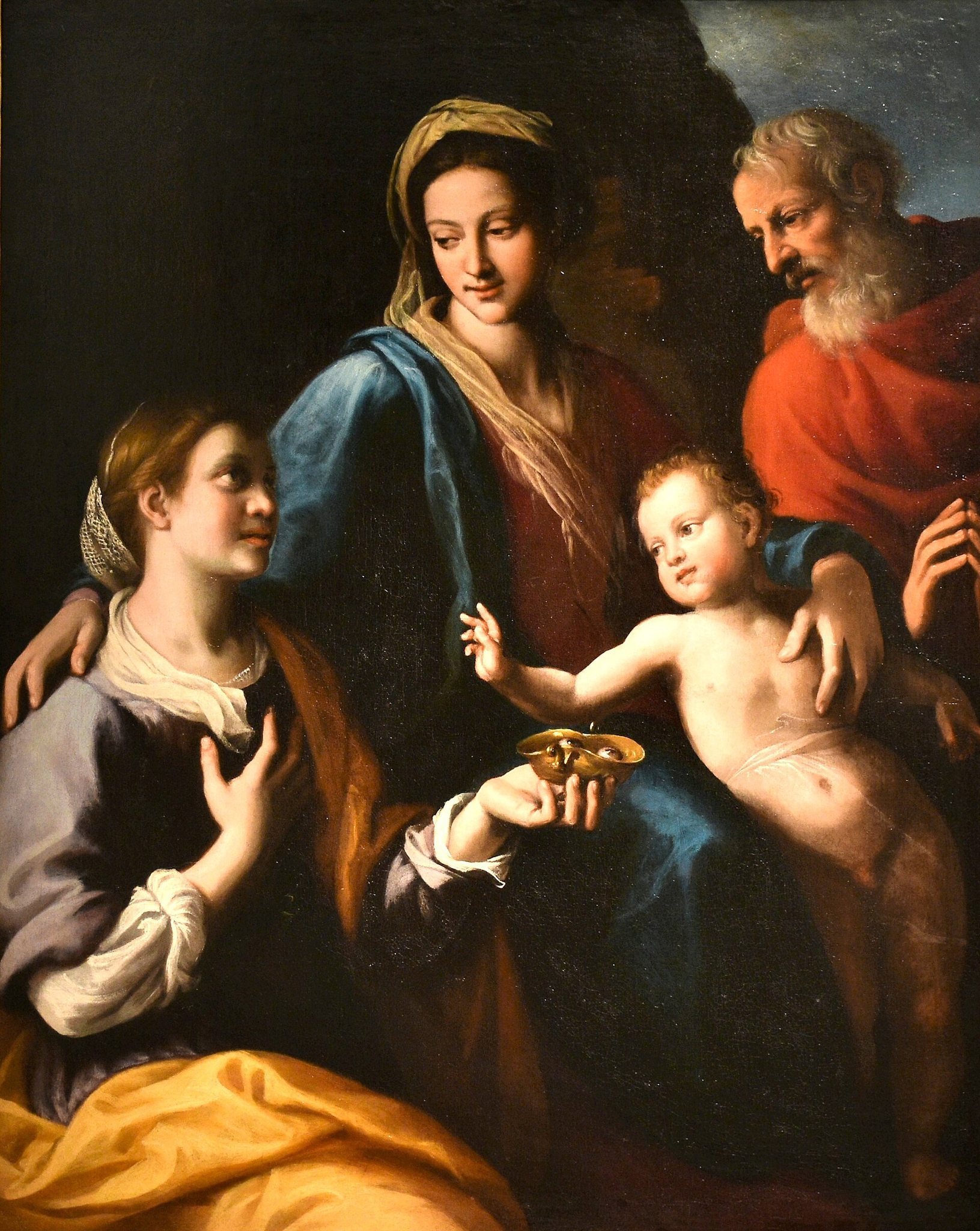
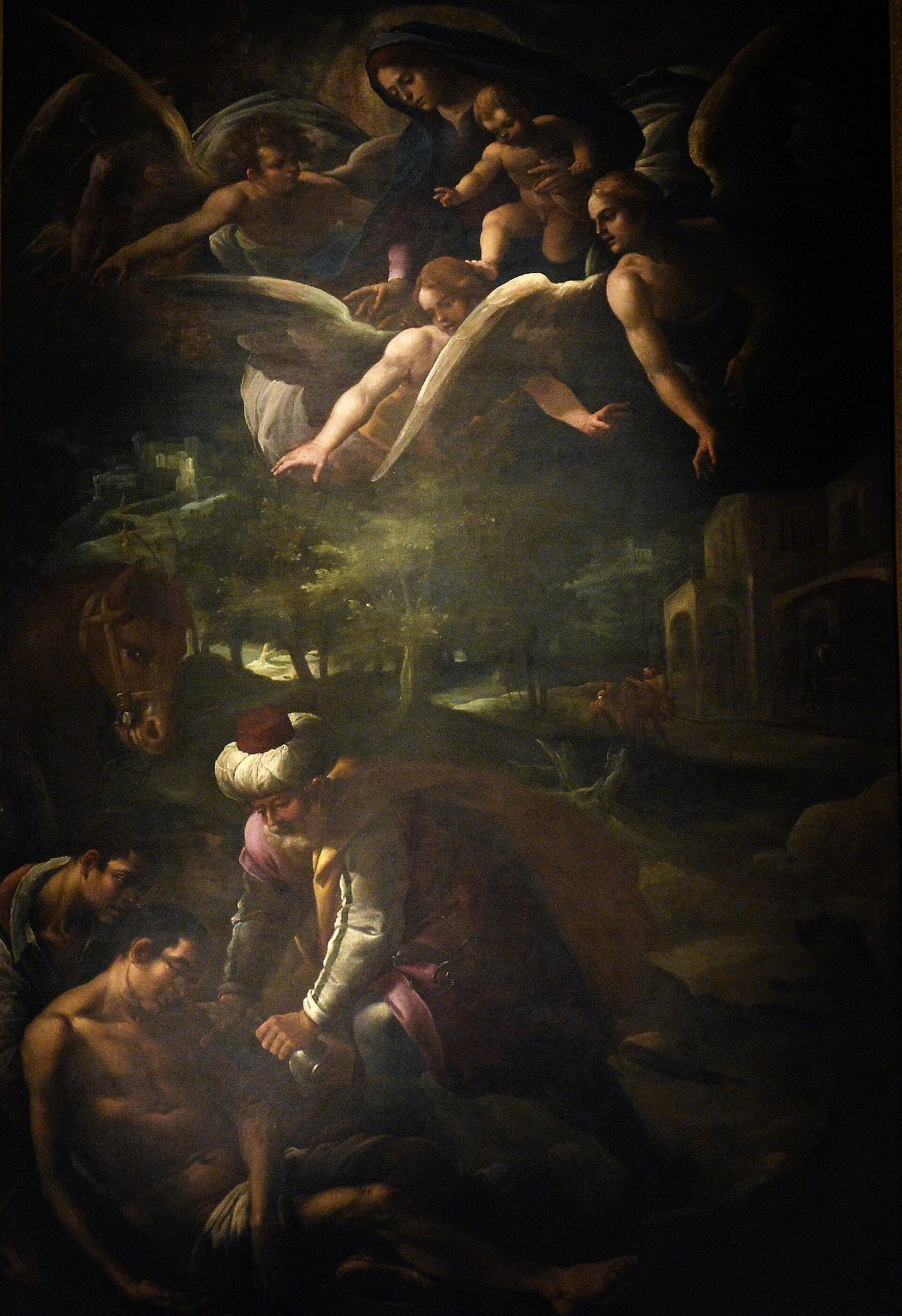
The paintings in the six chapels use Gospel scenes as allegories for individual corporal works of mercy. On the right, Giovanni Bernardino Azzolino’s Saint Paulinus Freeing the Slave, painted between 1626 and 1630, represents the redemption of slaves. Fabrizio Santafede’s Christ in the House of Martha and Mary, from 1612, represents hospitality to pilgrims. Giovan Vincenzo da Forlì’s The Good Samaritan, from 1607 to 1608, represents care for the sick.
Left-hand chapels
On the left, Battistello Caracciolo’s The Liberation of Saint Peter, from 1615, represents the freeing of prisoners. Luca Giordano’s Entombment of Christ, commissioned in 1671, represents burial of the dead. Fabrizio Santafede’s Saint Peter Resurrecting Tabitha, from 1611, brings together feeding the hungry, giving drink to the thirsty, and clothing the naked.
Interior sculpture and viewing spaces
Andrea Falcone’s statue of King David stands on the monumental staircase leading to the first-floor rooms. Falcone also made the portico sculptures, the church’s two holy-water basins, the polychrome marble and terracotta floor, and other sculptural elements. Niches above the smaller corner chapels contain small balconies reached from the palace’s first-floor rooms. Another niche above the entrance arch allowed the governors to view Caravaggio’s altarpiece from the first-floor room called the coretto.
Collections, archive, and library
The palace’s first-floor rooms contain the Quadreria, the institution’s historic picture collection. It holds 140 paintings, of which approximately 122 are displayed, dating from the sixteenth to the nineteenth century. Many entered through donations, including the 180 paintings originally bequeathed by Francesco De Mura in 1782, the 1802 donation from the estate of Gennaro Marciano, and the 1933 donation from Maria Sofia Capece Galeota.
The museum rooms also preserve seventeenth- and eighteenth-century sacred vestments, applied-art objects, archival documents, and original furnishings. Among them is the historic seven-sided table used by the governors, made by anonymous seventeenth-century woodcarvers. Each segment bears the words “Fluent ad eum omnes gentes” and an image of one of the seven works of mercy. In the coretto, a false cupboard conceals an opening through which the governors could view Caravaggio’s altarpiece.
The library and historical archive occupy a wing of the palace. Established with the institution, the library contains approximately 17,000 volumes, chiefly concerning history, southern Italian studies, heraldry, and art history. The archive preserves a copy of the 1602 foundation document, the 1604 approval of the first Capitulation signed by Viceroy Giovanni Alfonso Pimentel de Herrera, and the papal approval of 1605. It also contains artists’ contracts, payment records, Picchiatti’s project documents, and Francesco De Mura’s testament bequeathing his paintings to the institution.