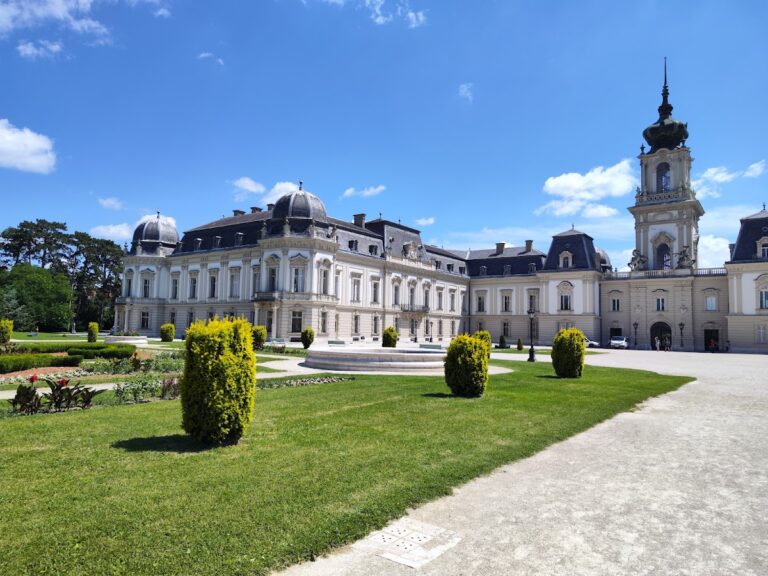
Esterházy Castle in Szigliget: A Historic Estate and Artists’ Residence
Site at a Glance
- Rating
- 3.5
- Popularity
- Very Low
- Country
- Hungary
- Primary era
- Modern
- External website
- Open
- Eras represented
- Early Modern, Modern
- Civilizations
- Austria-Hungary, Habsburg, Hungarian
- Site type
- Domestic
- Remains
- Castle
On this page10 sections
History
Esterházy Castle is a historic noble residence in Szigliget, Hungary, built in the late 18th century and enlarged in the Classical and Neo-Baroque styles. It served as the administrative center of an estate associated successively with the Lengyel, Puteani, and Esterházy families, and later became a writers’ and artists’ residence.
The Lengyel and Puteani Estate
The predecessor of the present residence does not appear on the 1784 military survey map. The late-Baroque house was probably built for the Lengyel family around 1785 to 1787. After Lengyel Gáspár III died in 1807, his daughter Krisztina Lengyel inherited the estate. Through her marriage, ownership passed to her husband, Baron Vencel Puteani. Their son, József Puteani, received the inheritance in 1830 and enlarged the residence during the 1830s in the Classical style.
József Puteani also took part in the liberal opposition at the assemblies of Zala County. In 1834, he sheltered a Polish officer who had fled to Hungary in the castle. He was elected as a representative in 1848, during the Hungarian War of Independence against Habsburg rule, and was not brought before a court after the war was defeated.
The estate later passed to his son, Baron Géza Puteáni. In 1912, Géza sold the castle together with 589 cadastral holds of land and 3,000 cadastral holds of Lake Balaton water surface to Count Pál Esterházy II. A cadastral hold was a historical Central European unit used to measure and register estates. Géza then moved to his castle at Balatonederics.
The Esterházy Enlargement
Pál Esterházy II belonged to the Tata branch of the Fraknó line, one branch of the prominent Esterházy aristocratic family. He held the court office of Imperial and Royal chamberlain and had served as an ambassador. In 1915 and 1916, he commissioned the Viennese architects Eduard Thumb and Carl Badstieber to enlarge the castle. The work added a new upper-storey section to the left wing, created the Neo-Baroque Bujtás Gate, filled in the rear courtyard, and changed the rear eastern facade from a raised-ground-floor arrangement to a single-storey appearance.
Pál Esterházy died in 1932. His widow, Countess Izabella Deym, inherited the castle and lived there until 1945. The wider estate passed to János Esterházy, who moved to Szigliget with his family and lived in the estate manager’s house, also known as the small castle.
War, Nationalization, and Cultural Reuse
As Soviet troops approached in 1945, Countess Deym fled to Steinhof in Austria. Valuable furniture and several personal objects belonging to Pál Esterházy, including his sword, gold chain, and goblets, were concealed inside a wall. They were found much later when the wall was opened after a burst pipe.
The castle was nationalized after the Second World War. An agricultural school for farm managers and housekeepers operated there in 1947 and 1948. In 1952, the building was transferred to the Literary Fund. At the initiative of the writer and journalist György Bölöni, it was converted into a residence for writers and artists, with alterations carried out in several stages during the following decade.
During the Kádár era, the period of communist rule associated primarily with János Kádár from 1956 to 1988, many prominent Hungarian writers and poets stayed at the residence. They included István Örkény, Zoltán Zelk, Lajos Kassák, Ágnes Nemes Nagy, Emil Kolozsvári Grandpierre, Magda Szabó, László Nagy, János Pilinszky, László Németh, István Fekete, Ervin Lázár, Sándor Weöres, Tibor Déry, and Milán Füst. Other associated literary figures included Imre Kertész, István Vas, Sándor Tatay, Boris Palotai, György Somlyó, Amy Károlyi, Árpád Göncz, Péter Esterházy, and Károly Makk.
Since 1968, the residence has also hosted painters, sculptors, composers, and photographers. The József Attila Literary Circle holds an annual literary camp there, while the park has hosted concerts connected with Szigligeti Nyár, a summer cultural program in Szigliget, and an international conference on vernacular architecture. The park has been protected since 1954 and strictly protected since 1997. The castle continues to function as the Szigliget Artists’ Residence.
Remains
Castle and Estate Buildings
Main Residence
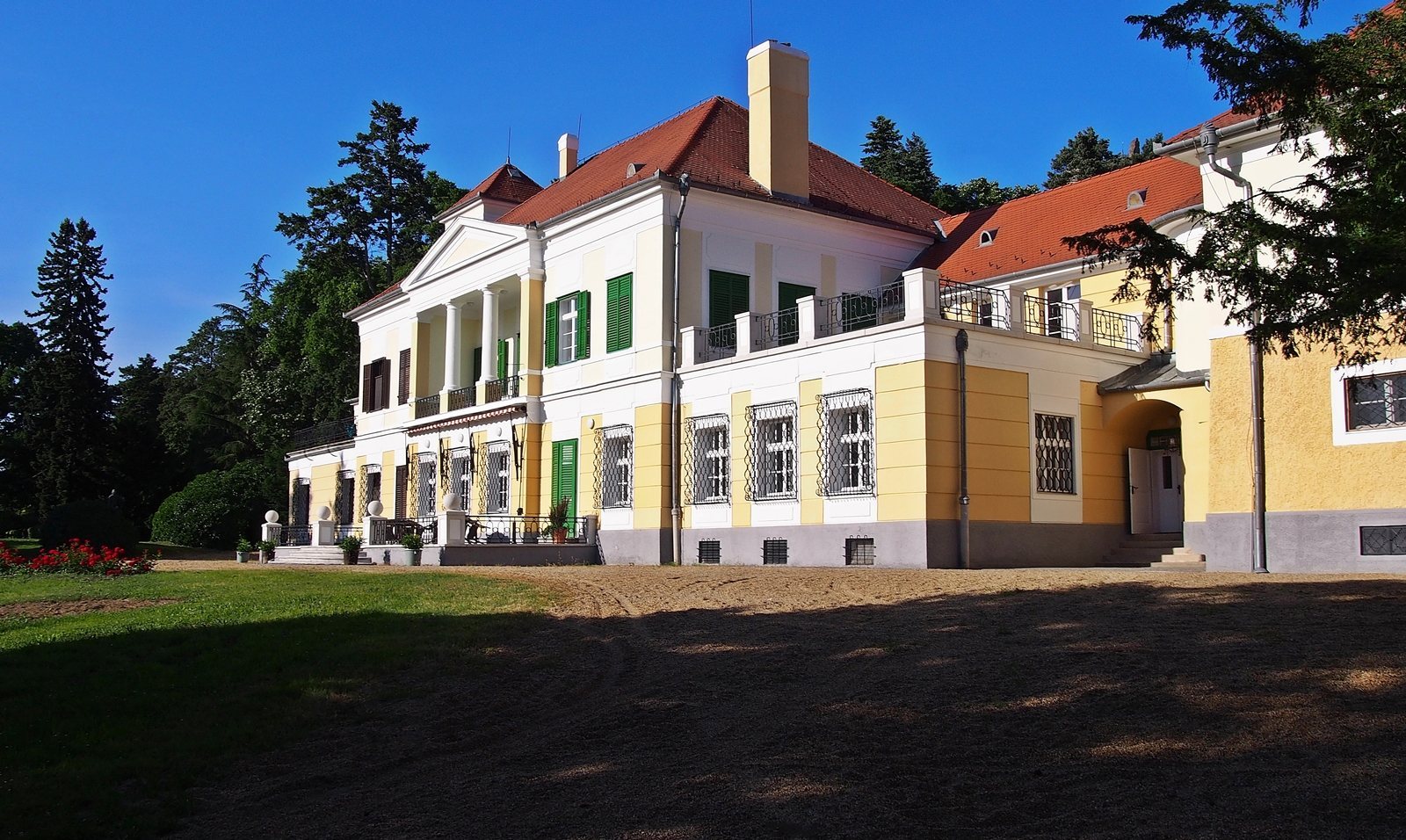
The castle is a partly two-storey building with cellars and an approximately J-shaped plan. The original late-Baroque residence was single-storey, and two vaulted ground-floor rooms from that phase remain identifiable beneath a terrace. József Puteani’s rebuilding in the 1830s added a single upper storey to the main facade, while the side wings remained single-storey. A northern tower was also added at this stage, initially without a roof.
The main facade has an upper storey, a projecting central section with a pediment and columns, and lower side sections with terraces. The right wing projects outward, while the rear facade has a single-storey appearance. The 1915 to 1916 enlargement extended the left wing with another upper-storey section and reshaped the rear courtyard and eastern facade. A wall bearing the signatures of artists who stayed at the residence has been framed and preserved in one of the rooms.
Gates and Chapel
The Neo-Baroque Bujtás Gate was created during the early 20th-century enlargement. A lower gate and an adjoining chapel were built in the northeastern part of the park. The estate also included an English-influenced cattle stable and a horticultural garden. A 65-metre-deep artesian well supplied water to the castle, the stable, and the garden. An artesian well draws groundwater from a confined underground aquifer under natural pressure.
Landscape Garden
The castle stands within a 9.2-hectare landscape garden. This type of garden is arranged to imitate a natural scene through irregular planting, lawns, paths, and water features rather than a rigid geometric design. By 1854, an English-style landscape park had been laid out beside the residence.
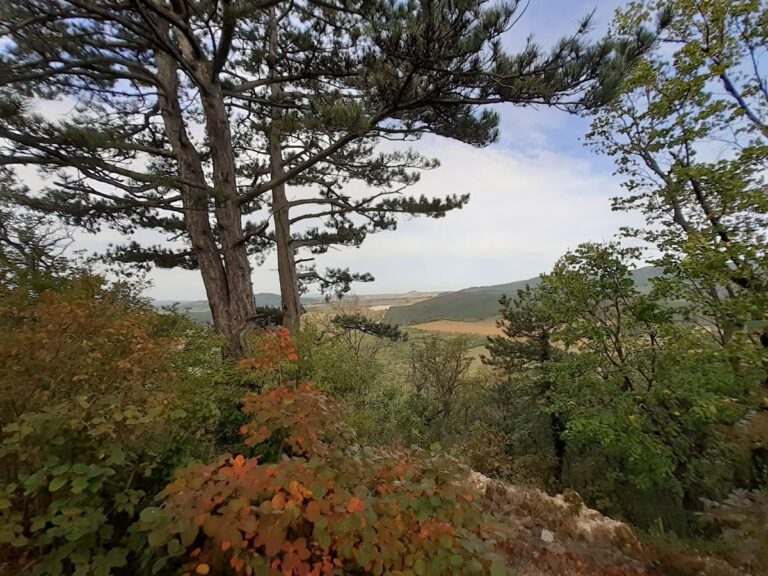
The earliest plantings stand along the Tapolca Stream at the property boundary and include yews, white poplars, horse chestnuts, pedunculate oaks, limes, and beeches. Nineteenth-century conifer planting developed into one of Hungary’s largest conifer collections, with approximately 120 species. The garden contains about 520 species overall, including trees introduced from four continents.
Pond and Sculptures
A small pond was created in the deepest part of the park in 1962. Its island contains a large plane tree, and the garden also includes a rose collection. Park sculptures include Pál Pátzay’s Woman Drying Herself from 1968, Miklós Borsos’s Primavera, and a bust of György Bölöni, whose initiative helped establish the cultural residence.