Castle Fácános in Fonyód: A Medieval Frontier Fortress in Hungary


Site at a Glance
- Rating
- 3.9
- Popularity
- Low
- Country
- Hungary
- Primary era
- Early Modern
- External website
- Open
- Eras represented
- Medieval, Early Modern
- Civilizations
- Habsburg, Hungarian
- Site type
- Military
- Remains
- Castle
On this page13 sections
History
Castle Fácános in Fonyód, Hungary, was a medieval Hungarian palisade fortress on the southern shore of Lake Balaton. Developed as a frontier stronghold during the sixteenth-century Ottoman wars, it protected a settlement whose earlier history reached back to the period after the Hungarian conquest, when Magyar communities established themselves in the Carpathian Basin.
Early settlement and the medieval church
After the Hungarian conquest, Fonyód became the possession of Koppány, son of Tar Zerind of the Lád kindred. An alleged reference to the settlement in an 1082 charter cannot be relied upon because the document itself is considered forged. Fonyód later belonged to Pannonhalma Abbey, a major Benedictine ecclesiastical institution in Hungary. In a papal tithe register, which listed church institutions and their payments to the papacy, the settlement appears as Fonold and already had its own parish.
The medieval church later became the core of Fonyód’s fortification. This church belonged to the Árpád period, the era of the Árpád dynasty, which ruled Hungary from the late ninth century until 1301. The first reliable mention of the castle dates from 1548, when the settlement was called Fonód.
Creation of the double fortress
After the Ottoman capture of Buda in 1541, Palonai Magyar Bálint strengthened the village church with a timber palisade and a surrounding ditch. He then enclosed a larger area in the same way, producing a fortress with separate outer and inner sections. A palisade fortress was a defensive enclosure made chiefly from upright timber stakes or a wooden framework, usually supported by earthworks and ditches. Such forts formed part of Hungary’s frontier defence against Ottoman expansion.
In 1544, Lengyel Boldizsár of Lengyeltóti built the fortification known as the Lower Castle in the Fácános area. It consisted largely of reinforcing the settlement’s Árpád-period church with an earthwork and ditch. Palonai Magyar Bálint later became the castle captain and married Brigitta, Lengyel Boldizsár’s daughter. Through this marriage, he gained control, or possibly ownership, of estates belonging to the Lengyel family.
Palonai Magyar Bálint and the Ottoman frontier
Palonai Magyar Bálint first appears in 1543 as a familiaris, a noble retainer serving a more powerful lord, in the household of Tamás Nádasdy. That spring, Nádasdy sent him to defend Pécs against the Ottomans, after which he joined the defenders of Szigetvár. He continued his military career as a lieutenant and commander among Nádasdy’s troops.
From 1548, Palonai Magyar Bálint commanded forces belonging to Nádasdy’s chief-captaincy. From the following year, he repeatedly attacked Ottoman targets even after regulations prohibiting such raids had been withdrawn. These actions led to complaints being sent to the king. The pasha of Buda accused Palonai and his companions of pillaging and raiding as far as Pécs and Székesfehérvár.
In 1551, Palonai served among 500 cavalrymen assembled for the intended union of Royal Hungary, the Habsburg-ruled part of the Hungarian kingdom, and separately governed Transylvania. A prominent contemporary chronicler praised his bravery. During the Ottoman war of 1552, he was repeatedly assigned to different locations and often had to leave Fonyód, leaving the fortress exposed to attack.
In a letter written from Fonyód in 1553, Palonai reported Ottoman raids around Lak, now Öreglak, and Somogyvár. Attacks on the castles around Lake Balaton intensified in 1553 and 1554. On the night of 21 September 1555, troops commanded by Mehmed Bey, an Ottoman military and administrative official, attacked Fonyód. The assault began at midnight. The attackers seized the old palisades but were driven back, while Ottoman pressure continued until 1562, including periods when Palonai was away on military duty.
Decline and destruction
After Tamás Nádasdy’s death, Palonai Magyar Bálint’s position weakened. He was held responsible for disputed estates and abuses of power. As a landless nobleman, he repeatedly clashed with commanders of neighbouring castles over control of villages. In 1562, he was serving as a soldier at Szigetvár. Miklós Zrínyi, a Hungarian nobleman and commander in the anti-Ottoman defence, was among the magnates who viewed the captain of Fonyód unfavourably.
In the summer of 1563, Palonai lost the favour of Ferdinand I and the new king, Maximilian II, both Habsburg rulers who also held the Hungarian crown. He was not invited to the coronation. Fonyód did not pass immediately into Ottoman hands after the fall of Szigetvár. Palonai died in 1573, but two years later, in 1575, Ottoman forces captured and destroyed the castle.
A ground plan prepared in 1569 and 1570 by Giulio Turco, a military engineer working for the Habsburg imperial authorities, preserved the arrangement of the fortress before its destruction. Fitz Jenő’s archaeological investigations between 1957 and 1959 used this plan to identify the site and guide its reconstruction. Before this work, the area had become neglected and overgrown. The name Fácános derives from pheasants that nested in the tall vegetation. The reconstructed site later became a park and playground and hosted events in Fonyód. Historical military games held there were discontinued after 2013.
Remains
Castle Fácános occupied a roughly square area measuring about 60 by 60 metres. It was a double palisade fortress, with an outer castle surrounding an inner castle. Wood, stone, brick, and clay formed its principal construction materials. Square, water-filled ditches enclosed both sections, while the medieval church provided the central structural core.
Outer and inner fortifications
Outer castle
The entrance lay on the side of present-day Szent István Street. A drawbridge crossed the outer ditch and led into the outer courtyard. A second bridge of similar type connected that courtyard with the inner castle. The surviving ditch remains help define the fortress’s original divisions, while reconstructed palisades and wooden watchtowers evoke the timber defences shown on the sixteenth-century plan.
Inner castle
The inner castle contained broad-walled buildings, stone fortifications, and a watchtower. Its position within the double enclosure formed the more protected part of the fortress. The surviving evidence combines limited wall remains with the visible line of the surrounding water ditch and the reconstructed timber elements.
Lower Castle
The Lower Castle in the Fácános area was formed by strengthening the Árpád-period church with an earthwork and ditch. Only limited wall remains survive from this part of the fortification. Its physical remains preserve the connection between the earlier religious building and the later frontier defence.
Church foundations and reconstruction
Medieval church
The foundation remains of the medieval church survive as the archaeological core of the site. The church was incorporated into the sixteenth-century defensive works, first through the addition of an earthwork and ditch and later within the double palisade fortress.
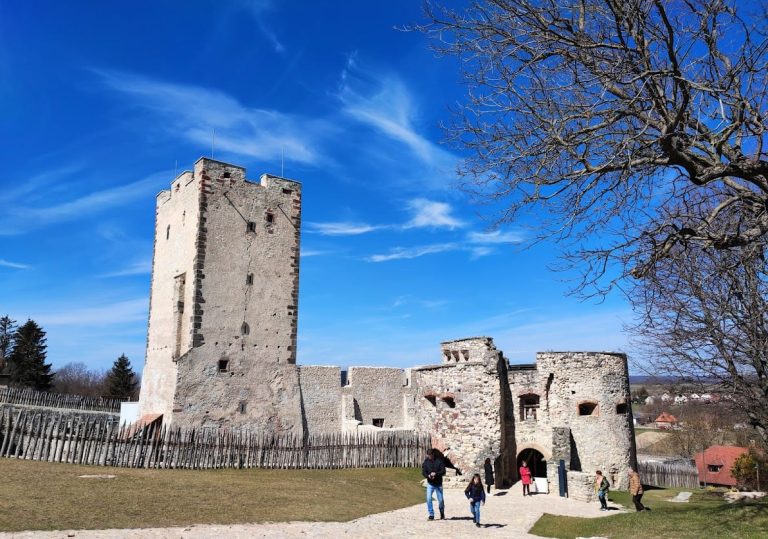
Twentieth-century reconstruction
Palisades and wooden watchtowers were reconstructed during the twentieth century. The work followed Turco’s 1569 to 1570 ground plan and the investigations carried out by Fitz Jenő between 1957 and 1959. The reconstructed wooden structures have since deteriorated, and several sections of the palisade require renewal. The water ditch and church foundations remain part of the surviving archaeological layout.